day trading systems

DayTradeToWin Review

Trends: How Many of Us “Have Them?”

While the title of this post is a play on words from a popular 1984 hit by the group, Whodini, there is no illusion here. Rather, we’re focusing on clear and concise price action rules you can use to identify and manage trends on your day trading charts. As a matter of fact, this part one of a two-part webinar series that was recorded in front of a live audience. As with the case with actual good friends, the same may be said for trends: most of us would probably prefer having more of them than less. In reality, trending days are less common than those with rather spontaneous chop. If you’re brand new to price action concepts or DayTradeToWin, then start with the first video. If you’ve seen some of John Paul’s footage in the past, you can probably skip the first video and go right into the second. Both are posted below. Part 1: Applying the ATR correctly, live Trade Scalper signals, and chart types Part 2: Identifying trends and counter-trends, mitigating loss with pivot stops, handling reversals, and examples While you may become an expert in identify areas of where not to trade, what about finding those potential winners? John Paul believes his trading methods are best suited for that purpose, whether that be the Trade Scalper, Atlas Line, ATO 2, Roadmap, Blueprint, or any of the methods taught in the 8-Week Mentorship Program. Mentorship is the only way to get all courses and software in one complete package. Though you may not have any more friends by the time you’re done reading this, you may be able to find more trends. At least, that is the goal of these two webinar recordings. If you want to attend the next live webinar or learn more about price action trading, head on over to the DayTradeToWin official website and sign up: https://daytradetowin.com.

DayTradeToWin Review

Trading Strategy: Tops & Bottoms Recipe for Disaster?

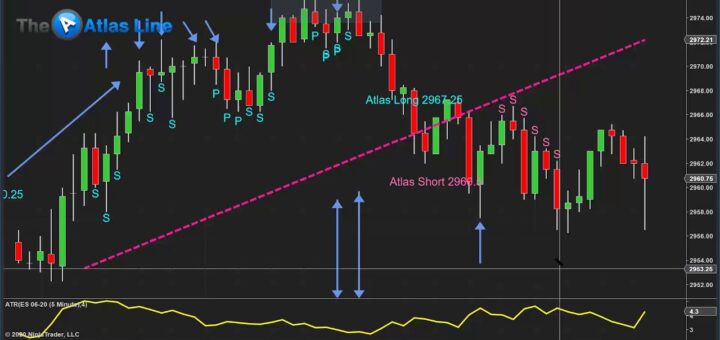
Beginner and experienced traders like to identify areas of support and resistance, or recent highs and lows, by drawing horizontal lines on the chart that coincide with barriers where price did not cross. The idea is that price, again, will not want to tread beyond those lines/values for whatever reason. High-frequency trading algorithms, which regular at-home traders are constantly up against, probably take into account these barriers and where price is “apprehensive” to penetrate. It’s also likely that these barriers are used to lure human traders in and then fake them out with a great degree of speed and precision. What is a regular stay-at-home day trader to do? Well, it’s important to first recognize tops and bottoms. From there, you may want to avoid trading around them because it may be impossible to “know” when price will retrace or surpass with any significance. This video discusses this topic. John Paul, founder of DayTradeToWin, approaches the temptation of bottom-and-top picking through his explanation of Yo-Yo Bars. He demonstrates how a 35+ min. period of stagnation is a problem. He prefers to use signals from his trading systems, namely the Atlas Line and Trade Scalper, to get an idea of when the market will move next and in what direction. Of course, these systems are not 100% accurate; no trading system is. It’s all about recognizing the risk involved with trading and making the best decision you can for your unique needs and goals, at any given moment. You’ll notice how the Atlas Line’s Strength (S) and Pullback (P) trades mark areas where price is (was) expected to move significantly. The exact mechanics of those signals are only provided to customers in the included members-only video and live training. Yes, you’ll learn exactly what constitutes those price action signals. Conceptually, John Paul belives that multiple indicator or systems that indicate, “Here is a trade and here is the anticipated direction” is better than guessing, aka picking tops and bottoms or going by arbitrary interpretations of common indicators. Indeed, the focus of DayTradeToWin has been to “listen” to price and trade based on what price is saying, rather than following one’s own impulses. Some traders will tell you that trading is a psychological game against the self. The temptation can be strong to place “one more trade” to make up for prior losses, win big enough to buy a new toy or pay that dated bill. Using price action objectively can remove the guesswork and over-trading, which are big obstacles for trading beginners and veterans alike.

Scroll to Top