
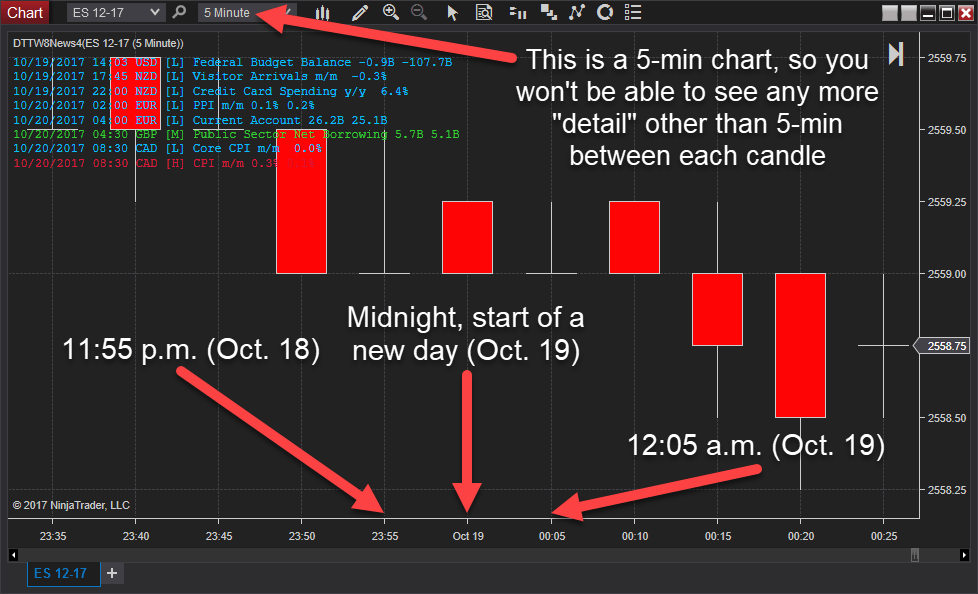
To answer the main question of this post, trading 24 hours a day is really never a good idea. The more you trade, the greater the risk. However, it is important that you understand when the markets are open in a 24-hour cycle. This requires an understanding of the 24-hour time format. Working with 24-hour time formats can be confusing. Nearly all trading platform use this format. Most people in the U.S. are accustomed to regular time, which observes counting to twelve twice a day. In comparison, a 24-hour clock starts at midnight and stops just before midnight the next day. If you have ever seen a time such as 22:54 and wanted to know how to convert it to regular time (10:54 p.m.), this post is for you.
- If the time you want to covert is before noon (i.e. in the morning), you probably don’t need to convert it. For example, 9:00 in 24-hour time is the same as 9:00 a.m. regular time. The slight difference here is 00:30, which is 12:30 a.m. Note that in 24-hour time, the clock “resets” to zero at midnight. In regular time, there is no “zero time”. Instead, the clock resets to 1 after 12:59 a.m.
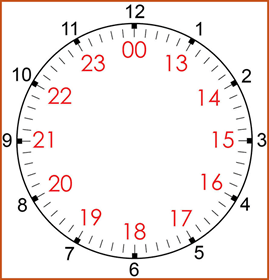
- If the time you want to covert is in the afternoon, then you’ll need to do some math or memorization. When it’s 1:00 p.m. regular time, it’s 13:00 24-hour time. Similarly, 2:00 p.m. regular time is 14:00 24-hour time. See the pattern? We’re just counting up by one instead of resetting the clock to 1. One trick to calculate regular time is to subtract 12 from a 24-hour time. For example, 23:30 – 12 = 11:30, and we add p.m. because we know that any time after 12 on the 24-hour click is a p.m. time.
- Seconds and minutes are counted and expressed the same. If you see 20:30:01, the regular time is 8:30:01 p.m. (one second past 8:30 p.m.).
- What about time zone conversion? Yes, different time zones have different times. That means you can express time zones in both their regular times and 24-hour times. You should not have much trouble doing a conversion because you’re going to add or subtract the same amount of hours regardless of the time format. In other words, +8 hours will be the same mental process of addition, whether you’re using 24-hour time or regular time.
If you want to learn how to read 24-hour time quicker, or you for some reason want to start trading 24 hours, consider changing your smartphone’s time format or using a wristwatch that displays both formats.
See this conversion website to improve your understanding. Also, study this chart and the 24-hour clock:

John Paul is the founder of DayTradeToWin, a trading education and software company established in 2008, supporting traders worldwide. His expertise focuses on price action-based futures trading strategies and structured market analysis.
DayTradeToWin delivers trading education, indicators, and software tools designed to help traders apply disciplined, rule-based decision-making across global futures markets.
He is the creator of multiple trading methodologies, including the Sonic System, Atlas Line, and Trade Scalper, which help traders identify structured opportunities in markets such as the E-mini S&P 500 (ES), Nasdaq (NQ), crude oil (CL), and gold (GC).
Official website: https://daytradetowin.com