e-mini
DayTradeToWin Review

Micro E-Mini & Micro Nasdaq Futures: Capturing Short Trades With Price Action

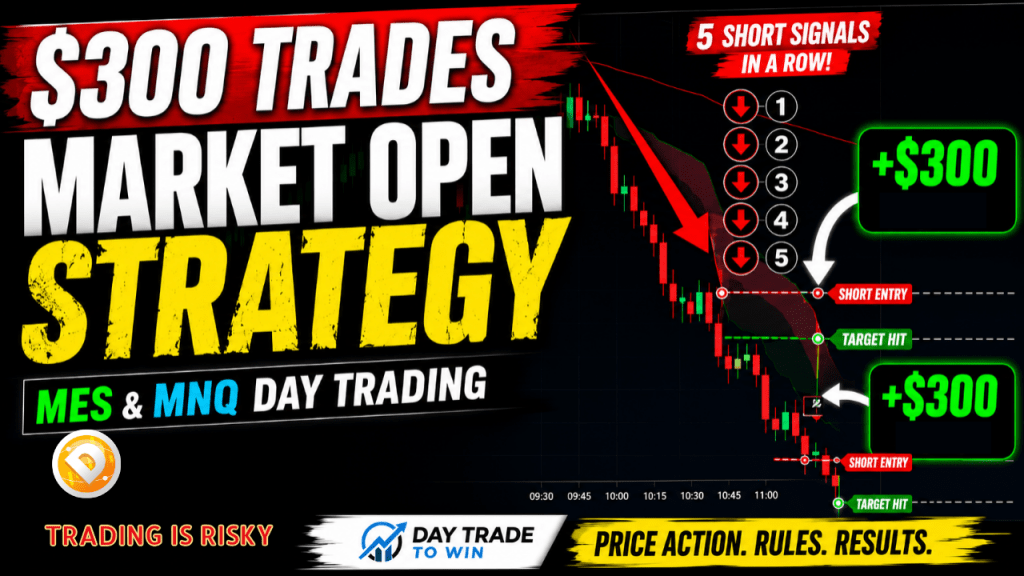
Monday, December 15 | Futures Market Breakdown When futures markets open with clear direction, disciplined traders can capitalize quickly. On Monday, December 15, price action across the Micro E-mini S&P 500 (MES) and Micro E-mini Nasdaq (MNQ) delivered exactly that—strong downside momentum and a series of high-probability short setups. For traders focused on micro futures, this session showcased how a rules-based, price-action strategy can produce consistent results in fast-moving markets. Early Market Action Signals a Bearish Bias From the opening bell, the market showed immediate weakness: When major futures contracts move in sync, it often reflects institutional selling—not random volatility. Why Micro Futures Attract Active Traders Micro futures contracts offer flexibility without sacrificing opportunity: Because the Sonic system is built entirely on price action, it can be applied to nearly any market—futures, stocks, indices, or commodities. Micro Nasdaq Trade Execution During this session on the Micro Nasdaq (MNQ): A single MNQ contract was used, with a balanced risk-to-reward ratio. Although a better entry price was possible, the strength of the trend justified taking the trade. The position moved in favor almost immediately. With one-minute candles, the trade reached its profit target in under two minutes, reinforcing the benefit of quick, decisive execution. Consistency Comes From Risk Management Even during strong trends, risk control remains critical: Despite seeing six to eight winning short signals in succession, disciplined risk management is what protects traders over time. Trading Price Action Instead of Indicators One of the strengths of the Sonic system is its simplicity: The system is available on TradingView and NinjaTrader, providing consistent signals regardless of platform. Adapting When the Market Changes Direction If market conditions shift and price begins to trend higher, the approach remains unchanged: Follow the signals—long or short. The goal is not prediction, but reaction to what price is doing in real time. Learn to Trade With Structure and Confidence Traders looking to develop consistency can access: To get started, visit daytradetowin.com and begin learning a structured, price-action-based approach to trading. Key Takeaway This Micro E-mini and Micro Nasdaq trading session highlights a simple truth: Clear trends, disciplined execution, and price action create opportunity. Whether markets move higher or lower, following a proven system keeps emotions out of the equation.

AI
Market News

Citi Sees AI Adoption Driving S&P 500 Gains in 2026

Citi expects a shift in market leadership from AI “enablers” to AI “adopters” as investors head into what could be a more volatile 2026. With the bull market entering its fourth year, volatility is likely to increase, making it harder to separate winners from losers in the AI race. Even so, Citi strategists remain constructive, citing an accommodative Federal Reserve, earnings growth above consensus, and a stronger fiscal boost from the OBBBA. Together, these factors support a year-end S&P 500 target of 7,700. That forecast is above the MarketWatch consensus of 7,500, which already implies roughly 10% upside from Friday’s close. Citi projects total market returns of around 13% in 2026 but expects leadership to rotate away from companies that build AI infrastructure toward firms that successfully adopt AI to boost productivity. The firm also anticipates broader participation across the index. Starting from elevated valuations, U.S. equities will face growing pressure to deliver strong fundamentals to justify prices. Citi’s base-case target of 7,700—outlined by Scott Chronert, Drew Pettit, and Patrick Galvin in the firm’s 2026 U.S. equity outlook—assumes S&P 500 earnings of $320 per share and a valuation multiple of 24 times earnings. While that represents only modest compression from current levels, Citi warns that greater dispersion in returns, especially among AI-related stocks, will make stock selection more difficult. Wall Street consensus earnings estimates for 2026 are closer to $310 per share, though Citi points to the ongoing resilience of corporate earnings. AI remains a powerful tailwind, but Citi sees investor focus gradually shifting away from hyperscalers, whose outlook remains debated, toward companies that can effectively integrate AI into their business models. The firm also expects more idiosyncratic performance among AI enablers, which now make up roughly 40% of the S&P 500, adding complexity to portfolio construction. To benefit from broader market leadership, Citi recommends positioning for positive earnings revision momentum in value, cyclical, and small-cap stocks. Growth stocks, including mega-cap technology names, will need continued earnings beats and guidance upgrades to support valuations. Citi’s outlook also assumes the Fed will cut rates twice in early 2026—earlier than markets currently expect—as higher unemployment emerges as a side effect of AI-driven productivity gains. The firm forecasts the U.S. 10-year Treasury yield will fall to 3.75% by the end of 2026, from about 4.18% today. In a bull-case scenario, stronger-than-expected earnings growth could push the S&P 500 to 8,300. In a downside scenario marked by weaker fundamentals and multiple compression, Citi sees the index falling to 5,700.

markets
DayTradeToWin Review

How to Trade High-Volatility Markets

When markets accelerate lower, traders face a choice: react emotionally or trade with structure. On high-volatility days like this Friday session, price action becomes fast, directional, and unforgiving for anyone without a clear plan. In this guide, we’ll walk through how to trade a strong selloff using Average True Range (ATR), Sonic trading signals, and micro futures to manage risk while staying aligned with momentum. A Reminder About Trading Risk Before any strategy discussion, one rule always comes first: Never trade with money you can’t afford to lose. Volatile markets offer opportunity, but they also magnify mistakes. Risk management matters more than any single setup. Why ATR Is Critical in Fast-Moving Markets The first thing to analyze during a sharp move is market volatility, and ATR is one of the most reliable ways to do that. ATR shows the average range of each candle. In this session, candles are moving roughly six to seven points from high to low, confirming that volatility is expanding rapidly. What High ATR Tells Traders This environment demands adjustments — especially in contract selection. Why Micro Futures Make Sense During Selloffs Trading full-size contracts like the E-mini S&P (ES) during high volatility can expose traders to unnecessary risk. A smarter approach is switching to micro futures, such as: Micro contracts allow traders to: When ATR expands, trading smaller isn’t being cautious — it’s being professional. How the Sonic Trading System Confirms Direction The Sonic trading system is designed to highlight momentum and trend continuation using price action. What traders want to see: In this market, the system delivered 12 to 13 consecutive short signals, confirming strong downside pressure. Knowing When to Slow Down After Multiple Wins A strong trend doesn’t mean unlimited opportunity. After: Traders should become more selective. Even in powerful moves, markets can pause or reverse quickly. Protecting gains is just as important as finding entries. Trading the MNQ in High-Volatility Conditions The MNQ (Micro Nasdaq) is especially effective when volatility increases. Advantages include: As volatility rises, the MNQ allows traders to stay engaged without over-leveraging. Using News Awareness to Avoid Surprises Even when scheduled news is light — as it often is on Fridays — unexpected global developments can still impact price. A news indicator helps traders: Awareness doesn’t replace strategy, but it strengthens it. Always Check Risk-to-Reward Before Entering Each Sonic signal provides: If the stop is too wide or the risk outweighs the reward, the trade isn’t worth taking. Skipping poor setups is a skill, not a weakness. There will always be another opportunity. Trade Price Action, Not Lagging Indicators Successful traders rely on: —not crowded charts filled with lagging indicators. By combining: Traders can navigate fast-moving markets with confidence and consistency. Final Takeaway High-volatility selloffs reward discipline, not aggression. Focus on: That mindset is what separates short-term excitement from long-term trading success.

AI
Market News

Why Space Could Be the Next Big AI Boom

The next major investing edge in AI may come from identifying where capital for orbital computing flows first, according to Matthew Tuttle, CEO and CIO of Tuttle Capital. Just months ago, anything tied to OpenAI could send tech stocks soaring. Today, the mood has cooled. Investors are more skeptical, and the AI sector now faces the classic “front-cover curse” after Time named several AI leaders as Persons of the Year—including Nvidia’s Jensen Huang, who also just received Financial Times Person of the Year honors. AI’s narrative may need a fresh spark. That spark could be space. The Wall Street Journal reports that Jeff Bezos and Elon Musk are exploring orbital data centers designed to support Earth’s growing AI workloads. In a recent blog post, Tuttle breaks down how investors can position for this next frontier. The biggest constraint for AI’s expansion, he argues, isn’t chips—it’s power. “AI and data centers are set to drive a major surge in electricity demand this decade, which is why ‘grid tech’ has become a real market theme,” he writes. Space, however, has a distinct energy advantage. Orbital data centers can harness uninterrupted solar power. “That’s where ‘compute in orbit’ becomes a serious idea,” Tuttle says. “AI has extremely high revenue per kilowatt, and solar in space is always on—unlike Earth-based constraints.” Scaling orbital computing and delivering that power back to Earth remains the main challenge. The real opportunity, Tuttle says, is recognizing where capex flows first—into edge inference and space infrastructure—while full-scale gigawatt beamed power remains a long-term, sci-fi vision. He lays out a three-phase investable roadmap: Phase 1: Happening Now — On-Orbit InferenceExisting satellites used for weather, communications, Earth observation, maritime tracking, and missile warning. “If satellites classify, compress, and decide onboard, they downlink answers—not terabytes,” he writes. “That cuts bandwidth, speeds up action, and reduces the need for ground stations. That’s today’s ‘sky-brains.’” Phase 2: Purpose-Built AI SatellitesSatellites designed with compute modules. “You’re not just processing your own sensor stream—you’re renting compute,” Tuttle notes. Challenges include radiation tolerance, launch cadence, and networking. This works for niche workloads where latency or sovereignty matters more than cost. Phase 3: Space-Based Solar PowerBeaming solar power from space to Earth. This requires massive lightweight structures, conversion systems, beam-safety protocols, and grid integration—making it the hardest engineering challenge. For the first two phases, Tuttle highlights potential winners in space infrastructure: Redwire, Rocket Lab, L3Harris Technologies, RTX, Northrop Grumman, and Lockheed Martin. “These companies benefit from any version of orbital compute or space power,” he says, “because they supply spacecraft platforms, integration, communications, and space-qualified components.” Radiation-tolerant processors will also be crucial. Tuttle points to Microchip Technology as a direct play on space-grade silicon. But near term, most AI workloads will stay Earth-based. The real spending boom, he says, is still in the power grid—transformers, cooling systems, and distribution. His picks for that theme include Eaton, Hubbell, Quanta Services, and Vertiv. Asked whether any ETF captures this orbital-AI opportunity, Tuttle joked: “Not until I launch it.”

tax refunds
Market News

Tax Refunds Forecast: A Major Tailwind for the Economy

Tax-rebate checks are expected to start arriving in the second quarter, but most of the relief from Trump’s One Big Beautiful Bill Act is directed toward businesses. Stocks could see another leg higher next year as taxpayers begin receiving refunds tied to President Donald Trump’s major tax-and-spending package signed this summer. White House National Economic Council Director Kevin Hassett said Monday that typical workers, now exempt from taxes on tips or overtime, could receive an extra $1,600 to $2,000 next year. “A lot of that will come as tax refunds at the beginning of the year,” he told CNBC. Hassett is also viewed as a top contender to replace Fed Chair Jerome Powell in May. Analysts at the Wells Fargo Investment Institute expect about $517 billion in tax refunds next year — a surge they believe will help “reignite broad consumer spending” and support both the economy and markets. If accurate, it would be one of the largest refund years since 2017, excluding the pandemic-stimulus years. “We expect the nearly 44% year-over-year increase to meaningfully boost consumer spending and help the U.S. economy gather renewed momentum in 2026,” wrote Jennifer Timmerman, an investment-strategy analyst at Wells Fargo. Wells Fargo forecasts the S&P 500 ending 2025 in the 7,400–7,600 range, while the 10-year Treasury yield is expected to stay between 4% and 5%. On Wednesday, the 10-year yield was at 4.15% and the S&P 500 closed just below record highs at 6,886 — poised for a 17.1% annual gain. Will stocks stumble early next year? Meghan Shue, chief investment strategist at Wilmington Trust, expects the current rally to continue through December but is more cautious about the first quarter. After a strong 2025 — especially for AI-related stocks — she anticipates more volatility, selling, and profit-taking as investors rebalance. She also notes tariff uncertainty. Many businesses may be holding off on passing higher import costs to consumers during the critical holiday season. “There could be more supply-chain pressure and more tariff price increases to come in the first quarter,” she said. The outlook brightens in the second quarter as clarity around tariffs and tax relief improves. For consumers, that’s when tax refunds arrive. For businesses — the biggest winners under the new tax law — the payoff will depend more on capital-expenditure incentives than timing.

CTA
Market News

UBS Warns CTA Positioning Could Intensify Market Drop

UBS warns that CTA positioning could sharply amplify any market downturn. With a major U.S. options expiration approaching on Dec. 19, markets are heading into a dense cluster of risk events — the Fed decision on Wednesday, nonfarm payrolls on Dec. 16, and the CPI report on Dec. 18. UBS analysts say that given current positioning and the size of outstanding options, even a small pullback could morph into a much steeper decline. Their analysis shows that a drop in the S&P 500 to around 6,500 — about 5% below current levels — could trigger a critical downside inflection point. UBS’s proprietary model, built to track macro hedge fund behavior around expiration, highlights major sensitivity near 6,850. If the index weakens toward 6,500, commodity trading advisors (CTAs), who follow momentum-driven, algorithmic strategies, would be forced to sell into the decline, accelerating the move lower. The Dec. 19 expiration carries unusually heavy risk, with large open interest at the 5,000, 6,000, 6,850, and 8,000 S&P 500 strikes. Because CTAs rely on systematic trend-following and delta hedging intensifies into expiry, their positioning can significantly exaggerate market swings. December’s expiry is even more consequential because it caps both the quarter and the year. UBS finds CTAs have recently added risk but remain skewed toward selling. A slide toward 6,500 would likely force them to unload increasing amounts of futures to manage directional exposure. In Europe, CTAs are very long Eurostoxx 50 near 5,700, and a move toward 5,600 could trigger heavier selling. UBS also highlights other areas of sensitivity: CTAs are near max short the Japanese yen ahead of the Dec. 19 BOJ meeting, heavily long the Chinese yuan, and holding notable long positions in U.S. 10-year Treasurys that could come under pressure if yields rebound toward 4.25%.

Scroll to Top