
The U.S. stock market is undergoing one of the most important changes in years — and many investors haven’t noticed it yet.
While the S&P 500 index has barely moved since late October, a powerful rotation trade has been unfolding beneath the surface. For the first time in years, technology stocks are no longer the only engine driving market gains. Instead, leadership is shifting toward value stocks, energy, financials, materials, and small-cap stocks.
This change could define market performance in 2026 and beyond.
After more than two years of AI-fueled dominance by mega-cap tech stocks, investors are now looking for better valuations, broader earnings growth, and new opportunities outside Big Tech.
What Is a Stock Market Rotation?
A stock market rotation happens when investors move money from one group of stocks or sectors into others.
Since the bull market began in late 2022, market returns have been heavily concentrated in a handful of mega-cap technology stocks tied to artificial intelligence. But that narrow leadership is now starting to fade.
According to UBS, market participation is finally broadening.
“We’ve already been seeing a little bit of broadening out,” said David Lefkowitz, Head of U.S. Equities at UBS Global Wealth Management. “We think it could broaden further.”
This is exactly what a healthy bull market looks like: more stocks, more sectors, and more styles participating in the rally.
The Data Confirms It: The Average Stock Is Beating Big Tech
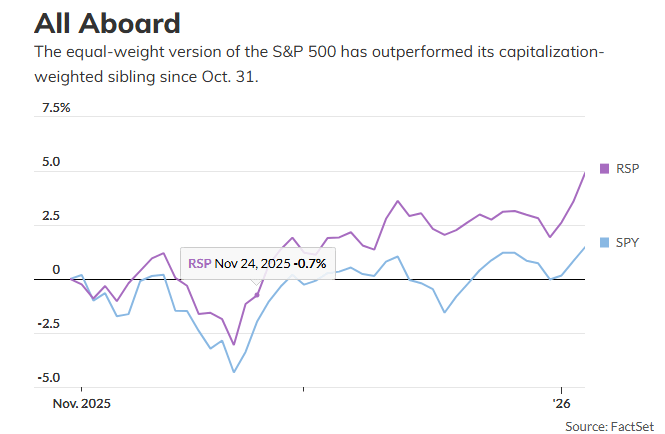
For years, the traditional S&P 500 (which is weighted toward the biggest companies) easily outperformed the equal-weight version of the index. That meant a few giant tech stocks were doing most of the work.
Now that trend has flipped.
Since late October:
- The S&P 500 Equal Weight Index is up nearly 5%
- The regular S&P 500 is up only about 1.5%
This tells us something crucial:
👉 The average stock is now outperforming the mega-cap giants.
The Dow Jones Industrial Average — which is more value-oriented — is also off to its best start to a year in more than two decades.
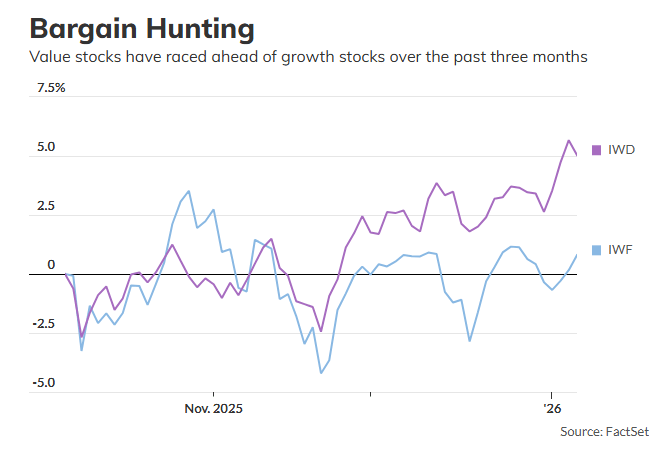
Value Stocks Are Beating Growth Stocks Again
Another major shift is happening in investment style leadership.
Since October:
- Value stocks in the Russell 1000 are up more than 5%
- Growth stocks in the same index are down
Value stocks typically:
- Trade at lower valuations
- Pay dividends
- Perform better when economic growth is stable and interest rates are falling
Growth stocks, especially in tech, dominate when money is cheap and hype is high. That environment is now changing.
Sector Rotation: Energy, Financials, and Materials Take the Lead
The clearest evidence of rotation is in sector performance:
Since late October:
- Technology stocks: down more than 4%
- Energy: up more than 5%
- Financials: up more than 7%
- Materials: up more than 10%
This shows investors are repositioning for economic growth, falling interest rates, and improving global demand.
Rising commodity prices have also boosted materials and mining stocks, while financials benefit from a stronger economy and healthier lending conditions.
Why This Is Happening: The 2026 “Goldilocks” Economy
Markets are starting to price in a Goldilocks scenario for 2026:
- Economic growth stays solid
- Inflation continues to cool
- The Federal Reserve cuts interest rates
- Recession risks remain low
“2026 could mark the return of a Goldilocks economy — and a reset for both equity and fixed-income markets,” said Jack Janasiewicz of Natixis.
This environment is perfect for value stocks, cyclical sectors, and small-cap stocks.
Small-Cap Stocks Could Be the Biggest Winners
After years of underperformance, small-cap stocks are finally showing signs of life.
Even more important:
📊 Analysts now expect small-cap earnings to grow faster than large-cap earnings in 2026 — the first time this has happened since the bull market began in 2022.
According to Yardeni Research, small and mid-cap stocks could outperform large caps this year, especially in:
- Financials
- Industrials
- Healthcare
Small caps also benefit the most from:
- Falling interest rates
- Domestic economic growth
- Rising business investment
The AI Trade Isn’t Dead — But Leadership Is Changing
Artificial intelligence is still a massive long-term trend. But investors are no longer buying every stock with “AI” in the story.
Instead, markets are becoming more selective, separating real winners from overpriced hype.
The bigger change is this:
👉 The market no longer depends on just 7 stocks to go up.
That’s a healthy and sustainable shift.
The S&P 500 Still Has a Dangerous Concentration Problem
Even after the recent rotation:
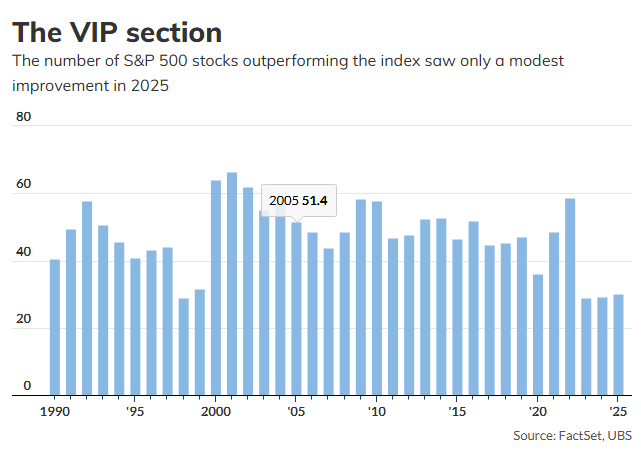
- The top 10 stocks make up more than 40% of the S&P 500
- The “Magnificent Seven” still drove about 40% of last year’s returns
- Only 30% of S&P 500 stocks beat the index last year
This extreme concentration is another reason why broader market participation matters so much going forward.
Valuations: The Biggest Reason the Rotation Has More Room to Run
The valuation gap in the U.S. stock market is enormous:
- The S&P 500 trades at a 36% premium to the equal-weight index
- It trades at a 49% premium to small-cap stocks
That means:
💡 There is massive upside potential in value stocks and small caps if this rotation continues.
“If this trend holds, there is a vast valuation gap to close,” said Michael O’Rourke of Jones Trading.
What This Means for Investors
This is what a healthier bull market looks like:
- Less dependence on Big Tech
- More sectors participating
- More stocks contributing to returns
- Better opportunities outside crowded trades
For diversified investors, 2026 could be one of the best years in a long time to look beyond mega-cap tech.
Final Thoughts: The Market Is Entering a New Phase
After years of narrow leadership dominated by AI and mega-cap tech, the U.S. stock market is finally broadening out.
If economic growth holds, inflation stays controlled, and the Fed cuts rates, value stocks, cyclical sectors, and small caps could lead the next phase of the bull market.
The rotation trade is no longer a theory.
It’s already happening. 🚀

John Paul is the founder of DayTradeToWin, a trading education and software company established in 2008, supporting traders worldwide. His expertise focuses on price action-based futures trading strategies and structured market analysis.
DayTradeToWin delivers trading education, indicators, and software tools designed to help traders apply disciplined, rule-based decision-making across global futures markets.
He is the creator of multiple trading methodologies, including the Sonic System, Atlas Line, and Trade Scalper, which help traders identify structured opportunities in markets such as the E-mini S&P 500 (ES), Nasdaq (NQ), crude oil (CL), and gold (GC).
Official website: https://daytradetowin.com