
stock market

goldman
Market News

Why Goldman Sees Trouble Ahead for Stocks

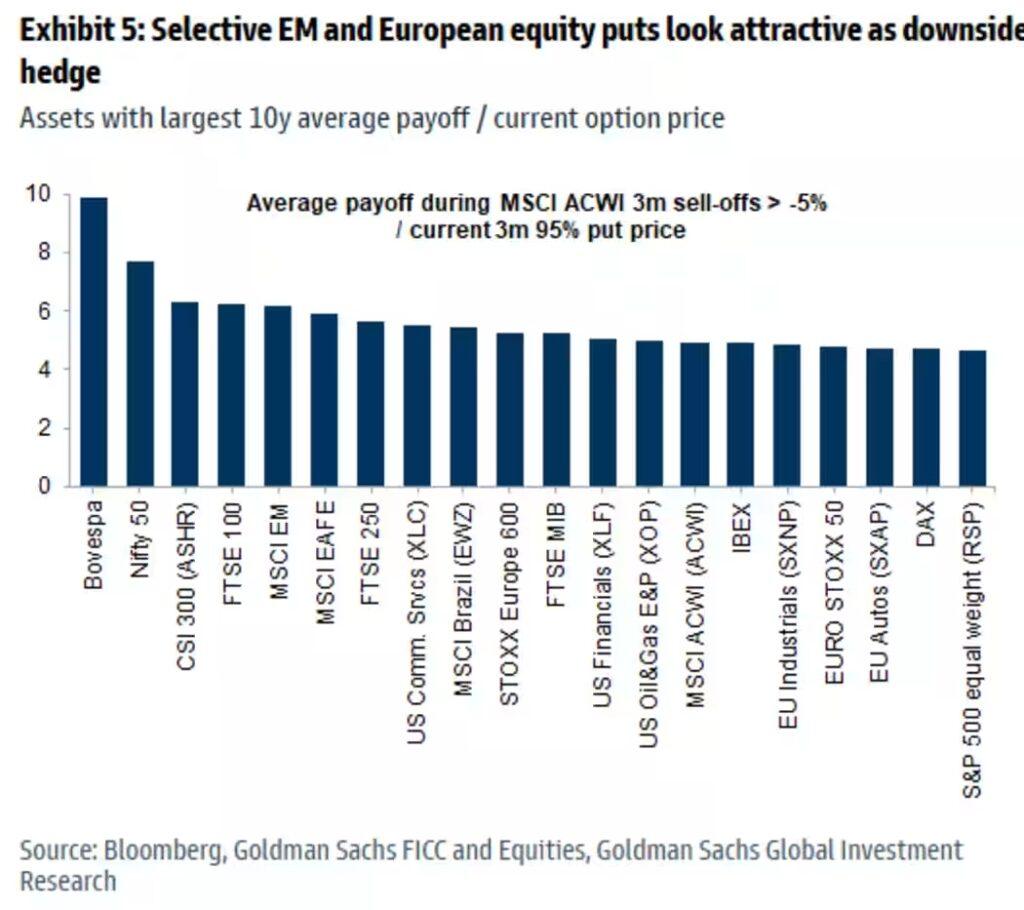
Goldman Warns: Calm in Equities May Be Ending The S&P 500 just notched its 18th record close of 2025, fueled by strong corporate earnings—boosted by AI spending—and softer Fed expectations, according to Goldman Sachs. Risk premiums have narrowed, credit spreads have tightened, and the VIX has fallen to its lowest since December. But Goldman strategists Christian Mueller-Glissmann and Andrea Ferrari say the setup is less friendly than past low-volatility periods. The chance of outsized rallies is slim, while the probability of a sharp pullback is climbing. High valuations, weakening labor data, and slowing business-cycle momentum have all pushed their drawdown probability index higher—similar to the spike seen after Trump’s April tariff announcement. Tariff uncertainty, sticky inflation, and lingering geopolitical risks could also limit Fed rate cuts, keeping markets vulnerable. Goldman sees U.S. growth staying weak in the second half, meaning more Fed easing is possible—but likely alongside higher equity volatility. Their stance: tactically neutral—overweight cash, neutral on equities, credit, and bonds, underweight commodities. For hedging, they favor cheap put spreads and selective downside plays on Brazil’s Bovespa, India’s Nifty 50, and China’s CSI 300. On the upside, they see potential in calls on the S&P 500 Equal Weight Index if gains spread beyond mega-cap tech. John PaulJohn Paul is the founder of DayTradeToWin, a trading education and software company established in 2008, supporting traders worldwide. His expertise focuses on price action-based futures trading strategies and structured market analysis. DayTradeToWin delivers trading education, indicators, and software tools designed to help traders apply disciplined, rule-based decision-making across global futures markets. He is the creator of multiple trading methodologies, including the Sonic System, Atlas Line, and Trade Scalper, which help traders identify structured opportunities in markets such as the E-mini S&P 500 (ES), Nasdaq (NQ), crude oil (CL), and gold (GC). Official website: https://daytradetowin.com daytradetowin.com
markets
Market News

Momentum Meets Markets Skeptic

Markets have been behaving oddly over the past two days — maybe a long-awaited sector rotation, or just thin summer trading paired with optimism over how aggressively the Fed might cut rates. Andrew Left Says Palantir’s Valuation Outpaces Even Nvidia’s Small caps and homebuilders have rallied, but momentum giants have stalled. Leading that group is Palantir (PLTR -1.39%), up 144% year-to-date, making it the S&P 500’s top performer. Its surge has pushed valuations to extreme territory — 242x forward earnings and 137x sales, according to FactSet. Short-seller Andrew Left of Citron Research thinks that’s unsustainable. “I like Alex Carp, the company’s mission, and its leadership,” Left said on Fox Business. “But even if Palantir traded at Nvidia’s 2023 multiples, the stock could still drop by two-thirds — to about 35x sales. You can’t be a big data company and tell investors to ignore big data.” Left noted that no company with such lofty multiples has avoided a 50% correction. He also pointed to competition from Databricks, a rival with similar revenue and more corporate customers, rumored to be going public this year. Though he admits he could be wrong and still holds positions in Apple and Amazon, Left sees Palantir as dangerously overpriced. Separately, Left is battling SEC and DOJ charges over his short-selling markets activities. His attempt to dismiss the case was rejected in July, with trial set for March. John PaulJohn Paul is the founder of DayTradeToWin, a trading education and software company established in 2008, supporting traders worldwide. His expertise focuses on price action-based futures trading strategies and structured market analysis. DayTradeToWin delivers trading education, indicators, and software tools designed to help traders apply disciplined, rule-based decision-making across global futures markets. He is the creator of multiple trading methodologies, including the Sonic System, Atlas Line, and Trade Scalper, which help traders identify structured opportunities in markets such as the E-mini S&P 500 (ES), Nasdaq (NQ), crude oil (CL), and gold (GC). Official website: https://daytradetowin.com daytradetowin.com
rally
Market News

S&P 500 Eyes 7,500 in “Unreasonable Rally”

An ‘Unreasonable Rally’ Is Taking Shape—Powered by Tech and Policy Shifts Hotter-than-expected inflation data on Tuesday didn’t rattle Wall Street—stocks climbed anyway. For James Thorne, chief market strategist at Wellington-Altus, that’s just the beginning. He’s calling for the S&P 500 to reach 7,500 by next spring—a 16% jump from current levels—putting him in rare company with bullish forecasters like Ed Yardeni. A vocal crypto supporter, Thorne welcomed the passage of the Genius Act, which regulates stablecoins, and the pending Clarity Act, which would split digital asset oversight between the SEC and CFTC. Thorne dubs the current upswing “America’s unreasonable rally,” fueled by fiscal reform, technological disruption, and a resurgence of pragmatic innovation. He points to June’s rare budget surplus as proof the bond market’s doomsayers are losing their edge, even though July’s $291 billion deficit shows the battle isn’t over. “When the worst doesn’t happen, the skeptics just change the story—deficits, inflation, regulation, geopolitics,” he says. “Wall Street has an entire industry built on bad predictions.” Although he didn’t weigh in directly on July’s CPI report, Thorne notes that three-month annualized inflation is running at 2.3%, and believes a 50-basis-point Fed rate cut should be on the table. He likens current White House policy to “unplugging and rebooting” the economy, with recent tariff rollbacks marking the start of a historically strong four-year cycle. In this landscape, he sees gold and bitcoin as portfolio cornerstones, and urges investors to increase stakes in AI, blockchain, tokenization, digital infrastructure, industrials, and financials. “A political reset, bullish market setup, and blockchain breakthroughs are converging,” Thorne says. “This is a generational opportunity for investors ready to adapt.” John PaulJohn Paul is the founder of DayTradeToWin, a trading education and software company established in 2008, supporting traders worldwide. His expertise focuses on price action-based futures trading strategies and structured market analysis. DayTradeToWin delivers trading education, indicators, and software tools designed to help traders apply disciplined, rule-based decision-making across global futures markets. He is the creator of multiple trading methodologies, including the Sonic System, Atlas Line, and Trade Scalper, which help traders identify structured opportunities in markets such as the E-mini S&P 500 (ES), Nasdaq (NQ), crude oil (CL), and gold (GC). Official website: https://daytradetowin.com daytradetowin.com
markets
Market News

Markets Ready to Break Higher from 6,500

Lord Fed: In Thin Summer Markets, Round Numbers Can Be Launchpads — Not Ceilings The S&P 500 is once again brushing up against record highs, sitting just a fraction below its all-time close. For some, this altitude feels treacherous — the air too thin to sustain the rally much longer. Whispers of a potential ceiling at 6,500 grow louder among the cautious. But for Lord Fed — the pseudonymous investor behind Lord Fed’s Gazette, Substack’s 13th most popular finance blog — that level is no cliff edge. It’s a launchpad. “Here’s what people keep getting wrong about tops,” he wrote over the weekend. “They’re expecting some orderly rotation, some gentle rolling over. That’s not how this works. Real tops are chaos — euphoric, messy, and loud. Positioning is maxed out, volatility is climbing, correlations spike to 1, and retail is frantically buying index funds at the highs.” None of those signals are visible today, he argues. Instead, the market is methodically climbing “a wall of worry,” brick by brick, while the so-called smart money sits underweight, still waiting for the meaningful pullback that never seems to arrive. “That’s not topping behavior,” he says. “That’s fuel.” He lays out the evidence: Even valuations look sturdier post-earnings season. Twelve-month forward S&P earnings estimates are up 3.6% over the past month — the strongest seasonal start in years. “These aren’t just companies clearing a low bar,” Lord Fed says. “They’re actively reshaping the forward outlook.” Taken together, this paints a market that is under-owned, not overextended — and one that’s rising largely because so few believe it should. “And that’s exactly why 6,500 won’t be a ceiling,” he concludes. “It could be the floor we rocket past on our way to something much higher. You don’t get a real top when half the street is still positioned for disaster — you get melt-ups.” Thin August liquidity, he warns, could accelerate that melt-up. In quieter summer markets, round numbers act like magnets — pulling in stops, triggering systematic buying programs, and forcing dealers to hedge aggressively into the move. To be clear, he admits, shocks like a sudden inflation spike or a major geopolitical surprise could derail the rally. But absent that, investors who have been waiting for a dip will increasingly panic about being left behind — bidding at any price, pushing the market through resistance in a messy, disorderly surge. In Lord Fed’s view, this isn’t the airless summit many fear. It’s the edge of a launchpad — with the countdown already underway. John PaulJohn Paul is the founder of DayTradeToWin, a trading education and software company established in 2008, supporting traders worldwide. His expertise focuses on price action-based futures trading strategies and structured market analysis. DayTradeToWin delivers trading education, indicators, and software tools designed to help traders apply disciplined, rule-based decision-making across global futures markets. He is the creator of multiple trading methodologies, including the Sonic System, Atlas Line, and Trade Scalper, which help traders identify structured opportunities in markets such as the E-mini S&P 500 (ES), Nasdaq (NQ), crude oil (CL), and gold (GC). Official website: https://daytradetowin.com daytradetowin.com

S&P 500
Market News

Could Tech Soon Be 70% of the S&P 500?

S&P 500’s Tech Weight Back at Dot-Com Era Levels — Some See Room to Run The S&P 500 came within 0.01% of logging its 16th record close of the year on Friday, while the Nasdaq notched its 18th. Futures suggest more milestones could be reached this week, with many traders viewing the path of least resistance for equities as higher — until it isn’t. Howard Lindzon, co-founder and CEO of StockTwits, says investor conversations are centered on record highs for tech stocks, bitcoin, and gold. The prevailing market posture? Bullish on tech via the Invesco QQQ Trust, bullish on bitcoin and alternative cryptocurrencies, bullish on gold — and a decisive “get me out” when it comes to bonds. At the center of the current boom-or-bust debate is a chart from Charlie Bilello, chief market strategist at Creative Planning, showing that tech now commands 34% of the S&P 500. That’s higher than its weighting at the height of the dot-com bubble in 2000, before the dramatic market collapse that followed. Yet Lindzon points to another chart that may temper fears of excessive concentration. Sourced from Bank of America and shared by Marlin Capital founder David Marlin, it shows that in 1881 railroads represented 63% of the U.S. stock market. That dominance ultimately faded, but it also suggests that the current tech cycle may still have a long way to go before peaking. Ed Yardeni, president of Yardeni Research, is also leaning bullish — particularly on the so-called Magnificent Seven megacap tech stocks. He told clients that “the sky may be the limit” for both these companies and the bull market they’re driving, so long as the broader economy avoids trouble. He cautions, however, that valuations are stretched: forward price-to-earnings ratios stand at 22.5 for the S&P 500, 19.9 excluding the Mag-7, and 29.7 for the Mag-7 themselves. Still, he believes these multiples can hold if recession odds remain low. Lindzon adds that it took 25 years for tech’s share of the S&P 500 to return to its 2000 peak of 34%. Now, with the rise of mobile computing, cloud infrastructure, and artificial intelligence, he sees potential for technology to make up 70% of the index in the future. What could drive such growth? The sheer scale and financial power of the sector’s biggest players. “The 10 largest companies have massive cash reserves, global reach, and strong balance sheets,” Lindzon says. “They have to spend that money on R&D, people, and raw materials — not only to compete with each other but to protect their market positions. While it might be nicer to have 50 or 100 slightly smaller giants, 10 healthy, paranoid giants is better than two or three.” John PaulJohn Paul is the founder of DayTradeToWin, a trading education and software company established in 2008, supporting traders worldwide. His expertise focuses on price action-based futures trading strategies and structured market analysis. DayTradeToWin delivers trading education, indicators, and software tools designed to help traders apply disciplined, rule-based decision-making across global futures markets. He is the creator of multiple trading methodologies, including the Sonic System, Atlas Line, and Trade Scalper, which help traders identify structured opportunities in markets such as the E-mini S&P 500 (ES), Nasdaq (NQ), crude oil (CL), and gold (GC). Official website: https://daytradetowin.com daytradetowin.com

coal
Market News

Coal Isn’t Dead—It’s Undervalued

Why Coal Stocks Are Drawing Interest Despite Their Unpopularity Coal has long been considered one of the least desirable investments, especially as environmental concerns and ESG trends steer capital toward cleaner energy. Yet despite its tarnished reputation, a growing group of investors is taking a fresh look at it—largely due to ongoing demand and limited supply. Energy consultancy Wood Mackenzie recently projected that coal demand could remain resilient through 2030, contradicting many past forecasts of rapid decline. “While the long-term move toward renewables is still in motion, the transition is proving more complex,” said Anthony Knutson, global head of thermal coal markets at Wood Mackenzie. “Energy security and affordability are now top priorities for many countries.” These shifting priorities led Range Fund Holdings to launch the Range Global Coal Index ETF (COAL) in early 2024. Despite its modest $20 million size, the fund is one of the few dedicated ETFs on the market. CEO Tim Rotolo told MarketWatch the fund reflects a broader recognition of coal’s role in supporting energy reliability—especially following Russia’s invasion of Ukraine and the resulting energy crisis. “In a crisis, the goal becomes ensuring access to affordable energy—not climate goals,” Rotolo said. The fund’s top holdings include Yancoal Australia, Warrior Met Coal, and Alliance Resource Partners. It maintains a 50/50 allocation between metallurgical coal (used in steelmaking) and thermal coal (used for electricity and heating). Since launch, the ETF is down around 21%, but Rotolo sees long-term opportunity in the sector’s overlooked fundamentals. He argues that investor aversion to coal has created a market mispricing. For example, Peabody Energy dropped to under $1 per share in 2021, down from $45, and has since rebounded to around $17. Limited financing and regulatory hurdles forced many companies to focus on buying back stock or reducing debt—moves that can benefit shareholders when valuations are low. “There were no other options,” Rotolo said. “And that’s often when you find value—when everyone else has walked away.” He believes the bigger factor for coal prices is supply, not demand. “If demand remains stable and supply contracts, its prices can surge. That’s good for coal stocks.” Countries like India and China continue to drive demand, and coal remains an affordable energy option—especially given the long lead times for gas turbines and the limitations of renewables in fast-growing economies. “Asia’s younger coal fleet is adapting alongside renewable expansion,” Knutson added. Rotolo’s firm also launched a nuclear-focused ETF (NUKZ) at the same time as COAL, which is up 75% since inception—showing that investors are open to energy strategies beyond mainstream narratives. In a market where consensus often proves wrong, some see coal’s deep unpopularity as an opportunity—not a warning sign. John PaulJohn Paul is the founder of DayTradeToWin, a trading education and software company established in 2008, supporting traders worldwide. His expertise focuses on price action-based futures trading strategies and structured market analysis. DayTradeToWin delivers trading education, indicators, and software tools designed to help traders apply disciplined, rule-based decision-making across global futures markets. He is the creator of multiple trading methodologies, including the Sonic System, Atlas Line, and Trade Scalper, which help traders identify structured opportunities in markets such as the E-mini S&P 500 (ES), Nasdaq (NQ), crude oil (CL), and gold (GC). Official website: https://daytradetowin.com daytradetowin.com

Scroll to Top