

stock market

nvidia
Market News

Nvidia Proves Tech Loyalty Pays, Says Strategist

Retail Investors Have Played the Dip Right — But the Real Test May Still Lie Ahead, Strategist Says A renewed wave of optimism is sweeping through markets, thanks to Nvidia blockbuster earnings and a court challenge to the so-called “Liberation Day” tariffs. According to Ross Mayfield, investment strategist at Baird, these developments are reigniting interest in tech and AI — and could support a broader market rebound after a muted start to 2025. “Nvidia results, especially the relentless demand for its core products, are helping to recharge confidence in the AI trade,” Mayfield told MarketWatch in comments following a recent interview. “The company remains the bellwether for what is arguably the most powerful secular trend in the market today.” Mayfield has been bullish on AI-adjacent stocks since the April pullback, and he continues to view the sector as a structural winner — less susceptible to political volatility and policy shifts. “There’s massive capital going into data centers, chips, and infrastructure to support an AI-driven future. That’s not something short-term politics can derail,” he said. For him, Nvidia, big tech and AI leaders present long-term opportunities, especially when prices dip. “When you get the chance to buy companies you believe in for the next five years — and they’re trading at a discount — you don’t want to miss that,” he said. Looking out six to twelve months, Mayfield remains optimistic. While the recent rally has left stocks looking a bit overbought, he sees positive momentum not just in tech but across cyclical sectors including consumer, financials, and industrials. “We’re in a risk-on environment,” he noted. “From the April lows, we’ve seen leadership return to the Magnificent Seven and other AI-linked stocks.” He does caution, however, that risks remain. A market bubble, akin to the one in the late 1990s, can’t be ruled out. “If ChatGPT was the modern ‘Aha’ moment, we may still have runway before hitting those excesses — but the comparison is worth keeping in mind,” he said. Valuations are another concern. “Markets tend to get into trouble when prices are stretched. We’re near that point,” he warned. A shift in trade policy or tariffs under a future Trump administration could also trigger renewed volatility. “Investors should be prepared for more turbulence — potentially at levels we haven’t seen since the pandemic.” One key difference in this market cycle, Mayfield argues, is the emergence of more consistent retail investor participation. In recent weeks, individual investors have stepped in to buy the dip while institutional players remained cautious. “There’s been a real shift — retail investors are becoming more disciplined, contributing regularly to retirement accounts and staying invested,” he said. “It’s changing how we think about the divide between so-called ‘smart money’ and ‘dumb money.’” Still, the durability of that retail resilience remains uncertain. “The past decade has seen a number of short-lived bear markets. Dip-buying has worked — and fast. Eventually, that playbook will get tested in a deeper, more sustained downturn,” Mayfield said. John PaulJohn Paul is the founder of DayTradeToWin, a trading education and software company established in 2008, supporting traders worldwide. His expertise focuses on price action-based futures trading strategies and structured market analysis. DayTradeToWin delivers trading education, indicators, and software tools designed to help traders apply disciplined, rule-based decision-making across global futures markets. He is the creator of multiple trading methodologies, including the Sonic System, Atlas Line, and Trade Scalper, which help traders identify structured opportunities in markets such as the E-mini S&P 500 (ES), Nasdaq (NQ), crude oil (CL), and gold (GC). Official website: https://daytradetowin.com daytradetowin.com
market
Market News

Hot Weather, Cold Market Truths

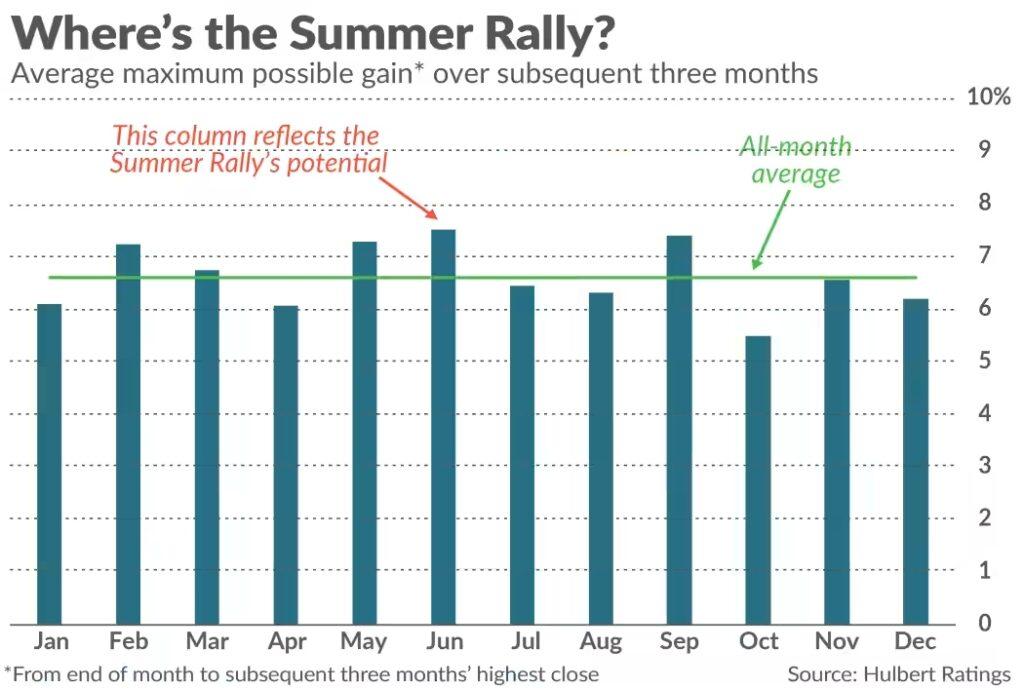
June Market Myths: Don’t Bet on a Swoon or a Rally Two seasonal stock market clichés tend to resurface each June: the ominous “June swoon” and the optimistic “summer rally.” Neither stands up to scrutiny. Wall Street lore says stocks either fall sharply in June or kick off a strong summer run. But historical data suggests otherwise. Since its inception in 1896, the Dow Jones Industrial Average has posted an average monthly gain of 0.62%. June is neither better nor worse than that — just average. Debunking the “June Swoon” Yes, stocks often decline at some point during a month — any month. But to test the so-called June swoon, we need to ask: is June uniquely prone to bigger drops? Looking at more than a century of data on the Dow, the average maximum intra-month loss in June is nearly identical to the average for all months. In fact, May, September, and October have shown larger average declines. There’s nothing special — or especially negative — about June. The Reality of the “Summer Rally” What about the summer rally? To test that theory, we examined the Dow’s biggest gain from early June through late August. While June does show slightly more upside potential than other months, the difference — just 0.9 percentage points — isn’t statistically significant. And even if it were, capturing it would require perfect foresight. A Flip of the Coin The takeaway? Acting on these seasonal narratives is no better than guessing. Neither the swoon nor the rally has reliable evidence behind it. Why Theory Matters Even if a seasonal trend did show a statistical edge, you shouldn’t act on it unless there’s a plausible reason it exists. Many patterns are flukes, not signals — a point emphasized by David Leinweber in “Stupid Data Miner Tricks,” which details how spurious correlations can mislead investors. And as Lawrence Tint, former U.S. CEO of BGI, notes: if there were a clear reason behind a pattern, it would quickly vanish. Once investors understand it, they act on it — and the edge disappears. Final Thought Seasonal patterns like the June swoon and summer rally make for catchy headlines, but not sound investment strategies. If you’re looking for reliable returns, skip the calendar myths and focus on fundamentals. John PaulJohn Paul is the founder of DayTradeToWin, a trading education and software company established in 2008, supporting traders worldwide. His expertise focuses on price action-based futures trading strategies and structured market analysis. DayTradeToWin delivers trading education, indicators, and software tools designed to help traders apply disciplined, rule-based decision-making across global futures markets. He is the creator of multiple trading methodologies, including the Sonic System, Atlas Line, and Trade Scalper, which help traders identify structured opportunities in markets such as the E-mini S&P 500 (ES), Nasdaq (NQ), crude oil (CL), and gold (GC). Official website: https://daytradetowin.com daytradetowin.com
retail
Market News

Retail Confidence May Backfire

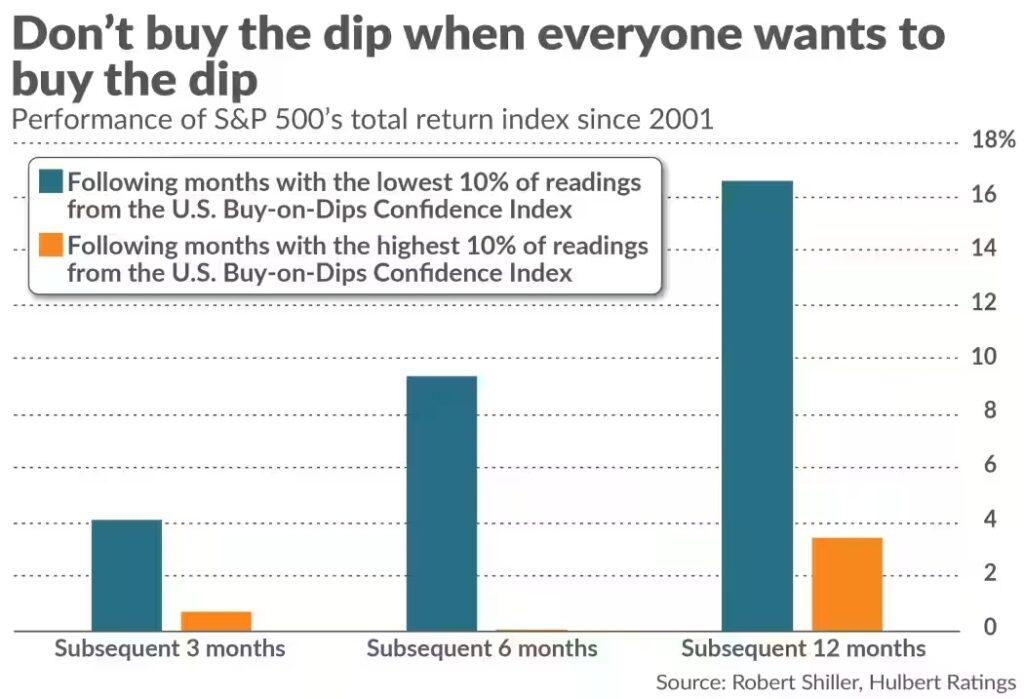
Retail Investors Are Rushing to Buy the Dip — And That’s a Problem Retail investors have been aggressively buying every market dip — a classic sign of overconfidence that often precedes a market top. As Warren Buffett famously said, “Be fearful when others are greedy.” Following the S&P 500’s sharp drop in early April — over 12% in just four trading days — retail traders piled in. “An army of amateur investors stepped up to buy the dip with both hands,” reported MarketWatch’s Joseph Adinolfi. JPMorgan analysts estimated that individuals bought $50 billion in stocks in April alone, accounting for nearly a third of daily trading volume at times. This kind of enthusiasm usually spells trouble. History shows that aggressive dip-buying by individual investors is far more common near market peaks than bottoms. In contrast, true market bottoms tend to occur when fear dominates — when investors sell into rallies, not buy into selloffs. One tool that highlights this dynamic is Yale professor Robert Shiller’s “Buy on Dips Confidence Index.” This survey gauges how likely retail investors believe the market will rebound after a drop. When confidence is high, forward returns are typically poor. When confidence is low — when investors doubt any rebound — future returns improve significantly. The data is statistically strong. Though Shiller’s index is released with a lag, recent behavior suggests we’re near the high end of its historical range. That’s a warning sign. Each successful dip-buy emboldens investors, reinforcing a cycle of confidence and risk-taking. But this cycle can’t last forever. Eventually, it takes a much deeper, more painful correction to shake that conviction and reset sentiment. Until then, the foundation for a sustainable rally just isn’t in place. And when the reset comes, it won’t be gentle. John PaulJohn Paul is the founder of DayTradeToWin, a trading education and software company established in 2008, supporting traders worldwide. His expertise focuses on price action-based futures trading strategies and structured market analysis. DayTradeToWin delivers trading education, indicators, and software tools designed to help traders apply disciplined, rule-based decision-making across global futures markets. He is the creator of multiple trading methodologies, including the Sonic System, Atlas Line, and Trade Scalper, which help traders identify structured opportunities in markets such as the E-mini S&P 500 (ES), Nasdaq (NQ), crude oil (CL), and gold (GC). Official website: https://daytradetowin.com daytradetowin.com

markets
Market News

Trump Delays EU Tariffs, Markets Rally

Markets Rebound After Trump Delays EU Tariff Hike U.S. stock futures and European equity markets rallied Monday after former President Donald Trump announced a delay to the planned 50% tariffs on European Union goods, easing immediate trade tensions. In a Truth Social post on Sunday, Trump said he would postpone the tariff increase from June 1 to July 9 following a phone call with European Commission President Ursula von der Leyen, who requested more time to negotiate a deal. His Friday announcement of the tariff hike had rattled global markets, with the S&P 500 falling 0.6%. While U.S. markets were closed Monday for Memorial Day, futures signaled strong gains when trading resumes Tuesday. Dow futures rose 450 points, or 1%, to 42,124. S&P 500 futures climbed 1.2% to 5,888, and Nasdaq-100 futures gained 1.4% to 21,272. European stocks rebounded from Friday’s losses. The Stoxx Europe 600 rose 1%, offsetting its 0.9% drop in the previous session—its worst since April 9. Germany’s DAX surged 1.7%, and France’s CAC 40 advanced 1.1%. The euro edged up 0.1% to $1.1384, while the 10-year German bund yield increased by 3 basis points to 2.602%, amid broad dollar weakness. “The EU is the U.S.’s largest trading partner, and renewed tensions could spark a broader risk-off sentiment,” said Ipek Ozkardeskaya, senior analyst at Swissquote Bank. She noted the euro is attracting haven flows as uncertainty rises. Analysts warn that the risk of further tariffs could shake investor confidence heading into the summer. “June could be a rocky month for markets, with the U.S. working to avoid retaliatory tariffs through global trade talks,” said Jochen Stanzl, chief market analyst at CMC Markets. The EU had already faced a 10% tariff following Trump’s April 2 “liberation day” trade policy. Friday’s proposed hike to 50% briefly threatened to escalate the standoff before the delay was confirmed. Von der Leyen described her conversation with Trump as “good,” posting on X that the extension to July 9 would give both sides time to work toward a deal. Trade uncertainty is also impacting U.S. businesses. Minneapolis Fed President Neel Kashkari told Bloomberg TV on Monday that companies want clarity before making investment decisions. He added that upcoming trade outcomes could influence Fed policy, alongside inflation and labor data. The CME FedWatch tool currently shows a 58% probability of a September rate cut. European stocks have drawn more interest from Wall Street this year. The Stoxx Europe 600 is up 8.3%, while the S&P 500 is down 1.3%. Still, Citigroup analysts cautioned that a lasting 50% tariff could cause the European index to drop by 7% to 8%. Goldman Sachs economists, led by Guillaume Jaisson, forecast flat GDP growth for the eurozone in 2025, warning that renewed trade friction could further strain the region’s weak economic outlook. “Investor flows into European equities have improved, but remain relatively light,” Jaisson said. “While domestic interest is rising, positioning is still cautious.” John PaulJohn Paul is the founder of DayTradeToWin, a trading education and software company established in 2008, supporting traders worldwide. His expertise focuses on price action-based futures trading strategies and structured market analysis. DayTradeToWin delivers trading education, indicators, and software tools designed to help traders apply disciplined, rule-based decision-making across global futures markets. He is the creator of multiple trading methodologies, including the Sonic System, Atlas Line, and Trade Scalper, which help traders identify structured opportunities in markets such as the E-mini S&P 500 (ES), Nasdaq (NQ), crude oil (CL), and gold (GC). Official website: https://daytradetowin.com daytradetowin.com

trade
Market News

The Bold Trade That Doubled a Fund

Rob Citrone Predicts U.S. Economic Trade Boom in 2026, Sees Big Upside in Latin America Despite recent market turbulence, hedge fund veteran Rob Citrone remains confident in both the U.S. economy and select global opportunities. Speaking on Goldman Sachs’ Exchanges podcast, the Discovery Capital Management founder shared his view that markets have grown more volatile and less efficient — but also more full of opportunity. “Markets today don’t anticipate events the way they used to,” said Citrone, a former protégé of George Soros and Julian Robertson. “There’s more retail money and algorithmic trading now, and they react to headlines rather than looking ahead.” Citrone’s approach combines macroeconomic analysis with deep dives into individual assets — a strategy he’s used successfully for over 25 years. His fund has gained roughly 50% in each of the past two years, bringing Discovery Capital’s assets under management to around $3 billion. A key driver of those returns: shorting two of the regional banks that failed in 2023. He acknowledges that shorting is now rare, calling it “a lost art” after many funds were burned during the meme-stock era. But he still sees compelling opportunities on both the long and short side of the market. Citrone is optimistic about the U.S. economy’s future. He expects a boom in 2026, powered by potential tax cuts and relatively modest tariffs, likely capped at 10% outside of China. He believes this will push the 10-year Treasury yield above 5% by year-end, making rate cuts by the Federal Reserve unlikely. His confidence in the U.S. rests on what he calls its “exceptionalism” — a strong private sector and technological leadership. But valuations are already pricing in a lot of that optimism, which is why he’s also looking abroad. One region he’s especially excited about: Latin America. Citrone says the area offers undervalued assets and outsized returns across equities, bonds, credit, and currencies. He sees the region as a relative safe haven amid shifting U.S. trade policy, with no country facing tariffs above 10%. “Latin America is often overlooked in favor of Asia,” he said. “But China faces a tough road ahead, and I believe Latin America is on the verge of a boom.” Argentina is his biggest conviction trade right now. Since President Javier Milei’s election in December 2023, Citrone has loaded up on local peso-denominated credit, calling it “a home run.” Milei’s market-friendly reforms and commitment to reducing government spending have fueled a rally, with Argentina’s MERVAL index up roughly 150% since he took office. Citrone compares the trade to one of his most successful bets — going long the dollar versus the yen in 2013, which earned his fund over a billion dollars. For retail investors looking to tap into these opportunities, Citrone points to ETFs like the iShares Latin America 40 ETF (ILF) and the Global X MSCI Argentina ETF (ARGT). In a market that’s increasingly driven by noise, Citrone believes fundamentals still matter — and that patient, thoughtful investors can thrive. John PaulJohn Paul is the founder of DayTradeToWin, a trading education and software company established in 2008, supporting traders worldwide. His expertise focuses on price action-based futures trading strategies and structured market analysis. DayTradeToWin delivers trading education, indicators, and software tools designed to help traders apply disciplined, rule-based decision-making across global futures markets. He is the creator of multiple trading methodologies, including the Sonic System, Atlas Line, and Trade Scalper, which help traders identify structured opportunities in markets such as the E-mini S&P 500 (ES), Nasdaq (NQ), crude oil (CL), and gold (GC). Official website: https://daytradetowin.com daytradetowin.com

memorial day
Market News

Memorial Day Closures: Market, Banks, Post Office

Memorial Day Weekend 2025: What’s Open and What’s Closed As Memorial Day weekend kicks off, many are keeping a close eye on the markets. While stocks have bounced back from April’s tariff concerns, uncertainty still lingers around trade policies and tax reform. Meanwhile, turbulence in the $29 trillion Treasury market has investors on edge heading into the three-day break. Here’s your quick guide to what’s open and closed during the holiday weekend, including early Friday closures and full shutdowns on Memorial Day, Monday, May 26. U.S. Financial Markets Mail and Delivery Services Banks Most banks, including Federal Reserve branches, will be closed on Monday. ATMs and mobile banking remain available for transactions. Government Offices Expect closures at most federal, state, and local government offices, including courthouses and DMVs, in observance of the federal holiday. Schools Public schools are generally closed on Memorial Day, though it’s best to check with your local school district. Retail Stores and Pharmacies Holiday Shopping Memorial Day is known for major retail sales. Expect big discounts on furniture, mattresses, outdoor gear, and summer apparel. It’s one of the best times of year to shop for your home and garden. In Summary:Markets, mail, and government offices will hit pause for Memorial Day, while most stores stay open—and sales heat up. Whether you’re planning a shopping trip or just trying to beat the rush, a little planning can go a long way. John PaulJohn Paul is the founder of DayTradeToWin, a trading education and software company established in 2008, supporting traders worldwide. His expertise focuses on price action-based futures trading strategies and structured market analysis. DayTradeToWin delivers trading education, indicators, and software tools designed to help traders apply disciplined, rule-based decision-making across global futures markets. He is the creator of multiple trading methodologies, including the Sonic System, Atlas Line, and Trade Scalper, which help traders identify structured opportunities in markets such as the E-mini S&P 500 (ES), Nasdaq (NQ), crude oil (CL), and gold (GC). Official website: https://daytradetowin.com daytradetowin.com

Scroll to Top