
stock market

nvidia
Market News

Nvidia Just Dropped 6 Words That Shocked Wall Street

Six Words That Lit Up Wall Street: “Vera Rubin Is in Full Production” Nvidia CEO Jensen Huang spent much of his CES keynote focused on real-world artificial intelligence, highlighting breakthroughs in self-driving cars and robotics. But it was one short sentence — delivered about an hour into the presentation — that grabbed Wall Street’s attention: “Vera Rubin is in full production.” Nvidia is currently rolling out its Blackwell Ultra lineup, but the company is already preparing its next major platform as demand for computing power continues to surge. The chipmaker is expected to begin shipping Vera Rubin later this year, keeping pace with its rapid annual product cycle. Huang said the biggest challenge facing AI today is the explosive growth in computing demand — and the fierce race among companies to run larger, faster, and more complex models. “The race is so intense,” Huang said, as customers push to accelerate both training and inference workloads. “Rubin arrives at exactly the right moment, as AI computing demand for both training and inference is going through the roof,” he added. The Vera Rubin platform consists of six chips, anchored by the Vera CPU, which Huang said delivers twice the performance per watt of the world’s most advanced processors. The platform also includes the Rubin GPU, optimized for inference tasks, and a Spectrum-6 Ethernet switch, forming the networking backbone of what Huang described as future “AI factories.” The Vera CPU and Rubin GPU were co-designed to move data faster and reduce latency — a critical advantage as AI models grow ever larger and more complex. Nvidia’s announcement drew praise from major industry leaders. Tesla CEO Elon Musk called Rubin “a rocket engine for AI” and said it is “the infrastructure you use” to deploy models at scale. Anthropic CEO Dario Amodei said the platform’s efficiency gains will enable “longer memory, better reasoning, and more reliable outputs.” While product launches remain a key focus for investors, Huang also used much of his keynote to outline Nvidia’s broader vision — especially around physical AI, where machines operate autonomously in the real world. “The ChatGPT moment for physical AI is here — when machines begin to understand, reason, and act in the real world,” Huang said. Developing physical AI has been more challenging because it requires massive real-world simulation data, but it represents a huge opportunity for Nvidia as it pushes deeper into factory automation, autonomous vehicles, and humanoid robots. Huang showcased new advances in self-driving cars, humanlike robots, and AI agents that can help design chips. He also unveiled a new lineup of open-source autonomous driving models called Alpamayo, which he said will help move the industry toward a future where “every single car” is AI-powered. “There’s no question in my mind now that this is going to be one of the largest robotics industries,” Huang said. True self-driving, he added, depends on reasoning, because it’s impossible to preprogram every possible situation on the road. Instead, those situations can be broken down into smaller problems that AI systems can learn to solve. John PaulJohn Paul is the founder of DayTradeToWin, a trading education and software company established in 2008, supporting traders worldwide. His expertise focuses on price action-based futures trading strategies and structured market analysis. DayTradeToWin delivers trading education, indicators, and software tools designed to help traders apply disciplined, rule-based decision-making across global futures markets. He is the creator of multiple trading methodologies, including the Sonic System, Atlas Line, and Trade Scalper, which help traders identify structured opportunities in markets such as the E-mini S&P 500 (ES), Nasdaq (NQ), crude oil (CL), and gold (GC). Official website: https://daytradetowin.com daytradetowin.com

stocks
Market News

U.S. Energy Stocks Climb on Venezuela News

Energy stocks rallied sharply on Monday, from oil producers to service companies, as investors rushed to assess the implications of fast-moving events in Venezuela. Shares surged even as crude prices edged lower and U.S. stock futures were little changed, signaling a decisive shift into risk-on mode for the sector. Chevron and ConocoPhillips led the gains, jumping 8% and 7% respectively, while Exxon Mobil climbed 4%. Oilfield services stocks also soared. SLB rose 8% and Halliburton advanced 7%, while refiners Marathon Petroleum and Valero Energy posted solid gains. The rally followed reports that Venezuelan President Nicolás Maduro had been captured by the U.S. military, raising expectations that the country’s long-stalled oil industry could be reopened to foreign investment. Oil services firms stand to benefit first, as any restart would require extensive rebuilding of damaged fields, pipelines, and facilities. Refiners could also gain from increased supplies of Venezuelan heavy crude. “Restarting Venezuela would be highly service-intensive,” said Matthew Tuttle, chief executive of Tuttle Capital Management. “That’s why the initial trade favors oil services and infrastructure companies, even if long-term oil prices remain under pressure.” Analysts at TD Cowen said Chevron appears best positioned among major oil producers due to its ongoing presence in Venezuela. The company has maintained a U.S. Treasury license since late 2022 allowing it to produce and export crude from existing assets. “Chevron’s established footprint gives it a clear advantage if new opportunities emerge,” the analysts wrote, noting the company produces roughly 200,000 barrels per day through its joint ventures in the country. ConocoPhillips also drew attention from Citi analysts, who estimate the stock could see about 8% upside if Venezuela begins settling long-standing debts. The company was awarded $10.5 billion plus interest following the 2007 nationalization of Venezuela’s oil industry, but has recovered only about $800 million so far. Legal actions in 2025 could add another $1 billion, while the remaining balance has been valued near zero due to uncertainty around repayment. Still, analysts urged caution. Given the oil industry’s turbulent history in Venezuela, Citi said meaningful re-entry would require major political and fiscal reforms. President Donald Trump added fuel to speculation over the weekend, saying U.S. oil companies would move into Venezuela, invest billions to repair its “badly broken” oil infrastructure, and ultimately generate revenue for the country. He said oil companies were contacted both before and after the operation. Despite Monday’s surge, energy stocks have lagged broader markets in recent years as oil prices have struggled since 2022. The Energy Select Sector SPDR ETF gained just over 7% in 2025, far behind the explosive rally in precious metals, where the iShares MSCI Global Silver and Metals Miner ETF surged more than 200%. John PaulJohn Paul is the founder of DayTradeToWin, a trading education and software company established in 2008, supporting traders worldwide. His expertise focuses on price action-based futures trading strategies and structured market analysis. DayTradeToWin delivers trading education, indicators, and software tools designed to help traders apply disciplined, rule-based decision-making across global futures markets. He is the creator of multiple trading methodologies, including the Sonic System, Atlas Line, and Trade Scalper, which help traders identify structured opportunities in markets such as the E-mini S&P 500 (ES), Nasdaq (NQ), crude oil (CL), and gold (GC). Official website: https://daytradetowin.com daytradetowin.com
stocks
Market News

Are Tech Stocks Losing Their Market Edge?

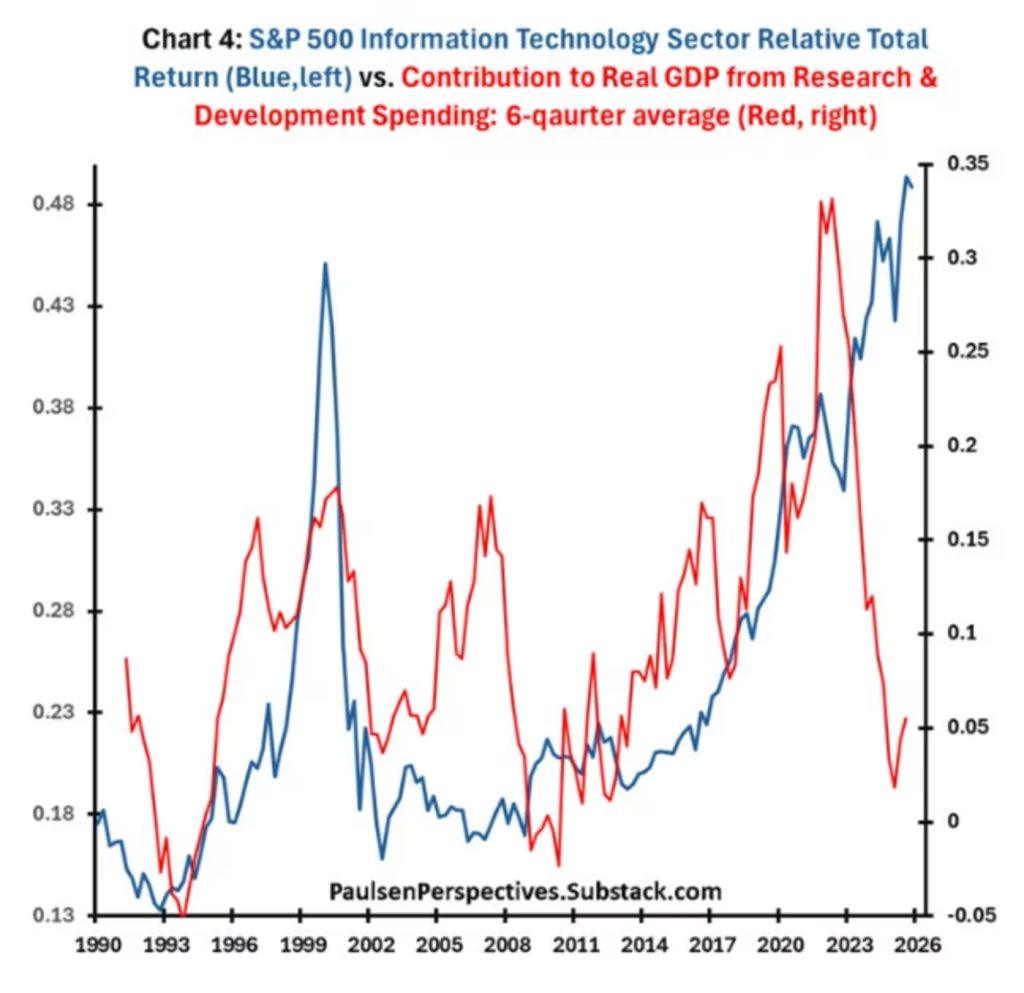
Wall Street veteran warns tech stocks are crowded and at risk of losing leadership U.S. stock futures point to a strong start to the year, with artificial-intelligence names once again driving early gains. But Jim Paulsen argues that technology stocks — what he calls “new era investments” — could lag the broader market in 2026. His concern isn’t just the familiar Big Tech story. While investors remain heavily overweight technology and valuations are stretched, those factors alone have led to only modest pullbacks in exposure so far. Writing in his Paulsen Perspectives blog, Paulsen highlights several lesser-known warning signals that could undermine tech’s dominance. One key risk is that tech stocks may stop outperforming growth in new era spending. Using GDP data, Paulsen tracks investment in information-processing equipment and intellectual property. Historically, tech stock prices have risen faster than this type of economic spending. But three times over the past decade that relationship stalled or reversed — and each instance was followed by a period of significant tech underperformance. Since late September, S&P 500 technology stocks have only kept pace with new era economic spending. “If tech stocks are no longer leading spending growth,” Paulsen asks, “does this point to another stretch of underperformance?” Corporate liquidity is another red flag. Paulsen shows that tech bull markets have been fueled by rising corporate cash levels, measured against nominal GDP. The powerful tech rallies of the 1990s and the post-2014 period both coincided with expanding cash balances. That tailwind may now be fading. The corporate cash-to-GDP ratio peaked at the end of 2024 and has since turned lower. Paulsen expects it to decline further in 2026 as short-term interest rates fall. “When excess cash dries up,” he warns, “the technology boom tends to pause.” Paulsen also sees a connection between tech performance and research-and-development spending. When R&D slipped relative to real GDP in 2022, technology stocks began trailing the broader S&P 500. While that link has weakened since late 2022, he questions whether a renewed slowdown in R&D could again pressure tech shares. Finally, Paulsen cautions that any sustained stumble in tech could trigger a psychological shift among investors, turning yesterday’s winners into tomorrow’s “losers.” Given how crowded the trade has become, such a shift could be painful — and may open the door for value stocks, small and mid-caps, and international markets to outperform. Paulsen stresses he is not calling for a crash. Rather, he believes a growing set of warning signs suggests technology stocks may soon surrender their long-held leadership role. John PaulJohn Paul is the founder of DayTradeToWin, a trading education and software company established in 2008, supporting traders worldwide. His expertise focuses on price action-based futures trading strategies and structured market analysis. DayTradeToWin delivers trading education, indicators, and software tools designed to help traders apply disciplined, rule-based decision-making across global futures markets. He is the creator of multiple trading methodologies, including the Sonic System, Atlas Line, and Trade Scalper, which help traders identify structured opportunities in markets such as the E-mini S&P 500 (ES), Nasdaq (NQ), crude oil (CL), and gold (GC). Official website: https://daytradetowin.com daytradetowin.com
gold
Market News

Gold Dominates 2025 While Crypto Struggles

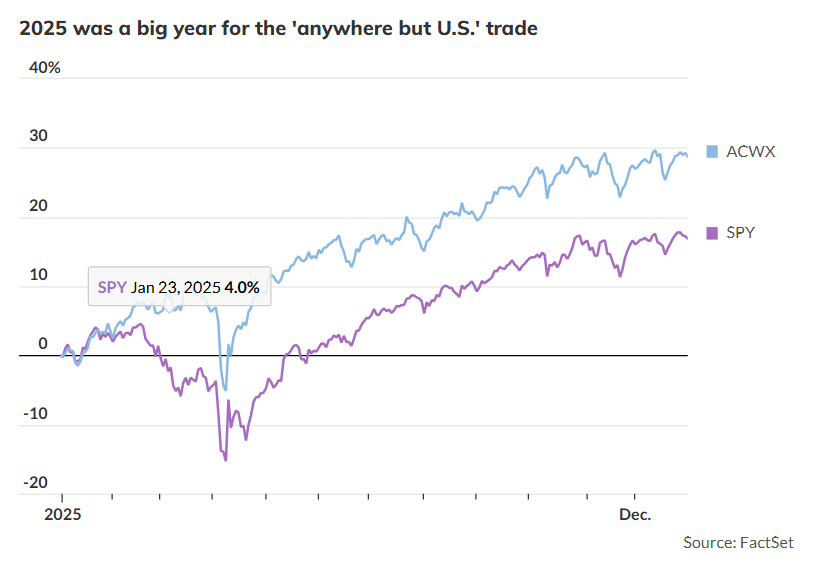
Gold and silver outperformed bitcoin in 2025 as global stocks beat the U.S. For investors around the world, 2025 proved to be anything but predictable. President Donald Trump’s return to the White House rattled global markets, with his aggressive tariff agenda quickly becoming one of the defining market themes of the year. At the same time, the artificial-intelligence boom pushed ahead, with gains spreading far beyond the familiar “Magnificent Seven.” Yet despite the spotlight on crypto and next-generation technology, some of the strongest returns came from assets that have served as stores of value for centuries. “This was supposed to be a year dominated by crypto and a continuation of the AI-driven bull market,” said Steve Sosnick, chief strategist at Interactive Brokers. “Instead, two of the biggest winners were gold — and especially silver — both of which crushed a weak year for crypto and even outpaced double-digit gains in major equity indexes.” Precious metals stole the show The metals market surged in 2025, with sharp swings in silver forcing the Chicago Mercantile Exchange to raise margin requirements twice in one week. Gold, after setting new records, finished the year up 64.4%, while silver skyrocketed 141.4% — their largest annual percentage gains since 1979. Copper also delivered a standout performance, climbing 41.2% for its strongest yearly advance since 2009, according to Dow Jones Market Data. With China’s silver export controls set to begin Jan. 1 and industrial demand for silver and copper expected to remain strong amid the data-center boom, supply constraints are likely to remain a key theme heading into 2026. U.S. stocks staged a historic rebound Trump’s “liberation day” tariffs, announced after the close on April 2, sent the S&P 500 sliding toward bear-market territory as investors feared the tariffs could choke off global growth. Markets reversed course after Trump announced a 90-day pause to allow time for negotiations. By June 27, the S&P 500 reached a new closing high — its first since Feb. 19 — completing the fastest recovery on record following a drop of 15% or more. The index needed just 89 days to reclaim its peak, surpassing the previous record set in 1998. From its April 8 closing low — when it was down 18.9% from its February high — the rally was powerful. By year-end, the Dow Jones Industrial Average was up 27.7% from its low, the Nasdaq Composite had surged 52.2%, and the S&P 500 had climbed 37.4%, marking their strongest recoveries from a yearly low since 2020. Bitcoin failed to live up to expectations 2025 was widely expected to be bitcoin’s breakout year. Trump campaigned as a crypto ally, pushed pro-crypto policies after taking office, and oversaw broader institutional adoption of digital assets. Instead, bitcoin disappointed. After trading above $100,000 early in the year, it plunged during April’s tariff-driven market selloff, falling below $75,000 at its low. Although it later rebounded and hit a record high of $126,184 in early October, those gains quickly faded. Heavy selling by large holders pushed bitcoin into a bear market late in the year. It ended 2025 near $88,000 — roughly 30% below its peak and about 6% lower than where it began the year. The dollar had a rough year Trump’s tariffs and “America First” agenda weighed heavily on the U.S. dollar. The ICE U.S. Dollar Index fell 9.4% in 2025, its worst annual performance since 2017 and one of its weakest years on record. While some analysts argue the dollar could stabilize after the U.S. economy avoided recession, Robin Brooks of the Brookings Institution warned risks remain. “One of the great puzzles of 2025 is that markets largely ignored President Trump’s pressure on the Fed,” Brooks wrote. “As we move closer to 2026, that issue may come back into focus — making me more cautious on the dollar despite growing bullish sentiment.” International stocks outpaced U.S. markets Equities outside the U.S. delivered an exceptional year. Although American markets posted solid gains — with the S&P 500 notching its third straight year of double-digit returns — international stocks outperformed by their widest margin since 2009. The MSCI All Country World ex-USA Index gained 29.3% in 2025, compared with a 16.4% increase for the S&P 500, an outperformance of nearly 13 percentage points. The index is also on track for its best annual performance since 2009. Standout performers included technology shares in Hong Kong, Japan and South Korea, along with European defense contractors and banks. In the end, 2025 delivered a clear takeaway for investors: while crypto and AI dominated headlines, precious metals and international markets ultimately delivered the strongest results. John PaulJohn Paul is the founder of DayTradeToWin, a trading education and software company established in 2008, supporting traders worldwide. His expertise focuses on price action-based futures trading strategies and structured market analysis. DayTradeToWin delivers trading education, indicators, and software tools designed to help traders apply disciplined, rule-based decision-making across global futures markets. He is the creator of multiple trading methodologies, including the Sonic System, Atlas Line, and Trade Scalper, which help traders identify structured opportunities in markets such as the E-mini S&P 500 (ES), Nasdaq (NQ), crude oil (CL), and gold (GC). Official website: https://daytradetowin.com daytradetowin.com

stocks
Market News

U.S. Stock Market Overvaluation vs Non-U.S. Stocks: A Safer Bet?

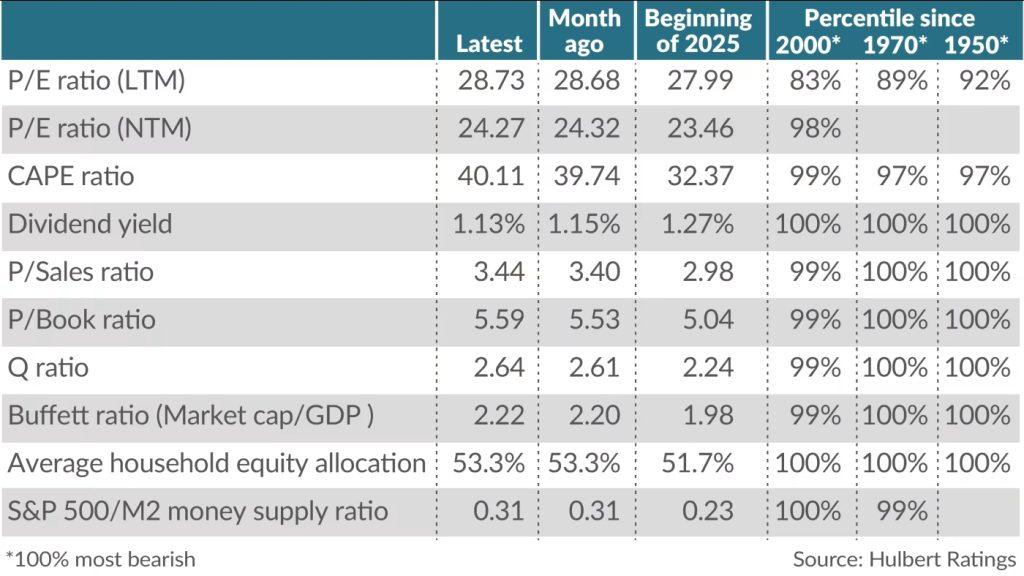
Valuation signals are flashing deep red for U.S. stocks, while non-U.S. markets appear far more attractive. It’s hard to imagine valuation indicators painting a more bearish picture for U.S. equities than they do today. By nearly every measure, U.S. stocks are priced at extreme levels. Meanwhile, non-U.S. stocks have already delivered more than twice the return of the S&P 500 this year, and there’s a compelling case that their strong performance will continue into 2026. For investors who want to stay invested in equities but are increasingly uneasy about lofty U.S. valuations, global markets offer a more appealing alternative. Many U.S. investors may not realize how strong non-U.S. performance has been in 2025, as headlines have been dominated by the “Magnificent Seven” and the AI-driven rally. Yet through Dec. 26, the S&P 500 is up 16.3%, while non-U.S. stocks have surged 33.1%, based on the MSCI All-Country World ex-U.S. index. A weaker U.S. dollar helped fuel some of that outperformance, boosting dollar-based returns for overseas assets. Even so, non-U.S. equities remain significantly cheaper than U.S. stocks after their rally. That valuation gap suggests non-U.S. markets could continue to outperform in 2026, even if the dollar stops falling. The contrast becomes even clearer when looking at cyclically adjusted CAPE ratios, which compare current market levels to the past 10 years of inflation-adjusted earnings. This valuation metric, popularized by economist Robert Shiller, highlights how stretched U.S. equities have become. According to Barclays Indices, the U.S. CAPE ratio is higher than those of roughly two dozen other global markets. On average, those countries trade at just over half the valuation of the U.S. Overvaluation warnings The CAPE ratio is just one of 10 valuation indicators tracked monthly for their ability to forecast long-term, inflation-adjusted returns. Today, all 10 point to the same conclusion: U.S. stocks are extremely overvalued. The latest readings place the average valuation percentile at 98%, meaning the market is more expensive than at nearly any other point in U.S. history. It’s difficult to envision a more cautionary signal. That leaves investors with a critical question: Will U.S. stocks once again defy gravity in 2026, or will far cheaper non-U.S. markets prove to be the safer — and stronger — bet? John PaulJohn Paul is the founder of DayTradeToWin, a trading education and software company established in 2008, supporting traders worldwide. His expertise focuses on price action-based futures trading strategies and structured market analysis. DayTradeToWin delivers trading education, indicators, and software tools designed to help traders apply disciplined, rule-based decision-making across global futures markets. He is the creator of multiple trading methodologies, including the Sonic System, Atlas Line, and Trade Scalper, which help traders identify structured opportunities in markets such as the E-mini S&P 500 (ES), Nasdaq (NQ), crude oil (CL), and gold (GC). Official website: https://daytradetowin.com daytradetowin.com

market
Market News

Why Treasury Yields Are a Red Flag for the Market

Samantha LaDuc: Rising Treasury Yields Could Be a Warning Sign for Stocks in 2026 Samantha LaDuc, founder of LaDucTrading, was among the market strategists who correctly anticipated this year’s S&P 500 trajectory — a sharp selloff followed by a strong rebound. A veteran trader since 2008, LaDuc warned clients in early December 2024 that equities were heading for a “bloodbath,” forecasting a roughly 20% decline in the first half of 2025. Her view was based on tariffs not being priced in and a weakening U.S. dollar. The equity pullback arrived on Liberation Day, while the dollar has yet to recover from its early-year slump. In a recent MarketWatch interview, LaDuc said she turned bullish around April 9, projecting an upside target of “hellbent on 6,666” for the S&P 500. By June, she outlined two potential paths: if the index could reach and hold above 6,100, she saw 7,000 as the next milestone. Sustained strength above 7,000, she said, could ultimately pave the way toward 8,200. The S&P 500 has already moved close to that level, recently topping out at 6,945.77. LaDuc has built a reputation for timely market calls. In 2022, she warned of an impending “tech wreck,” a year that proved difficult for the Nasdaq. In early 2024, she urged investors to stay invested in equities — advice that aligned with a record-setting year for the S&P 500. Looking ahead to 2026, LaDuc expects a challenging but upward-trending market. “My core theme is a recession into all-time highs,” she said. “Stocks can continue to rise even as unemployment increases.” She added that concerns about stagflation are already surfacing within the Federal Open Market Committee. For the S&P 500 to reach 8,200, LaDuc believes two forces must work together. The first is continued enthusiasm around artificial intelligence. With several major AI-related IPOs potentially arriving in 2026 — including OpenAI, SpaceX and Anthropic — she argues it’s difficult to envision a sustained market breakdown. The second factor is a weaker U.S. dollar. “A falling dollar is extremely supportive for inflationary assets and equities,” she said. Combined with AI-driven excitement, LaDuc believes this could fuel a melt-up toward the 8,200 level. She estimates current AI revenues at around $60 billion and says meaningful productivity gains and margin expansion — even if driven by layoffs — would be key to justifying higher equity valuations. That upside, however, could come alongside labor market stress and persistently high inflation. With Wall Street projecting a roughly 16% gain for the S&P 500 by the end of 2026, LaDuc cautions that stocks are “priced for perfection.” In her view, elevated valuations leave little room for macroeconomic shocks. Her biggest concern for equities is rising Treasury yields. LaDuc sees the 10-year yield as a major risk, arguing that higher unemployment and inflation would push yields higher as investors demand greater term premiums. “Rising yields tend to pull capital away from growth assets and into safety,” she said. The key level she’s watching is 4.6%. “If yields reach that level and hold, the move higher likely continues,” she warned. Overall, LaDuc expects 2026 to be a “hold-your-nose” market — one where stocks grind higher but experience pullbacks due to stretched valuations. She also notes that midterm election years are typically supportive for equities, as policymakers prefer to avoid weak markets ahead of elections. Beyond stocks, LaDuc remains bullish on commodities, a stance she’s held since spring 2024. She describes the trend as “phenomenal,” particularly for miners, though she excludes oil. In April 2024, she made the contrarian call that crude would fall from around $80 a barrel into the $60–$40 range, easing energy costs for miners. Her long-term optimism on precious metals is driven by falling energy costs and a weaker U.S. dollar. “The big-picture trend in precious metals isn’t going away,” LaDuc said. “The only thing that would change it is the U.S. government balancing its budget — and the odds of that are slim.” John PaulJohn Paul is the founder of DayTradeToWin, a trading education and software company established in 2008, supporting traders worldwide. His expertise focuses on price action-based futures trading strategies and structured market analysis. DayTradeToWin delivers trading education, indicators, and software tools designed to help traders apply disciplined, rule-based decision-making across global futures markets. He is the creator of multiple trading methodologies, including the Sonic System, Atlas Line, and Trade Scalper, which help traders identify structured opportunities in markets such as the E-mini S&P 500 (ES), Nasdaq (NQ), crude oil (CL), and gold (GC). Official website: https://daytradetowin.com daytradetowin.com

Scroll to Top