
stock market

S&P 500
Market News

S&P 500 Gets a Boost on Trade Optimism

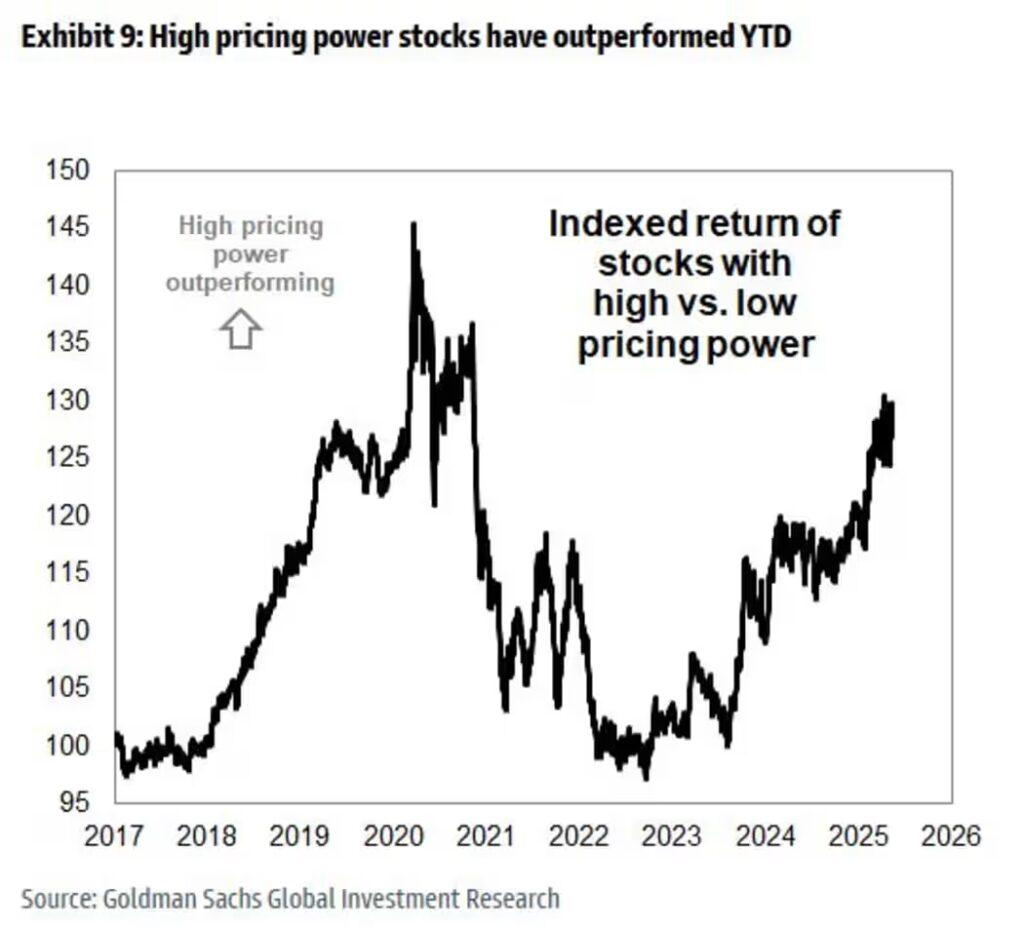
Goldman Sachs: Focus on High-Pricing-Power Stocks Like Meta Amid Upgraded S&P 500 Outlook While markets pause after recent gains fueled by a U.S.-China tariff deal, Wall Street strategists are turning more bullish—led by Goldman Sachs. The investment bank has raised its six-month S&P 500 forecast to 6,100, up from 5,900, citing lower tariff risks, stronger economic growth, and reduced recession odds. On Monday, the index closed at 5,844, inching closer to breakeven for the year. “We’re adjusting our expectations based on improved macro conditions,” said David Kostin, Goldman’s chief U.S. equity strategist. His team is now forecasting earnings per share of $262 for 2025, a 7% annual increase, up from 3% previously. For 2026, earnings are expected to hit $280, also a 7% rise. Goldman also bumped its 12-month forward price-to-earnings multiple to 20.4x, from 19.5x, reflecting “reduced uncertainty, stronger earnings growth, lower inflation, and growing investor confidence in large-cap fundamentals.” Still, Kostin cautioned that ongoing macro risks could affect both valuations and earnings. In a separate update, Goldman’s chief economist Jan Hatzius lowered the firm’s recession odds to 35%, down from 45%, citing a smaller drag on GDP, fewer production delays from tariffs, and a more stable trade outlook. So where should investors look? Kostin recommends stocks with high pricing power—companies that can defend their profit margins even as input costs rise and tariffs remain higher than last year. These firms significantly outperformed during the 2018–2019 trade tensions. Goldman isn’t alone in its optimism. Ed Yardeni of Yardeni Research raised his S&P 500 target to 6,500, cutting his recession probability to 25%. Christopher Harvey at Wells Fargo remains the most bullish strategist on the Street, projecting a year-end 2025 S&P 500 level of 7,007. John PaulJohn Paul is the founder of DayTradeToWin, a trading education and software company established in 2008, supporting traders worldwide. His expertise focuses on price action-based futures trading strategies and structured market analysis. DayTradeToWin delivers trading education, indicators, and software tools designed to help traders apply disciplined, rule-based decision-making across global futures markets. He is the creator of multiple trading methodologies, including the Sonic System, Atlas Line, and Trade Scalper, which help traders identify structured opportunities in markets such as the E-mini S&P 500 (ES), Nasdaq (NQ), crude oil (CL), and gold (GC). Official website: https://daytradetowin.com daytradetowin.com

trade
Market News

Trade Deals Boost This Overlooked Strategy

UBS Highlights 29 “Growth at a Reasonable Price” Stocks Amid Shifting Market Uncertainty Roughly a month after “Liberation Day” and the subsequent flurry of trade tariff announcements, much of the initial drama has subsided. With U.S.–China tariffs largely rolled back, the market’s focus is now shifting from policy uncertainty to uncertainty around the actual outcomes of these changes. In a fresh note, UBS strategists led by Sean Simonds suggest that while tariff details are now clearer, the bigger question is how these policies will impact the economy going forward. “We may have moved past the peak of uncertainty,” they write, “but what lies ahead is policy outcome uncertainty.” UBS based its economic outlook on a hypothetical scenario involving a 10% across-the-board tariff and a 60% tariff on Chinese goods—though the real rates are about half that. Still, with industry-specific tariffs, UBS sees its assumptions as a realistic baseline. Under this model, the firm expects U.S. economic growth to slow from 2% year-over-year in Q1 to just 0.7% by Q4. This uncertain backdrop leads UBS to favor a balanced investment approach: avoid overpaying for overhyped stocks, but don’t shy away from select cyclical growth opportunities. “Elevated but unclear risks support a value tilt, but continued economic momentum into 2026 means maintaining exposure to cyclical growth makes sense,” the team advises. The recommended strategy? Growth at a reasonable price, or GARP. Though GARP strategies like the Invesco S&P 500 GARP ETF have trailed the broader S&P 500 in recent years, UBS believes the environment may now favor a revival of this approach. “Valuations expanded over the last decade while fewer companies consistently delivered growth, making GARP harder. But after the recent valuation reset and ongoing economic transitions, GARP could be due for a comeback.” UBS identified 29 stocks that meet its GARP criteria. These companies, with market caps above $10 billion, trade at an average of 30 times projected 2025 earnings and carry a 19% upside potential according to UBS analysts. The list, generated using the HOLT valuation tool inherited from Credit Suisse, screens for high operational quality (top 50% of the market), strong growth (top 25%), and excludes names that are either value traps or overly expensive. The roster includes familiar names like Broadcom (AVGO) and lesser-known plays like Swiss footwear brand On Holdings (ONON), backed by tennis icon Roger Federer. John PaulJohn Paul is the founder of DayTradeToWin, a trading education and software company established in 2008, supporting traders worldwide. His expertise focuses on price action-based futures trading strategies and structured market analysis. DayTradeToWin delivers trading education, indicators, and software tools designed to help traders apply disciplined, rule-based decision-making across global futures markets. He is the creator of multiple trading methodologies, including the Sonic System, Atlas Line, and Trade Scalper, which help traders identify structured opportunities in markets such as the E-mini S&P 500 (ES), Nasdaq (NQ), crude oil (CL), and gold (GC). Official website: https://daytradetowin.com daytradetowin.com
goldman
Market News

Goldman Sees Trigger for Market Drop

Goldman Sachs: Recession Still a Serious Threat Despite Market Rally The S&P 500 futures have climbed about 18% since hitting a low on April 7, edging closer to a bull market once again. Investors appear to believe the market overreacted to fears surrounding the Trump administration’s trade war, especially after the president paused his proposed “reciprocal” tariffs for 90 days. But Goldman Sachs isn’t convinced the danger has passed. Alec Phillips, Goldman’s chief political economist, cautions that President Trump’s recent remarks on a U.K. trade deal indicate higher tariffs could still be coming for many countries. This, he warns, could pose a lasting economic threat. In a recent podcast titled “On the Precipice of Another Dip?”, Goldman’s chief economist Jan Hatzius and chief global equity strategist Peter Oppenheimer shared a more cautious outlook. Hatzius estimates a 45% chance of a U.S. recession within the next 12 months. While hard data like payrolls remains strong, soft indicators such as consumer and business sentiment have weakened. He explains that hard data often lags behind, especially when trade activity has been pulled forward to avoid tariffs. “There is a very significant risk of a recession,” Hatzius said. He also warned that the Federal Reserve may not respond in time. If the Fed waits for clear signs of inflation or labor market weakness, it may be forced into aggressive rate cuts—possibly up to 200 basis points—once a recession is underway. Oppenheimer added that the recent stock rally was driven by Trump’s easing of tariff threats, solid (though early) corporate earnings, and strong buying from retail investors. But he noted that Q1 earnings don’t yet reflect the impact of recent trade tensions. “If hard data starts to weaken, particularly in the labor market, markets could quickly refocus on recession risks and pull back,” he said. He also highlighted concerns about U.S. equity valuations. With the S&P 500 trading at a price-to-earnings ratio of 20, it isn’t cheap. A 10% drop in earnings, typical during a recession, could drive the market lower—possibly toward 4,600. Adding to the pressure, foreign investors may reduce exposure to U.S. equities as the dominance of large American tech firms declines and the global valuation gap narrows. U.S. stocks currently make up 70% of global market capitalization—a level Goldman believes is unsustainable. On a more positive note, Oppenheimer doesn’t expect a long-lasting structural bear market, which usually follows asset bubbles or deep financial imbalances. Still, he emphasized that in the short term, stocks face a clear downside risk. John PaulJohn Paul is the founder of DayTradeToWin, a trading education and software company established in 2008, supporting traders worldwide. His expertise focuses on price action-based futures trading strategies and structured market analysis. DayTradeToWin delivers trading education, indicators, and software tools designed to help traders apply disciplined, rule-based decision-making across global futures markets. He is the creator of multiple trading methodologies, including the Sonic System, Atlas Line, and Trade Scalper, which help traders identify structured opportunities in markets such as the E-mini S&P 500 (ES), Nasdaq (NQ), crude oil (CL), and gold (GC). Official website: https://daytradetowin.com daytradetowin.com

dollar
Market News

U.S. Dollar on Thin Ice

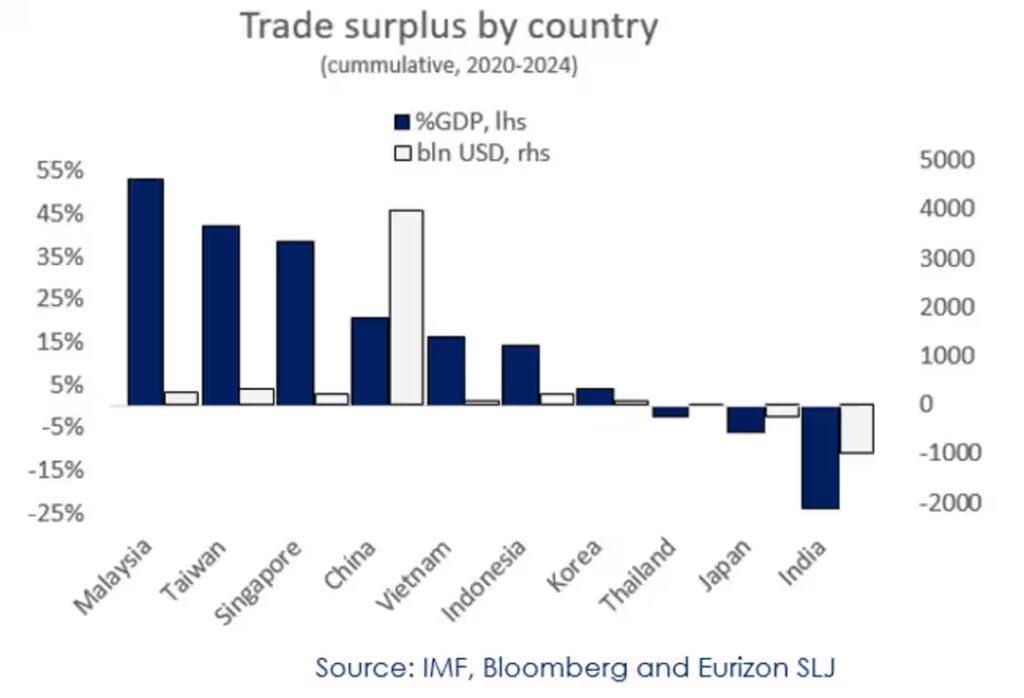
Taiwan Dollar’s Surge May Foreshadow a Sharp Decline in the U.S. Dollar, Analyst Warns A sudden spike in the Taiwan dollar could be an early sign of a much larger, disorderly drop in the U.S. dollar, according to Stephen Jen, CEO and co-CIO of Eurizon SLJ Capital. Jen, a veteran currency strategist, has warned since 2022 of a potential “avalanche”-like selloff in the greenback. In a new report with co-author Joana Freire, he suggests that recent currency movements in Asia — particularly the Taiwan dollar’s surge — may signal that such a scenario is unfolding. “We believe the risk of investors being blindsided by a sudden, non-linear selloff in the dollar is rising,” Jen and Freire wrote. “The Taiwan dollar’s sharp move is one example. We expect others to follow.” Their concern stems from a buildup of over $2.5 trillion in U.S. dollar reserves across key Asian exporters including China, Taiwan, Malaysia, and Vietnam. Much of this capital is held in liquid instruments not reflected in standard investment flow data. If even a portion of these holdings is sold, it could trigger a sharp drop in the dollar’s value. Jen notes that these countries are well aware the dollar is overvalued — a view that could accelerate selling if confidence erodes. Additional risks include a potential rebound in China’s economy and anticipated interest-rate cuts by the Federal Reserve in 2025, which could further weaken the dollar. While the Fed is not expected to cut rates immediately, markets are pricing in 75 basis points of easing next year. At the same time, U.S. dollar reserves held by foreign central banks have been declining for years. A second Trump presidency, with its focus on tariffs and currency policy, could add more pressure on foreign holders to reduce exposure. Jen sees China as the most immediate threat. The People’s Bank of China has so far kept the yuan stable against the dollar, even as the greenback has fallen over 8% this year, according to the ICE U.S. Dollar Index (DXY). But if Beijing allows the yuan to appreciate — possibly in response to U.S. accusations of currency manipulation — it could trigger broader dollar weakness. “The dollar overhang is just too large,” Jen and Freire warned. “If the Fed cuts, the dollar weakens, and China rebounds, the stage is set for an avalanche.” The dollar’s recent 9% drop against the Taiwan dollar — the largest move in that currency pair since at least 2007 — has revived speculation that foreign investors may be reducing their U.S. asset exposure. Other Asian currencies, like the South Korean won, also saw gains. Still, some remain skeptical. Analysts at Barclays argue the Taiwan dollar’s rally is overdone and say large Taiwanese insurers are unlikely to sell dollar assets at a loss, just as they avoided doing so in 2022. Though Treasury yields spiked last week, some economists attribute that to a strong April jobs report rather than foreign selling. However, Deutsche Bank data shows Taiwan-based ETFs recently offloaded U.S. fixed-income assets, hinting that the shift may already be underway. For now, Jen and his team are watching closely — waiting to see whether the dollar’s long-feared avalanche has indeed begun. John PaulJohn Paul is the founder of DayTradeToWin, a trading education and software company established in 2008, supporting traders worldwide. His expertise focuses on price action-based futures trading strategies and structured market analysis. DayTradeToWin delivers trading education, indicators, and software tools designed to help traders apply disciplined, rule-based decision-making across global futures markets. He is the creator of multiple trading methodologies, including the Sonic System, Atlas Line, and Trade Scalper, which help traders identify structured opportunities in markets such as the E-mini S&P 500 (ES), Nasdaq (NQ), crude oil (CL), and gold (GC). Official website: https://daytradetowin.com daytradetowin.com
amd
Market News

AMD’s Move Amid Rising Trade Tensions

AMD Projects Strong Growth in 2025 Despite Economic and Regulatory Pressures Advanced Micro Devices Inc. (AMD) expects strong growth this year, bolstered by its expanding product lineup, even as it navigates a challenging macroeconomic climate and new U.S. export restrictions targeting sales to China. During AMD’s fiscal first-quarter earnings call, CEO Lisa Su said that while the global environment remains “dynamic,” the company is well-positioned to outperform due to the strength of its product portfolio. Su noted that restrictions on the export of its Instinct MI308X accelerators to China are expected to be offset by momentum in its core computing and AI businesses. The company anticipates double-digit revenue growth in 2025, driven by increased market share for its new “Zen 5” Epyc and Ryzen CPUs, as well as its Radeon GPUs. Su also confirmed AMD plans to scale up production of its next-gen Instinct MI350 AI accelerators in the second half of the year. “We see the current environment as a strategic opportunity to further differentiate AMD,” Su said. “Our growing portfolio combines leadership in compute and AI across data centers, PCs, edge, and embedded applications.” AMD reported first-quarter revenue of $7.4 billion—up 36% year-over-year and above the $7.1 billion expected by analysts. Adjusted earnings per share came in at 96 cents, topping Wall Street’s estimate of 94 cents. The company’s stock rose 1.8% in after-hours trading, though it remains down roughly 18% year to date. Data center revenue reached $3.7 billion, a 57% year-over-year increase, driven by strong sales of Epyc CPUs and Instinct GPUs. Su said the company delivered a strong start to 2025, marking the fourth straight quarter of accelerating annual growth. For the current quarter, AMD expects revenue of approximately $7.4 billion, plus or minus $300 million—above the $7.2 billion projected by analysts. However, it anticipates adjusted gross margins of around 43%, factoring in $800 million in charges related to compliance with the new export control rules. Elsewhere, AMD’s client segment posted a 68% jump in revenue to $2.3 billion on strong Ryzen demand, while gaming revenue declined 30% to $647 million due to lower semicustom product sales. John PaulJohn Paul is the founder of DayTradeToWin, a trading education and software company established in 2008, supporting traders worldwide. His expertise focuses on price action-based futures trading strategies and structured market analysis. DayTradeToWin delivers trading education, indicators, and software tools designed to help traders apply disciplined, rule-based decision-making across global futures markets. He is the creator of multiple trading methodologies, including the Sonic System, Atlas Line, and Trade Scalper, which help traders identify structured opportunities in markets such as the E-mini S&P 500 (ES), Nasdaq (NQ), crude oil (CL), and gold (GC). Official website: https://daytradetowin.com daytradetowin.com

market
Market News

Stock Market Rally at Risk After Tariff Reversal

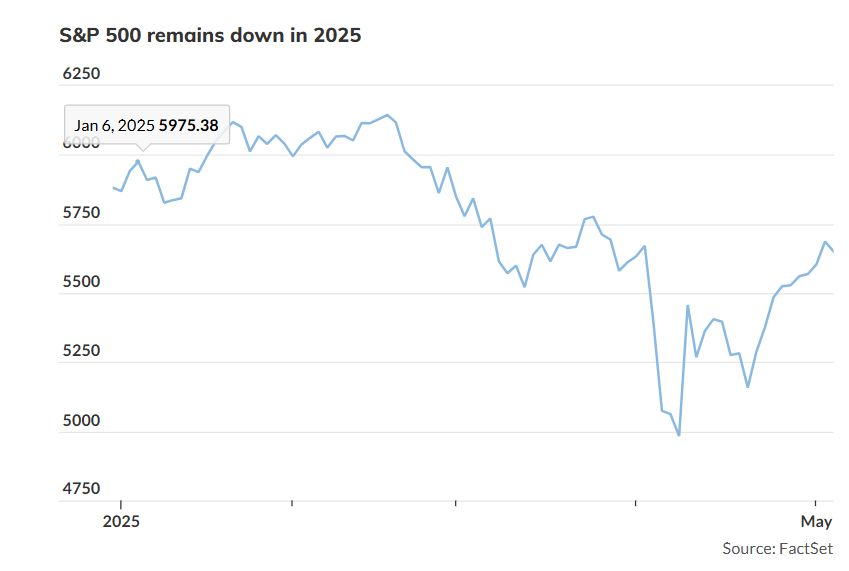
Sevens Report Warns of Potential ‘Sell-the-News’ Market Reaction Amid Trade Optimism The U.S. stock market may struggle to extend recent gains—even if new trade deals are announced—because much of the tariff relief has already been priced in, according to Sevens Report Research. “We could even see a ‘sell-the-news’ move once some trade deals are announced,” warned Tom Essaye, founder of Sevens Report Research, in a note Monday. He noted that the Trump administration has significantly scaled back its sweeping April 2 “liberation day” tariff plan, delaying implementation and exempting key sectors like semiconductors, electronics, pharmaceuticals, and autos. The S&P 500 fell 0.6% on Monday to 5,650.38 after logging a nine-day winning streak, the longest since 2004. But despite the recovery from early April losses, Essaye remains skeptical that current momentum can continue. “The recent developments aren’t enough to push the S&P 500 sustainably higher,” he said, maintaining a target range of 5,100 to 5,500. Investors have closely tracked trade negotiations, concerned that higher tariffs will weigh on growth and raise consumer costs. While easing tensions with China have buoyed sentiment, Essaye cautioned that risks remain. “Tariffs will still be significantly higher than they were at the start of the year, and that’s a headwind,” he said. The S&P 500 has trimmed earlier losses but remains down 3.9% year-to-date after April marked its third straight monthly decline. Broader indexes, including the Nasdaq and Dow, also ended lower on Monday. “Economic data has been solid, but we haven’t felt the real impact of tariffs yet,” Essaye said. “The risk to growth is clearly to the downside.” In this environment, he favors defensive market sectors such as utilities, consumer staples, and healthcare. He also recommends diversification through equal-weighted and low-volatility ETFs, such as the Invesco S&P 500 Equal Weight ETF (RSP), the iShares MSCI USA Min Vol Factor ETF (USMV), and the iShares MSCI USA Quality Factor ETF (QUAL). “While the past month hasn’t been as bad as feared, ‘not as bad’ isn’t the same as good,” Essaye concluded. “Markets may be pricing in more strength than the fundamentals currently support.” John PaulJohn Paul is the founder of DayTradeToWin, a trading education and software company established in 2008, supporting traders worldwide. His expertise focuses on price action-based futures trading strategies and structured market analysis. DayTradeToWin delivers trading education, indicators, and software tools designed to help traders apply disciplined, rule-based decision-making across global futures markets. He is the creator of multiple trading methodologies, including the Sonic System, Atlas Line, and Trade Scalper, which help traders identify structured opportunities in markets such as the E-mini S&P 500 (ES), Nasdaq (NQ), crude oil (CL), and gold (GC). Official website: https://daytradetowin.com daytradetowin.com

Scroll to Top