
stock market

S&P 500
Market News

S&P Hits 6,000, Dow Breaks 44,000 — What’s Next?

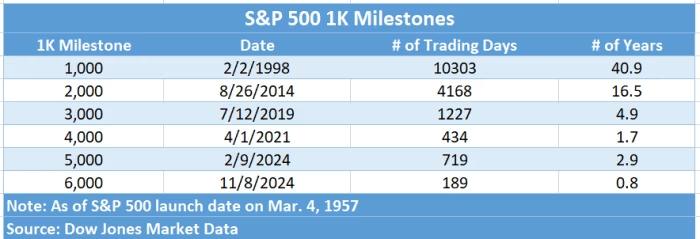
Tony Roth, Chief Investment Officer at Wilmington Trust, projects that the S&P 500 could climb into the mid-6,000s over the next two months, as recent market optimism shows no signs of slowing. On Monday, the S&P 500 closed above 6,000, while the Dow Jones Industrial Average topped 44,000 for the first time. Both indexes are riding the momentum from last week’s rally following Donald Trump’s presidential victory and a 25 basis point rate cut by the Federal Reserve. Clark Geranen, chief market strategist at CalBay Investments, highlighted the S&P’s 6,000 milestone as “a psychologically significant level” that could draw in more investors still holding cash in money-market funds and bonds. He attributes the market’s recent strength to a combination of easing volatility, boosted by a drop in the VIX, and renewed optimism in the economy. On Monday, the S&P 500 gained 5.81 points, or 0.1%, to close at 6,001.35—marking its first close above 6,000. The Dow rose 0.7% to 44,293.13, reaching another historic milestone. According to Dow Jones Market Data, this marks the quickest 1,000-point climb for the index in its history. Leading this surge were stocks like Vistra Corp., Palantir Technologies Inc., Targa Resources Corp., Nvidia Corp., and United Airlines Holdings Inc. The recent rally gained strength after Trump’s return to the White House and prospects of a Republican-led Congress, with the Fed’s rate cut providing an extra boost. The Nasdaq Composite Index also showed resilience, inching up 0.1% on Monday after a strong week of gains. Yet some analysts urge caution. Paul Christopher, head of global investment strategy at Wells Fargo, warns that while the market has latched onto specific policy hopes, these selective reactions may not guarantee lasting gains. He suggests waiting for a clearer picture of the administration’s main policy directions. Bond markets, closed Monday for the Veterans Day holiday, are also on investors’ minds. The 10-year Treasury yield recently ended at 4.307%, raising concerns over inflation and potential impacts of higher borrowing costs on equities. Roth remains bullish in the near term but notes that once Trump takes office, the market will be looking closely at his plans for lowering taxes without excessively increasing deficits. John PaulJohn Paul is the founder of DayTradeToWin, a trading education and software company established in 2008, supporting traders worldwide. His expertise focuses on price action-based futures trading strategies and structured market analysis. DayTradeToWin delivers trading education, indicators, and software tools designed to help traders apply disciplined, rule-based decision-making across global futures markets. He is the creator of multiple trading methodologies, including the Sonic System, Atlas Line, and Trade Scalper, which help traders identify structured opportunities in markets such as the E-mini S&P 500 (ES), Nasdaq (NQ), crude oil (CL), and gold (GC). Official website: https://daytradetowin.com daytradetowin.com
Wall Street
Market News

The Wall Street-Main Street Divide in 2024

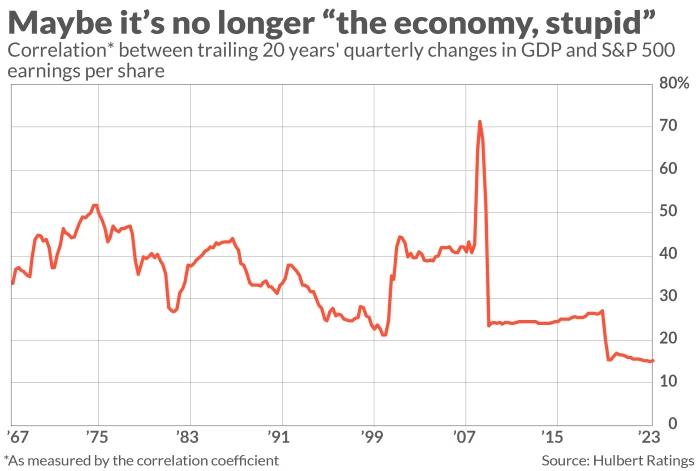
This year’s strong gains in the Dow Jones suggested an advantage for the Democrats and Kamala Harris in the presidential election, but it underscored an important reality: Wall Street and Main Street are drifting further apart. Historically, the stock market has been viewed as a bellwether for election outcomes, but this election proved otherwise, raising the question of why it failed to predict the results. Over recent months, I tracked a model that connected the incumbent party’s chances of staying in office to the Dow Jones Industrial Average’s performance. Leading up to the election, this model gave Vice President Kamala Harris, the Democratic candidate, a 70% likelihood of defeating former President Donald Trump. When models like this one falter, it’s an opportunity to reassess their assumptions. Is this merely an example of a model’s natural limitations? Or does it reflect fundamental shifts in the economy and markets, diminishing the model’s relevance? In retrospect, the breakdown seems to stem from a widening gap between Wall Street’s performance and the realities of the broader economy—often referred to as the Wall Street-Main Street divide. In the past, the Dow was a fairly reliable indicator of the economy’s health and, by extension, voters’ economic sentiment. But that connection has weakened considerably over the years. To highlight this shift, I examined the long-term relationship between quarterly U.S. GDP growth and S&P 500 earnings per share (EPS) going back to 1947, using a 20-year trailing correlation. This correlation, which reached about 40% in the early 1990s, is now just 15%, showing a steady decline, with the only notable exception being the brief alignment during the 2008-09 financial crisis. This declining correlation sheds light on why this year’s stock market surge didn’t translate into stronger support for Harris. While Wall Street rallied, many Americans are still grappling with financial hardships. The implications are clear: traditional economic indicators may be losing their forecasting power, and analysts may need to focus more on company-specific factors rather than broad economic cycles. Vincent Deluard, StoneX’s director of global macro strategy, recently echoed this sentiment, observing that “investors spend far too much time worrying about the next recession. Economic growth is just one small driver of stock prices. Margins and multiples matter a lot more.” In other words, understanding stock performance today may require focusing on the profitability and valuation multiples of companies rather than macroeconomic indicators. This shift doesn’t simplify forecasting; profit margins and price-to-earnings ratios are challenging to project. However, by recognizing the diminishing role of economic growth in market performance, analysts can refocus on these crucial factors driving stock prices in the current economy. John PaulJohn Paul is the founder of DayTradeToWin, a trading education and software company established in 2008, supporting traders worldwide. His expertise focuses on price action-based futures trading strategies and structured market analysis. DayTradeToWin delivers trading education, indicators, and software tools designed to help traders apply disciplined, rule-based decision-making across global futures markets. He is the creator of multiple trading methodologies, including the Sonic System, Atlas Line, and Trade Scalper, which help traders identify structured opportunities in markets such as the E-mini S&P 500 (ES), Nasdaq (NQ), crude oil (CL), and gold (GC). Official website: https://daytradetowin.com daytradetowin.com
S&P 500
Market News

S&P 500 Surge Sparks Bubble Worries on Wall Street

Stifel’s Barry Bannister Warns: “The Train is Approaching Crazy Town” Wall Street bear Barry Bannister cautioned Thursday that the S&P 500 is entering “mania” territory, as surging valuations push stocks to expensive and potentially unstable levels. This rally, he says, may lead to a further near-term surge before a significant pullback looms on the horizon. In a report titled, “This is your conductor … the train is approaching Crazy Town,” Stifel’s chief equity strategist Bannister warns that even under a favorable scenario, where the U.S. achieves a “soft landing,” various factors—such as increased U.S. fiscal spending, China’s economic stimulus, and global geopolitical tensions—are amplifying the risks. These factors are pushing the S&P 500 toward valuation highs unseen in nearly 80 years. With the S&P 500 recently closing above 5,970, Bannister suggests a fair valuation would be closer to 5,250. He argues that the index is overvalued by about five multiples based on the financial conditions index and the cyclically adjusted price-to-earnings (CAPE) ratio. Reflecting on historical “manias,” Bannister believes the S&P 500 could climb into the low 6,000s this quarter before retracing to fair value around 5,250 by early 2026. He’s also closely watching for a possible resurgence in inflation, noting similarities to the late inflationary stages of past periods like 1932-39, 1945-52, and 1967-74. If inflation does rise in a similar pattern, Bannister sees a high-risk period ahead for investors, especially during the final year of Fed Chair Jerome Powell’s term (May 2025 to May 2026). He adds that political pressures around the 2026 U.S. midterm elections could further amplify these risks. Bannister also notes that the S&P 500’s rising price-to-earnings (P/E) ratio, alongside the performance of growth stocks over value stocks, both appear overstretched. “Following recent political shifts, we may see a pullback in growth as fiscal populism, potential reflation, and geopolitical factors come into play,” he says. Historically, defensive stocks have tended to perform well during periods of slowing economic growth. Bannister suggests that the current environment favors “defensive value” sectors, including healthcare, utilities, and consumer staples, along with high-quality stocks. John PaulJohn Paul is the founder of DayTradeToWin, a trading education and software company established in 2008, supporting traders worldwide. His expertise focuses on price action-based futures trading strategies and structured market analysis. DayTradeToWin delivers trading education, indicators, and software tools designed to help traders apply disciplined, rule-based decision-making across global futures markets. He is the creator of multiple trading methodologies, including the Sonic System, Atlas Line, and Trade Scalper, which help traders identify structured opportunities in markets such as the E-mini S&P 500 (ES), Nasdaq (NQ), crude oil (CL), and gold (GC). Official website: https://daytradetowin.com daytradetowin.com
inflation
Market News

Inflation, Rates, and Deficits: Druckenmiller’s Take

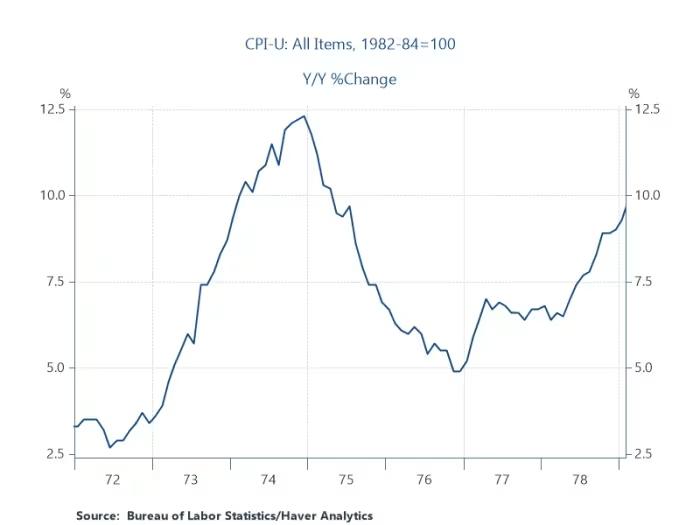
The Fed’s latest interest-rate decision comes on the heels of a historic post-election stock market rally. Reflecting on recent market trends, Druckenmiller, a former top advisor to George Soros and now head of the Duquesne Family Office, shared that while he accurately predicted a decline in inflation, his concerns about an economic downturn were off the mark. Legendary investor Stanley Druckenmiller has projected that if the U.S. faces a major budget deficit issue, it could surface in late 2025 or early 2026. Now, he’s more concerned about inflation’s potential resurgence than about economic weakness. Druckenmiller observed that inflation in the 1970s dropped temporarily before surging again, and with U.S. inflation having peaked in June 2022 before easing, he believes the Fed might be declaring victory too early. With tight credit spreads, record-high gold prices, and a robust stock market, he worries that recent rate cuts could risk another spike in inflation. Commenting on fiscal policy, Druckenmiller warned of an eventual “reckoning” over the growing budget deficit. While the U.S. has avoided a crisis due to the dollar’s status as the global reserve currency, he pointed out that recent policies are even more aggressive than those that triggered bond market volatility in the U.K. For now, refinancing has prevented serious debt issues, but he suggests that as debt rolls over, a fiscal crisis could emerge in the next couple of years if left unaddressed. John PaulJohn Paul is the founder of DayTradeToWin, a trading education and software company established in 2008, supporting traders worldwide. His expertise focuses on price action-based futures trading strategies and structured market analysis. DayTradeToWin delivers trading education, indicators, and software tools designed to help traders apply disciplined, rule-based decision-making across global futures markets. He is the creator of multiple trading methodologies, including the Sonic System, Atlas Line, and Trade Scalper, which help traders identify structured opportunities in markets such as the E-mini S&P 500 (ES), Nasdaq (NQ), crude oil (CL), and gold (GC). Official website: https://daytradetowin.com daytradetowin.com
S&P 500
Market News

Why the S&P 500 Trades at Higher Valuations

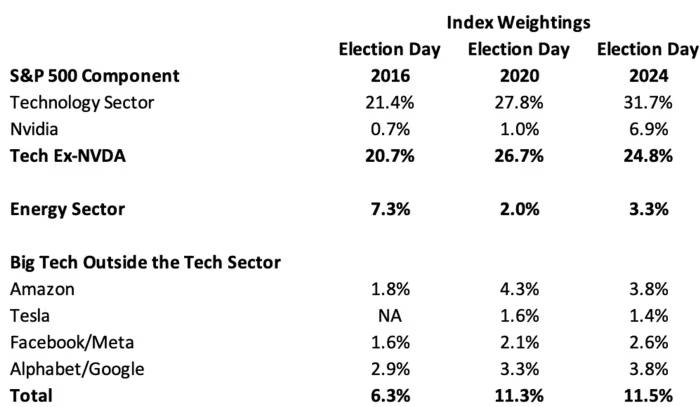
Nicholas Colas, co-founder of DataTrek Research, notes that substantial changes within the S&P 500 over the last four to eight years have led to its high valuation compared to 2016. On Election Day 2024, the S&P 500 rose by 1.2%, boosted by gains in Big Tech stocks like Nvidia, Meta, and Tesla, as voters cast their ballots for the next U.S. president. Colas explained that the S&P 500’s price-to-earnings (P/E) ratio has increased significantly since 2016, though it is now closer to 2020 levels. This rise has been driven by shifts in fiscal and monetary policy and a greater weighting of technology stocks in the index. For example, Nvidia’s weighting in the S&P 500 has surged from 0.7% in 2016 to 6.9%, reflecting its position as a leader in AI. The tech sector now represents 31.7% of the index, up from 21.4% eight years ago. Dominic Rizzo, portfolio manager for the T. Rowe Price Technology ETF, emphasized the critical role that technology and related sectors play in the S&P 500, with Big Tech names like Apple, Microsoft, Amazon, and Meta now accounting for 43.2% of the index, up from 27.7% in 2016. For investors, this high concentration of tech stocks makes valuation a key consideration. DataTrek’s analysis shows that, despite high interest rates, tech valuations remain strong. Colas noted that while many expected tech sector valuations to decline in a rising-rate environment, they have instead expanded more than any other sector, with Nvidia trading at 40 times forward earnings, underscoring the ongoing demand for tech-driven growth. John PaulJohn Paul is the founder of DayTradeToWin, a trading education and software company established in 2008, supporting traders worldwide. His expertise focuses on price action-based futures trading strategies and structured market analysis. DayTradeToWin delivers trading education, indicators, and software tools designed to help traders apply disciplined, rule-based decision-making across global futures markets. He is the creator of multiple trading methodologies, including the Sonic System, Atlas Line, and Trade Scalper, which help traders identify structured opportunities in markets such as the E-mini S&P 500 (ES), Nasdaq (NQ), crude oil (CL), and gold (GC). Official website: https://daytradetowin.com daytradetowin.com

24-Hour Trading
Market News

Why 24-Hour Trading is the Future of Investing

For global investors, 24-hour trading offers a significant advantage — particularly when market-moving events happen outside regular trading hours. In the U.S., stock markets operate on a schedule that suits East Coast traders, opening at 9:30 a.m. and closing at 4 p.m. But for those in different time zones, trading can be less convenient. West Coast traders need an early start, while international investors in Asia, for example, face a more challenging overlap with U.S. hours. To meet the growing demands of investors worldwide, financial institutions have been pushing for expanded trading hours, with some now offering nearly 24-hour access. Advances in technology, combined with the globalization of financial markets, have made it easier to accommodate around-the-clock trading. This concept isn’t new; futures markets in the U.S. have traded almost continuously from Sunday evening to Friday afternoon for years, and commodity markets also offer extensive weekday hours. Cryptocurrencies, meanwhile, have proven the viability of 24/7 trading. Yet, the U.S. stock exchanges still operate within limited hours set back in 1985, offering only some premarket and after-hours trading. This gap is now closing. The New York Stock Exchange recently extended trading on its Arca Exchange, which now operates from 1:30 a.m. to 11:30 p.m. Eastern Time, allowing nearly 22 hours of trading per day. Major brokerages, like Charles Schwab, are also expanding access. Schwab now offers clients the ability to trade all stocks in the S&P 500 and Nasdaq 100 indices, plus hundreds of ETFs, 24 hours a day. Driving this shift is Blue Ocean Technologies, whose alternative trading system (ATS) runs from 8 p.m. to 4 a.m. Eastern, supporting trading during hours that align with the Asian market. Blue Ocean works with over 50 brokerages, including Robinhood and Webull, to serve a growing number of investors looking to trade U.S. stocks in their local daylight hours. The need for resilient, 24-hour trading systems has become more critical as volume surges during major after-hours events. For example, when a surprise move in the yen caused volatility in Asian markets, Blue Ocean’s ATS experienced an intense surge in trades. Recognizing the importance of handling such spikes, Blue Ocean partnered with MEMX exchange to upgrade its system’s capacity, ensuring stability during high-volume events. Investors are increasingly expecting reliable access to the market at all hours, especially in response to impactful events like geopolitical developments or election results. For brokerages, any outage during after-hours trading could damage their reputation, as clients expect the same reliability during extended hours as they do within regular market hours. In today’s interconnected markets, where events in one part of the world affect investors everywhere, the demand for accessible 24-hour trading is only set to rise, making it a valuable tool for investors across the globe. John PaulJohn Paul is the founder of DayTradeToWin, a trading education and software company established in 2008, supporting traders worldwide. His expertise focuses on price action-based futures trading strategies and structured market analysis. DayTradeToWin delivers trading education, indicators, and software tools designed to help traders apply disciplined, rule-based decision-making across global futures markets. He is the creator of multiple trading methodologies, including the Sonic System, Atlas Line, and Trade Scalper, which help traders identify structured opportunities in markets such as the E-mini S&P 500 (ES), Nasdaq (NQ), crude oil (CL), and gold (GC). Official website: https://daytradetowin.com daytradetowin.com

Scroll to Top