
stock market

Market News

AI Frenzy Spells Trouble: Contrarian Investor Sounds Off on Tech Stock Risks

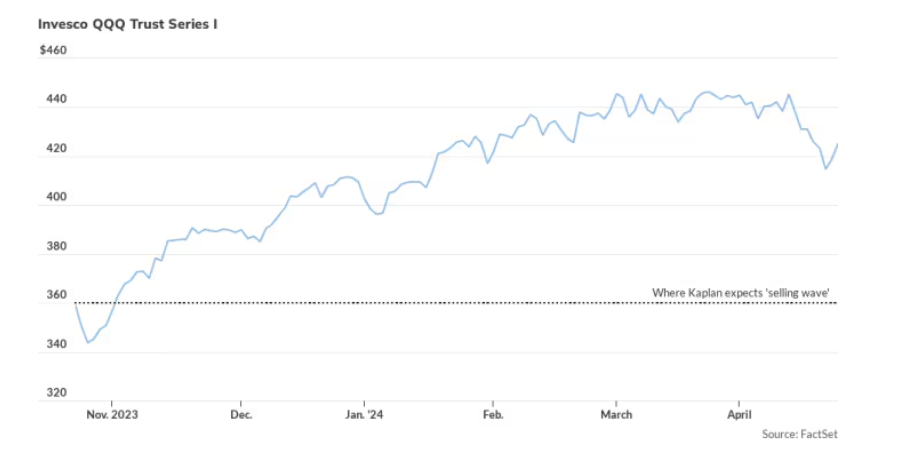
Tech stocks may be gearing up for a comeback, but Steven Jon Kaplan, CEO of True Contrarian blog and newsletter with $120 million under management, warns of a potential repeat of history. He foresees the Invesco QQQ Trust Series, which mirrors the Nasdaq-100, plummeting from its current 427 to below 300 within a year, with even grimmer prospects over three years. Kaplan suggests that the fervor for artificial intelligence (AI) in companies like Microsoft and Apple might not translate into the expected profits. Despite heavy investment in AI chips, returns have been lackluster due to the steep costs of hiring AI engineers and uncertain profitability. He cautions that investors might be overestimating these companies’ worth, drawing parallels to the irrational exuberance of the late 1990s dot-com bubble. Using law firms as an illustration, Kaplan underscores how AI adoption could lead to cost savings for clients but decreased revenues for the firms themselves. He has been betting against the QQQ since February, observing hedge funds’ behavior as they typically follow a pattern of initial enthusiasm followed by significant shorting once assets cool off. Kaplan predicts a substantial selling wave if the QQQ dips to around 360, driven by hedge fund actions. To gauge market sentiment, Kaplan looks for insider buying in tech stocks and significant outflows from U.S. stock funds. He believes that a reversal in these trends could signal a buying opportunity. Meanwhile, he favors “boring” investments like the iShares 20+ Year Treasury Bond ETF, anticipating significant gains due to undervaluation. Additionally, he anticipates a rebound for the Japanese yen, which has been suppressed due to government policies favoring exports, and holds exposure to the Invesco Currency Shares Japanese Yen Trust. John PaulJohn Paul is the founder of DayTradeToWin, a trading education and software company established in 2008, supporting traders worldwide. His expertise focuses on price action-based futures trading strategies and structured market analysis. DayTradeToWin delivers trading education, indicators, and software tools designed to help traders apply disciplined, rule-based decision-making across global futures markets. He is the creator of multiple trading methodologies, including the Sonic System, Atlas Line, and Trade Scalper, which help traders identify structured opportunities in markets such as the E-mini S&P 500 (ES), Nasdaq (NQ), crude oil (CL), and gold (GC). Official website: https://daytradetowin.com daytradetowin.com
Market News

Hold or Sell? Exploring the Case for Keeping Your Stocks

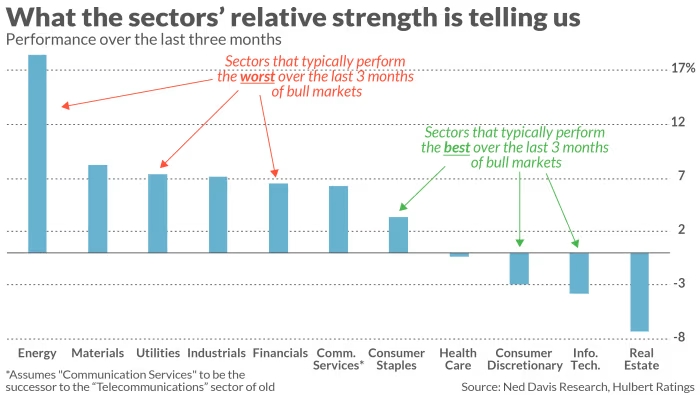
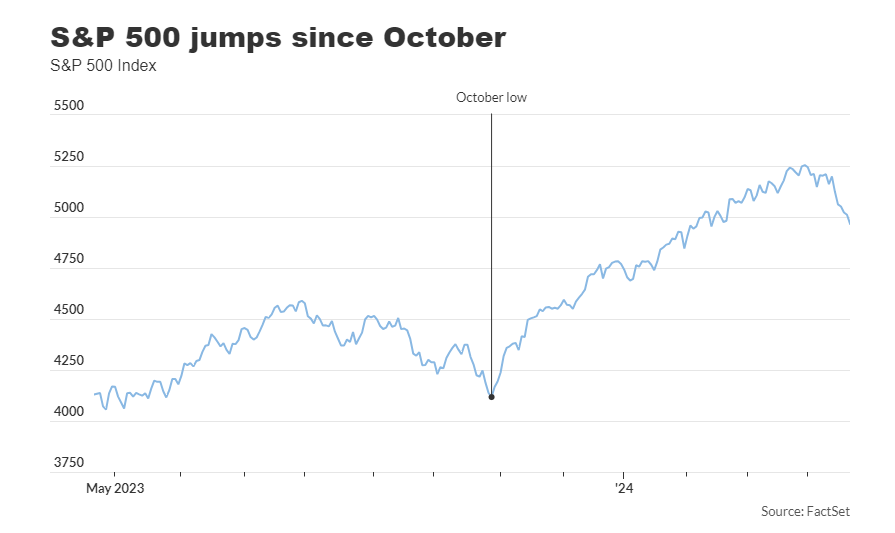
Sectors that typically experience a surge towards the end of bull markets are currently showing signs of lagging behind. Despite a week of volatile trading sessions, the primary trend in the U.S. stock market remains upward. This conclusion is supported by the sector relative-strength rankings, which have remained positive despite recent market fluctuations. My optimistic outlook is based on an analysis of sector performance during the final stages of bull markets. However, recent market behavior deviates from historical norms: sectors that usually thrive in the late stages of bull markets are struggling, while traditionally weaker sectors are unexpectedly leading the pack. This deviation is evident in the accompanying chart, which highlights the disparity between recent sector relative-strength and historical trends. While this doesn’t conclusively confirm the continuation of the bull market, it suggests that dismissing it prematurely may be unwise. The recent rally in the S&P 500 at the beginning of this week indicates that many investors share this sentiment, despite six consecutive sessions of decline last week. Twice within the past year, I’ve assessed the market using sector relative-strength rankings. In early April 2023, amidst widespread skepticism toward the nascent bull market, I contended that the rankings signaled the emergence of a new bull market rather than a correction in a bear market. Since then, the S&P 500 has surged by over 22% on a total-return basis. Similarly, in mid-August 2023, when the S&P 500 was 5% below its recent peak, I argued against interpreting the weakness as the end of the bull market. Since then, the S&P 500 has risen by 15% on a total-return basis. To gauge the extent of the current deviation from the historical pattern for bull market endings, it’s instructive to examine the rank correlation coefficient between the two. This statistic, ranging from a theoretical maximum of 1.0 (indicating identical rankings) to minus-1.0 (indicating perfect inverse rankings), currently stands at minus-0.70, one of the lowest readings in recent decades. In contrast, last August, the correlation coefficient was minus-0.01, and in April 2023, it was plus-0.31. Evidently, sector relative-strength readings are increasingly diverging from the typical pattern observed at the end of bull markets. In summary, premature reports of the bull market’s demise may be unwarranted. John PaulJohn Paul is the founder of DayTradeToWin, a trading education and software company established in 2008, supporting traders worldwide. His expertise focuses on price action-based futures trading strategies and structured market analysis. DayTradeToWin delivers trading education, indicators, and software tools designed to help traders apply disciplined, rule-based decision-making across global futures markets. He is the creator of multiple trading methodologies, including the Sonic System, Atlas Line, and Trade Scalper, which help traders identify structured opportunities in markets such as the E-mini S&P 500 (ES), Nasdaq (NQ), crude oil (CL), and gold (GC). Official website: https://daytradetowin.com daytradetowin.com
Market News

Inflation Jitters Shake Markets: S&P 500 Braces for Worst Month in Years

Bob Elliott, Chief Investment Officer at Unlimited Funds, underscores the Federal Reserve’s challenge amid the recent surge in commodity prices. Bond yields have risen sharply this month, reflecting concerns about persistent inflationary pressures amidst a thriving economy. This development marks a notable setback for the prevailing bullish trend in the U.S. stock market. The S&P 500 is presently witnessing its most significant monthly decline since December 2022, with April’s downturn eroding nearly half of the gains amassed earlier in the year. Despite this setback, the index remains within 5.5% of its record high achieved on March 28. Elliott observes that while investors accurately assessed the robustness of U.S. economic growth, the challenge lies in the fact that this optimism is already priced into stock valuations. Consequently, bond yields are catching up, leading to market disruptions. The recent uptick in Treasury bond yields, especially in April, has unsettled U.S. stocks. However, Elliott suggests that these long-term rates may need to ascend further to moderate demand within the economy. Only then will the Federal Reserve feel sufficiently assured that inflation is trending towards its 2% target. Elliott notes that current financial conditions favor ongoing economic expansion, with robust indicators pointing towards strong first-quarter GDP growth. Despite the Fed’s efforts to curb inflation through monetary tightening, the economy has demonstrated resilience. Looking ahead, investors await the Bureau of Economic Analysis’ estimation of first-quarter GDP growth, scheduled for release on April 25. Recent data, including low initial jobless claims, indicate a stable labor market and sustained economic growth. However, concerns linger regarding inflation, driven by the surge in commodity prices. This encompasses notable increases in industrial metals, precious metals, agricultural commodities, and oil. The impact of escalating oil prices on consumer gasoline costs underscores broader economic implications. Traders in the federal-funds futures market anticipate potential rate cuts by the Fed, albeit with moderated expectations compared to earlier in the year. The prevailing macroeconomic data suggests limited Fed intervention, unless significant disinflationary pressures or adverse labor market conditions emerge. Despite recent declines, the stock market remains prone to volatility, particularly in the technology sector, as evidenced by the Nasdaq Composite’s prolonged losing streak. Overall, the market landscape underscores a delicate balance between economic growth, inflationary pressures, and monetary policy considerations. John PaulJohn Paul is the founder of DayTradeToWin, a trading education and software company established in 2008, supporting traders worldwide. His expertise focuses on price action-based futures trading strategies and structured market analysis. DayTradeToWin delivers trading education, indicators, and software tools designed to help traders apply disciplined, rule-based decision-making across global futures markets. He is the creator of multiple trading methodologies, including the Sonic System, Atlas Line, and Trade Scalper, which help traders identify structured opportunities in markets such as the E-mini S&P 500 (ES), Nasdaq (NQ), crude oil (CL), and gold (GC). Official website: https://daytradetowin.com daytradetowin.com
Market News

Market-Cap Disaster: Nvidia’s Stock Plunge Sets Record for ‘Magnificent Seven’ Losses

This week witnessed a dramatic downturn in the market values of the top-tier tech companies, known as the “Magnificent Seven,” collectively shedding a staggering $950 billion. Among them, Nvidia bore the brunt, losing almost $300 billion, a figure exceeding the entire market worth of its rival, Advanced Micro Devices Inc. Nvidia’s stock took a significant hit, dropping 13.6% over the week, marking its worst performance since September 2, 2022. The semiconductor sector, in which Nvidia operates, faced notable pressure, intensifying Nvidia’s losses. Analyst Jordan Klein from Mizuho highlighted a broader trend of sectoral unwinding over the past week. Notably, other tech giants like Apple and Microsoft also experienced substantial market cap declines of $178 billion and $169 billion, respectively. This downturn was not unique to Nvidia, as the entire Magnificent Seven saw their stock prices decline throughout the week, with Tesla leading the decline at 14%. Tesla, in particular, suffered a notable setback, losing $76 billion in market cap, leading to a slip in its rank among the largest U.S. companies. Additionally, Amazon, Alphabet, and Meta Platforms also faced significant declines in their market values, contributing to the overall downturn. The cumulative losses experienced by the Magnificent Seven this week far exceeded the previous record set in January 2022, indicating the severity of the market turbulence. John PaulJohn Paul is the founder of DayTradeToWin, a trading education and software company established in 2008, supporting traders worldwide. His expertise focuses on price action-based futures trading strategies and structured market analysis. DayTradeToWin delivers trading education, indicators, and software tools designed to help traders apply disciplined, rule-based decision-making across global futures markets. He is the creator of multiple trading methodologies, including the Sonic System, Atlas Line, and Trade Scalper, which help traders identify structured opportunities in markets such as the E-mini S&P 500 (ES), Nasdaq (NQ), crude oil (CL), and gold (GC). Official website: https://daytradetowin.com daytradetowin.com

Market News

On the Horizon: Five Reasons to Believe the Stock Market’s ‘Painful’ Retreat Is Coming to a Close

The performance of U.S. stocks lately isn’t exactly flattering. Despite starting strong, they consistently close lower, sending concerning signals about the overall market health. Thursday marked the fourth consecutive session where the S&P 500 experienced this reversal trend, the longest such streak in six years, indicating significant underlying issues despite recent rallies. Even amidst Friday’s early downturn in stock index futures following geopolitical tensions between Israel and Iran, there’s a silver lining: the S&P 500 seems poised to open in the red. Nevertheless, the prevailing sentiment is undeniably pessimistic. Since reaching its peak close on March 28, the S&P 500 has declined by 4.63%, while the Nasdaq Composite, dominated by tech stocks, has seen a 5.11% drop in just five sessions, marking its most significant five-day percentage decline since December 2022. What traders could really use right now is some optimism to uplift their spirits. Enter Tom Lee, Fundstrat’s head of research, who has a track record of accurately predicting market surges. Lee acknowledges the recent bleak market activity, attributing it to a painful deleveraging process exacerbated by concerns over persistent U.S. inflation and geopolitical tensions. Despite the gloom, Lee identifies five reasons why investor deleveraging might be nearing its end: Lee acknowledges the potential risks posed by escalating conflicts, such as the recent tensions between Israel and Iran, which could adversely impact equities and other cyclical assets. However, he maintains that the fundamental case for stocks in 2024 remains robust, supported by improving earnings and a substantial amount of sidelined cash, totaling $6 trillion. John PaulJohn Paul is the founder of DayTradeToWin, a trading education and software company established in 2008, supporting traders worldwide. His expertise focuses on price action-based futures trading strategies and structured market analysis. DayTradeToWin delivers trading education, indicators, and software tools designed to help traders apply disciplined, rule-based decision-making across global futures markets. He is the creator of multiple trading methodologies, including the Sonic System, Atlas Line, and Trade Scalper, which help traders identify structured opportunities in markets such as the E-mini S&P 500 (ES), Nasdaq (NQ), crude oil (CL), and gold (GC). Official website: https://daytradetowin.com daytradetowin.com

Market News

Rising Tide: Wall Street’s ‘Fear Gauge’ Surges Amidst Market Volatility Revival

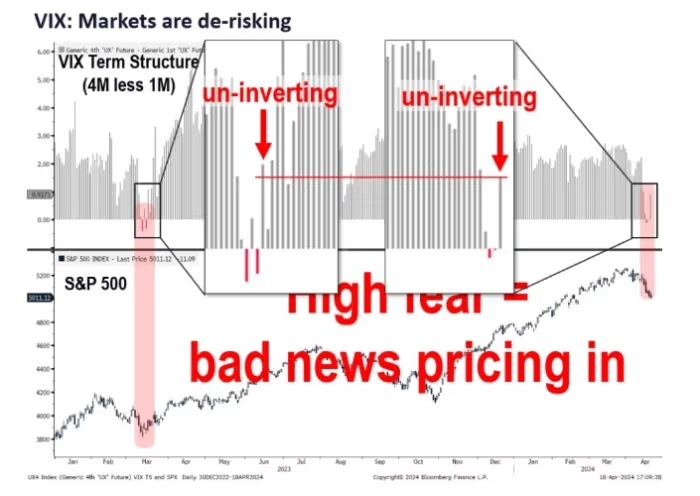
Over the past week, there has been a significant increase in implied volatility across stocks, bonds, and currencies, marking a departure from the previous period of relative calmness. For instance, the Cboe Volatility Index (VIX), often seen as Wall Street’s “fear gauge,” surged to 19.56 on Tuesday, reaching its highest level since October 31st. This was accompanied by notable upticks in volatility indicators tracking options linked to Treasury bonds and major G-10 currencies. The ICE BofAML MOVE Index, which measures implied volatility in Treasurys, rose by over 40% since March 27th to hit 121.15 on Monday, its highest level since January 3rd. This surge in volatility reflects increasing uncertainty among investors regarding potential interest-rate adjustments by the Federal Reserve. Federal Reserve Chair Jerome Powell’s recent comments hinting at a pause in rate cuts have added to market jitters. Traders now anticipate preemptive actions from entities like the European Central Bank, which could lead to higher Treasury yields and strengthen the U.S. dollar throughout April. The rising dollar has also pushed the JPMorgan G-7 Volatility Index to its highest level since January, signaling increased fluctuations in major currency pairs. Previously, the market appeared calm, but some analysts noted signs of complacency. Unexpected events triggered significant market reactions, contrary to the prevailing tranquility. To manage the risks associated with heightened volatility, traders are increasingly turning to options-market hedges. Demand for such hedges has surged across various asset classes and currency pairs. Notably, VIX-linked option contracts saw substantial trading activity, particularly VIX options, which experienced their busiest day in over six years. Traders are actively seeking protection against sharp declines in stock prices through VIX-linked calls. The increase in bond market volatility also raises concerns about the outlook for equities. Higher bond volatility typically signals an unfavorable environment for stocks. Additionally, fluctuations in credit spreads, especially on high-yield bonds, tend to correlate with movements in the VIX, potentially indicating future declines in the stock market. Currently, U.S. stocks show mixed trading patterns, with the S&P 500 and Nasdaq Composite facing the possibility of a fourth consecutive day of losses, while the Dow Jones Industrial Average looks set to finish higher. Meanwhile, Treasury yields have decreased, and the U.S. dollar index has retraced slightly from its recent peak. John PaulJohn Paul is the founder of DayTradeToWin, a trading education and software company established in 2008, supporting traders worldwide. His expertise focuses on price action-based futures trading strategies and structured market analysis. DayTradeToWin delivers trading education, indicators, and software tools designed to help traders apply disciplined, rule-based decision-making across global futures markets. He is the creator of multiple trading methodologies, including the Sonic System, Atlas Line, and Trade Scalper, which help traders identify structured opportunities in markets such as the E-mini S&P 500 (ES), Nasdaq (NQ), crude oil (CL), and gold (GC). Official website: https://daytradetowin.com daytradetowin.com

Scroll to Top