
stock trading

trading
Market News

First Hour Trading Tactics: How to Make the Most of the Opening Bell

Economic conditions are proving to be difficult, with stocks facing substantial volatility and ongoing inflation. However, some economists argue that these tumultuous times can present new opportunities and risks for investors. What’s happening: The global economy is in a constant state of flux. The labor market has shown remarkable resilience, but other economic indicators, such as spending and manufacturing, show weakness. Additionally, unrest in Russia can trigger another inflation surge if its extensive commodity exports are disrupted. Earlier this year, central banks appeared to be pausing or winding down their year-long series of painful, inflation-fighting rate hikes. However, policymakers have recently shifted their stance, warning investors that more challenges are ahead. US stocks have managed to bounce back from their recent bear market and enter bull territory. However, analysts remain unsure whether this is a disguised bear market, as markets ended last week significantly lower, breaking a multi-week winning streak. Indrani De, head of global investment research at FTSE Russell, believes investors have valid reasons for optimism, as macroeconomic indicators suggest a renewed appetite for risk. Before the Bell: Inflation and Bond Yields Indrani De: Inflation is still high, but the key factor is its trajectory, which is moving toward disinflation. Different countries are at various stages in their inflation journeys, leading to significant dispersion between asset classes and countries. This requires investors to be more selective. Resilient economic growth in the US has resulted in higher earnings forecasts. Stocks have performed particularly well since the US dollar weakened from its recent highs in the last quarter of 2022. A weak dollar is beneficial for risky assets and large-cap stocks. The market tends to focus on short-term policy rates, but the 10-year Treasury yield is more important for equities and other risk assets. This rate peaked in early 2022 and has since decreased and stabilized, which has supported tech stock growth. Artificial Intelligence and Market Froth Optimism is not only driven by cyclical factors like better-than-expected GDP and upward corporate earnings revisions. There is genuine hope that artificial intelligence (AI) could lead to a structural upgrade in economic growth prospects, akin to the 1990s when internet stocks sparked growth in the tech sector and eventually impacted the entire economy. AI has the potential to boost productivity and economic growth significantly. However, if the rally remains concentrated solely in technology, it could be riskier, as no single industry can grow indefinitely in the stock market. Potential Worries for Markets While there are reasons for optimism, it’s crucial not to underestimate the remaining stock risks. Valuations may have outpaced growth improvement prospects, and there are other economic risks, such as a slowing manufacturing purchasing managers’ index and tightening bank lending standards. The macroeconomic picture is mixed, but optimism drives US equity markets higher. Looking Ahead: The Third Quarter Predicting market performance is challenging, but analysts and companies continue to make forecasts. For the third quarter, analysts are most optimistic about the Energy, Communications Services, and Information Technology sectors, while they are most pessimistic about the Consumer Staples sector. In conclusion, although the current economic landscape presents challenges, there are also opportunities for investors who can navigate the risks and find growth potential in various sectors. John PaulJohn Paul is the founder of DayTradeToWin, a trading education and software company established in 2008, supporting traders worldwide. His expertise focuses on price action-based futures trading strategies and structured market analysis. DayTradeToWin delivers trading education, indicators, and software tools designed to help traders apply disciplined, rule-based decision-making across global futures markets. He is the creator of multiple trading methodologies, including the Sonic System, Atlas Line, and Trade Scalper, which help traders identify structured opportunities in markets such as the E-mini S&P 500 (ES), Nasdaq (NQ), crude oil (CL), and gold (GC). Official website: https://daytradetowin.com daytradetowin.com


federal
Market News

Investors Brace for Impact: Fed Hints at Further Interest Rate Increases

The S&P 500 fell in value over the course of the week following Jerome Powell’s testimony to Congress in which he revealed that all members of the Federal Open Market Committee had reached a consensus regarding the intention to increase interest rates before the year’s end. In the general market gauge, June saw a significant decrease, which brought an end to several weeks of strong performance. Other indexes, such as the Dow Jones and Nasdaq Composite, also struggled during the week, with the former dropping by 2% and the latter experiencing a drop of over 2.6% by the end of the week. During the past five days of trading until June 21st, the technology sector encountered a loss of 2 billion dollars, marking the largest reduction within the last 10 weeks. After the Federal Open Market Committee’s decision to stop increasing interest rates in March 2022, investors from various fields felt positive. Although Powell’s remarks were met with disappointment, the optimism continued among investors. It is expected that central banks all over the world will raise interest rates once more due to the continuation of inflation in various economies. Narendra Modi, the leader of India, being in Washington, D.C., was a noteworthy occurrence as the Biden administration gave him tremendous attention. President Biden highlighted the importance of the relationship between the United States and India, which is expected to be essential for this century, as India aims to establish its position as one of the world’s most influential financial and military powers. During the earnings call of FedEx Corp., there were mixed reactions regarding the news that the company’s revenue for the fourth quarter decreased by 10.2% or $21.9 billion, falling short of the analysts’ predicted revenue of $22.7 billion. Nevertheless, the company surpassed the estimated earnings per share of $4.89 by achieving $4.94 per share. Remember Bitcoin? The digital currency grew substantially, with a weekly increment of around 20% until Friday. It went beyond the $30,000 mark, reaching $31,200 after various financial organizations revealed new cryptocurrency initiatives. What’s next The forthcoming report on New Home Sales will give an understanding of the state of the housing market in May, whereas the Personal Consumption Expenditures index, due on Thursday, will provide a view of the inflation measure that the Federal Reserve is inclined towards. Walgreens, a company specializing in pharmaceuticals, is scheduled to disclose its profits on Tuesday. The following day, Micron Technologies, a manufacturer of semiconductor chips, and General Mills, a dominant player in the food sector, will also divulge their financial outcomes. On Thursday, Nike, an industry leader in sportswear, will reveal their earnings. Lastly, on Friday, Constellation Brands, a major producer of beverages, will report its financial standing. John PaulJohn Paul is the founder of DayTradeToWin, a trading education and software company established in 2008, supporting traders worldwide. His expertise focuses on price action-based futures trading strategies and structured market analysis. DayTradeToWin delivers trading education, indicators, and software tools designed to help traders apply disciplined, rule-based decision-making across global futures markets. He is the creator of multiple trading methodologies, including the Sonic System, Atlas Line, and Trade Scalper, which help traders identify structured opportunities in markets such as the E-mini S&P 500 (ES), Nasdaq (NQ), crude oil (CL), and gold (GC). Official website: https://daytradetowin.com daytradetowin.com

wall climbing
Market News

Stock Investors’ Wall of Worry: A Surprising Catalyst for the Emergence of a New Bull Market

The most recent data regarding money movement within mutual funds indicates a positive stock trend. However, it harms bonds. By only considering the information provided, your resulting conclusion would differ. According to EPFR-TrimTabs, American equity funds (both open-end and exchange-traded) have experienced a total net outflow of $86.5 billion in the current year. Conversely, U.S. bond funds have gained a total of $169.9 billion in investments. When analyzing fund flows, it is essential to take a contrarian approach. This idea is demonstrated in the provided chart, which shows that despite the stock market‘s positive performance from 2016 to 2020, U.S. equity funds had net outflows every year during this period. Nonetheless, things changed in 2021 when there was a switch to inflows, which came just in time for the 2022 bear market. Bond funds showed some behavior that went against the norm. They experienced significant amounts of money coming in during 2021, which was the highest in quite some time. Nonetheless, during 2022, they faced a significant decrease in the market, which was one of the worst in a long time or even ever before. The relationship between the performance of a fund and the movement of money in or out of it is not always clear-cut. Sometimes the connection is immediate, while other times it takes longer to become apparent. Thus, using monetary data to predict market timing over a long period may not be straightforward. However, as a general rule, when a large amount of money flows into a fund, the returns are usually average or even negative, while significant outflows often lead to decent returns, if not better than expected. Scholars have analyzed the relationship between exchange-traded funds (ETFs) and fund flow. In a study published in the Review of Finance two years ago, it was found that ETFs that experience substantial outflows usually perform better than ETFs with large inflows for up to a year after these notable fund movements. In an interview, Matthew Ringgenberg, a finance professor at the University of Utah and co-author of the research, explained the likely sequence of events that led to inadequate performance. He suggested that when ETFs become saturated with investors, particularly those in retail, the price exceeds the net asset value of its underlying stocks. To rectify this, certain market facilitators called authorized participants to create new ETF shares and eliminate the excess value. During the previous summer, a report was published in the Review of Financial Studies that found an explanation for poor performance; it could be due to investors being too excited about the most popular funds and ETFs. The report showed that ETFs that are created to cater to specific investor trends often receive a substantial amount of investment shortly after their launch but underperform compared to the market’s risk-adjusted returns by 5% yearly over five years after launch. In recent times, investors have shown a keen interest in artificial intelligence, which is evident from a recent trend. A study published in Finance Research Letters indicates that there was better stock performance when the ETF featured the acronym “AI.” This trend is similar to the internet bubble in the late 1990s, where adding “dot com” to a company’s name improved its stock performance. This research reveals a crucial concept that contradicts common perceptions, which Warren Buffett expressed as “being careful when others are being reckless, and being reckless when others are being careful.” Recent information on investment funds suggests that most people investing in the stock market are currently being more careful than adventurous. This is evident because, even though the S&P 500 has grown by an impressive 15% in 2023, investors have generally taken their money from U.S. equity funds. Taking a broad perspective, this is particularly good news. If regular investors had eagerly participated in the positive trend, those who are opposed to it would have more reason to worry about the sustainability of this new upward trend in the stock market. Nonetheless, the fact that they haven’t done so implies that there is a substantial amount of prudent hopefulness supporting this optimistic market. John PaulJohn Paul is the founder of DayTradeToWin, a trading education and software company established in 2008, supporting traders worldwide. His expertise focuses on price action-based futures trading strategies and structured market analysis. DayTradeToWin delivers trading education, indicators, and software tools designed to help traders apply disciplined, rule-based decision-making across global futures markets. He is the creator of multiple trading methodologies, including the Sonic System, Atlas Line, and Trade Scalper, which help traders identify structured opportunities in markets such as the E-mini S&P 500 (ES), Nasdaq (NQ), crude oil (CL), and gold (GC). Official website: https://daytradetowin.com daytradetowin.com

Bull Market
Market News

Stock-Market Rally Resilience: Uncovering Signs of Stability for Investors Even with S&P 500 Downturns

The S&P 500 index is predicted to have a third day of falling based on information from FactSet. This is the index’s first series of losses since May 4th, but it does not suggest its profitable trajectory is over. Instead, it is probable that the trend is just starting to rise. According to Steve Suttmeier, a technical research strategist at BofA Global Research, if the stock market’s large-cap gauge stays above 4,200 (a resistance level observed between August and June), even minor drops will not harm the bullish trend. An individual sent a message to MarketWatch on Wednesday, stating that maintaining the 4300 to 4200 levels during brief declines would result in a beneficial breakthrough and a pattern of reassessment. If the index drops below 4,200, it could find backing at approximately 4,100 or 4,050. New information from FactSet indicates that the bearish market trend for the S&P 500 has ended, since it finished the year with a 20% higher closing number of 3,577.03 on October 12th. The index has seen significant growth of nearly 14% at the onset of the year, largely attributed to the exceptional performance of select prominent technology stocks. However, of late, the upward trend has expanded to include a more extensive range of stocks. According to Suttmeier, improvements made to the moving averages demonstrated on price charts and the development of a favorable “bullish cup-and-handle-pattern” signal that the S&P 500 has begun a bullish breakout phase that expects additional expansion. It is feasible that the S&P 500 may exceed 4,500 in the upcoming rally, which marks a significant advancement. Until recently, even the most hopeful economic experts had projected that the S&P 500 would only reach 4,500 or more by the conclusion of 2023. FactSet information shows that the S&P 500, Nasdaq Composite, and Dow Jones Industrial Average are predicted to undergo drops on Wednesday. Specifically, the S&P 500 is anticipated to drop by 0.3%, the Nasdaq Composite by 0.8%, and the Dow Jones Industrial Average by 0.1%. This is mainly due to Jerome Powell, the Fed Chair, announcing the possibility of two additional interest rate increases this year. Based on FactSet data, all three indexes are expected to experience losses for the week. John PaulJohn Paul is the founder of DayTradeToWin, a trading education and software company established in 2008, supporting traders worldwide. His expertise focuses on price action-based futures trading strategies and structured market analysis. DayTradeToWin delivers trading education, indicators, and software tools designed to help traders apply disciplined, rule-based decision-making across global futures markets. He is the creator of multiple trading methodologies, including the Sonic System, Atlas Line, and Trade Scalper, which help traders identify structured opportunities in markets such as the E-mini S&P 500 (ES), Nasdaq (NQ), crude oil (CL), and gold (GC). Official website: https://daytradetowin.com daytradetowin.com
lucid
Market News

Lucid’s Game-Changing Decision: Stock Surges as They Dive into China’s Fierce EV Market

Lucid, a company renowned for producing top-of-the-line electric cars, has reportedly expressed its desire to launch its automotive products in China, a country that is widely regarded as the largest market for vehicles. A Reuters report states that Lucid intends to sell foreign cars in China and also investigate setting up factories in the area, as indicated by an informed source. Lucid chose not to respond to Barron’s request for comment, which was not surprising since the company had already announced plans to enter the Chinese market in 2023. However, despite this, shares in the company increased by 2.5% in premarket trading, with investors seeing the move into new markets as a potential opportunity for growth. In China, Lucid is not yet a major competitor to EV leaders BYD and Tesla, who offer cars at a lower price point. Analysts do not expect the company to generate positive free cash flow for a few years yet, which means that Lucid may need to raise more funds to support its expansion. While Lucid intends to sell cars in China, it is not clear whether production will take place in the country. China is the largest market for new cars and EVs, and 60% of global battery-electric EVs were sold there in 2022. Lucid entered the European market later in the same year, but has faced challenges with sales, resulting in a decline of over 50% in the company’s stock since last year. According to a report, Lucid, a company that specializes in producing luxury electric cars, plans to penetrate the biggest automotive market in the world, which is China, and offer its products for sale there. A person who wishes to remain unidentified and has knowledge about the matter has informed Reuters that Lucid intends to sell imported automobiles in China and also investigate the option of building production facilities in the nation. Lucid, a company planning to enter the Chinese market in 2023, did not respond to Barron’s request for comment. Despite this, their shares increased by 2.5% in premarket trading as investors see this as an opportunity for growth. However, with projected cash use of $4 billion this year and production of only 4,300 vehicles in 2022 and 10,000 in 2023, the company is not expected to generate positive free cash flow. Their current models’ high prices also do not pose a threat to the biggest EV sellers in China, like BYD and Tesla. Lucid plans to raise more capital in the next few years and has secured $3 billion from Saudi Arabian investors to keep the company going until 2025. Despite opening design studios in Europe, the company has struggled to increase sales, causing their shares to fall by 66% over the past year. Barron’s had concerns about investing in Lucid stock in November, as they believed that boosting sales would pose a challenge. The stock has plummeted by more than 50% since that article was published. Lucid, a company renowned for producing top-of-the-line electric cars, has reportedly expressed its desire to launch its automotive products in China, a country that is widely regarded as the largest market for vehicles. A Reuters report states that Lucid intends to sell foreign cars in China and also investigate setting up factories in the area, as indicated by an informed source. Lucid chose not to respond to Barron’s request for comment, which was not surprising since the company had already announced plans to enter the Chinese market in 2023. However, despite this, shares in the company increased by 2.5% in premarket trading, with investors seeing the move into new markets as a potential opportunity for growth. In China, Lucid is not yet a major competitor to EV leaders BYD and Tesla, who offer cars at a lower price point. Analysts do not expect the company to generate positive free cash flow for a few years yet, which means that Lucid may need to raise more funds to support its expansion. While Lucid intends to sell cars in China, it is not clear whether production will take place in the country. China is the largest market for new cars and EVs, and 60% of global battery-electric EVs were sold there in 2022. Lucid entered the European market later in the same year, but has faced challenges with sales, resulting in a decline of over 50% in the company’s stock since last year. According to a report, Lucid, a company that specializes in producing luxury electric cars, plans to penetrate the biggest automotive market in the world, which is China, and offer its products for sale there. A person who wishes to remain unidentified and has knowledge about the matter has informed Reuters that Lucid intends to sell imported automobiles in China and also investigate the option of building production facilities in the nation. Lucid, a company planning to enter the Chinese market in 2023, did not respond to Barron’s request for comment. Despite this, their shares increased by 2.5% in premarket trading as investors see this as an opportunity for growth. However, with projected cash use of $4 billion this year and production of only 4,300 vehicles in 2022 and 10,000 in 2023, the company is not expected to generate positive free cash flow. Their current models’ high prices also do not pose a threat to the biggest EV sellers in China, like BYD and Tesla. Lucid plans to raise more capital in the next few years and has secured $3 billion from Saudi Arabian investors to keep the company going until 2025. Despite opening design studios in Europe, the company has struggled to increase sales, causing their shares to fall by 66% over the past year. Barron’s had concerns about investing in Lucid stock in November, as they believed that boosting sales would pose a challenge. The stock has plummeted by more than 50% since that article was published. John PaulJohn Paul is the founder of DayTradeToWin, a trading education and software company established in 2008, supporting traders worldwide. His

Market News

Navigating the 2023 Market: Small-Cap Stocks Trail S&P 500 and Nasdaq’s Dominance

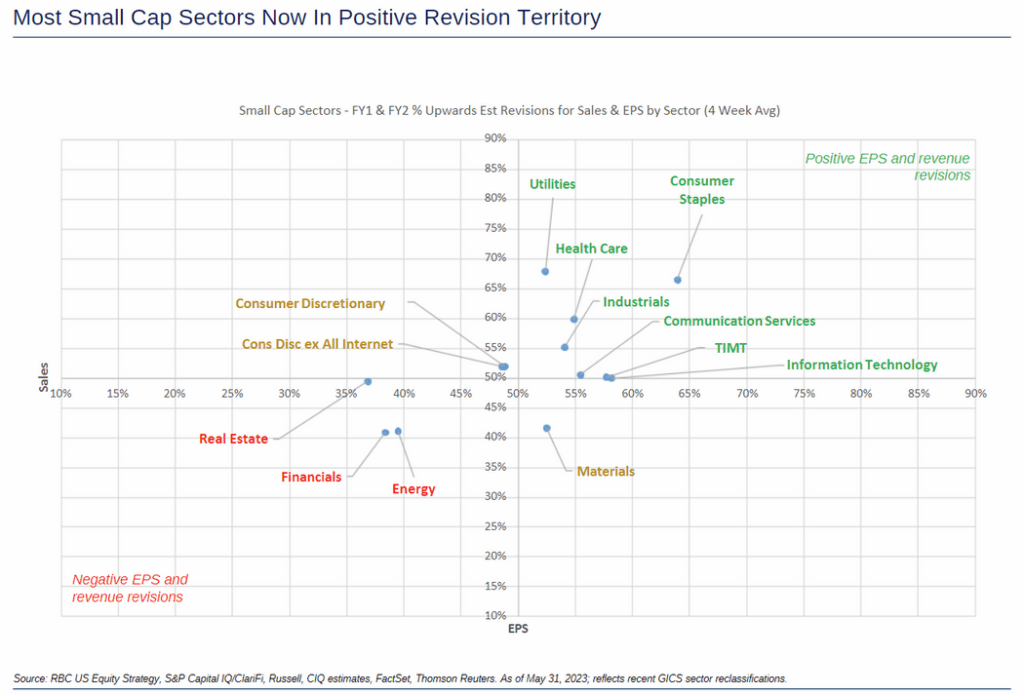
According to RBC Capital Markets, small-cap stocks in the United States are performing relatively well compared to the S&P 500 and Nasdaq Composite, despite still falling behind them this year. They are said to be putting up a strong fight and showing positive trends. Based on Monday afternoon trading levels, FactSet data shows that the Russell 2000, which monitors small-cap stocks in the United States, has experienced a slight increase of approximately 2.8% in 2023, in contrast to the S&P 500, which has risen by 11.7%, and the technology-focused Nasdaq Composite, which has surged by 26.8%. According to Calvasina, who leads U.S. equity strategy at RBC Capital Markets, Nasdaq valuations appear overpriced. However, the S&P 500 and Russell 2000 are currently lower than recent peaks, which differs from the Tech bubble. RBC Capital Markets has a preference for small-cap stocks over large-cap stocks. Calvasina stated that small-cap stocks are finally becoming involved in the earnings per share (EPS) revisions recovery. She noted that the rate of upward EPS estimate revisions has increased to 50% for the Russell 2000, with over half the sectors in the index displaying positive revisions in terms of both EPS and revenues. RBC identified several small-cap stock areas that exhibit positive revisions in both revenue and EPS. These areas include utilities, consumer goods, healthcare, industrial manufacturing, communications services, information technology, and TIMT, which stands for technology, internet, media, and telecommunications sector. As stated in the written communication, stocks with a smaller market capitalization generally reach their lowest point in value before the estimated earnings per share projections begin to increase once more, typically taking three to six months. Calvasina stated that the Russell 2000 has been struggling to reach a low in comparison to the S&P 500. Currently, the ratio between the two indexes is only slightly higher than their lowest point in March 2020. According to data from FactSet, the S&P 500, which measures the performance of U.S. large-cap stocks, is close to exiting a bear market as its current trading level sits around 4,287 as of Monday afternoon. Dow Jones Market Data suggests that the index will only officially exit its bear market status if its trading level reaches or surpasses 4,292.438. According to FactSet data, the stock market in the US showed a variety of results on Monday afternoon. At the time of the data, the S&P 500 increased by 0.1%, the Dow Jones Industrial Average decreased by 0.3%, and the Nasdaq gained 0.2%. In the context of stocks with small market capitalization, the Russell 2000 saw a 1.1% decrease during Monday afternoon trading. This came after a 3.6% increase on Friday, resulting in the largest daily percentage gain for the Russell 2000 since November 10th, as reported by Dow Jones Market Data. John PaulJohn Paul is the founder of DayTradeToWin, a trading education and software company established in 2008, supporting traders worldwide. His expertise focuses on price action-based futures trading strategies and structured market analysis. DayTradeToWin delivers trading education, indicators, and software tools designed to help traders apply disciplined, rule-based decision-making across global futures markets. He is the creator of multiple trading methodologies, including the Sonic System, Atlas Line, and Trade Scalper, which help traders identify structured opportunities in markets such as the E-mini S&P 500 (ES), Nasdaq (NQ), crude oil (CL), and gold (GC). Official website: https://daytradetowin.com daytradetowin.com

Scroll to Top