
Tariff Relief Buoys Markets for Now, but Recession Risks Remain
President Trump’s recent tariff adjustments have offered temporary relief to U.S. financial markets, but underlying economic risks are far from resolved. Daniel von Ahlen, senior macro strategist at GlobalData TS Lombard, warns that investors may be underestimating the threat of a recession, which could result in more severe market volatility later this year.
In a report shared with MarketWatch, von Ahlen highlighted several troubling indicators. Federal workforce layoffs could strain the job market at a time when hiring has already slowed. Tariffs are expected to raise consumer prices just as income growth loses momentum, potentially weakening household spending power.
Additional risks include Chinese retaliatory tariffs that could harm U.S. exports, a shrinking labor force due to tighter immigration policies, and potential fiscal drag if spending cuts are implemented to extend Trump’s first-term tax cuts.
“Taken together, these forces may be strong enough to tip the U.S. economy into recession,” von Ahlen wrote, noting that declining real personal income growth leaves little room for policy missteps.
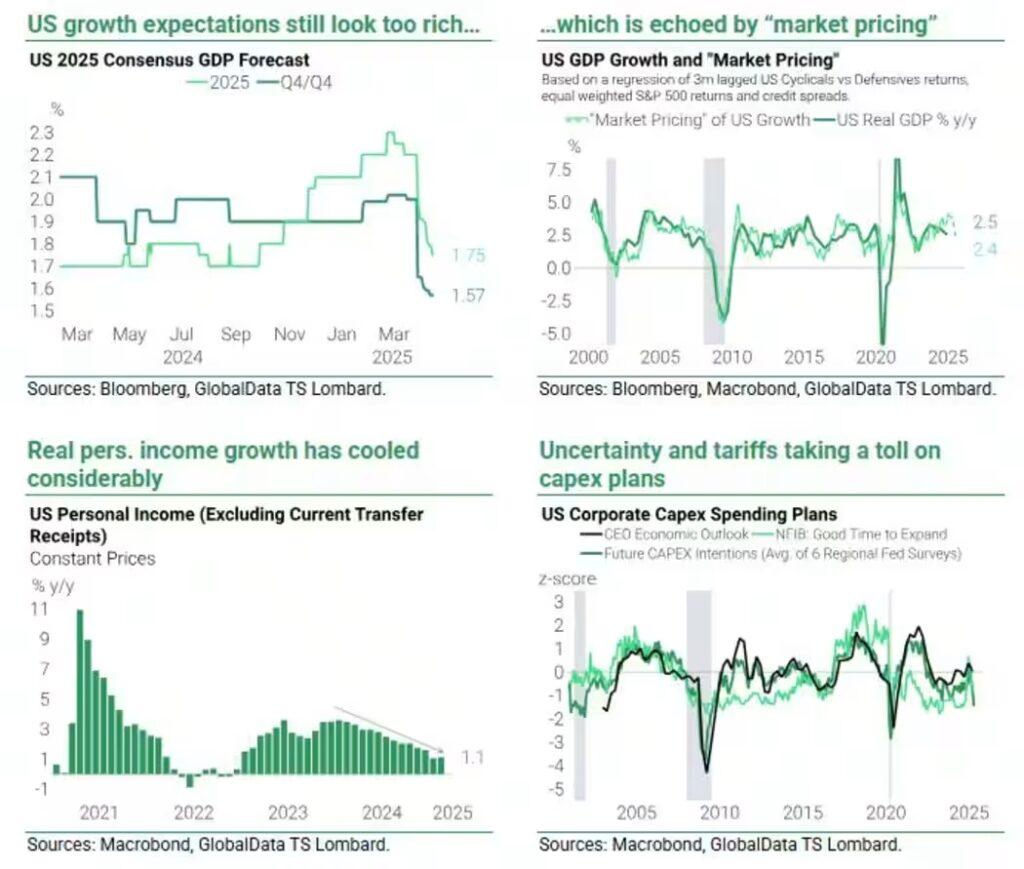
Despite lowered growth forecasts from Wall Street economists, market pricing still reflects expectations for robust economic expansion. At the same time, earnings projections remain optimistic, with analysts calling for 8.9% growth in 2025—a figure that would be unlikely in a downturn, where corporate earnings typically stagnate or decline.
Further stock market weakness could also weigh on consumer spending, given the growing role equities play in household wealth.
Von Ahlen isn’t alone in his caution. Michael Brown, senior research strategist at Pepperstone, echoed similar concerns, pointing to continued trade uncertainty. He noted that new tariffs on sectors like semiconductors and pharmaceuticals are looming, and the broader U.S.–China trade relationship remains tense. Beijing recently halted Boeing jet deliveries, and reciprocal tariff negotiations have made little progress.
“I worry markets are underpricing the risks,” Brown said. “We haven’t fully accounted for the inflationary or growth-related consequences these tariffs could trigger, both domestically and globally.”
To prepare for a potential recession, von Ahlen recommends rotating into defensive assets. He suggests gaining exposure to utilities through ETFs like the Utilities Select Sector SPDR Fund (XLU), while reducing exposure to cyclical sectors such as financials via the Financial Select Sector SPDR Fund (XLF). Long-term inflation-protected bonds—like those in the Pimco 15+ Year U.S. TIPS Index ETF (LTPZ)—may also offer downside protection.
Additionally, he advocates using the Mexican peso to fund long positions in the Japanese yen (MXNJPY), citing the yen’s safe-haven status and relative undervaluation despite recent appreciation.
Markets showed renewed volatility midweek. After the White House blocked Nvidia from exporting more AI chips to China without a license, and Beijing suspended Boeing aircraft deliveries, stocks fell sharply. The S&P 500 dropped 1.3%, the Nasdaq declined over 2%, and Nvidia shares plunged nearly 7%.

John Paul is the founder of DayTradeToWin, a trading education and software company established in 2008, supporting traders worldwide. His expertise focuses on price action-based futures trading strategies and structured market analysis.
DayTradeToWin delivers trading education, indicators, and software tools designed to help traders apply disciplined, rule-based decision-making across global futures markets.
He is the creator of multiple trading methodologies, including the Sonic System, Atlas Line, and Trade Scalper, which help traders identify structured opportunities in markets such as the E-mini S&P 500 (ES), Nasdaq (NQ), crude oil (CL), and gold (GC).
Official website: https://daytradetowin.com