
Gold Suffers Sharpest Drop Since 2021 as Trade Tensions Ease and Fed Uncertainty Fades
Gold prices saw their steepest single-day drop in nearly four years on Wednesday, as a shift in U.S. trade policy rhetoric and reduced fears over the Federal Reserve’s leadership deflated the metal’s momentum.
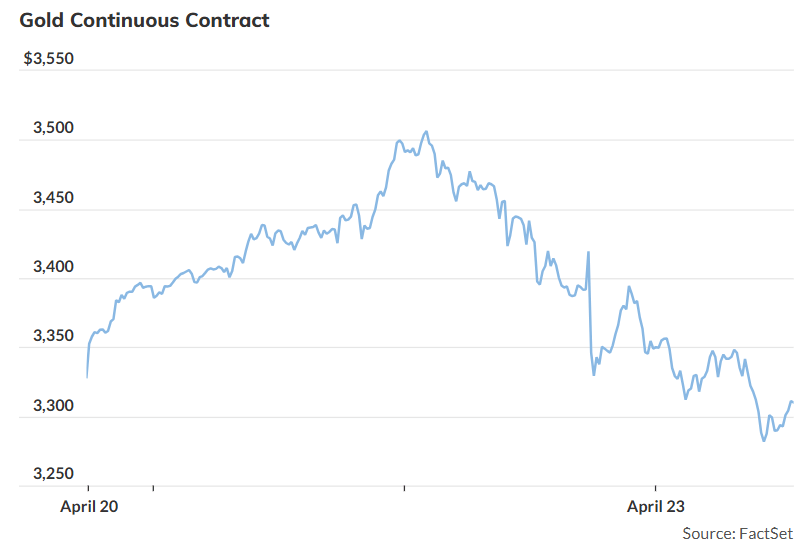
After a blistering rally that saw gold top $3,500 an ounce earlier this week, prices tumbled $125.30, or 3.7%, to close at $3,294.10 — the biggest one-day percentage drop since June 2021, according to Dow Jones Market Data. Tuesday’s session had already hinted at weakness, with gold futures pulling back from a record intraday high of $3,509.90 to settle at $3,419.40.
The decline followed signs that the White House may ease tariffs on Chinese imports, according to reports, and a softening stance from former President Trump toward Fed Chair Jerome Powell. That double shift eased fears that had fueled gold’s rally and reduced demand for the metal as a safe-haven asset.
“Gold’s been riding the trade-war narrative, and that leg just got wobbly,” said Stephen Innes, managing partner at SPI Asset Management. He added that the rally had been driven more by headlines and speculation than fundamentals, and with those headlines cooling, the rally is deflating fast.
Jonathan Krinsky of BTIG noted that gold had climbed to more than 27% above its 200-day moving average — a historically extreme level that often signals overbought conditions and a potential “blow-off” top. When that threshold has been reached in the past, gold has typically pulled back toward its average in the following months.
Despite the sharp correction, many analysts see this as a healthy pause rather than a definitive peak. “There’s nothing indicating that $3,500 is a hard top,” said Michael Armbruster of Altavest. “We’re still in an uptrend — this looks like a standard correction within a bull market.”
Jim Wyckoff of Kitco.com agreed, suggesting the rally may be near the end of its cycle in terms of timing, but not necessarily in price. “Markets often experience larger swings near the end of a bull phase, but gold could still surprise to the upside before it’s over.”
Gold had been on a tear since 2022, rising from around $1,600 an ounce on the back of geopolitical turmoil, high inflation, and fears over global economic stability. Even after this week’s drop, the metal remains up significantly, with gains of over 25% year to date.
“This correction doesn’t change the underlying bullish thesis,” said Trevor Yates, senior investment analyst at Global X ETFs. “It’s more about investor positioning than any shift in fundamentals.” He noted continued demand from central banks and ongoing economic uncertainty as key supports for gold.
With the metal still outperforming equities in 2025 and broader market volatility persisting, analysts suggest the recent dip may offer a strategic entry point for long-term investors

John Paul is the founder of DayTradeToWin, a trading education and software company established in 2008, supporting traders worldwide. His expertise focuses on price action-based futures trading strategies and structured market analysis.
DayTradeToWin delivers trading education, indicators, and software tools designed to help traders apply disciplined, rule-based decision-making across global futures markets.
He is the creator of multiple trading methodologies, including the Sonic System, Atlas Line, and Trade Scalper, which help traders identify structured opportunities in markets such as the E-mini S&P 500 (ES), Nasdaq (NQ), crude oil (CL), and gold (GC).
Official website: https://daytradetowin.com