
Taiwan Dollar’s Surge May Foreshadow a Sharp Decline in the U.S. Dollar, Analyst Warns
A sudden spike in the Taiwan dollar could be an early sign of a much larger, disorderly drop in the U.S. dollar, according to Stephen Jen, CEO and co-CIO of Eurizon SLJ Capital.
Jen, a veteran currency strategist, has warned since 2022 of a potential “avalanche”-like selloff in the greenback. In a new report with co-author Joana Freire, he suggests that recent currency movements in Asia — particularly the Taiwan dollar’s surge — may signal that such a scenario is unfolding.
“We believe the risk of investors being blindsided by a sudden, non-linear selloff in the dollar is rising,” Jen and Freire wrote. “The Taiwan dollar’s sharp move is one example. We expect others to follow.”
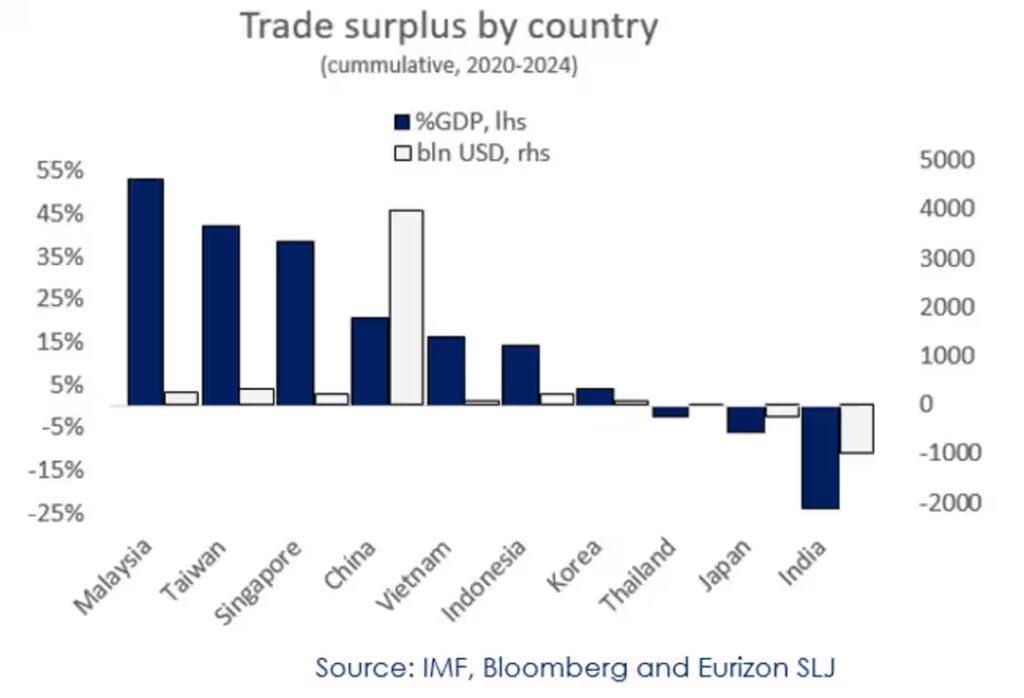
Their concern stems from a buildup of over $2.5 trillion in U.S. dollar reserves across key Asian exporters including China, Taiwan, Malaysia, and Vietnam. Much of this capital is held in liquid instruments not reflected in standard investment flow data. If even a portion of these holdings is sold, it could trigger a sharp drop in the dollar’s value.
Jen notes that these countries are well aware the dollar is overvalued — a view that could accelerate selling if confidence erodes. Additional risks include a potential rebound in China’s economy and anticipated interest-rate cuts by the Federal Reserve in 2025, which could further weaken the dollar.
While the Fed is not expected to cut rates immediately, markets are pricing in 75 basis points of easing next year. At the same time, U.S. dollar reserves held by foreign central banks have been declining for years. A second Trump presidency, with its focus on tariffs and currency policy, could add more pressure on foreign holders to reduce exposure.
Jen sees China as the most immediate threat. The People’s Bank of China has so far kept the yuan stable against the dollar, even as the greenback has fallen over 8% this year, according to the ICE U.S. Dollar Index (DXY). But if Beijing allows the yuan to appreciate — possibly in response to U.S. accusations of currency manipulation — it could trigger broader dollar weakness.
“The dollar overhang is just too large,” Jen and Freire warned. “If the Fed cuts, the dollar weakens, and China rebounds, the stage is set for an avalanche.”
The dollar’s recent 9% drop against the Taiwan dollar — the largest move in that currency pair since at least 2007 — has revived speculation that foreign investors may be reducing their U.S. asset exposure. Other Asian currencies, like the South Korean won, also saw gains.
Still, some remain skeptical. Analysts at Barclays argue the Taiwan dollar’s rally is overdone and say large Taiwanese insurers are unlikely to sell dollar assets at a loss, just as they avoided doing so in 2022.
Though Treasury yields spiked last week, some economists attribute that to a strong April jobs report rather than foreign selling. However, Deutsche Bank data shows Taiwan-based ETFs recently offloaded U.S. fixed-income assets, hinting that the shift may already be underway.
For now, Jen and his team are watching closely — waiting to see whether the dollar’s long-feared avalanche has indeed begun.

John Paul is the founder of DayTradeToWin, a trading education and software company established in 2008, supporting traders worldwide. His expertise focuses on price action-based futures trading strategies and structured market analysis.
DayTradeToWin delivers trading education, indicators, and software tools designed to help traders apply disciplined, rule-based decision-making across global futures markets.
He is the creator of multiple trading methodologies, including the Sonic System, Atlas Line, and Trade Scalper, which help traders identify structured opportunities in markets such as the E-mini S&P 500 (ES), Nasdaq (NQ), crude oil (CL), and gold (GC).
Official website: https://daytradetowin.com