
Trump’s Tariff Pause May Signal Market Floor—but Investors Should Stay Alert
President Trump’s recent decision to partially pause tariffs may indicate where equities need to fall before prompting a White House policy reversal. But investors shouldn’t assume this marks a reliable safety net.
The stock market’s sharp rebound—following steep losses tied to trade tensions—suggests a new threshold for how far Wall Street can drop before Trump steps in. The S&P 500 turned positive for the year on Tuesday after the U.S. and China agreed to pause certain tariffs. That recovery from the April 8 low of 4,982.77 suggests an informal “Trump put” may kick in after a drop of around 18.5%.
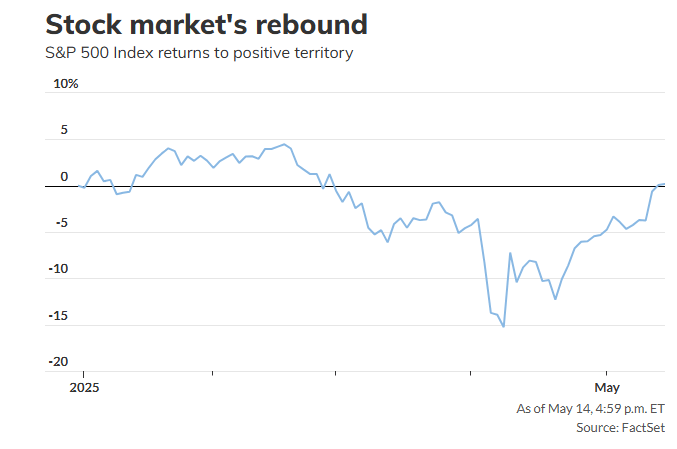
Trump’s re-election in November triggered a surge in U.S. equities, with indexes hitting new highs through February. Wharton finance professor Jeremy Siegel even called Trump the most “pro-stock-market president” in U.S. history, as noted by MarketWatch’s Joseph Adinolfi.
But by January, optimism had faded. Trump’s aggressive trade stance toward China rattled markets and raised recession fears. The turbulence eased only after reciprocal tariffs (excluding China) were paused on April 9, followed by a suspension of tit-for-tat measures with Beijing on May 12.
“The ‘Trump put’ is alive and well,” said Tom Lee, head of research at Fundstrat, in a recent podcast. “The White House doesn’t want the stock market to go down.”
Still, Trump offered little indication this spring that he was concerned about falling markets, casting doubt on the immediacy of any protective pivot. Meanwhile, Fed Chair Jerome Powell dismissed the idea that monetary policy would be used as a market backstop.
“Investors were spooked in early April because they feared the Trump put wouldn’t activate until the S&P 500 dropped deep into the 4,000s,” noted Tom Essaye, president of Sevens Report Research. Now, he says, the threshold appears closer to the mid-to-low 5,000s.
As of Tuesday, the S&P 500 sat 4.2% below its record close of 6,144.15 on February 19, according to Dow Jones Market Data. Stocks gained further ground on Wednesday, pushing closer to those highs.
Steven Blitz, chief U.S. economist at GlobalData TS Lombard, said he wasn’t surprised by Trump’s 90-day tariff pause on China, given the severity of the recent selloff. But he remains cautious about future reversals.
“I’m skeptical of how Trump’s trade rhetoric evolves after the budget is passed,” Blitz told MarketWatch, referring to the GOP’s proposed budget bill. “It’s unclear whether market volatility or political strategy drove the tariff pause. He needs congressional votes to move the bill forward.”
As of Wednesday, the S&P 500 was up 0.2% for the year. The Dow was down 1%, while the Nasdaq had slipped 0.9%, according to FactSet.

John Paul is the founder of DayTradeToWin, a trading education and software company established in 2008, supporting traders worldwide. His expertise focuses on price action-based futures trading strategies and structured market analysis.
DayTradeToWin delivers trading education, indicators, and software tools designed to help traders apply disciplined, rule-based decision-making across global futures markets.
He is the creator of multiple trading methodologies, including the Sonic System, Atlas Line, and Trade Scalper, which help traders identify structured opportunities in markets such as the E-mini S&P 500 (ES), Nasdaq (NQ), crude oil (CL), and gold (GC).
Official website: https://daytradetowin.com