
Retail Investors Are Rushing to Buy the Dip — And That’s a Problem
Retail investors have been aggressively buying every market dip — a classic sign of overconfidence that often precedes a market top. As Warren Buffett famously said, “Be fearful when others are greedy.”
Following the S&P 500’s sharp drop in early April — over 12% in just four trading days — retail traders piled in. “An army of amateur investors stepped up to buy the dip with both hands,” reported MarketWatch’s Joseph Adinolfi. JPMorgan analysts estimated that individuals bought $50 billion in stocks in April alone, accounting for nearly a third of daily trading volume at times.
This kind of enthusiasm usually spells trouble. History shows that aggressive dip-buying by individual investors is far more common near market peaks than bottoms. In contrast, true market bottoms tend to occur when fear dominates — when investors sell into rallies, not buy into selloffs.
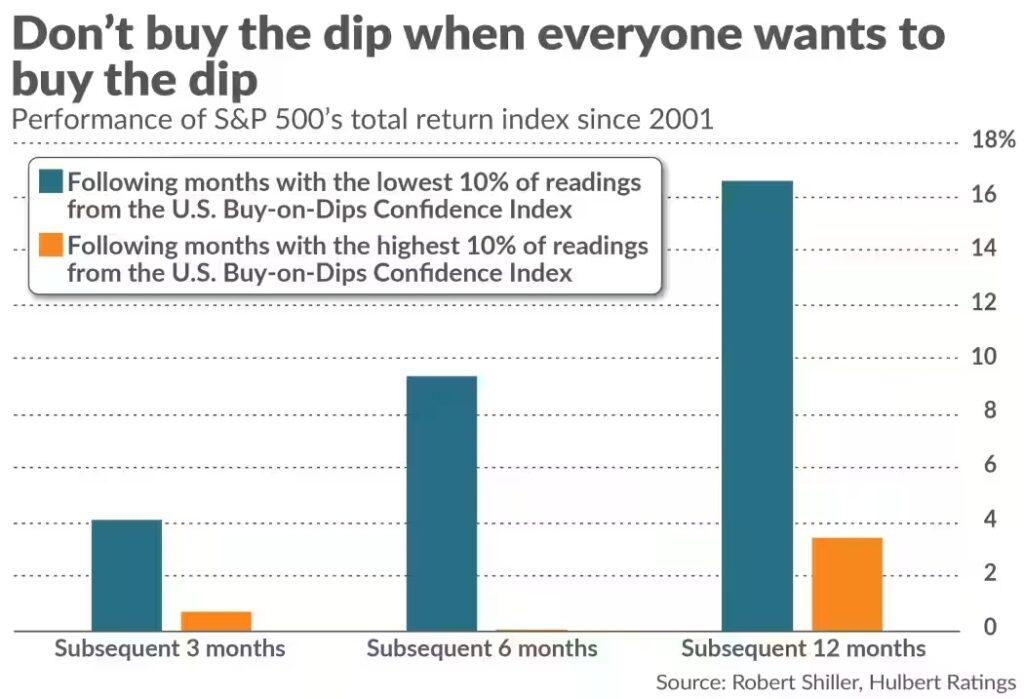
One tool that highlights this dynamic is Yale professor Robert Shiller’s “Buy on Dips Confidence Index.” This survey gauges how likely retail investors believe the market will rebound after a drop. When confidence is high, forward returns are typically poor. When confidence is low — when investors doubt any rebound — future returns improve significantly. The data is statistically strong.
Though Shiller’s index is released with a lag, recent behavior suggests we’re near the high end of its historical range. That’s a warning sign. Each successful dip-buy emboldens investors, reinforcing a cycle of confidence and risk-taking.
But this cycle can’t last forever. Eventually, it takes a much deeper, more painful correction to shake that conviction and reset sentiment. Until then, the foundation for a sustainable rally just isn’t in place.
And when the reset comes, it won’t be gentle.

John Paul is the founder of DayTradeToWin, a trading education and software company established in 2008, supporting traders worldwide. His expertise focuses on price action-based futures trading strategies and structured market analysis.
DayTradeToWin delivers trading education, indicators, and software tools designed to help traders apply disciplined, rule-based decision-making across global futures markets.
He is the creator of multiple trading methodologies, including the Sonic System, Atlas Line, and Trade Scalper, which help traders identify structured opportunities in markets such as the E-mini S&P 500 (ES), Nasdaq (NQ), crude oil (CL), and gold (GC).
Official website: https://daytradetowin.com