
Why Tax Refunds Could Delay Fed Rate Cuts
Markets are counting on the Federal Reserve to trim rates in September, but a surge of tax refunds in early 2026 could complicate that outlook, says David Kelly, chief global strategist at JPMorgan Asset Management.
The IRS recently confirmed that withholding levels won’t change this year as it implements the One Big Beautiful Bill Act (OBBBA).
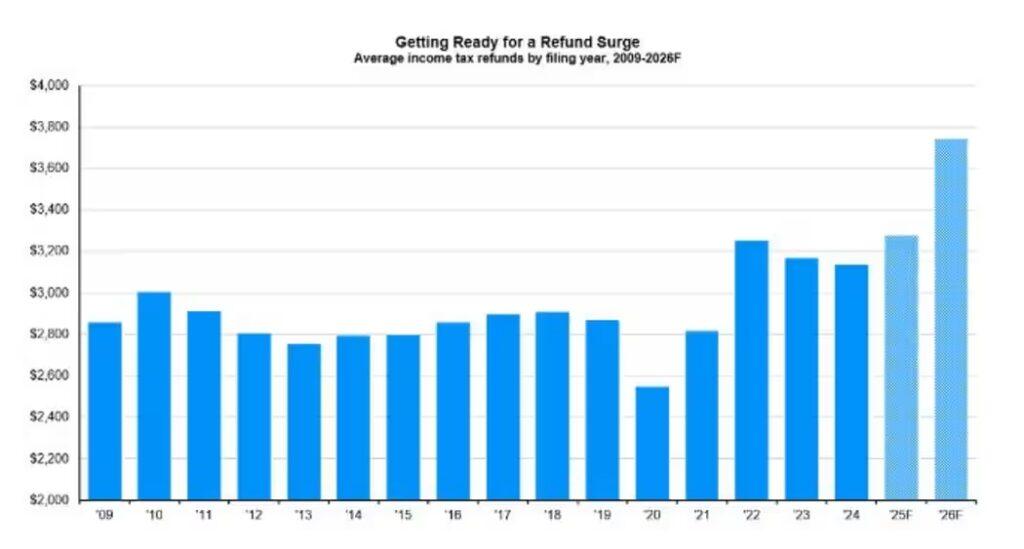
That means taxpayers will likely see unusually large refunds when they file 2025 returns. With seven retroactive tax breaks—ranging from no tax on tips and overtime to bigger child credits and standard deductions—refunds could average $3,743 across roughly 110 million households.
Kelly warns these payouts could act like “stimulus checks,” fueling spending and inflation through early next year. While upper-middle-income households will capture most of the benefit—and may save more than spend—many consumers could still bring forward spending into this holiday season, creating a short-term economic lift.
But the effect may fade fast. If refunds are spent quickly, growth could slow sharply by late 2026, just as tariffs and weaker immigration weigh on the economy. That could set the stage for Washington to consider fresh stimulus before midterm elections.
For the Fed, the risk is clear: cutting rates into a refund-driven “sugar rush” could stoke inflation, undermine credibility, and weigh on the dollar and equities. Kelly advises investors to diversify into international and alternative assets to hedge against these risks.

John Paul is the founder of DayTradeToWin, a trading education and software company established in 2008, supporting traders worldwide. His expertise focuses on price action-based futures trading strategies and structured market analysis.
DayTradeToWin delivers trading education, indicators, and software tools designed to help traders apply disciplined, rule-based decision-making across global futures markets.
He is the creator of multiple trading methodologies, including the Sonic System, Atlas Line, and Trade Scalper, which help traders identify structured opportunities in markets such as the E-mini S&P 500 (ES), Nasdaq (NQ), crude oil (CL), and gold (GC).
Official website: https://daytradetowin.com