
Markets No Longer Cheer Layoffs, Goldman Sachs Warns
Announcing job cuts used to be a quick way for companies to boost their share prices, particularly when layoffs were framed as efficiency or cost-saving measures. That reaction has faded. Goldman Sachs says companies now underperform the broader market by around 2% after revealing layoffs.
Investors appear increasingly unconvinced by management’s explanations. Even when job cuts are presented as part of harmless restructuring or productivity initiatives, equity markets are punishing stocks rather than rewarding them.
Goldman Sachs analyst Elsie Peng says the shift reflects growing investor skepticism. In a research note published Monday, Peng analyzed stock performance following layoff announcements and found that markets may view claimed productivity gains as a cover for deeper problems, such as rising interest expenses or weakening profitability.
According to Peng, labor market weakness in 2025 has been marked more by sluggish hiring than by traditional layoff indicators.
Initial jobless claims and official layoff rates remain low, yet third-quarter earnings commentary suggested more job cuts could be coming. Many companies have blamed these reductions on automation and the use of AI to lower labor costs.
Goldman’s findings show that the market reaction worsens when layoffs are explicitly tied to restructuring. While stocks announcing job cuts generally lag the market by about 2%, companies that directly cite restructuring have suffered much steeper declines, with average excess returns of negative 7%.
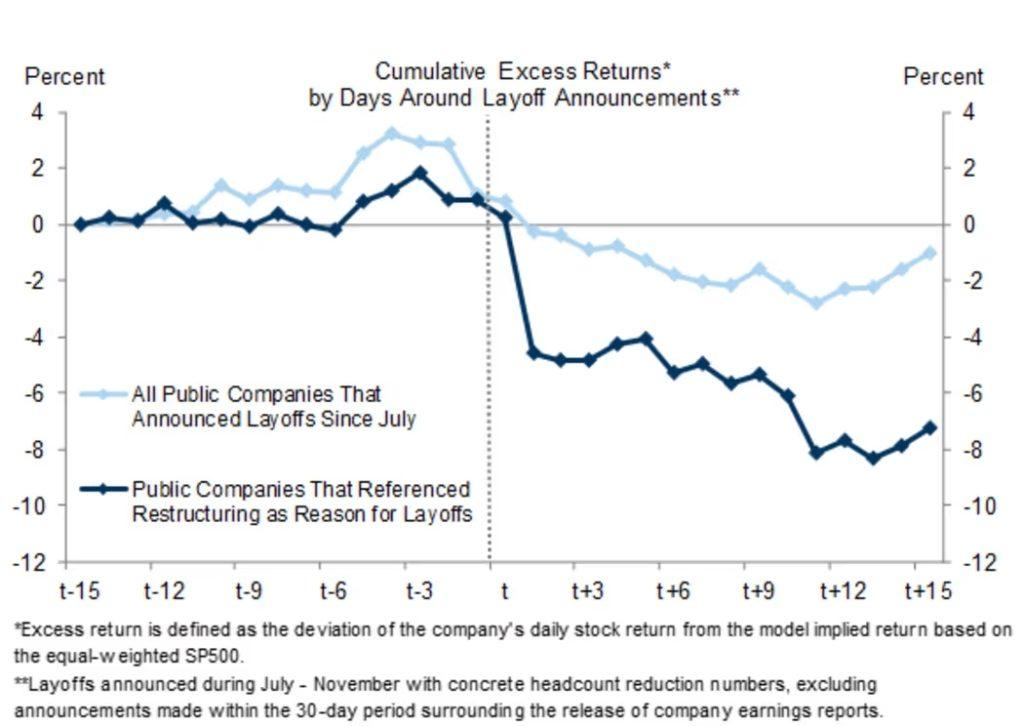
The analysis also shows that firms announcing layoffs have experienced faster growth in capital spending, debt, and interest expenses, alongside weaker profit growth than industry peers this year. That pattern suggests layoffs may be driven by more concerning financial pressures than companies publicly admit.
Despite this, Peng notes that Goldman’s equity and credit analysts see limited risk to the broader economy from layoffs so far. Corporate balance sheets remain broadly strong, and profit margins are still elevated.
The S&P 500 ended slightly lower on Monday and is just over 1% below its record high after gaining 16% this year. U.S. stock index futures also edged lower ahead of key jobs data.

John Paul is the founder of DayTradeToWin, a trading education and software company established in 2008, supporting traders worldwide. His expertise focuses on price action-based futures trading strategies and structured market analysis.
DayTradeToWin delivers trading education, indicators, and software tools designed to help traders apply disciplined, rule-based decision-making across global futures markets.
He is the creator of multiple trading methodologies, including the Sonic System, Atlas Line, and Trade Scalper, which help traders identify structured opportunities in markets such as the E-mini S&P 500 (ES), Nasdaq (NQ), crude oil (CL), and gold (GC).
Official website: https://daytradetowin.com