
Goldman Sachs is keeping its 7,600 target for the S&P 500, suggesting the market still has about 9% upside this year. But beneath that optimistic headline, the investment bank is warning investors that U.S. stocks are entering a far more fragile and volatile phase.
In a new strategy note led by Ben Snider, Goldman says today’s market is showing a dangerous combination of rich valuations, heavy concentration in mega-cap stocks, and strong recent gains — a pattern that has historically appeared near major market tops.
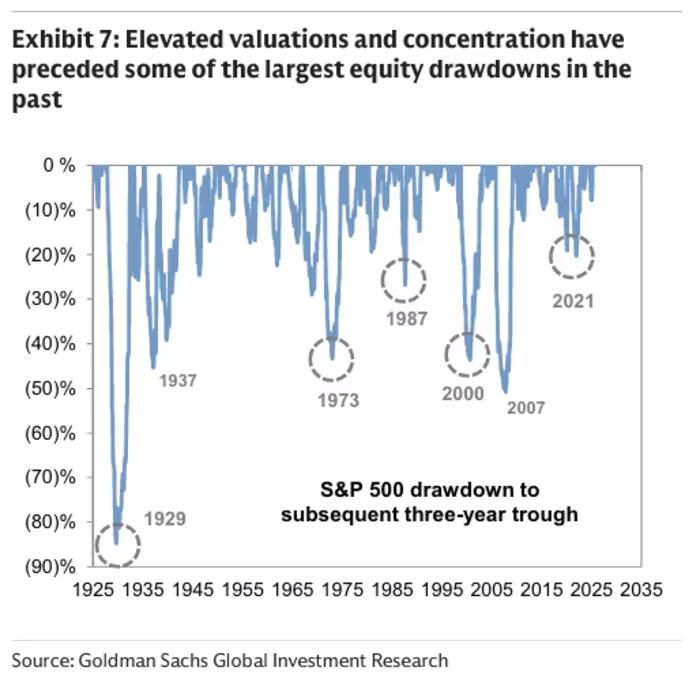
The firm points to similarities with the 1920s boom, the Nifty Fifty era of the 1970s, the 1987 rally, the dot-com bubble, and the 2021 surge — all periods that ended with painful market corrections.
Is the Stock Market Overheated?
Goldman is careful not to call this a full-blown bubble yet. Some classic signs of excessive speculation are missing. IPO activity remains muted, fund flows are relatively weak, and corporate leverage is still low by historical standards, even though it is rising.
Speculative trading, as defined by Goldman, includes heavy activity in unprofitable companies, penny stocks, and stocks trading at more than 10 times enterprise value to sales — and those areas have not reached previous extremes.
On the economic side, the bank says the main risks would be either a sharp slowdown in growth or a sudden shift toward tighter monetary policy. For now, neither seems likely. Still, Goldman warns that the supportive macro environment could fade later in the year as fiscal and monetary stimulus weakens and AI-driven disruption accelerates.
Earnings Growth May Slow, Volatility May Rise
Looking further ahead, Goldman expects S&P 500 earnings growth to decelerate in 2027 compared to 2026. At the same time, the upcoming midterm election cycle could increase policy uncertainty and market volatility, as has often happened in the past.
While new policy tailwinds are possible, the firm says investors should prepare for a noisier and more unpredictable market environment.
AI Spending Is Exploding — and So Is the Use of Debt
One of the biggest structural shifts in the market is the massive surge in AI investment. Goldman notes that capital spending has risen to roughly 75% of corporate cash flow, meaning future growth in AI investment will increasingly rely on borrowing.
“As spending and debt grow, the level of profits needed to justify these investments also rises,” the strategists caution.
So far, mega-cap tech leaders such as Amazon, Alphabet, Meta, and Microsoft have mostly seen their stock prices move in line with earnings expectations — a big difference from the valuation excesses of the late 1990s tech bubble.
“Phase 3-D”: Where AI Moves Into the Real World
While much of the AI boom has focused on chips, cloud computing, and data centers, Goldman believes the next major opportunity lies in AI-powered robotics and automation.
The firm calls this shift “Phase 3-D” — the stage where artificial intelligence starts interacting directly with the physical world.
A basket of 26 stocks commonly held in U.S. robotics and automation ETFs — including Kratos Defense, Joby Aviation, AeroVironment, and Teradyne — delivered strong gains in early 2023 and again in 2025. Despite that, these stocks still trade at a reasonable 26 times forward earnings.
Even more telling, investor exposure remains low. The largest robotics ETFs attracted only $750 million in inflows in the second half of last year, suggesting the theme is still under-owned.
The Next Phase of the AI Stock Market Trade
Goldman expects the AI investment story to broaden beyond infrastructure spending. As corporate adoption increases and spending growth slows, attention should shift toward:
- “Phase 4” companies using AI to improve productivity and margins
- “Phase 3” companies generating new revenue from AI adoption
- “Phase 3-D” companies bringing AI into factories, logistics, defense, and transportation through robotics and automation
Bottom Line: Robotics and Automation Could Be the Next AI Mega-Trend
While Goldman Sachs is warning that the overall stock market is becoming more vulnerable to pullbacks and volatility, it also sees a powerful opportunity taking shape.
As artificial intelligence moves from software into the real economy, robotics and automation stocks could become the next big winners of the AI revolution — and one of the most compelling investment themes for traders and long-term investors alike.

John Paul is the founder of DayTradeToWin, a trading education and software company established in 2008, supporting traders worldwide. His expertise focuses on price action-based futures trading strategies and structured market analysis.
DayTradeToWin delivers trading education, indicators, and software tools designed to help traders apply disciplined, rule-based decision-making across global futures markets.
He is the creator of multiple trading methodologies, including the Sonic System, Atlas Line, and Trade Scalper, which help traders identify structured opportunities in markets such as the E-mini S&P 500 (ES), Nasdaq (NQ), crude oil (CL), and gold (GC).
Official website: https://daytradetowin.com