
Market Sell-Off From Greenland Crisis May Be a Buying Opportunity, HSBC Says
Major geopolitical shocks over the past 25 years have repeatedly turned into buying opportunities — and according to HSBC, the current market turmoil sparked by the Greenland crisis is likely to follow the same pattern.
The latest escalation in geopolitical tensions and the renewed threat of tariffs triggered a broad-based sell-off across global markets, hitting a rare trifecta: U.S. stocks, bonds, and the dollar all declined at the same time.
On Tuesday, the S&P 500 fell 2.1%, while the U.S. 10-year Treasury yield jumped six basis points to around 4.29%. Meanwhile, the U.S. dollar weakened against the euro, British pound, and Canadian dollar. Investors rushed toward traditional safe havens, lifting gold and the Swiss franc sharply.
Despite the turbulence, HSBC chief multi-asset strategist Max Kettner says history suggests investors should stay calm. In a note released Tuesday, Kettner pointed out that roughly 75% of geopolitical and macro crises over the past 25 years have ultimately been “faded” by markets — meaning the initial panic selling eventually gives way to recovery.
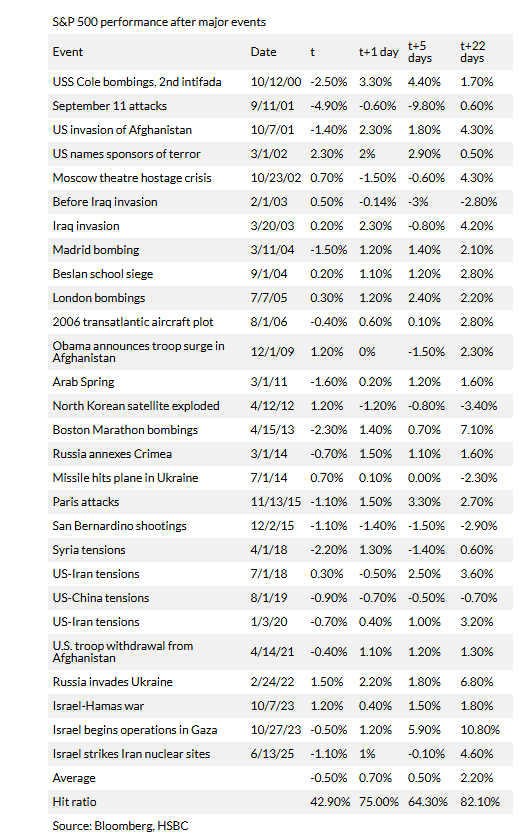
He cited recent examples, including the 2025 market sell-off following President Donald Trump’s “Liberation Day” tariff announcement and the Israeli strikes on Iran, as evidence that looking past short-term volatility has consistently rewarded long-term investors. Kettner expects a similar pattern this time, with tough opening rhetoric eventually softening into negotiations and compromise.
Still, HSBC is not ignoring the risks. Kettner warned that U.S. interest rates and risk assets are approaching a “danger zone.” He identified 4.4% on the U.S. 10-year yield and 5% on the 30-year bond as critical technical levels. A sustained break above those levels could trigger a deeper and more prolonged market downturn.
For now, however, Kettner believes the U.S. economy remains in a “Goldilocks” environment, with growth, employment, and inflation balanced well enough to keep the Federal Reserve on a dovish path. That backdrop should prevent a major repricing of expectations for two interest rate cuts in 2026.
He also noted that the VIX volatility index futures curve is in backwardation — a technical signal that markets may already be oversold. On top of that, with fourth-quarter earnings expectations set relatively low, companies could find it easier to beat forecasts, potentially providing another boost to stock market sentiment.
Bottom Line: Is This Market Dip a Buying Opportunity?
HSBC’s conclusion is clear: while geopolitical headlines are driving short-term volatility, history suggests this sell-off is more likely to become another buying opportunity rather than the start of a sustained bear market.
For traders and investors, the message is simple — don’t confuse short-term fear with long-term fundamentals.

John Paul is the founder of DayTradeToWin, a trading education and software company established in 2008, supporting traders worldwide. His expertise focuses on price action-based futures trading strategies and structured market analysis.
DayTradeToWin delivers trading education, indicators, and software tools designed to help traders apply disciplined, rule-based decision-making across global futures markets.
He is the creator of multiple trading methodologies, including the Sonic System, Atlas Line, and Trade Scalper, which help traders identify structured opportunities in markets such as the E-mini S&P 500 (ES), Nasdaq (NQ), crude oil (CL), and gold (GC).
Official website: https://daytradetowin.com