
Market News

equities
Market News

Equities vs. Liquidity: What’s the Real Risk?

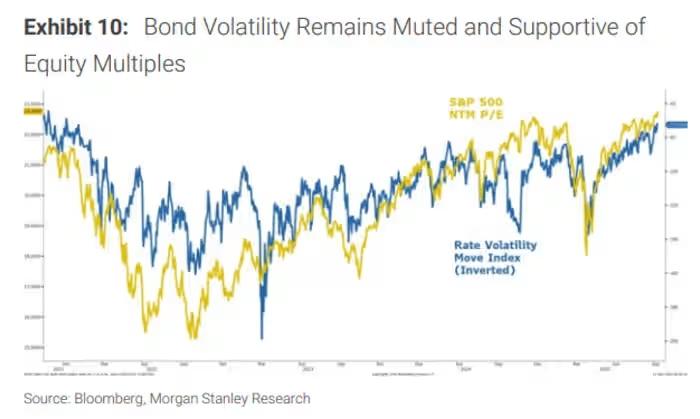
Mike Wilson Warns: Equities at Risk Amid Potential Liquidity Stress The S&P 500, Dow, and Nasdaq all closed last week at fresh record highs. The S&P 500 has jumped 33.75% since its April low, and it’s up 13.3% year-to-date, as the market becomes increasingly immune to White House policy uncertainty and continues to ride the wave of optimism around the AI boom. On top of that, the Federal Reserve has introduced another round of monetary easing, which is helping to support market sentiment. However, Mike Wilson and his team at Morgan Stanley are raising a red flag about the potential risks ahead for equities. The concern: if the Fed doesn’t meet market expectations, it could lead to a market shake-up. Currently, traders are pricing in a strong likelihood of a 50 basis point rate cut from the Fed this year, which would lower the current range of 4.00% to 4.25%. By this time next year, the fed funds futures market anticipates the rate dropping to around 3%. Wilson, however, believes the economy may not actually need such drastic cuts. “We still maintain our view that the rolling recession ended with ‘Liberation Day,’ and that we’re now entering an early-cycle recovery phase, where earnings growth is likely to outperform expectations,” he explains. This outlook is backed by a rise in analysts’ earnings revisions, as well as improving economic indicators like the ISM Purchasing Managers’ Index, which Wilson expects to strengthen further. He points out that pent-up demand is increasingly evident in sectors that have lagged for the past few years, including housing, consumer goods, industrials, transportation, and commodities. Against this backdrop, Wilson argues that the Fed isn’t as accommodative as it would usually be at this point in the cycle. That’s because, while the labor market is holding up, inflation remains persistently above the Fed’s 2% target. “The tension between the Fed’s cautious stance and the market’s expectation of quick rate cuts is a key risk for equities, especially with the historically weak seasonal period ahead,” Wilson says. He notes that the market’s growing correlation between poor economic data and rising stock prices suggests that investors are betting on more rate cuts. The real risk, however, is that the Fed may recognize the ongoing recovery and decide that the economy doesn’t require such aggressive easing. While this may be the right decision from an economic standpoint, it could disappoint markets that have already priced in more cuts. This could also prevent a full early-cycle rotation, leaving lower-quality stocks and small caps to outperform. Wilson also warns about the potential for liquidity stress as the Fed continues with its quantitative tightening, alongside increased Treasury bond issuance and high levels of corporate debt. Liquidity pressure may show up first in the spread between the Secured Overnight Financing Rate (SOFR) and the Fed Funds rate, Wilson says. Traders should also keep an eye on the BofA Merrill Lynch MOVE index, which tracks Treasury volatility. A meaningful rise in the MOVE, currently near a four-year low at 72.5, could signal growing strain in the Treasury market. “Although it’s not a concern yet, we think liquidity stress could surface here first,” Wilson says. “If the Fed doesn’t address these risks, it could trigger a sharp correction in the equity market.” John PaulJohn Paul is the founder of DayTradeToWin, a trading education and software company established in 2008, supporting traders worldwide. His expertise focuses on price action-based futures trading strategies and structured market analysis. DayTradeToWin delivers trading education, indicators, and software tools designed to help traders apply disciplined, rule-based decision-making across global futures markets. He is the creator of multiple trading methodologies, including the Sonic System, Atlas Line, and Trade Scalper, which help traders identify structured opportunities in markets such as the E-mini S&P 500 (ES), Nasdaq (NQ), crude oil (CL), and gold (GC). Official website: https://daytradetowin.com daytradetowin.com

tesla
Market News

Why Tesla’s Future May Ride on Robots, Not Cars

Tesla’s Next Act: From Cars to “Physical AI” The rally is spreading. The Russell 2000 (+2.51%) just hit its first record since 2021, joining the S&P 500, Dow, and Nasdaq at fresh highs. But while the market broadens, Tesla remains in the spotlight. Shares are up 22.6% in the past month, and Baird’s Ben Kallo just upgraded the stock to outperform, hiking his target from $320 to $548. His bullish view isn’t about cars. With EV sales slowing, Kallo says Tesla’s future lies in robots and robotaxis — the foundation of what Elon Musk calls a “physical AI” company. Baird’s 10-year framework (2026–2035) envisions: If Tesla clears those milestones, Baird sees a path to a $5.5T market cap and a $1,412 share price. In a “bull case,” doubling those volumes could lift Tesla to $12T in value, with shares soaring to $3,043. Kallo stresses these are stretch scenarios — not his base case. Still, he argues Tesla is evolving from a carmaker into the leader of a new era: physical AI. John PaulJohn Paul is the founder of DayTradeToWin, a trading education and software company established in 2008, supporting traders worldwide. His expertise focuses on price action-based futures trading strategies and structured market analysis. DayTradeToWin delivers trading education, indicators, and software tools designed to help traders apply disciplined, rule-based decision-making across global futures markets. He is the creator of multiple trading methodologies, including the Sonic System, Atlas Line, and Trade Scalper, which help traders identify structured opportunities in markets such as the E-mini S&P 500 (ES), Nasdaq (NQ), crude oil (CL), and gold (GC). Official website: https://daytradetowin.com daytradetowin.com
markets
Market News

Markets Eye Jobs & Inflation Data for Next Big Move

Markets Eye Two Big Data Points Next Month After Wednesday’s modest pullback in the S&P 500 (-0.10%) and Nasdaq (-0.33%), investors appear ready to step back in, despite a Fed decision that some viewed as less dovish than expected. Much of the rebound is tied to Fed Chair Jerome Powell’s comment that the 25 bps rate cut was “risk management.” While some saw that as a signal of fewer cuts ahead, Goldman Sachs argues Powell effectively hinted at another move in October. From JPMorgan’s trading desk comes the call of the day: buy the dips. Led by Andrew Tyler, the team sees the potential for an “explosive” rally if the right data hits. The two numbers to watch: If hiring rebounds after two soft reports and inflation remains under control, JPMorgan expects stocks to surge, boosted further by what could be a strong Q3 earnings season. With the S&P 500 just 4% away from 7,000, they say this data could be the spark. A rally wouldn’t just lift U.S. stocks — JPMorgan also sees upside for the dollar and emerging markets. Even acknowledging Powell’s slightly hawkish tone, Tyler’s team insists: “Any and all dips should be bought,” with only limited risk of weakness into month- or quarter-end. Historically, September has been a tough month, but the S&P 500 is already up 2.17% — pacing for its best September since 2025. Retail investors jumped into April’s selloff with success, and institutions may still be catching up. For now, all eyes are on early October data — the potential trigger for JPMorgan’s bullish scenario. John PaulJohn Paul is the founder of DayTradeToWin, a trading education and software company established in 2008, supporting traders worldwide. His expertise focuses on price action-based futures trading strategies and structured market analysis. DayTradeToWin delivers trading education, indicators, and software tools designed to help traders apply disciplined, rule-based decision-making across global futures markets. He is the creator of multiple trading methodologies, including the Sonic System, Atlas Line, and Trade Scalper, which help traders identify structured opportunities in markets such as the E-mini S&P 500 (ES), Nasdaq (NQ), crude oil (CL), and gold (GC). Official website: https://daytradetowin.com daytradetowin.com
fed
Market News

Fed Cuts Spark Fresh Rally Potential

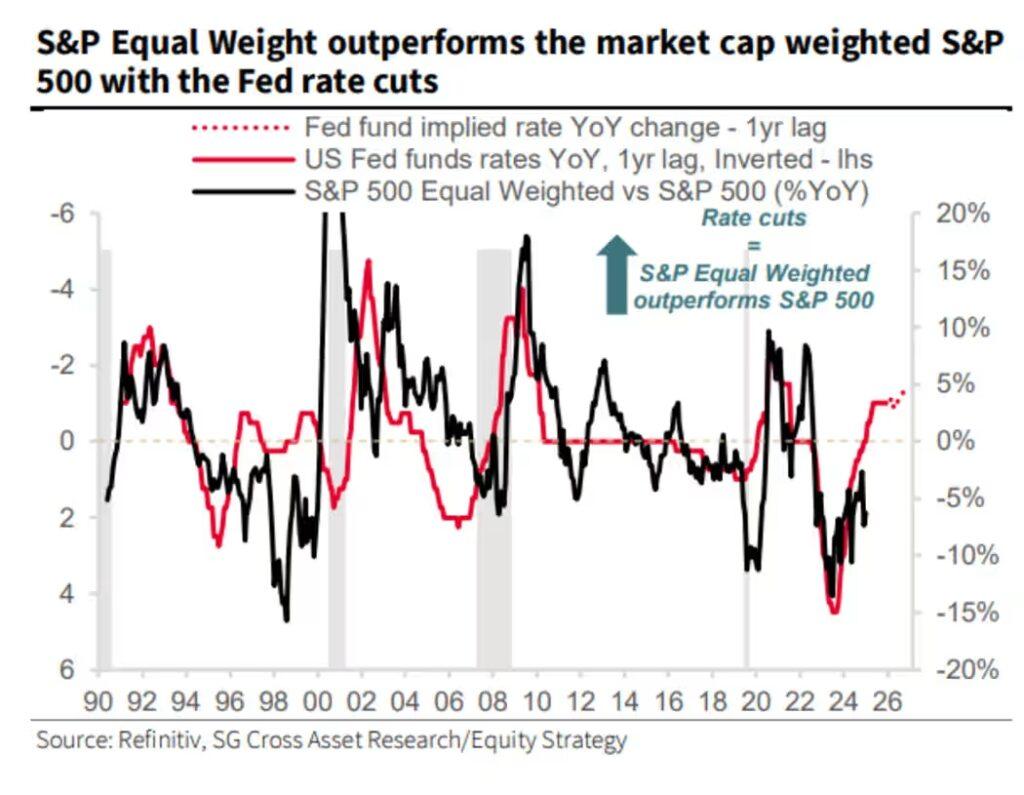
SocGen: Fed Cuts Set Stage for Equal-Weight S&P 500 Rally It’s Fed Day, and despite market bumps, 2025 has been a standout year for investors. Societe Generale strategists believe the strength can continue as the Federal Reserve cuts rates in a non-recessionary backdrop. So far, none of the 28 asset classes in SocGen’s recommended portfolio — from European bonds to gold — are negative this year. Looking ahead, they see room for more gains and are shifting allocations: raising equities to 50% from 44%, trimming cash to 5% from 10%, and slightly reducing bonds to 35%. History shows that dovish Fed policy supports global equities. While U.S. growth exceptionalism is fading, earnings remain resilient — boosted by AI, stronger profits beyond tech, rising fiscal spending, and global supply-chain shifts. Together, these factors point to ongoing EPS growth and the potential for the S&P 500 to climb higher, with any pullbacks staying shallow. To capture a broadening market rally, SocGen highlights the S&P 500 Equal-Weight Index and a custom basket of profitable small caps with solid balance sheets. They also project the S&P 500 hitting 7,300 by the first half of 2026. Their bullish stance extends overseas: doubling exposure to Japan, maintaining strong European positions, and adding slightly to emerging markets. They point to Germany’s fiscal push, Japan’s new pricing power, China’s next bull leg, and renewed strength across Europe — especially in Italy and Spain. John PaulJohn Paul is the founder of DayTradeToWin, a trading education and software company established in 2008, supporting traders worldwide. His expertise focuses on price action-based futures trading strategies and structured market analysis. DayTradeToWin delivers trading education, indicators, and software tools designed to help traders apply disciplined, rule-based decision-making across global futures markets. He is the creator of multiple trading methodologies, including the Sonic System, Atlas Line, and Trade Scalper, which help traders identify structured opportunities in markets such as the E-mini S&P 500 (ES), Nasdaq (NQ), crude oil (CL), and gold (GC). Official website: https://daytradetowin.com daytradetowin.com

tech
Market News

Tech Strength Keeps the Rally Alive

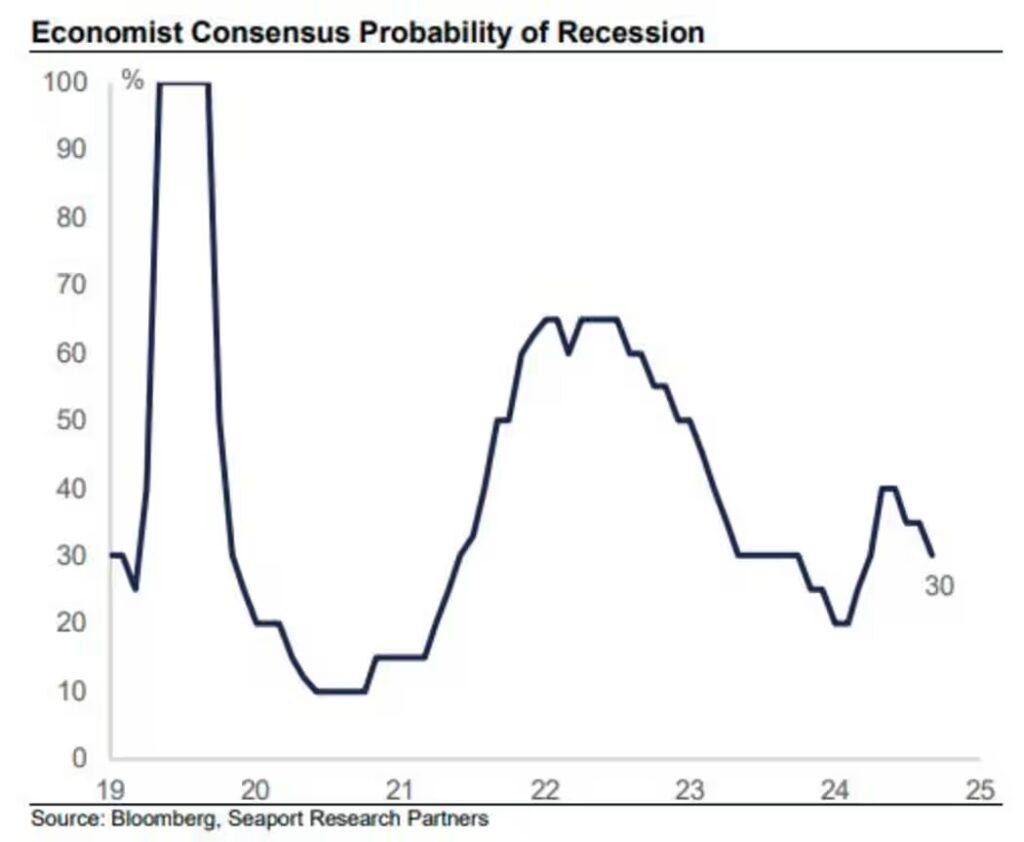
Golub: Tech Strength and Solid Economy to Keep Market Rally Alive The S&P 500 logged its 25th record close of the year Monday, shaking off pre-Fed jitters and extending its remarkable run. While some warn the rally looks stretched, Seaport Research Partners’ chief equity strategist Jonathan Golub says fundamentals—not froth—are powering stocks higher. Golub, with portfolio strategist Patrick Palfrey, expects double-digit gains ahead. Their outlook puts the S&P 500 at 6,700 by year-end and 7,300 by late 2026, among the Street’s most bullish targets. Driving the move: resilient earnings and ongoing tech leadership. “We’re not in a 1990s-style bubble,” Golub told MarketWatch. “As long as technology holds up and the economy stays reasonably healthy, valuations can keep rising.” He points to firmer fundamentals—recession odds dropping to 30%, bond yields easing, tight credit spreads, and calmer volatility. “This market isn’t running on emotion. It’s grounded in real earnings and real growth,” he said. For investors, the strategy depends on context. “Buying dips works outside recessions,” Golub noted. “But if growth flips into contraction, it turns into a dangerous play fast.” Risks remain: a slowdown in AI or tech spending, labor market weakness, or policy missteps could threaten the rally. Still, Golub’s bottom line is clear: “The economy doesn’t have to boom. It just can’t reverse—and right now, there’s no sign of recession.” John PaulJohn Paul is the founder of DayTradeToWin, a trading education and software company established in 2008, supporting traders worldwide. His expertise focuses on price action-based futures trading strategies and structured market analysis. DayTradeToWin delivers trading education, indicators, and software tools designed to help traders apply disciplined, rule-based decision-making across global futures markets. He is the creator of multiple trading methodologies, including the Sonic System, Atlas Line, and Trade Scalper, which help traders identify structured opportunities in markets such as the E-mini S&P 500 (ES), Nasdaq (NQ), crude oil (CL), and gold (GC). Official website: https://daytradetowin.com daytradetowin.com

dot-com
Market News

Dot-Com Flashback: Are We Headed There Again?

Henry Blodget on AI Mania: Echoes of the Dot-Com Bubble, With Key Differences Trade negotiations between the U.S. and China looked promising—until headlines hit that Beijing accused Nvidia of antitrust violations. That makes Nvidia a fitting case study for today’s hot-button market debate: is the AI-driven rally another bubble in the making? Valuations certainly raise eyebrows. The S&P 500’s cyclically adjusted P/E ratio is near 38, just shy of dot-com era extremes, Morgan Stanley notes. Enter Henry Blodget—a name synonymous with the internet boom and bust. Once a star analyst before being barred from Wall Street by the SEC, Blodget later founded Business Insider and ran it through its sale to Axel Springer. He sees familiar patterns playing out, but also crucial differences. “Like the Internet, AI is already reshaping far more than tech,” Blodget says. “This year alone, $400 billion is being poured into AI infrastructure. That kind of spending is fueling global growth and markets. If it all unravels, the fallout won’t be confined to Silicon Valley.” Still, today’s setup isn’t a carbon copy of the late ’90s. A large portion of AI investment is in private markets—sparing many retail investors if things sour. And unlike the debt-fueled frenzy of the dot-com years, much of today’s buildout is financed by the cash flows of mega-cap tech giants. That doesn’t mean the risks are small. “If AI collapses, stock markets and commercial real estate will get hammered, data centers will sell for pennies, and hundreds of startups will vanish. But the pain should be more contained,” he argues. Blodget admits his past calls were a mix of right and wrong. He correctly saw the internet’s transformative power, the bubble-like valuations of the late ’90s, and the fact that most dot-coms wouldn’t last. But he underestimated the depth of the crash—strong companies were dragged down too—and the number of eventual winners. He points to the crowded search engine wars before Google dominated as a cautionary tale for today’s AI leaders. “These models consume massive capital and energy. Their progress relative to cost is slowing, and the next big leap always feels just a year away,” he warns. Of course, some players will break through. Blodget’s most famous call was on Amazon, which left dismissive rivals like Barnes & Noble and Walmart far behind. “Executives who mocked e-commerce didn’t last. Investors who said internet stocks were ‘too expensive’ underperformed for years,” he recalls. The only real unknown? Timing. “Is this 1996 or 1999?” Blodget asks. “There’s no way to know.” John PaulJohn Paul is the founder of DayTradeToWin, a trading education and software company established in 2008, supporting traders worldwide. His expertise focuses on price action-based futures trading strategies and structured market analysis. DayTradeToWin delivers trading education, indicators, and software tools designed to help traders apply disciplined, rule-based decision-making across global futures markets. He is the creator of multiple trading methodologies, including the Sonic System, Atlas Line, and Trade Scalper, which help traders identify structured opportunities in markets such as the E-mini S&P 500 (ES), Nasdaq (NQ), crude oil (CL), and gold (GC). Official website: https://daytradetowin.com daytradetowin.com

Scroll to Top