

Market News

coal
Market News

Coal Isn’t Dead—It’s Undervalued

Why Coal Stocks Are Drawing Interest Despite Their Unpopularity Coal has long been considered one of the least desirable investments, especially as environmental concerns and ESG trends steer capital toward cleaner energy. Yet despite its tarnished reputation, a growing group of investors is taking a fresh look at it—largely due to ongoing demand and limited supply. Energy consultancy Wood Mackenzie recently projected that coal demand could remain resilient through 2030, contradicting many past forecasts of rapid decline. “While the long-term move toward renewables is still in motion, the transition is proving more complex,” said Anthony Knutson, global head of thermal coal markets at Wood Mackenzie. “Energy security and affordability are now top priorities for many countries.” These shifting priorities led Range Fund Holdings to launch the Range Global Coal Index ETF (COAL) in early 2024. Despite its modest $20 million size, the fund is one of the few dedicated ETFs on the market. CEO Tim Rotolo told MarketWatch the fund reflects a broader recognition of coal’s role in supporting energy reliability—especially following Russia’s invasion of Ukraine and the resulting energy crisis. “In a crisis, the goal becomes ensuring access to affordable energy—not climate goals,” Rotolo said. The fund’s top holdings include Yancoal Australia, Warrior Met Coal, and Alliance Resource Partners. It maintains a 50/50 allocation between metallurgical coal (used in steelmaking) and thermal coal (used for electricity and heating). Since launch, the ETF is down around 21%, but Rotolo sees long-term opportunity in the sector’s overlooked fundamentals. He argues that investor aversion to coal has created a market mispricing. For example, Peabody Energy dropped to under $1 per share in 2021, down from $45, and has since rebounded to around $17. Limited financing and regulatory hurdles forced many companies to focus on buying back stock or reducing debt—moves that can benefit shareholders when valuations are low. “There were no other options,” Rotolo said. “And that’s often when you find value—when everyone else has walked away.” He believes the bigger factor for coal prices is supply, not demand. “If demand remains stable and supply contracts, its prices can surge. That’s good for coal stocks.” Countries like India and China continue to drive demand, and coal remains an affordable energy option—especially given the long lead times for gas turbines and the limitations of renewables in fast-growing economies. “Asia’s younger coal fleet is adapting alongside renewable expansion,” Knutson added. Rotolo’s firm also launched a nuclear-focused ETF (NUKZ) at the same time as COAL, which is up 75% since inception—showing that investors are open to energy strategies beyond mainstream narratives. In a market where consensus often proves wrong, some see coal’s deep unpopularity as an opportunity—not a warning sign. John PaulJohn Paul is the founder of DayTradeToWin, a trading education and software company established in 2008, supporting traders worldwide. His expertise focuses on price action-based futures trading strategies and structured market analysis. DayTradeToWin delivers trading education, indicators, and software tools designed to help traders apply disciplined, rule-based decision-making across global futures markets. He is the creator of multiple trading methodologies, including the Sonic System, Atlas Line, and Trade Scalper, which help traders identify structured opportunities in markets such as the E-mini S&P 500 (ES), Nasdaq (NQ), crude oil (CL), and gold (GC). Official website: https://daytradetowin.com daytradetowin.com
market
Market News

Charts Hint at Bigger Market Decline

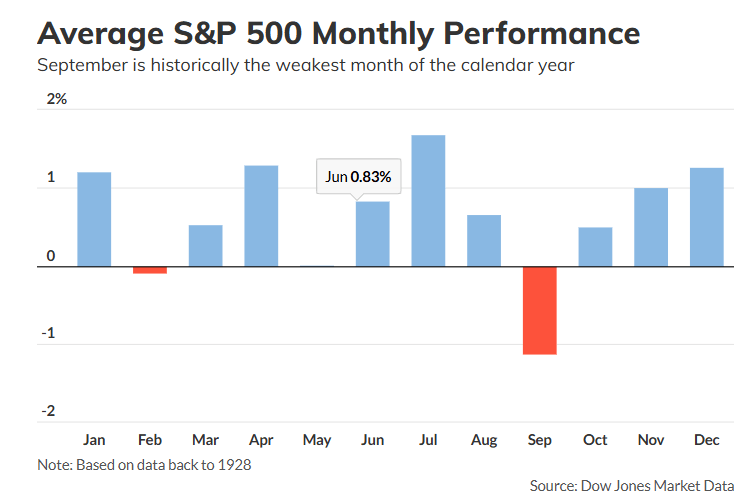
Stock Valuations Soar as Market Faces Historically Weak Season U.S. stocks have stumbled since early August, and Wall Street strategists are warning the slide may deepen. Julian Emanuel, chief equity and quantitative strategist at Evercore ISI, expects a 7% to 15% pullback by mid-October. Deutsche Bank strategists also foresee weakness, though they anticipate a more moderate decline. Despite near-term risks, Emanuel believes the long-term bull market remains intact and says deeper drops could attract dip buyers. Instead of selling outright, he recommends investors consider hedging strategies to protect portfolios. Valuations Back at Extreme Levels The Shiller CAPE ratio — a cyclically adjusted P/E metric — recently topped 38, its highest since late 2021. That previous peak preceded the S&P 500’s worst year since 2008 as the Federal Reserve’s aggressive rate hikes triggered a market rout. While Emanuel doesn’t expect a repeat, elevated valuations leave stocks vulnerable to negative surprises. Seasonal Weakness Ahead The stretch from August to October is historically the weakest for U.S. equities, according to BTIG’s Jonathan Krinsky. Although the relative strength index has cooled from overbought territory, it remains elevated — a signal that the current downturn could extend, noted Mark Hackett of Nationwide. Volatility Starting to Rise Wall Street’s “fear gauge,” the Cboe Volatility Index (VIX), is rebounding from its lowest level since January. Emanuel sees this as mean reversion, implying volatility could continue climbing in the weeks ahead. John PaulJohn Paul is the founder of DayTradeToWin, a trading education and software company established in 2008, supporting traders worldwide. His expertise focuses on price action-based futures trading strategies and structured market analysis. DayTradeToWin delivers trading education, indicators, and software tools designed to help traders apply disciplined, rule-based decision-making across global futures markets. He is the creator of multiple trading methodologies, including the Sonic System, Atlas Line, and Trade Scalper, which help traders identify structured opportunities in markets such as the E-mini S&P 500 (ES), Nasdaq (NQ), crude oil (CL), and gold (GC). Official website: https://daytradetowin.com daytradetowin.com
market
Market News

Hidden Market Forces at Play

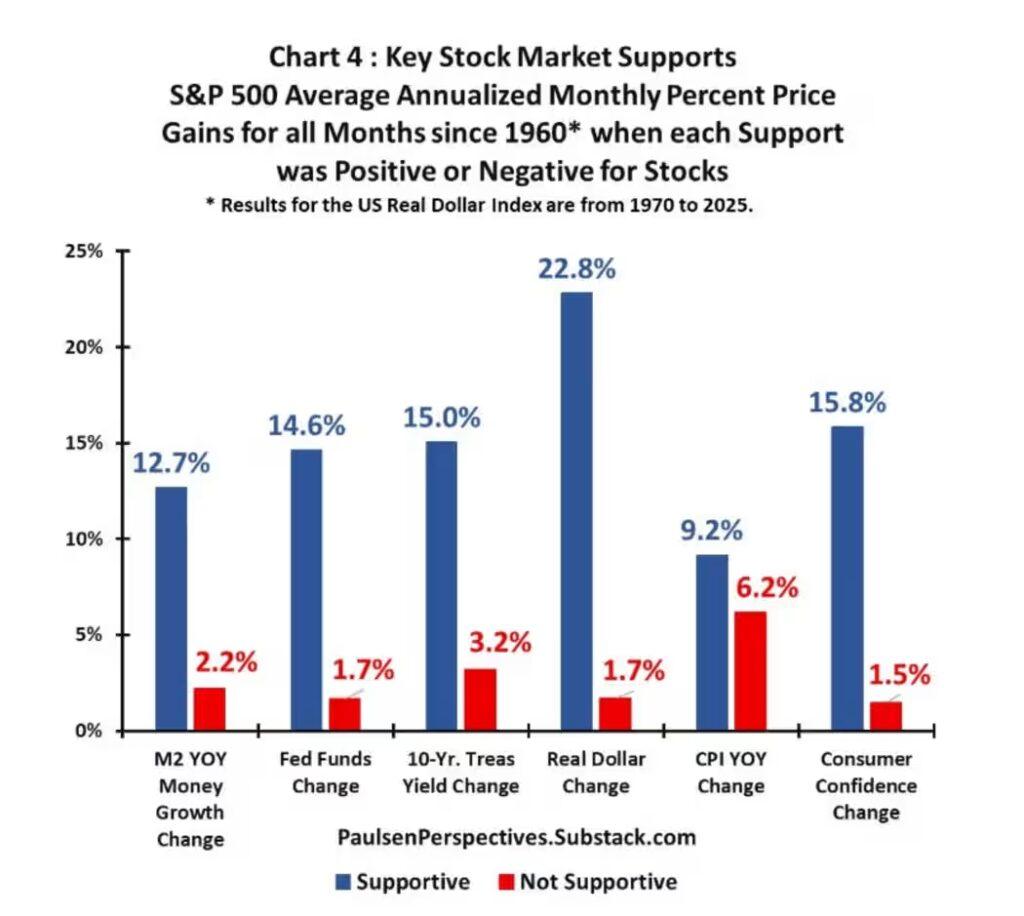
Jim Paulsen Says the Bull Market Is Just Getting Started — If the Fed Cuts Rates Stocks snapped back on Monday, with investors shaking off last week’s selloff and betting on Federal Reserve rate cuts ahead. But according to veteran strategist Jim Paulsen, the real rally hasn’t even started yet. In a new Substack post, the former chief investment strategist — now heading Paulsen Perspectives — says Wall Street is underestimating how much firepower this bull market still has. And the key to unlocking it? Rate cuts from the Fed. “This bull market has been running on fumes,” Paulsen writes. “Imagine what it could do if the Fed actually helped.” He points out that the current rally began and has matured while the Fed has kept interest rates high, the yield curve inverted, and money supply growth unusually weak — all hallmarks of a restrictive monetary environment. Typically, that kind of setup would slow the economy and limit market gains. Paulsen argues the Fed’s “chronic” tight policy has kept longer-term bond yields elevated, strengthened the dollar, and weighed down consumer confidence — all factors that have held stocks back. But if the Fed begins a sustained rate-cutting cycle? “It would trigger far more support for equities than most realize,” Paulsen says. Falling rates would likely weaken the dollar, ease bond and mortgage rates, boost the money supply, and lift consumer sentiment. He backs up his claim with a historical comparison: Since 1960, the S&P 500 has delivered annualized returns 10.5 percentage points higher during months when the Fed was cutting rates versus when it was hiking. Consumer confidence plays a major role too. When it rises, the average annualized gain in the S&P 500 jumps to 15.8%. But when confidence falls, that drops to just 1.5%. With sentiment currently near historic lows, Paulsen believes it’s more likely to rebound than fall further in the year ahead — a shift that could act as a powerful tailwind for stocks. “If confidence improves, it would be a rare and potent force that investors have barely benefited from during this entire bull run,” he notes. Of course, not everyone is as optimistic. Bank of America warned Monday that the market may be misreading the signals — confusing recession risks with stagflation — and that the Fed might keep rates unchanged until 2026. Still, Paulsen’s message is clear: this bull market isn’t running out of steam — it’s waiting for a green light from the Fed. John PaulJohn Paul is the founder of DayTradeToWin, a trading education and software company established in 2008, supporting traders worldwide. His expertise focuses on price action-based futures trading strategies and structured market analysis. DayTradeToWin delivers trading education, indicators, and software tools designed to help traders apply disciplined, rule-based decision-making across global futures markets. He is the creator of multiple trading methodologies, including the Sonic System, Atlas Line, and Trade Scalper, which help traders identify structured opportunities in markets such as the E-mini S&P 500 (ES), Nasdaq (NQ), crude oil (CL), and gold (GC). Official website: https://daytradetowin.com daytradetowin.com

Big tech
Market News

Big Tech on Thin Ice

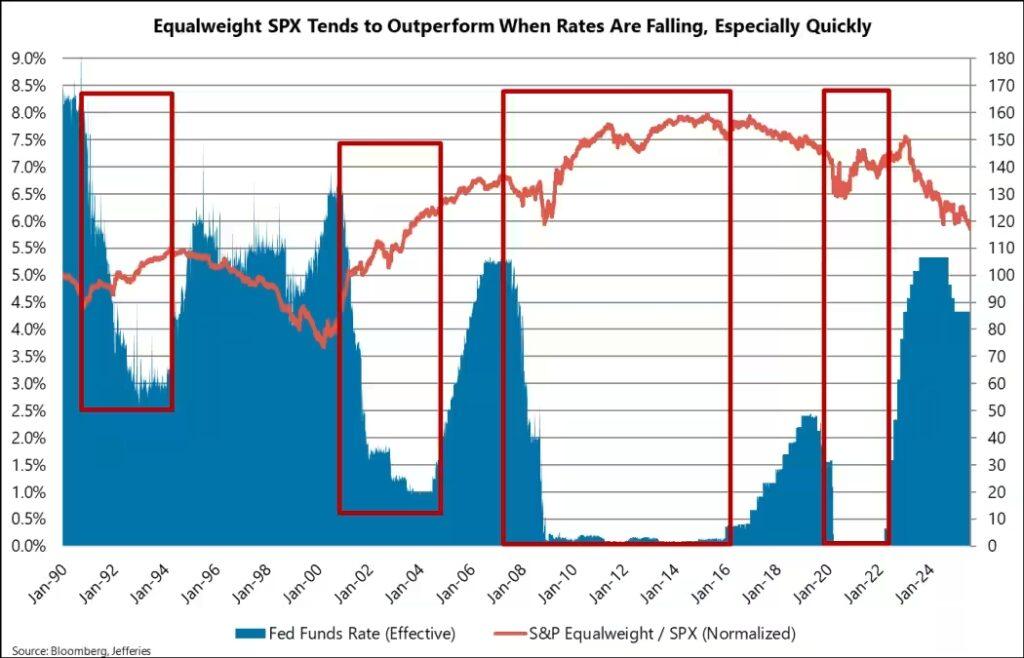
Jefferies: Fed Cuts May Spark Shift Away from Big Tech The S&P 500 fell 1.6% on Friday—its worst session since May—after soft jobs data and renewed tariff concerns rattled markets. But U.S. stock futures on Monday hint at a partial rebound, and some strategists remain optimistic despite near-term headwinds. According to Jefferies, investors now face a roughly seven-week period marked by a weakening labor market and limited central bank support. The Fed is widely expected to cut interest rates by 25 basis points at its September 17 meeting, lowering the target range to 4.00%–4.25%. Still, Jefferies remains positive. “It’s a tougher sell after this week, but we still believe equities are heading higher,” they wrote over the weekend. Strong second-quarter earnings are one reason: two-thirds of S&P 500 companies have reported so far, and 85% have beaten expectations—lifting earnings forecasts and supporting stock prices. But Jefferies is growing cautious on Big Tech. The sector now makes up a record 44% of the S&P 500 by weight—surpassing the 2000 dot-com peak. While still delivering solid results and acting as a defensive play, Jefferies questions how much longer that leadership can last. They’re not calling it a bubble, but note that valuations are stretched. The premium on tech versus the cheapest stocks is in the 87th percentile historically—making the trade look “long in the tooth.” More importantly, Jefferies notes that rate cuts tend to favor the equal-weighted S&P 500, which gives more influence to smaller names outside tech. Historically, most periods of outperformance for equal-weighted stocks have come when the Fed is easing policy. “We’re not predicting a major tech selloff,” Jefferies says. “But with the Fed turning dovish, history suggests a rotation may be starting. Friday’s payroll data could be the signal: it might finally be time to shift out of large-cap tech.” John PaulJohn Paul is the founder of DayTradeToWin, a trading education and software company established in 2008, supporting traders worldwide. His expertise focuses on price action-based futures trading strategies and structured market analysis. DayTradeToWin delivers trading education, indicators, and software tools designed to help traders apply disciplined, rule-based decision-making across global futures markets. He is the creator of multiple trading methodologies, including the Sonic System, Atlas Line, and Trade Scalper, which help traders identify structured opportunities in markets such as the E-mini S&P 500 (ES), Nasdaq (NQ), crude oil (CL), and gold (GC). Official website: https://daytradetowin.com daytradetowin.com

stocks
Market News

Stocks Fall on Tariff Shock; Amazon Shares Slide

Global stocks slumped Friday as President Donald Trump’s sweeping new import tariffs deepened concerns over global growth and inflation. S&P 500 futures fell more than 1%, signaling a fourth day of declines. Amazon.com Inc. tumbled up to 8% in premarket trading after underwhelming earnings, injecting caution into an otherwise upbeat Big Tech reporting season. The dollar and Treasury yields climbed after Trump blasted the Federal Reserve on social media, urging its board to “assume control” if Chair Jerome Powell fails to cut rates. Investors are also bracing for July’s US jobs report, expected later today. Trump’s plan imposes a 10% global minimum tariff and 15% or higher duties on trade-surplus nations, escalating his bid to rewrite global commerce. The measures have begun to overshadow the AI-driven optimism that had buoyed megacap stocks. “Next week marks a pivotal shift for global trade,” said Kim Heuacker, associate consultant at Camarco. “High US stock valuations are becoming increasingly tough to justify.” Europe’s Stoxx 600 dropped over 1% to a one-month low, led lower by pharma names like Novo Nordisk, GSK and AstraZeneca after Trump demanded drugmakers cut US prices. The MSCI All Country World Index declined for a sixth session — its longest losing streak since September 2023. “The tariffs are really bad for Europe,” warned Ludovic Subran, chief investment officer at Allianz SE. “The cost for companies will be huge, as the US is their biggest market by far.” Most baseline tariffs remain at 10%, but Trump’s move to hike duties on some Canadian goods to 35% risks straining relations further. Bloomberg Economics estimates the average US tariff will jump to 15.2% under the plan — up from 13.3% now and far above the 2.3% level before Trump returned to office. Bloomberg strategists caution that seasonal weakness, muted earnings, and a strong euro leave European stocks vulnerable: “Tariffs and soft growth remain major headwinds into year-end,” said Nour Al Ali of Macro Markets & Squawk. Attention now turns to July’s payrolls report, forecast to show moderating hiring and unemployment ticking up to 4.2%. “With so much uncertainty, it’s natural for traders to take profits ahead of nonfarm payrolls,” said Gareth Nicholson, CIO of Nomura International Wealth Management. John PaulJohn Paul is the founder of DayTradeToWin, a trading education and software company established in 2008, supporting traders worldwide. His expertise focuses on price action-based futures trading strategies and structured market analysis. DayTradeToWin delivers trading education, indicators, and software tools designed to help traders apply disciplined, rule-based decision-making across global futures markets. He is the creator of multiple trading methodologies, including the Sonic System, Atlas Line, and Trade Scalper, which help traders identify structured opportunities in markets such as the E-mini S&P 500 (ES), Nasdaq (NQ), crude oil (CL), and gold (GC). Official website: https://daytradetowin.com daytradetowin.com

nasdaq
Market News

Dow, S&P, Nasdaq Futures Climb on Strong Results

S&P 500 and Nasdaq futures jumped Thursday, pointing to fresh record highs after blowout earnings from Meta (META) and Microsoft (MSFT) reignited optimism over Big Tech’s AI spending spree. Nasdaq 100 futures (NQ=F) rose about 1.3%, while S&P 500 contracts (ES=F) gained nearly 1%. Dow Jones Industrial Average futures (YM=F) trailed with a 0.3% rise. Meta surged 12% premarket after topping earnings forecasts and raising guidance, while Microsoft jumped over 8%, moving closer to a $4 trillion valuation. Investors are now awaiting results from Apple (AAPL) and Amazon (AMZN) after the close for the next catalyst. On the macro front, the focus shifts to the Fed’s preferred inflation gauge — the PCE index — after the central bank left rates unchanged for a fifth straight meeting Wednesday. Chair Jerome Powell stressed “no decisions” had been made about a September cut, pushing back against President Trump’s claims one was imminent. Market odds of a September cut slid below 40% from 60% before the meeting, CME data shows. Meanwhile, a new trade deal with South Korea eased tariff tensions ahead of Friday’s deadline. The agreement imposes a 15% tariff on South Korean imports, eliminates duties on U.S. exports, and includes a $350 billion investment pledge along with increased U.S. energy purchases. John PaulJohn Paul is the founder of DayTradeToWin, a trading education and software company established in 2008, supporting traders worldwide. His expertise focuses on price action-based futures trading strategies and structured market analysis. DayTradeToWin delivers trading education, indicators, and software tools designed to help traders apply disciplined, rule-based decision-making across global futures markets. He is the creator of multiple trading methodologies, including the Sonic System, Atlas Line, and Trade Scalper, which help traders identify structured opportunities in markets such as the E-mini S&P 500 (ES), Nasdaq (NQ), crude oil (CL), and gold (GC). Official website: https://daytradetowin.com daytradetowin.com

Scroll to Top