
Market News

S&P 500
Market News

Rare S&P 500 Signal — Is a Big Move Coming?

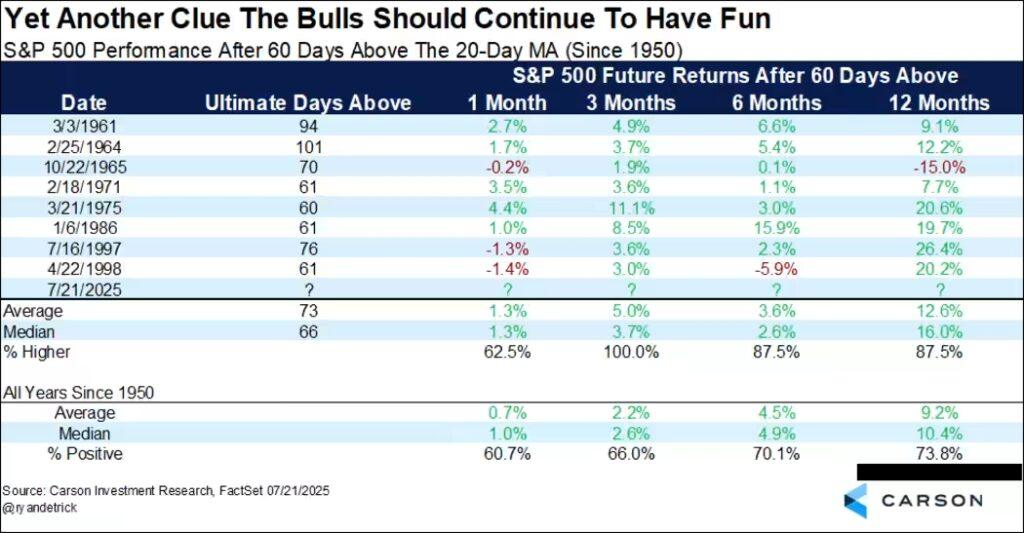
A key U.S. stock index has remained above its 20-day moving average, underscoring the market’s resilience. Japan is also in focus Wednesday after reaching a tentative trade agreement with the U.S., while speculation swirls over whether its prime minister will soon depart. The tariff news has fueled optimism heading into the Aug. 1 deadline — a date even President Donald Trump and Treasury Secretary Scott Bessent suggest is flexible. Carson Group’s chief market strategist, Ryan Detrick, points out a striking milestone: The S&P 500 (SPX) has now closed above its 20-day moving average for 60 straight sessions. Aside from a brief scare on June 20, the streak has remained unbroken. Historically, runs this long have occurred only four times since 1950, with average gains of 20% to 26% in the year that followed. Detrick’s analysis shows eight similar streaks overall, but this marks the first instance in the 21st century. While one exception in 1965 saw the market decline a year later, the typical outcome was a median gain of 10.4% and an average gain of 9.2%. “This is yet another clue this bull market still has legs,” Detrick said. Some analysts caution, however, that such strength could also signal overheating — a pattern recently noted in the Nasdaq-100 as well. John PaulJohn Paul is the founder of DayTradeToWin, a trading education and software company established in 2008, supporting traders worldwide. His expertise focuses on price action-based futures trading strategies and structured market analysis. DayTradeToWin delivers trading education, indicators, and software tools designed to help traders apply disciplined, rule-based decision-making across global futures markets. He is the creator of multiple trading methodologies, including the Sonic System, Atlas Line, and Trade Scalper, which help traders identify structured opportunities in markets such as the E-mini S&P 500 (ES), Nasdaq (NQ), crude oil (CL), and gold (GC). Official website: https://daytradetowin.com daytradetowin.com
stocks
Market News

Warning: Stocks Losing Support?

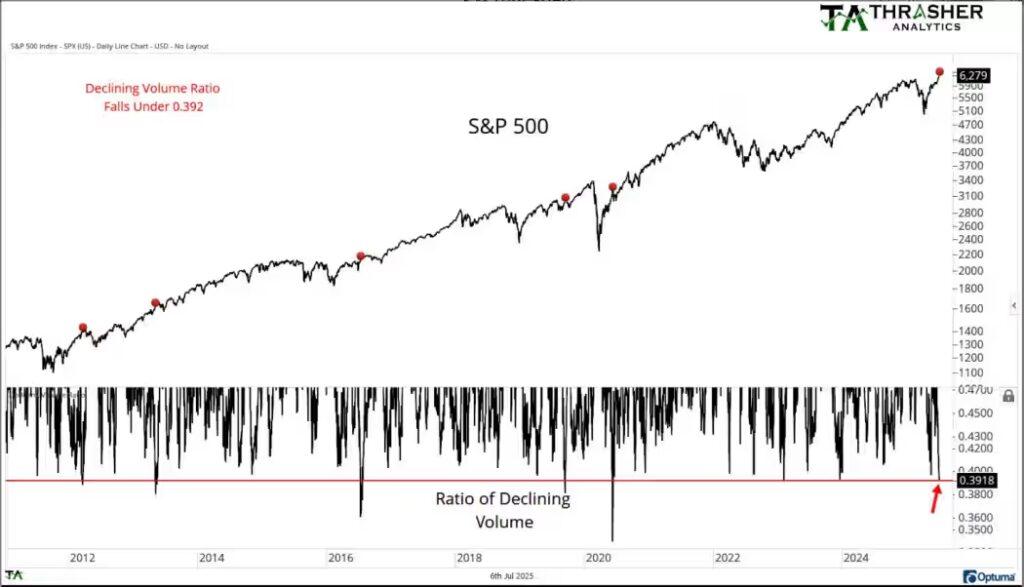
What Will Drive Stocks Higher Now? Strategist Sees Bullish Fatigue Setting In Since 2012, the S&P 500 has been on a mostly steady climb—an easy reason for investors to keep holding on. But recently, it’s not just that stocks are rising; it’s that sellers have all but vanished. And that, says Andrew Thrasher of Thrasher Analytics, could be a red flag. In his latest research, Thrasher found that downside activity in the market has hit unusually low levels. “We’re not seeing much volume in declining stocks,” he told MarketWatch. “There’s no real capitulation or heavy selling happening—just relentless buying. That’s often a sign of overly bullish sentiment.” His data shows that in early July, just 39% of trading volume came from declining stocks—well below the 42% threshold that has historically signaled a near-term pullback. Similar setups preceded drops in 2020, 2019, and 2016. Now, that ratio has nudged higher to 44%, a sign that sellers may finally be stepping back in. “We’re starting to see more downside volume, fewer new highs, and generally weaker participation from individual stocks,” Thrasher said. “It’s not falling apart—but it’s thinning out.” Thrasher, who helps manage over $800 million at The Financial Enhancement Group, says the market still looks “structurally sound,” but he questions what catalyst could drive the next big move up. Lingering tariff risks and the potential for rising inflation could pressure consumers and shift market sentiment. While he continues to focus on price action first and foremost, Thrasher warns that overly one-sided bullishness can’t last forever. “At extremes, the market becomes like a teeter-totter—too many people on one side, and it can’t move.” John PaulJohn Paul is the founder of DayTradeToWin, a trading education and software company established in 2008, supporting traders worldwide. His expertise focuses on price action-based futures trading strategies and structured market analysis. DayTradeToWin delivers trading education, indicators, and software tools designed to help traders apply disciplined, rule-based decision-making across global futures markets. He is the creator of multiple trading methodologies, including the Sonic System, Atlas Line, and Trade Scalper, which help traders identify structured opportunities in markets such as the E-mini S&P 500 (ES), Nasdaq (NQ), crude oil (CL), and gold (GC). Official website: https://daytradetowin.com daytradetowin.com

stocks
Market News

Too Hot? JPMorgan Warns on Crowded Volatile Stocks

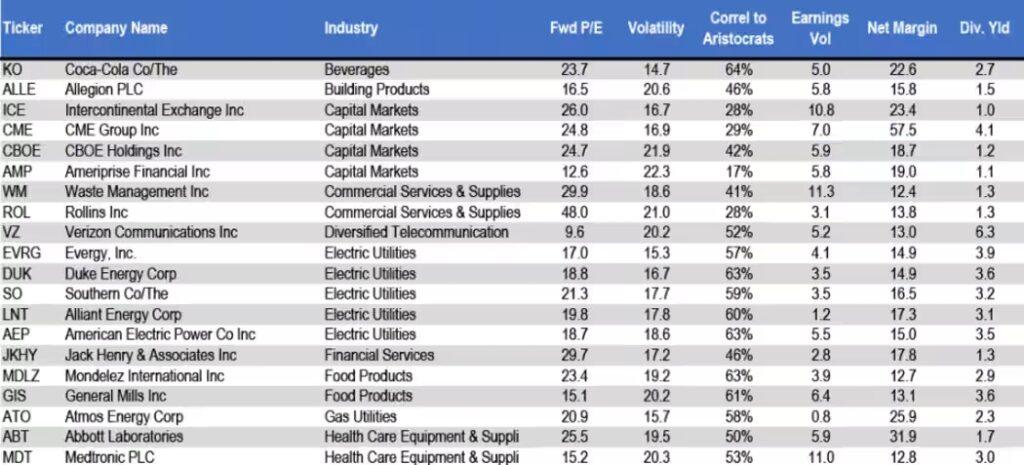
The High-Beta Frenzy: A Warning Sign for Markets As U.S. stocks hover near record highs, enthusiasm for high-volatility names is boiling over — and that’s making some analysts nervous. CNBC’s Jim Cramer just unveiled his latest acronym: PARC — Palantir, Applovin, Robinhood, and Coinbase — a group of high-beta, momentum-driven stocks. Critics were quick to point out that “PARC” spelled backward is a warning in itself. More importantly, this surge into high-beta stocks is setting off alarms on Wall Street. JPMorgan strategist Dubravko Lakos-Bujas says investor positioning has hit extreme levels. In fact, he notes this is the third major “crowding” event this year: According to JPMorgan, the current high-beta crowding is in the 100th percentile — meaning it’s as extreme as it gets — and the speed of the move is unprecedented, rising from the 25th to 100th percentile in just three months, the fastest in 30 years. Short interest has also collapsed, indicating that investors aren’t hedging for downside risk. “This level of positioning reflects complacency and presents a risk not just to these speculative stocks but to the broader market,” Lakos-Bujas warned. Many of the most crowded names are retail favorites, including: So, what now? JPMorgan suggests rotating into low-volatility stocks, which underperformed after peaking in April but now offer compelling risk/reward. With upcoming tariff deadlines (Aug. 1), seasonal market weakness, and stretched investor sentiment, defensive names could shine. Their top picks include: In a market chasing risky bets, the safer plays may soon have their moment again. John PaulJohn Paul is the founder of DayTradeToWin, a trading education and software company established in 2008, supporting traders worldwide. His expertise focuses on price action-based futures trading strategies and structured market analysis. DayTradeToWin delivers trading education, indicators, and software tools designed to help traders apply disciplined, rule-based decision-making across global futures markets. He is the creator of multiple trading methodologies, including the Sonic System, Atlas Line, and Trade Scalper, which help traders identify structured opportunities in markets such as the E-mini S&P 500 (ES), Nasdaq (NQ), crude oil (CL), and gold (GC). Official website: https://daytradetowin.com daytradetowin.com
market
Market News

What This Fund Manager Learned from Market Swings

Akre Capital’s John Neff Builds Cash Pile, Stays Focused on Quality Amid Uncertainty John Neff, CEO and CIO of Akre Capital Management, is preparing for potential market dislocations by raising the firm’s cash position from 1.4% to 8.1% this year. In his Q2 shareholder letter, Neff said the move isn’t driven by any immediate catalyst, but rather a desire to stay ready. “We’ve made a point of raising our cash position in case our valuation discipline and patience gets rewarded in the weeks and months ahead,” he explained. Neff leaned on historical research to frame his long-term approach. He referenced the 2021 study, Even God Would Get Fired as an Active Investor, which showed that even if an investor could perfectly predict the best-performing stocks over five years, they would still face major drawdowns — up to 76% during the Great Depression and roughly 40% in more recent crises. He also pointed to research from Morgan Stanley’s Michael Mauboussin and Dan Callahan. They found that even the most successful companies — Apple, Microsoft, Nvidia, Alphabet, Amazon, and Exxon Mobil — experienced average peak-to-trough losses of 80%. And the median stock never fully recovered. However, the highest-quality businesses nearly doubled in value five years after bottoming. Neff believes that insight supports Akre’s focus on business quality and compounding, which he says differs meaningfully from traditional value investing. “Those distinctions center on the primacy of business quality,” he noted. During the March 2020 COVID selloff, Akre invested $1.1 billion but avoided sectors like airlines and cruise lines, which he did not consider durable businesses. While the airline sector (via the JETS ETF) initially rebounded 86%, its long-term performance faded. In contrast, Akre’s 2020 investments gained 75% in the first year and have since compounded at 22% annually, excluding dividends. Today, Akre’s top holdings include Constellation Software, Mastercard, Visa, Brookfield, KKR, and Moody’s. On potential threats to Visa and Mastercard from stablecoins, Neff said he sees them more as new currencies to integrate into existing payment networks than as competitors. In the face of a richly valued market, Neff’s message is clear: stay focused on quality, be patient, and keep cash ready for when the odds improve. John PaulJohn Paul is the founder of DayTradeToWin, a trading education and software company established in 2008, supporting traders worldwide. His expertise focuses on price action-based futures trading strategies and structured market analysis. DayTradeToWin delivers trading education, indicators, and software tools designed to help traders apply disciplined, rule-based decision-making across global futures markets. He is the creator of multiple trading methodologies, including the Sonic System, Atlas Line, and Trade Scalper, which help traders identify structured opportunities in markets such as the E-mini S&P 500 (ES), Nasdaq (NQ), crude oil (CL), and gold (GC). Official website: https://daytradetowin.com daytradetowin.com
market
Market News

Whales May Drive the Next Market Move

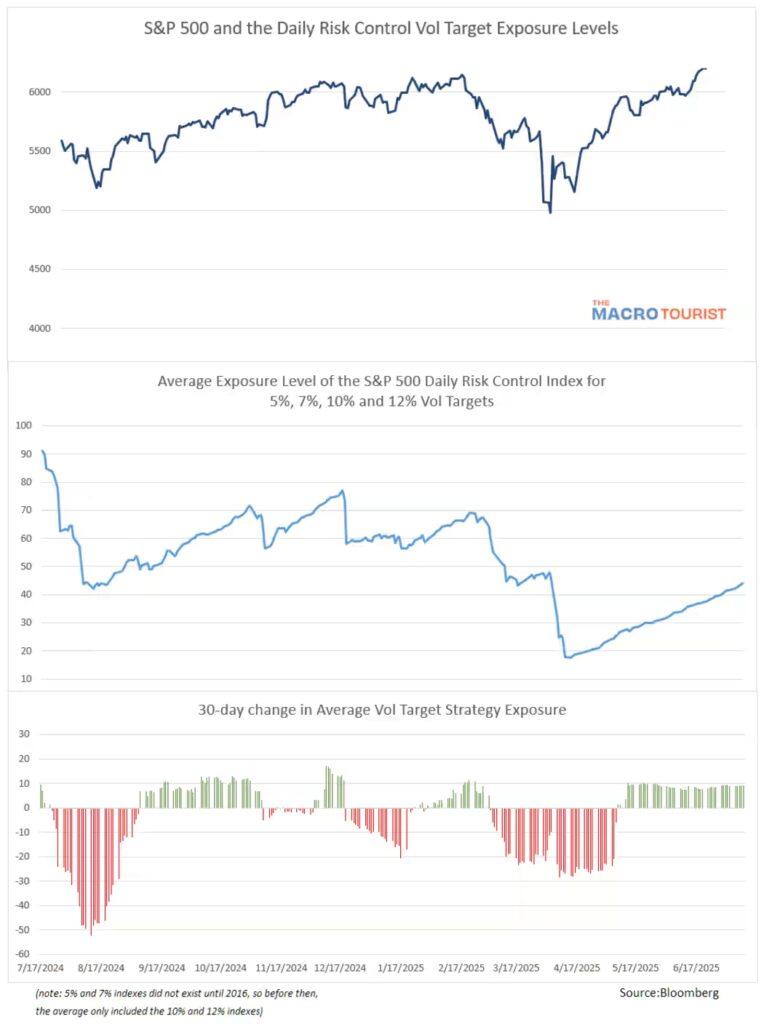
Kevin Muir Signals Caution as Vol-Control Funds Approach Buying Limit The stock market’s sharp rally this year has lifted investor sentiment—but it’s also raising red flags for some market veterans. Among them is Kevin Muir, former institutional trader and author of The Macro Tourist blog, who believes the powerful forces driving this surge may be losing steam. In a recent interview with MarketWatch, Muir warned that volatility control funds—also known as “vol-control” strategies—are nearing the end of their buying spree. These large institutional players, which include pensions and endowments, adjust their equity exposure based on market volatility. When markets are calm, they buy. When turbulence rises, they cut back. “This is the kind of behind-the-scenes force that gets little media attention, but moves serious money,” Muir said. He estimates these strategies manage between $300 billion and $500 billion, enough to influence major market swings. According to Muir, much of the stock market’s recent upside—especially over the past two months—can be attributed to these funds methodically re-entering equities after being forced to de-risk during volatility spikes earlier in the year. “I’ve been watching and waiting for the bulk of this buying to play out,” Muir said. “And while some is still ongoing, we’re getting close to the end of it.” He believes this explains why markets have seemed to drift higher on quiet days with no clear headlines. “It’s these vol-control funds steadily buying, even when it doesn’t seem like there’s a reason.” What concerns Muir even more is the relentless optimism from retail traders. “Retail has stayed in and kept buying. And while they’ve done well recently, it feels a lot like 1999—or even the euphoria we saw in 2021,” he said. To Muir, this rally now looks dangerously stretched. He sees U.S. stocks as overvalued, overowned, and heavily concentrated, all in a market environment he describes as unusually unstable due to unpredictable policy shifts and economic crosscurrents. “With seasonals still strong and vol-control flows in play, I didn’t want to fight the rally,” Muir admitted. “But now, it feels like the time has come to step back.” His advice for investors? Begin to reduce risk in U.S. equities and diversify globally. He also cautioned that geopolitical risks—such as tariffs—could become new headwinds for markets already priced for perfection. “The setup reminds me of moments in history when sentiment peaked and concentration was extreme,” Muir said. “I’m not calling a crash, but I am saying: this is the point to start being careful.” John PaulJohn Paul is the founder of DayTradeToWin, a trading education and software company established in 2008, supporting traders worldwide. His expertise focuses on price action-based futures trading strategies and structured market analysis. DayTradeToWin delivers trading education, indicators, and software tools designed to help traders apply disciplined, rule-based decision-making across global futures markets. He is the creator of multiple trading methodologies, including the Sonic System, Atlas Line, and Trade Scalper, which help traders identify structured opportunities in markets such as the E-mini S&P 500 (ES), Nasdaq (NQ), crude oil (CL), and gold (GC). Official website: https://daytradetowin.com daytradetowin.com

markets
Market News

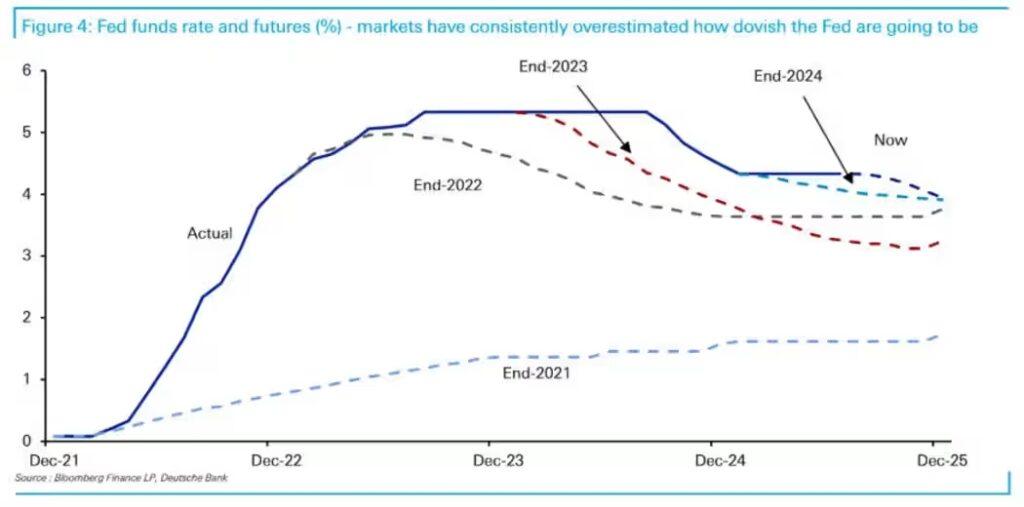
4 Years of Fed Misses: Will Markets Ever Learn?

Tariff Risks Are Rising—But Markets Aren’t Paying Attention Stocks look set for a subdued session, even as warning signs build beneath the surface. Tuesday’s bond market reaction to hotter-than-expected June inflation showed just how quickly sentiment can shift—especially as tariffs start to play a bigger role. Consumer prices jumped last month by the most since early 2025, and some economists are starting to connect the dots. Henry Allen, macro strategist at Deutsche Bank, says investors remain too relaxed about the inflation outlook. “There’s still a striking complacency across major asset classes,” Allen said in a Wednesday note. “This is now the fourth consecutive year that markets have misjudged how hawkish the Fed would actually be.” One key factor Allen flags: rising tariffs. Former President Donald Trump has proposed sweeping trade policies, including a 10% baseline tariff on most imports, with additional levies on steel, aluminum, autos, and possibly copper. Markets, however, haven’t priced in these possibilities. According to betting markets, there’s a 28% chance Trump’s proposed 30% tariff on EU goods becomes reality, and a 43% chance that Canada’s 35% tariff goes through. “If enacted, they’d be a major surprise,” Allen said. “Most investors aren’t prepared for them.” Beyond the U.S., retaliation is also a risk. The European Union reportedly has a list of U.S. products ready to target in response to new duties. Allen warns this could ignite a broader inflation wave by disrupting global supply chains and pushing prices higher. Evidence may already be emerging. Tuesday’s inflation data showed the largest-ever monthly jump in household appliance prices. Allen believes this could signal a broader trend: “The strength in core goods may soon spread across the consumer basket, making inflation more persistent.” Geopolitical risks could add fuel to the fire. Allen cites last month’s Iran-Israel tensions, which briefly drove oil prices higher, as the kind of unpredictable shock that can reignite inflation expectations. Meanwhile, central banks are still expected to cut rates later this year—bets that Allen says are increasingly out of touch. “Markets keep assuming dovish pivots that never arrive. At the start of 2025, traders were pricing in a Fed rate cut by June, which didn’t happen.” Debt burdens could also play a role. Governments may be tempted to tolerate surprise inflation as a short-term fix for high debt, even if markets eventually demand higher rates to compensate. “The bottom line,” Allen said, “is that markets continue to underestimate the inflation risks still ahead—particularly from tariffs. That could set the stage for yet another round of painful surprises.” John PaulJohn Paul is the founder of DayTradeToWin, a trading education and software company established in 2008, supporting traders worldwide. His expertise focuses on price action-based futures trading strategies and structured market analysis. DayTradeToWin delivers trading education, indicators, and software tools designed to help traders apply disciplined, rule-based decision-making across global futures markets. He is the creator of multiple trading methodologies, including the Sonic System, Atlas Line, and Trade Scalper, which help traders identify structured opportunities in markets such as the E-mini S&P 500 (ES), Nasdaq (NQ), crude oil (CL), and gold (GC). Official website: https://daytradetowin.com daytradetowin.com

Scroll to Top