

Market News

Goldman Sachs
Market News

Why Goldman Sachs Raised Its S&P 500 Target Again

As third-quarter earnings season begins, Goldman Sachs has once again raised its target for the S&P 500. Led by David Kostin, the Goldman Sachs team has now increased its forecast for the S&P 500 to 6,000 in the next three months, up from the previous estimate of 5,600. Looking further ahead, they expect the index to reach 6,300 in 12 months, an upgrade from their prior projection of 6,000. The driving force behind this upgrade is their optimism about earnings growth in 2025 and 2026. Goldman expects S&P 500 companies to earn $268 per share in 2025 and $288 in 2026, outpacing Wall Street’s consensus estimates of $265 and $281. Although these numbers are below aggregated estimates of $275 for 2025 and $307 for 2026, Goldman remains more positive than many of its peers. “From a top-down view, our U.S. GDP growth forecast is above consensus. However, bottom-up earnings estimates are often too optimistic and tend to be revised down over time,” said the team. Goldman Sachs attributes much of this confidence to expected improvements in profit margins. They now predict margins will increase to 12.3% in 2025, up from 11.5% in 2024, and will continue to rise to 12.6% by 2026. This marks a significant shift from their earlier projection of a 24-basis-point margin expansion in 2025, now revised to 78 basis points. “The economic backdrop continues to support moderate margin growth, with prices rising faster than input costs,” they explained. A portion of this margin improvement is also expected to come from industry-specific factors. Goldman anticipates that elevated research-and-development costs in healthcare, particularly for companies like Bristol-Myers Squibb, will stabilize. They also expect that one-time charges taken this year by Warner Bros. Discovery and Uber Technologies will not recur. Additionally, a recovery in the semiconductor industry and strong performance from large tech companies are anticipated to fuel growth. While Goldman acknowledges that earnings surprises may moderate, they believe the continued strong demand for AI, as highlighted in their recent GS Communacopia Conference, will benefit key technology stocks. John PaulJohn Paul is the founder of DayTradeToWin, a trading education and software company established in 2008, supporting traders worldwide. His expertise focuses on price action-based futures trading strategies and structured market analysis. DayTradeToWin delivers trading education, indicators, and software tools designed to help traders apply disciplined, rule-based decision-making across global futures markets. He is the creator of multiple trading methodologies, including the Sonic System, Atlas Line, and Trade Scalper, which help traders identify structured opportunities in markets such as the E-mini S&P 500 (ES), Nasdaq (NQ), crude oil (CL), and gold (GC). Official website: https://daytradetowin.com daytradetowin.com
U.S. stock
Market News

A Foreigner’s Take on U.S. Stock Market Revival

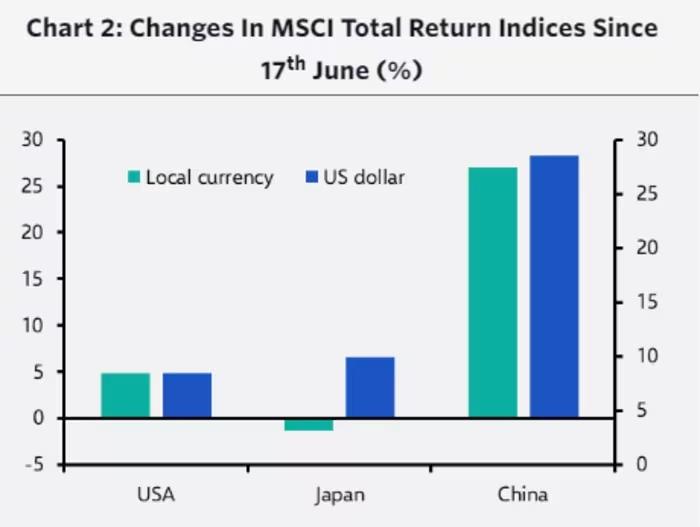
U.S. Equities Could Reclaim Market Leadership, Analyst Predicts As inflation cools and the nonfarm payroll report regains its prominence, some normalcy has returned for traders. However, the U.S. stock market has experienced unusual underperformance lately. Hubert de Barochez, senior markets economist at Capital Economics, notes that since mid-June, the MSCI USA index has returned less than 5%, only half of what global markets outside the U.S. have achieved. De Barochez highlights four main factors behind this lag. First, U.S. tech stocks, which represent a large part of the market, have been struggling. While there’s been a recent bounce, the U.S. tech sector has seen sharper declines than elsewhere, and communication services have fallen in the U.S. but gained globally. Fears of an economic slowdown have raised doubts about tech earnings growth, with many companies previously “priced for perfection.” Second, the U.S. market has a smaller share of financial stocks, which have benefited from a steepening yield curve. Financials make up just 13% of the U.S. index, compared to 22% of global markets outside the U.S., limiting their positive impact on U.S. returns. Third, the U.S. dollar’s depreciation has boosted foreign equity returns in dollar terms. For instance, Japanese stocks saw significant gains, driven in part by the yen’s 8% rise against the dollar since mid-June. Finally, a 30% surge in Chinese stocks, fueled by Beijing’s economic stimulus, has added to the pressure on U.S. equities. Despite these challenges, de Barochez believes the U.S. market will eventually retake the lead, consistent with historical trends during past Fed easing cycles, which have typically led to stronger returns for U.S. stocks. He also expects a renewed surge in investor enthusiasm for AI, potentially creating a stock market bubble. If AI is recognized as a transformative “general purpose technology” like the internet or the steam engine, equity valuations could soar even higher. However, de Barochez warns that a possible AI bubble burst around 2026 could hit U.S. stocks the hardest. John PaulJohn Paul is the founder of DayTradeToWin, a trading education and software company established in 2008, supporting traders worldwide. His expertise focuses on price action-based futures trading strategies and structured market analysis. DayTradeToWin delivers trading education, indicators, and software tools designed to help traders apply disciplined, rule-based decision-making across global futures markets. He is the creator of multiple trading methodologies, including the Sonic System, Atlas Line, and Trade Scalper, which help traders identify structured opportunities in markets such as the E-mini S&P 500 (ES), Nasdaq (NQ), crude oil (CL), and gold (GC). Official website: https://daytradetowin.com daytradetowin.com

market
Market News

Market Turbulence in 2025: The Presidential Factor

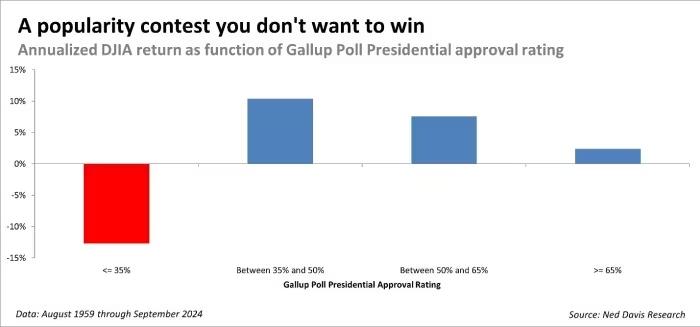
Stock market often experience a downturn in the three months following a presidential inauguration. No matter who wins the U.S. presidential election, the stock market tends to face challenges after Inauguration Day in January. Since the creation of the Dow Jones Industrial Average (DJIA) in 1896, one of its weakest quarters has been the first of a new president’s term, averaging a mere 0.2% return. By comparison, the market usually gains an average of 1.9% in other quarters, regardless of whether the incumbent party remains in power. A study by Ned Davis Research sheds light on this trend, revealing an inverse relationship between a president’s approval rating and the stock market. After Inauguration Day, a president’s approval rating is typically at its peak, which seems to create a drag on market performance. However, when a president’s approval rating dips below 35%, the market tends to fare worse. This has happened only 6.8% of the time since 1959, with notable examples including Richard Nixon’s resignation and the end of George W. Bush’s term during the financial crisis. Currently, President Biden’s approval rating is 39%. It’s puzzling why investors wait until Inauguration Day to recalibrate their expectations, especially since campaign promises often don’t align with economic realities. Even with a cooperative Congress, the math doesn’t support increasing government benefits while simultaneously cutting taxes and reducing the deficit. Yet, political rhetoric frequently leads to unrealistic optimism. Warren Buffett likens this to a joke about an oil prospector who convinces others that oil has been found in hell, prompting them to rush off in pursuit. Similarly, the lofty promises made by politicians are often equivalent to that rumor. Investors should remain cautious, even when the stock market is soaring. It’s important to remember that post-inauguration market weakness is an average trend, not a guarantee. In fact, other market indicators, such as the gold-platinum ratio, are currently signaling a bullish outlook, suggesting that stock prices could rise over the next year—even if the first quarter of 2025 is challenging. John PaulJohn Paul is the founder of DayTradeToWin, a trading education and software company established in 2008, supporting traders worldwide. His expertise focuses on price action-based futures trading strategies and structured market analysis. DayTradeToWin delivers trading education, indicators, and software tools designed to help traders apply disciplined, rule-based decision-making across global futures markets. He is the creator of multiple trading methodologies, including the Sonic System, Atlas Line, and Trade Scalper, which help traders identify structured opportunities in markets such as the E-mini S&P 500 (ES), Nasdaq (NQ), crude oil (CL), and gold (GC). Official website: https://daytradetowin.com daytradetowin.com
Market News

What Drove Tuesday’s Market Decline? More Than Just Iran

The strike has raised concerns about supply chain disruptions and price increases for goods. Jose Torres, a senior economist at Interactive Brokers, highlighted that the uncertainty around the strike, along with strong warnings from union leaders, has further unsettled market. Port Strike Adds to Softer Start for October While Iran’s missile strike on Israel triggered a sharp selloff in U.S. stocks on Tuesday and caused oil prices to surge, it wasn’t the only factor rattling Wall Street. Analysts also pointed to the impact of a U.S. dockworkers’ strike, which has shut down major East Coast and Gulf ports, potentially affecting the economy by as much as $4 billion per day. Although the missile attack sent stocks plummeting early in the session, pushing investors toward safe-haven assets like U.S. Treasurys and gold, markets regained some ground later in the day. The Dow Jones Industrial Average ended down 173 points, or 0.4%, and the S&P 500 closed with a 0.9% loss. Oil prices, which spiked earlier, settled with gains of over 2%. The geopolitical risks in the Middle East, alongside the port strike, are expected to keep markets volatile. Despite this, some analysts believe these events could present buying opportunities. Ed Yardeni, president of Yardeni Research, noted that market selloffs driven by geopolitical concerns often create favorable entry points for investors. However, the risk of further escalation in the Middle East remains a key threat to the stock market’s momentum. John PaulJohn Paul is the founder of DayTradeToWin, a trading education and software company established in 2008, supporting traders worldwide. His expertise focuses on price action-based futures trading strategies and structured market analysis. DayTradeToWin delivers trading education, indicators, and software tools designed to help traders apply disciplined, rule-based decision-making across global futures markets. He is the creator of multiple trading methodologies, including the Sonic System, Atlas Line, and Trade Scalper, which help traders identify structured opportunities in markets such as the E-mini S&P 500 (ES), Nasdaq (NQ), crude oil (CL), and gold (GC). Official website: https://daytradetowin.com daytradetowin.com

gold
Market News

Gold Surges Ahead of Stocks and Bonds in Q3

The SPDR Gold Shares ETF saw a strong surge in the third quarter, fueled by growing investor optimism that the Federal Reserve could successfully achieve a “soft landing” for the U.S. economy. By the end of September, many investors appeared more confident that the Fed could lower inflation without triggering a recession. “There’s more confidence that we’re going to stick the soft landing,” said Michael Arone, chief investment strategist at State Street Global Advisors. However, Arone also noted that such outcomes are rare, and gold’s strong performance suggests that some investors are still hedging against economic risks. The SPDR Gold Shares ETF (GLD), which invests in physical gold, has soared 27.1% this year, including a 13% rise in the third quarter. This outpaced the S&P 500, which gained 5.5% during the same period and is up 20.8% for the year. September marked the start of the Fed’s interest-rate-cutting cycle, with the central bank opting for a larger-than-expected half-point reduction. This move sparked a rally in U.S. bonds, as the iShares Core U.S. Aggregate Bond ETF (AGG), which tracks investment-grade bonds, gained 5.3% in the third quarter. Meanwhile, riskier corporate bonds, like the iShares iBoxx $ High Yield Corporate Bond ETF (HYG), saw a 5.7% gain. Despite the optimism, Arone recommends maintaining a small allocation to gold as a hedge against potential risks. He suggests that long-term investors consider a 3% to 10% allocation, emphasizing that falling interest rates make gold an increasingly attractive asset. As the “opportunity cost” of holding gold declines, it remains a valuable safeguard, especially if the economic outlook shifts unexpectedly. John PaulJohn Paul is the founder of DayTradeToWin, a trading education and software company established in 2008, supporting traders worldwide. His expertise focuses on price action-based futures trading strategies and structured market analysis. DayTradeToWin delivers trading education, indicators, and software tools designed to help traders apply disciplined, rule-based decision-making across global futures markets. He is the creator of multiple trading methodologies, including the Sonic System, Atlas Line, and Trade Scalper, which help traders identify structured opportunities in markets such as the E-mini S&P 500 (ES), Nasdaq (NQ), crude oil (CL), and gold (GC). Official website: https://daytradetowin.com daytradetowin.com

market
Market News

World Market Cap Crosses $123 Trillion: What’s Next?

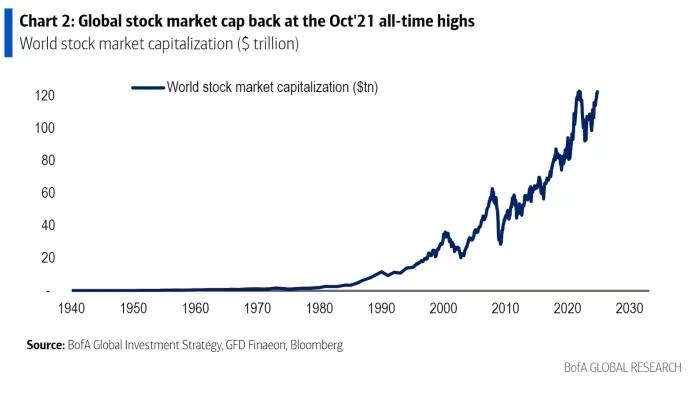
Strategists Suggest Industrial Metals, Materials, and International Stock market as Top Plays for China’s Rally Global stock market capitalization is on track to surpass its highest level in three years, driven by the Federal Reserve’s interest rate cuts and China’s latest economic stimulus efforts. Bank of America, citing data from GFD Finaeon, predicts global market cap will soon exceed the record $123 trillion reached in October 2021. The Vanguard Total World Stock ETF (VT), which tracks U.S. and global stocks, has already hit a new all-time high, overtaking its 2021 peak. According to Bank of America strategists led by Michael Hartnett, markets typically stabilize when policymakers intervene—exactly what’s happening now. China’s recent stimulus measures came on the heels of a half-point interest rate cut by the Fed, leading to a strong rally in Chinese assets. The Hang Seng Index jumped 13% this week, its best performance since 1998. With the Fed’s rate cuts and no recession on the horizon, risky assets are gaining momentum. Investors see the policy actions from the Fed and China as sufficient to reduce recession risks. Bank of America strategists advise that the best way to profit from China’s economic rally is by investing in industrial metals, materials, and international stocks, particularly as long as China’s 10-year yield stays above 2%. Currently, the yield stands at 2.17%. John PaulJohn Paul is the founder of DayTradeToWin, a trading education and software company established in 2008, supporting traders worldwide. His expertise focuses on price action-based futures trading strategies and structured market analysis. DayTradeToWin delivers trading education, indicators, and software tools designed to help traders apply disciplined, rule-based decision-making across global futures markets. He is the creator of multiple trading methodologies, including the Sonic System, Atlas Line, and Trade Scalper, which help traders identify structured opportunities in markets such as the E-mini S&P 500 (ES), Nasdaq (NQ), crude oil (CL), and gold (GC). Official website: https://daytradetowin.com daytradetowin.com

Scroll to Top