Market News

Financial Stocks
Market News

Can Financial Stocks Maintain Their Bullish Run?

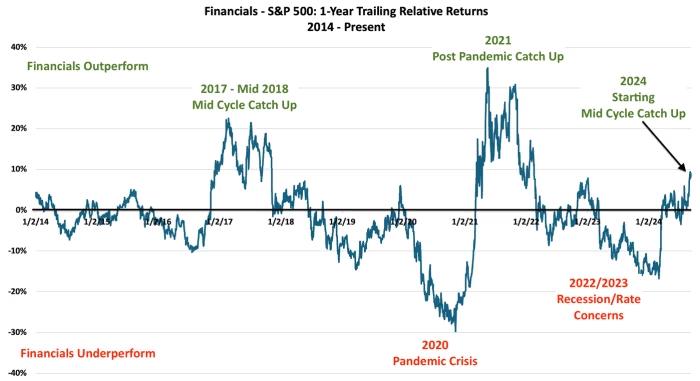
“The financial sector is much more than just banks,” says DataTrek Research. Financial stocks in the S&P 500 have outperformed the broader U.S. stock market over the past year, reflecting optimism about the economy, according to DataTrek. “Even if you’re not overweight on financials, their continued leadership reassures that equity markets are confident in further growth,” said Nicholas Colas, co-founder of DataTrek. The Financial Select Sector SPDR Fund (XLF), which tracks financial stocks in the S&P 500, surged 31.1% over the past 12 months, outpacing the S&P 500’s 22.7% rise, FactSet data shows. While the U.S. stock market has gained in 2024, investors are wary that the Federal Reserve’s tight monetary policy might trigger a recession. Despite this, Colas noted that the Atlanta Fed’s GDPNow model predicts solid economic growth in the third quarter, with a 2.5% estimate. “The financial sector extends beyond just banks, which only account for 25% of the index,” wrote Colas. It also includes growth-oriented companies like Visa, Mastercard, and S&P Global, as well as asset managers such as BlackRock, Blackstone, and KKR. Financials have continued to shine in 2024, with the Financial Select Sector SPDR Fund up 19.6%, outpacing the S&P 500’s 14.7% rise. However, Colas pointed out that while financials have outperformed by 8.4 percentage points, it’s still lower than past midcycle periods, such as 2017-18 when they led by as much as 20 points. On Tuesday, the financial sector in the S&P 500 faced a sharp drop as banks like JPMorgan, Goldman Sachs, and Citigroup saw steep losses. Investors are now looking ahead to new inflation data, set to be released Wednesday by the Bureau of Labor Statistics. John PaulJohn Paul is the founder of DayTradeToWin, a trading education and software company established in 2008, supporting traders worldwide. His expertise focuses on price action-based futures trading strategies and structured market analysis. DayTradeToWin delivers trading education, indicators, and software tools designed to help traders apply disciplined, rule-based decision-making across global futures markets. He is the creator of multiple trading methodologies, including the Sonic System, Atlas Line, and Trade Scalper, which help traders identify structured opportunities in markets such as the E-mini S&P 500 (ES), Nasdaq (NQ), crude oil (CL), and gold (GC). Official website: https://daytradetowin.com daytradetowin.com

Goldman Sachs
Market News

Navigating Market Corrections: Goldman Sachs’ Guide

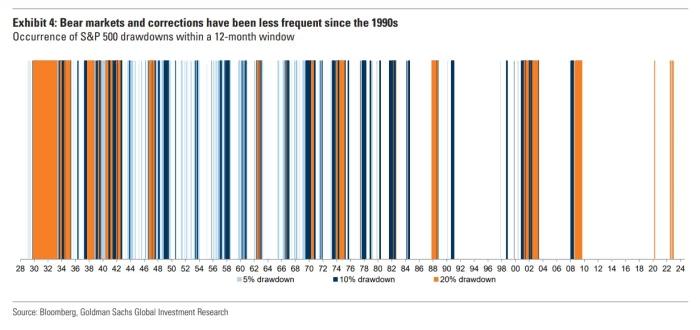
The S&P 500 had its worst week in 18 months, followed by its best day in three weeks on Monday, despite little new information. This highlights how uncertainty around interest rates and politics is likely to keep markets volatile in the coming months. Last month, 94% of global equity indexes experienced a drawdown of at least 5%, according to Goldman Sachs. Goldman Sachs strategists, led by Christian Mueller-Glissmann, now question whether the bull market will continue with strong returns or if there’s more volatility ahead and increased risk of drawdowns. Since 1928, the S&P 500 has faced 22 bear markets, with 20% declines happening roughly every four to five years. In the U.S., drawdowns of 10% to 20% occurred 15% of the time over any rolling 12-month period since 1973, with even higher frequency internationally. During these 10%-to-20% declines, the average drop was 13% and lasted about four months. However, they’ve become less frequent since the 1990s. Is buying the dip a smart move? It depends on the timeframe. Since 2010, buying corrections has generally paid off, but that wasn’t the case if you go back to the 1990s. After a market drop, lower valuations and bearish sentiment can create opportunities, but there’s always a risk of further economic and market downturns. Equity drawdowns also tend to tighten financial conditions, which can slow economic momentum further. Goldman Sachs has developed a model to predict drawdowns using various factors like economic indicators, volatility, inflation, and valuations. While the model’s accuracy is limited, with a correlation of 0.2 on a 0-to-1 scale, it shows stronger predictive power when the score rises above 30%. Right now, it’s at 20%, indicating moderate risk. In terms of portfolio strategy, the classic 60/40 split between stocks and bonds is performing well as concerns over economic growth help bonds, despite recent inflation. Goldman Sachs believes negative correlations between stocks and bonds will persist, but they suggest going beyond bonds for diversification. They recommend gold, the Japanese yen, and the Swiss franc, and favor defensive equities, especially in the U.K.’s FTSE 100. John PaulJohn Paul is the founder of DayTradeToWin, a trading education and software company established in 2008, supporting traders worldwide. His expertise focuses on price action-based futures trading strategies and structured market analysis. DayTradeToWin delivers trading education, indicators, and software tools designed to help traders apply disciplined, rule-based decision-making across global futures markets. He is the creator of multiple trading methodologies, including the Sonic System, Atlas Line, and Trade Scalper, which help traders identify structured opportunities in markets such as the E-mini S&P 500 (ES), Nasdaq (NQ), crude oil (CL), and gold (GC). Official website: https://daytradetowin.com daytradetowin.com
market
Market News

Is a Fed Misstep Behind the Market Decline?

Investors are uncertain about a potential market recession and the extent of the Fed’s forthcoming rate cuts. As September lives up to its reputation as a rough month for the stock market, concerns are rising that the Federal Reserve may have waited too long to ease monetary policy. Ivan Martchev, an investment strategist at Navellier & Associates, remarked that while the Fed has been slow to cut rates, Fed Chair Jerome Powell may avoid blame if he manages to prevent a recession. However, with weak economic data and a mixed August jobs report, the size of the next rate cut—whether 25 or 50 basis points—remains in question. The stock market reflected this uncertainty. The S&P 500 tumbled 4.3%, the Dow fell 2.9%, and the Nasdaq dropped 5.8% in their worst week since early 2023. Technology stocks took a major hit, with Nvidia leading the losses. Meanwhile, the bond market sent a potential recession signal as the yield curve shifted, raising alarm among investors. Despite this, experts like Chris Graham of Nationwide Financial and Larry Adam of Raymond James believe the Fed still has the tools to avoid a recession by adjusting rates. As the market eyes upcoming inflation data, investors hope for clearer signals on the Fed’s next move. John PaulJohn Paul is the founder of DayTradeToWin, a trading education and software company established in 2008, supporting traders worldwide. His expertise focuses on price action-based futures trading strategies and structured market analysis. DayTradeToWin delivers trading education, indicators, and software tools designed to help traders apply disciplined, rule-based decision-making across global futures markets. He is the creator of multiple trading methodologies, including the Sonic System, Atlas Line, and Trade Scalper, which help traders identify structured opportunities in markets such as the E-mini S&P 500 (ES), Nasdaq (NQ), crude oil (CL), and gold (GC). Official website: https://daytradetowin.com daytradetowin.com

sonic
Market News

Master Intraday Trading with Sonic Trading System

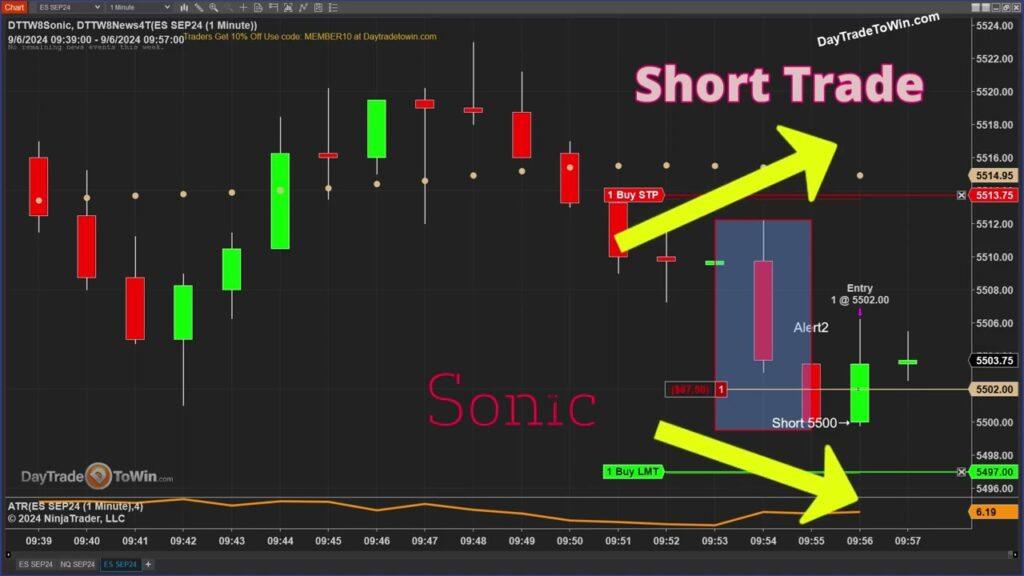
In today’s post, we’re diving into a real-time trading session using the Sonic Trading System, a powerful method for traders who focus on price action. During this live session, we’ll explore how the system works, key strategies for success, and why keeping things simple is the best approach to profitable trading. A Look at the Sonic Trading System The Sonic Trading System is designed for traders who rely on price patterns and market behavior rather than traditional indicators. It offers a structured yet flexible approach to trading, with built-in filters that help guide decisions on whether to go long or short. This system is a favorite for those looking to keep things straightforward while capitalizing on price action. Before jumping in, remember that trading involves risk. You can make or lose money, and it’s essential to understand the risks involved before taking trades. Kicking Off the Trade At 9:54 AM on a Friday morning, our trader looks for their first trade using the Sonic Trading System. The market is healthy, and the trader sets a target and stop-loss based on current conditions. The system suggests a short trade, triggered when the price falls below a key dotted line that serves as a filter, indicating bearish momentum. The initial entry point is around $5,500, with the system automatically adjusting the target to $54.97 and the stop-loss based on nearby market levels. This setup allows the trader to make decisions with confidence, knowing that the system provides precise entry and exit points. Price Action and Market Conditions One of the Sonic system’s core principles is price action. The trader highlights that a healthy move in the market typically amounts to about five or six points, translating into roughly $300 profit per trade. With this in mind, they are not looking to over-trade or chase the market, but rather to capture quality opportunities. A key point of focus is entering trades at the best possible price. In this session, the market moved in favor of the trader, allowing them to get a slightly better price than the initial setup. The lesson here? Use limit orders and avoid chasing trades, even if the market seems to be moving quickly. Multi-Timeframe Approach While the trader is using a one-minute chart for this particular trade, they also keep an eye on a 30-second chart on another screen. This multi-timeframe approach allows them to identify the earliest opportunities while staying in tune with short-term market fluctuations. However, for those just starting out, the trader recommends sticking with one chart to avoid overcomplicating things. The Sonic Trading System works across different markets and timeframes, offering flexibility for traders who might be working with various setups, like ASQ or E-mini contracts. Avoiding Over-Trading A critical takeaway from this session is the importance of not over-trading. The trader plans to take just one or two trades for the day, aiming to finish the week on a positive note and enjoy the weekend. By focusing on quality trades rather than quantity, the trader avoids the temptation to keep trading unnecessarily, which often leads to over-exposure and risk. This approach not only reduces stress but also helps traders maintain a consistent mindset, crucial for long-term success. News Events and Caution The trader also checks for any upcoming news events using a built-in news indicator. Although nothing significant is on the horizon, they caution that major news can cause unexpected volatility, making it wise to avoid trading during these times. Being aware of the news helps traders avoid entering the market when large, unpredictable moves might occur. Wrapping Up the Trade As the session progresses, the market moves in the trader’s favor, and by the end of the trade, they secure a profit of around $200–$225. The session is a success, but the trader emphasizes that this type of consistent performance comes from following the signals and staying disciplined. The goal is to keep things simple and avoid over-complicating the process. Final Thoughts: Learn More About Sonic Trading For traders interested in mastering the Sonic Trading System or exploring other advanced trading strategies, daytradetowin.com offers extensive resources, including the Sonic system, proprietary software, and mentorship programs. Whether you’re new to trading or experienced, their accelerated mentorship will equip you with the tools needed to trade confidently and profitably. This live trading session demonstrates the power of simplicity in trading. By following the Sonic Trading System, traders can focus on price action, avoid over-trading, and achieve consistent results. Ready to take the next step in your trading journey? Visit daytradetowin.com and get started today! John PaulJohn Paul is the founder of DayTradeToWin, a trading education and software company established in 2008, supporting traders worldwide. His expertise focuses on price action-based futures trading strategies and structured market analysis. DayTradeToWin delivers trading education, indicators, and software tools designed to help traders apply disciplined, rule-based decision-making across global futures markets. He is the creator of multiple trading methodologies, including the Sonic System, Atlas Line, and Trade Scalper, which help traders identify structured opportunities in markets such as the E-mini S&P 500 (ES), Nasdaq (NQ), crude oil (CL), and gold (GC). Official website: https://daytradetowin.com daytradetowin.com
Election
Market News

Election Jitters: Why the Market Dips Before Election Day

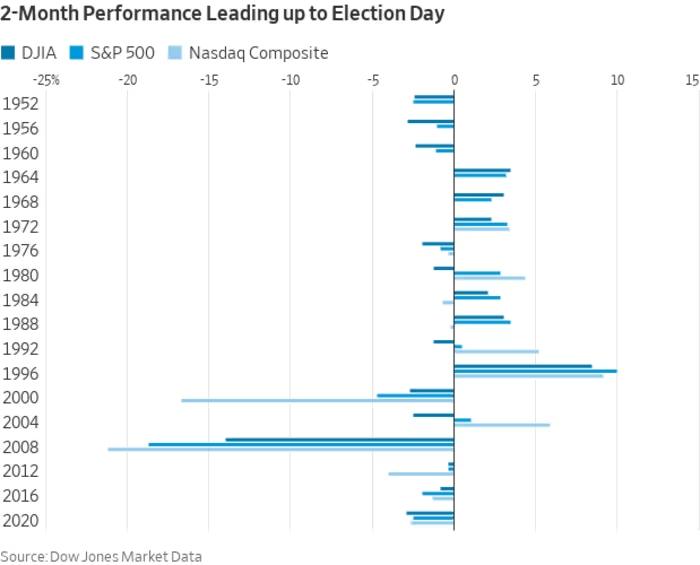
Since 2008, the S&P 500 has declined during the two months leading up to every U.S. presidential election, with an average drop of 5.8%, according to Dow Jones Market Data. Looking further back to 1952, the index has averaged a slight decline of 0.2% in this period, though the median result shows a 0.1% gain, with a 50-50 split between positive and negative outcomes. While historical trends can be insightful, market experts warn against viewing them as predictive. Both the Dow Jones Industrial Average and Nasdaq Composite have also typically declined in this two-month window. The Dow has risen only one-third of the time, and the Nasdaq just 38.5% of the time since 1972. September is historically the weakest month, with an average decline of 0.78% since 1944. In presidential election years, this weakness often extends into October. Normally a positive month with a 1.04% average gain, October has instead seen an average drop of 0.45% in election years. John PaulJohn Paul is the founder of DayTradeToWin, a trading education and software company established in 2008, supporting traders worldwide. His expertise focuses on price action-based futures trading strategies and structured market analysis. DayTradeToWin delivers trading education, indicators, and software tools designed to help traders apply disciplined, rule-based decision-making across global futures markets. He is the creator of multiple trading methodologies, including the Sonic System, Atlas Line, and Trade Scalper, which help traders identify structured opportunities in markets such as the E-mini S&P 500 (ES), Nasdaq (NQ), crude oil (CL), and gold (GC). Official website: https://daytradetowin.com daytradetowin.com
investors
Market News

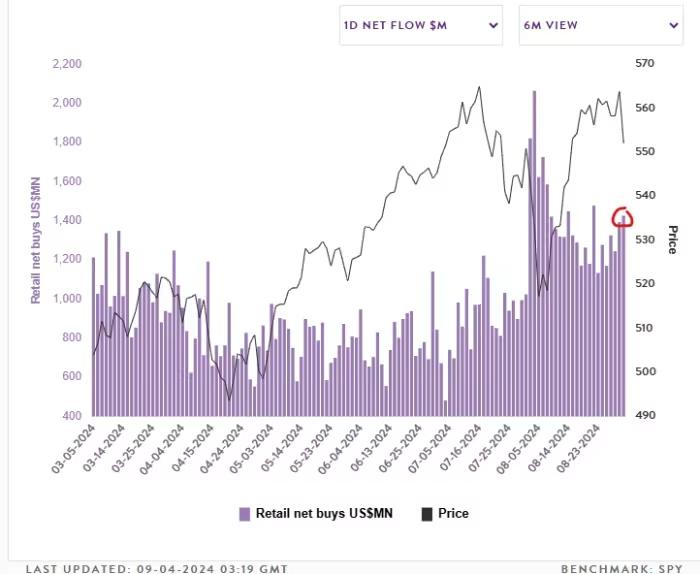
Did Retail Investors Pass Tuesday’s Dip-Buying Test?

When markets dip, it often see it as a buying opportunity. However, Tuesday’s selloff felt different. Following an ISM report indicating a slowdown in manufacturing, the S&P 500 plunged 2.1% and the Nasdaq Composite dropped 3.3%, marking the largest decline since August 5. Retail investors did step in to buy the dip, but their response wasn’t as strong as in August. Marco Iachini of Vanda Research noted that while buying increased, it didn’t reach the high levels seen during the earlier selloff. September 3 saw net buying that was higher than most recent days but still below August’s levels. Retail traders usually buy more aggressively after a few dips rather than the first one. Many investors had already been purchasing stocks recently, which might have depleted their available funds. Additionally, with pandemic-era savings largely gone, investors might be less prepared to buy the dip. Iachini wonders how long retail investors can keep up their buying if the market continues to fall. Despite recent volatility, data shows retail investors are still optimistic. Analysts like Bret Kenwell from eToro believe the market’s fundamentals remain solid, but upcoming events like the Fed’s policy meeting and the U.S. election could lead to increased volatility. John PaulJohn Paul is the founder of DayTradeToWin, a trading education and software company established in 2008, supporting traders worldwide. His expertise focuses on price action-based futures trading strategies and structured market analysis. DayTradeToWin delivers trading education, indicators, and software tools designed to help traders apply disciplined, rule-based decision-making across global futures markets. He is the creator of multiple trading methodologies, including the Sonic System, Atlas Line, and Trade Scalper, which help traders identify structured opportunities in markets such as the E-mini S&P 500 (ES), Nasdaq (NQ), crude oil (CL), and gold (GC). Official website: https://daytradetowin.com daytradetowin.com
Scroll to Top