
Market News

market
Market News

Is a Market Crash Looming? Signs of Overvaluation

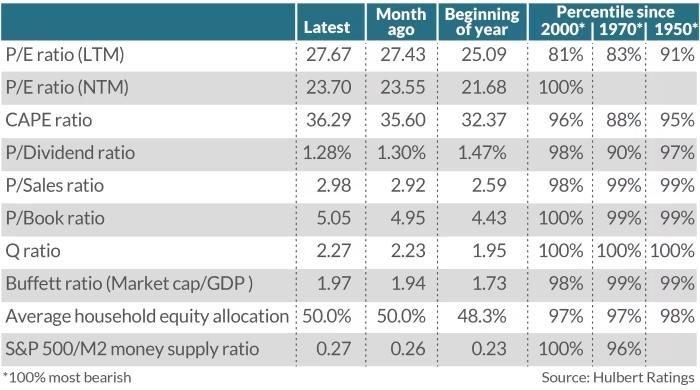
The U.S. stock market is approaching the high valuation levels last seen at the peak on January 3, 2022. When it recovers from a correction and approaches a new all-time high, it’s essential to compare current valuations with those at previous peaks. Investors often expect these downturns to eliminate prior excesses, setting the stage for a more sustainable bull market. Unfortunately, this isn’t happening with the S&P 500 (SPX) right now. The chart below shows where various valuation indicators currently stand relative to their monthly distribution since 2000. A 100% reading signals an extremely bearish scenario, while 0% reflects the most bullish. As the chart highlights, many of these indicators are hovering near the bearish end of the spectrum, close to—or even exceeding—the levels observed at the January 2022 peak. This doesn’t necessarily mean the stock market won’t keep rising. However, if it does, it will enter even riskier territory than before the 2022 bear market. Overvaluation doesn’t automatically trigger a market downturn, as valuations have limited predictive power over short-term horizons. But the indicators in this chart have a strong track record of forecasting returns over the next decade. As noted last month, they suggest that returns through 2034 may fall below inflation. How today’s valuations compare to the past The percentiles in the chart are based on monthly data since 2000, focusing on this period as some argue that older data is less relevant. Even if we accept this viewpoint, the market is still significantly overvalued. Extending the analysis to include data since 1970 or 1950 reveals an even more overvalued market. Any way you look at it, the stock market is dangerously overvalued. John PaulJohn Paul is the founder of DayTradeToWin, a trading education and software company established in 2008, supporting traders worldwide. His expertise focuses on price action-based futures trading strategies and structured market analysis. DayTradeToWin delivers trading education, indicators, and software tools designed to help traders apply disciplined, rule-based decision-making across global futures markets. He is the creator of multiple trading methodologies, including the Sonic System, Atlas Line, and Trade Scalper, which help traders identify structured opportunities in markets such as the E-mini S&P 500 (ES), Nasdaq (NQ), crude oil (CL), and gold (GC). Official website: https://daytradetowin.com daytradetowin.com

unemployment
Market News

Unemployment, Not Inflation, Is the Fed’s New Focus—Powell

Federal Reserve Chairman Jerome Powell has pledged to take all necessary measures to sustain a strong labor market, vowing to prevent a rise in unemployment that could push the U.S. economy into recession. “We do not seek or welcome further cooling in labor-market conditions,” Powell declared in a speech on Friday, justifying the potential for a reduction in interest rates. He stressed that the Fed is well-equipped to address any risks, including the threat of further deterioration in the job market. After maintaining interest rates at a 24-year high to curb inflation, the Fed is now considering rate cuts in September. With inflation gradually approaching its 2% target, the central bank’s focus has shifted to rising unemployment. Powell emphasized that the Fed’s dual mandate requires balancing low inflation with a robust labor market. “The upside risks to inflation have diminished,” Powell stated during the Fed’s annual Jackson Hole conference. “And the downside risks to employment have increased.” A primary concern is the recent surge in unemployment, which reached a nearly three-year high of 4.3% in July, up from 3.4% just 18 months ago. This figure now surpasses the Fed’s projections for the coming years. Chicago Fed President Austan Goolsbee expressed similar worries, noting in a CNBC interview that there are “warning signs” emerging in parts of the labor market. Other indicators, including job growth and openings, have also shown significant weakness. Recently revised government data revealed that the U.S. economy added 818,000 fewer jobs than initially reported between spring 2023 and spring 2024. “With inflation no longer the primary concern, the focus has shifted to the labor market,” said Ryan Sweet, chief U.S. economist at Oxford Economics. “The Fed won’t tolerate further increases in unemployment.” Powell has consistently highlighted the importance of a strong labor market during his time as chairman, underscoring the societal benefits of low unemployment, particularly for minorities and low-income communities. “In the years just prior to the pandemic, we saw the significant benefits to society that can come from a long period of strong labor market conditions,” Powell remarked, referencing low unemployment, high workforce participation, and healthy wage gains. Despite recent concerns, Powell reassured that the labor market remains relatively healthy, attributing the rise in unemployment primarily to an influx of workers into the labor force and a slowdown in hiring, rather than increased layoffs. He also noted that the current labor market hasn’t significantly contributed to inflation, a departure from past periods of high inflation. This unusual situation gives the Fed more flexibility to lower interest rates, which could boost economic growth and spur more hiring. “We will do everything we can to support a strong labor market,” Powell reaffirmed. John PaulJohn Paul is the founder of DayTradeToWin, a trading education and software company established in 2008, supporting traders worldwide. His expertise focuses on price action-based futures trading strategies and structured market analysis. DayTradeToWin delivers trading education, indicators, and software tools designed to help traders apply disciplined, rule-based decision-making across global futures markets. He is the creator of multiple trading methodologies, including the Sonic System, Atlas Line, and Trade Scalper, which help traders identify structured opportunities in markets such as the E-mini S&P 500 (ES), Nasdaq (NQ), crude oil (CL), and gold (GC). Official website: https://daytradetowin.com daytradetowin.com

nvidia
Market News

Nvidia Earnings Loom: Big Tech Faces a Reality Check

You might expect the final week of August to be one of the slowest on Wall Street, with traders enjoying the last days of summer before Labor Day. However, a major event is about to capture the market’s attention: Nvidia’s upcoming earnings report. In fact, one money manager suggested that Nvidia’s results could even steal the spotlight from Federal Reserve Chair Jerome Powell’s much-anticipated speech on inflation, the economy, and interest rates at Jackson Hole on Friday. “Forget the Fed—it’s all about Nvidia’s earnings on August 28th. The wait is the hardest part,” joked Gina Bolvin, president of Bolvin Wealth Management Group, in a nod to the late Tom Petty. For Nvidia to maintain its soaring valuation, the company will need to deliver another impressive quarter and provide strong guidance. The Roundhill Magnificent Seven ETF, which consists solely of Nvidia, Apple, Microsoft, Amazon, Alphabet, Meta, and Tesla, is currently trading at about 36 times estimated 2024 earnings, up from a P/E ratio of 32 following the market’s drop on August 5. This is significantly higher than both the broader market and the rest of the tech sector. The S&P 500 trades at around 23 times this year’s earnings forecasts, while the Invesco QQQ Trust, which tracks the Nasdaq 100, has a P/E of 30. The Magnificent Seven have a considerable impact on these indexes, skewing the multiples upward due to their massive market caps. The pressure is on Nvidia to prove that the AI buzz is justified and to support Big Tech’s elevated valuations. Nvidia is currently valued at around 47 times forward earnings estimates, with only Tesla among the Magnificent Seven having a higher P/E ratio, approaching 100. But Nvidia might be up to the task. Earnings and revenue are expected to more than double compared to a year ago. It’s worth remembering that Nvidia faced high expectations last May, and the company didn’t just meet them—it exceeded them, beating analysts’ forecasts by 7% and sparking another rally in tech stocks. With other major tech companies already reporting positive outlooks for AI-driven products and services, this is promising news for Nvidia, whose largest customers include Microsoft, Amazon, Alphabet, and Meta. “Each of these companies highlighted strong demand and investment in AI-related products that should support tech earnings moving forward,” said Larry Adam, chief investment officer at Raymond James, in a report. “This earnings strength is why we favor megacap tech and would view any weakness as a buying opportunity,” Adam added. Nvidia’s chips are also in high demand beyond the tech sector, particularly in the automotive industry. “Nvidia continues to experience strong demand from key customers across all its processors and is struggling to keep up,” said Ivan Feinseth, chief market strategist at Tigress Financial Intelligence. Feinseth also emphasized that “significant upside exists from current levels” for Nvidia. Wall Street is in agreement. Nearly all analysts covering the stock have given it a Buy rating, with the consensus price target nearly 10% above current levels. Nvidia shares were up 1.3% to $125.40 in premarket trading on Friday. While Nvidia is certainly a crowded trade, with nearly everyone betting on its continued rise, the company has consistently rewarded its investors and helped lift other Big Tech giants along the way. John PaulJohn Paul is the founder of DayTradeToWin, a trading education and software company established in 2008, supporting traders worldwide. His expertise focuses on price action-based futures trading strategies and structured market analysis. DayTradeToWin delivers trading education, indicators, and software tools designed to help traders apply disciplined, rule-based decision-making across global futures markets. He is the creator of multiple trading methodologies, including the Sonic System, Atlas Line, and Trade Scalper, which help traders identify structured opportunities in markets such as the E-mini S&P 500 (ES), Nasdaq (NQ), crude oil (CL), and gold (GC). Official website: https://daytradetowin.com daytradetowin.com
Goldman
Market News

Goldman Explains Hedge Funds’ Reluctance in Rebound Rally

Hedge funds have largely refrained from participating in the recent market rally following the unwinding of the yen carry trade over the past two weeks, according to a new analysis from Goldman Sachs’ prime brokerage division. Despite a strong rebound that has seen the Nasdaq 100 rise by 11% and the S&P 500 climb 8% since both indices hit multi-month lows on August 5, money managers have continued to reduce their exposure to equities. Goldman Sachs reports that hedge funds are now on track to sell global equities at their fastest pace since March 2022, when markets were disrupted by Russia’s invasion of Ukraine. “Despite the market’s recovery, gross and net leverage ratios have fallen in August, indicating a limited rebound in risk appetite after July’s significant de-grossing,” wrote Goldman Sachs analysts, led by Vincent Lin. The current sell-off is primarily driven by short sales in the U.S. and long sales elsewhere, with net selling across both single stocks and macro products through August 21, the analysis reveals. Bruno Schneller, managing partner at Erlen Capital Management, told MarketWatch that while there is broader market optimism, hedge funds remain cautious about the sustainability of the rally and are wary of potential headwinds. Schneller pointed out that despite ongoing institutional inflows into U.S. equities, hedge funds appear to be hedging against downside risks and maintaining a cautious stance until there is more clarity in the economic outlook. North America has seen the highest level of net selling this month, largely driven by short sales. In the U.S., hedge funds have been selling large-cap stocks while increasing their investments in small caps, according to Goldman Sachs. Meanwhile, energy, utilities, and real estate have been the most net bought sectors, signaling a shift toward high-dividend stocks. Schneller also suggested that hedge funds’ caution may reflect concerns about the impact of potential Federal Reserve rate cuts and ongoing market volatility. He highlighted the elevated levels of the VVIX, which measures volatility in the VIX, along with heightened volatility in bond and forex markets. “Hedge funds might be concerned that the market’s optimism is premature or that economic conditions could deteriorate before any rate cuts take effect, potentially leading to another downturn,” Schneller said. Additionally, developed market Asia has been the second most sold region globally, following the largest 10-day cumulative sell-off of Japanese stocks in over five years, triggered by the unwinding of the yen carry trade. Emerging markets in Asia and Europe have also experienced net selling, driven by significant risk unwinds in China, South Korea, and Taiwan, as well as modest net selling in Europe. “While the market’s surface-level optimism suggests a strong rally, underlying market stress and volatility are keeping hedge funds on edge,” Schneller concluded. John PaulJohn Paul is the founder of DayTradeToWin, a trading education and software company established in 2008, supporting traders worldwide. His expertise focuses on price action-based futures trading strategies and structured market analysis. DayTradeToWin delivers trading education, indicators, and software tools designed to help traders apply disciplined, rule-based decision-making across global futures markets. He is the creator of multiple trading methodologies, including the Sonic System, Atlas Line, and Trade Scalper, which help traders identify structured opportunities in markets such as the E-mini S&P 500 (ES), Nasdaq (NQ), crude oil (CL), and gold (GC). Official website: https://daytradetowin.com daytradetowin.com

market
Market News

Brace for Impact: 2024’s Volatile Election Year for Stocks

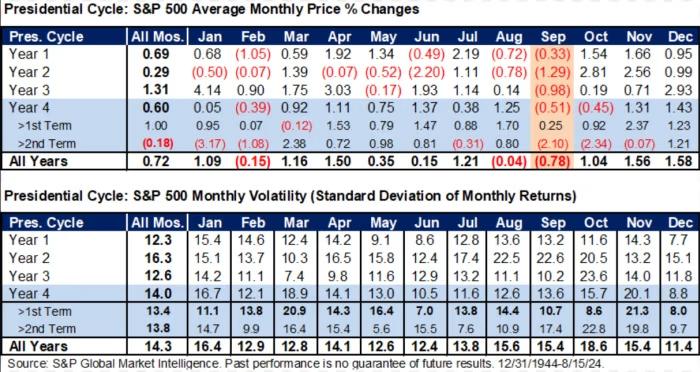
Analysts are cautioning investors to expect heightened stock market volatility as the 2024 presidential election approaches on November 5. Although recent economic data suggests that the Federal Reserve might begin cutting interest rates, providing some relief to U.S. financial markets, the upcoming election season is likely to bring increased uncertainty. Historically, election years have seen the S&P 500 underperform, with September often being the weakest month. According to CFRA Research, the S&P 500 has averaged a 0.8% decline in September during election years dating back to 1944. Sam Stovall, chief investment strategist at CFRA Research, highlights that August and September have consistently been among the worst months for the stock market during election years, with September showing the largest declines. October, while typically producing gains of over 1%, has been the most volatile month during election years, with a standard deviation 35% higher than other months, reflecting significant market fluctuations. The outcome of the election could also heavily influence market behavior. Historically, volatility has increased when the incumbent party loses the White House, as markets brace for potential policy changes. This year, the switch from President Joe Biden to Vice President Kamala Harris as the Democratic nominee has added another layer of uncertainty, particularly with Harris leading in polls against Republican nominee Donald Trump. Sector-specific impacts are also in focus. The healthcare industry, which has seen strong performance, could face challenges if Harris wins, especially regarding potential drug pricing reforms. This sector rotation could contribute to further market volatility as Election Day nears, potentially driving up the Cboe Volatility Index (VIX). Given the uncertain political landscape, investors should prepare for potential market turbulence in the weeks leading up to the election. John PaulJohn Paul is the founder of DayTradeToWin, a trading education and software company established in 2008, supporting traders worldwide. His expertise focuses on price action-based futures trading strategies and structured market analysis. DayTradeToWin delivers trading education, indicators, and software tools designed to help traders apply disciplined, rule-based decision-making across global futures markets. He is the creator of multiple trading methodologies, including the Sonic System, Atlas Line, and Trade Scalper, which help traders identify structured opportunities in markets such as the E-mini S&P 500 (ES), Nasdaq (NQ), crude oil (CL), and gold (GC). Official website: https://daytradetowin.com daytradetowin.com

markets
Market News

Can Markets Climb Without More Good News?

Dennis DeBusschere, chief market strategist at 22V Research in New York, believes that the recent mini-crash has left markets needing “more consistent optimism” to regain momentum. He noted that although recent economic data has eased recession fears triggered by the last jobs report, it hasn’t been enough to spark a rally. DeBusschere highlighted the latest U.S. jobless claims, ISM Services data, and the New York Fed’s August business leaders survey as signs of a strong economy. “The short-term recession scare appears to be over,” he said. Despite the S&P 500 closing just 1% below its July peak on Monday, DeBusschere identified the upcoming payrolls report on September 6 as the “next big hurdle” for the markets. He suggested that this report could have more impact than Fed Chair Jerome Powell’s upcoming speech at the Jackson Hole Economic Symposium. Given the subdued market response to recent data, DeBusschere believes that even more positive news will be necessary to trigger another rally, especially after the recent unwinding of the Japanese yen carry trade. He also pointed out that expectations for small-cap fundamentals remain weak through the second half of 2024, though there’s potential for improvement if economic conditions strengthen. The Russell 2000 index is currently 6% below its July highs. In the tech sector, valuations continue to be driven by long-term narratives, which, according to DeBusschere, suggests there’s still room for gains even as the AI frenzy cools down. John PaulJohn Paul is the founder of DayTradeToWin, a trading education and software company established in 2008, supporting traders worldwide. His expertise focuses on price action-based futures trading strategies and structured market analysis. DayTradeToWin delivers trading education, indicators, and software tools designed to help traders apply disciplined, rule-based decision-making across global futures markets. He is the creator of multiple trading methodologies, including the Sonic System, Atlas Line, and Trade Scalper, which help traders identify structured opportunities in markets such as the E-mini S&P 500 (ES), Nasdaq (NQ), crude oil (CL), and gold (GC). Official website: https://daytradetowin.com daytradetowin.com

Scroll to Top