
Market News

Market News

Market-Cap Disaster: Nvidia’s Stock Plunge Sets Record for ‘Magnificent Seven’ Losses

This week witnessed a dramatic downturn in the market values of the top-tier tech companies, known as the “Magnificent Seven,” collectively shedding a staggering $950 billion. Among them, Nvidia bore the brunt, losing almost $300 billion, a figure exceeding the entire market worth of its rival, Advanced Micro Devices Inc. Nvidia’s stock took a significant hit, dropping 13.6% over the week, marking its worst performance since September 2, 2022. The semiconductor sector, in which Nvidia operates, faced notable pressure, intensifying Nvidia’s losses. Analyst Jordan Klein from Mizuho highlighted a broader trend of sectoral unwinding over the past week. Notably, other tech giants like Apple and Microsoft also experienced substantial market cap declines of $178 billion and $169 billion, respectively. This downturn was not unique to Nvidia, as the entire Magnificent Seven saw their stock prices decline throughout the week, with Tesla leading the decline at 14%. Tesla, in particular, suffered a notable setback, losing $76 billion in market cap, leading to a slip in its rank among the largest U.S. companies. Additionally, Amazon, Alphabet, and Meta Platforms also faced significant declines in their market values, contributing to the overall downturn. The cumulative losses experienced by the Magnificent Seven this week far exceeded the previous record set in January 2022, indicating the severity of the market turbulence. John PaulJohn Paul is the founder of DayTradeToWin, a trading education and software company established in 2008, supporting traders worldwide. His expertise focuses on price action-based futures trading strategies and structured market analysis. DayTradeToWin delivers trading education, indicators, and software tools designed to help traders apply disciplined, rule-based decision-making across global futures markets. He is the creator of multiple trading methodologies, including the Sonic System, Atlas Line, and Trade Scalper, which help traders identify structured opportunities in markets such as the E-mini S&P 500 (ES), Nasdaq (NQ), crude oil (CL), and gold (GC). Official website: https://daytradetowin.com daytradetowin.com

Market News

On the Horizon: Five Reasons to Believe the Stock Market’s ‘Painful’ Retreat Is Coming to a Close

The performance of U.S. stocks lately isn’t exactly flattering. Despite starting strong, they consistently close lower, sending concerning signals about the overall market health. Thursday marked the fourth consecutive session where the S&P 500 experienced this reversal trend, the longest such streak in six years, indicating significant underlying issues despite recent rallies. Even amidst Friday’s early downturn in stock index futures following geopolitical tensions between Israel and Iran, there’s a silver lining: the S&P 500 seems poised to open in the red. Nevertheless, the prevailing sentiment is undeniably pessimistic. Since reaching its peak close on March 28, the S&P 500 has declined by 4.63%, while the Nasdaq Composite, dominated by tech stocks, has seen a 5.11% drop in just five sessions, marking its most significant five-day percentage decline since December 2022. What traders could really use right now is some optimism to uplift their spirits. Enter Tom Lee, Fundstrat’s head of research, who has a track record of accurately predicting market surges. Lee acknowledges the recent bleak market activity, attributing it to a painful deleveraging process exacerbated by concerns over persistent U.S. inflation and geopolitical tensions. Despite the gloom, Lee identifies five reasons why investor deleveraging might be nearing its end: Lee acknowledges the potential risks posed by escalating conflicts, such as the recent tensions between Israel and Iran, which could adversely impact equities and other cyclical assets. However, he maintains that the fundamental case for stocks in 2024 remains robust, supported by improving earnings and a substantial amount of sidelined cash, totaling $6 trillion. John PaulJohn Paul is the founder of DayTradeToWin, a trading education and software company established in 2008, supporting traders worldwide. His expertise focuses on price action-based futures trading strategies and structured market analysis. DayTradeToWin delivers trading education, indicators, and software tools designed to help traders apply disciplined, rule-based decision-making across global futures markets. He is the creator of multiple trading methodologies, including the Sonic System, Atlas Line, and Trade Scalper, which help traders identify structured opportunities in markets such as the E-mini S&P 500 (ES), Nasdaq (NQ), crude oil (CL), and gold (GC). Official website: https://daytradetowin.com daytradetowin.com
Market News

Rising Tide: Wall Street’s ‘Fear Gauge’ Surges Amidst Market Volatility Revival

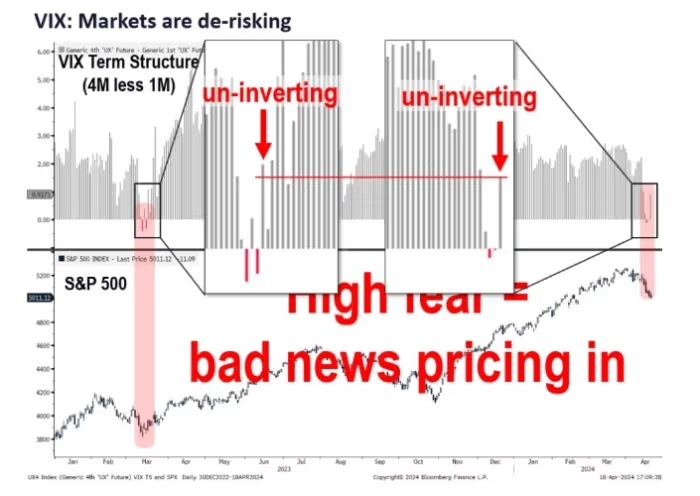
Over the past week, there has been a significant increase in implied volatility across stocks, bonds, and currencies, marking a departure from the previous period of relative calmness. For instance, the Cboe Volatility Index (VIX), often seen as Wall Street’s “fear gauge,” surged to 19.56 on Tuesday, reaching its highest level since October 31st. This was accompanied by notable upticks in volatility indicators tracking options linked to Treasury bonds and major G-10 currencies. The ICE BofAML MOVE Index, which measures implied volatility in Treasurys, rose by over 40% since March 27th to hit 121.15 on Monday, its highest level since January 3rd. This surge in volatility reflects increasing uncertainty among investors regarding potential interest-rate adjustments by the Federal Reserve. Federal Reserve Chair Jerome Powell’s recent comments hinting at a pause in rate cuts have added to market jitters. Traders now anticipate preemptive actions from entities like the European Central Bank, which could lead to higher Treasury yields and strengthen the U.S. dollar throughout April. The rising dollar has also pushed the JPMorgan G-7 Volatility Index to its highest level since January, signaling increased fluctuations in major currency pairs. Previously, the market appeared calm, but some analysts noted signs of complacency. Unexpected events triggered significant market reactions, contrary to the prevailing tranquility. To manage the risks associated with heightened volatility, traders are increasingly turning to options-market hedges. Demand for such hedges has surged across various asset classes and currency pairs. Notably, VIX-linked option contracts saw substantial trading activity, particularly VIX options, which experienced their busiest day in over six years. Traders are actively seeking protection against sharp declines in stock prices through VIX-linked calls. The increase in bond market volatility also raises concerns about the outlook for equities. Higher bond volatility typically signals an unfavorable environment for stocks. Additionally, fluctuations in credit spreads, especially on high-yield bonds, tend to correlate with movements in the VIX, potentially indicating future declines in the stock market. Currently, U.S. stocks show mixed trading patterns, with the S&P 500 and Nasdaq Composite facing the possibility of a fourth consecutive day of losses, while the Dow Jones Industrial Average looks set to finish higher. Meanwhile, Treasury yields have decreased, and the U.S. dollar index has retraced slightly from its recent peak. John PaulJohn Paul is the founder of DayTradeToWin, a trading education and software company established in 2008, supporting traders worldwide. His expertise focuses on price action-based futures trading strategies and structured market analysis. DayTradeToWin delivers trading education, indicators, and software tools designed to help traders apply disciplined, rule-based decision-making across global futures markets. He is the creator of multiple trading methodologies, including the Sonic System, Atlas Line, and Trade Scalper, which help traders identify structured opportunities in markets such as the E-mini S&P 500 (ES), Nasdaq (NQ), crude oil (CL), and gold (GC). Official website: https://daytradetowin.com daytradetowin.com
Market News

Beyond the Hype: Delving into the Rationality Behind Investors’ Dismissal of Powell’s Fed Rate-Cut Reset

Market analysts and fund managers suggest that markets are now less reliant on Federal Reserve rate cuts and more focused on the growth of corporate earnings. Federal Reserve Chair Jerome Powell’s recent remarks on interest rates didn’t stir up as much market turmoil as anticipated. The S&P 500 closed higher than its session lows, and the Dow Jones Industrial Average broke a six-session losing streak. Although there was a slight uptick in the yield on the 2-year Treasury note, it didn’t cause significant market disruption. Experts attribute the market’s stability to two main factors: Anticipation of aggressive Fed rate cuts last year led to a broad rally, but now attention has shifted. While the market has cooled off from its speculative highs, it remains significantly higher than previous lows. The current decline in the market is viewed as routine consolidation rather than a significant downturn. However, the primary risk to stocks isn’t seen as Fed policy but rather the ability of companies to meet earnings expectations. Investors can no longer rely solely on Fed rate cuts to prop up stocks; instead, companies must deliver on earnings growth to sustain the market rally. Analysts project significant earnings growth for the S&P 500 in the fourth quarter, but many companies may struggle to meet these expectations, particularly given the trend of declining profit margins outside of a few notable exceptions. Additional threats to the market include geopolitical tensions, such as those between Israel and Iran. Despite some recent declines, stocks have generally remained resilient, with the S&P 500 and Nasdaq Composite falling for three straight days but still significantly above their recent lows. The Dow Jones Industrial Average saw a slight gain, indicating mixed market performance. John PaulJohn Paul is the founder of DayTradeToWin, a trading education and software company established in 2008, supporting traders worldwide. His expertise focuses on price action-based futures trading strategies and structured market analysis. DayTradeToWin delivers trading education, indicators, and software tools designed to help traders apply disciplined, rule-based decision-making across global futures markets. He is the creator of multiple trading methodologies, including the Sonic System, Atlas Line, and Trade Scalper, which help traders identify structured opportunities in markets such as the E-mini S&P 500 (ES), Nasdaq (NQ), crude oil (CL), and gold (GC). Official website: https://daytradetowin.com daytradetowin.com
Market News

Bumpy Roads to Profits: Strategist’s Outlook on Stock Market Pullbacks

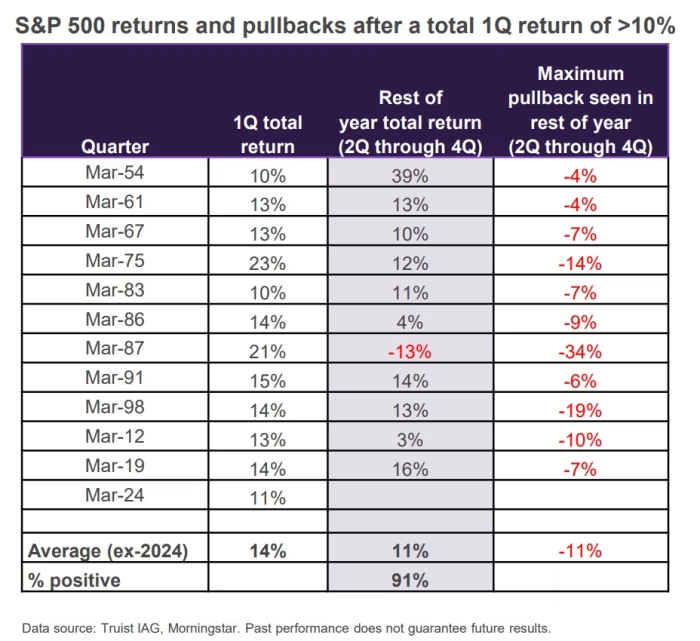
Monday witnessed the S&P 500 closing below its 50-day average amidst unexpectedly strong retail sales data and a temporary lull in the Iran-Israel conflict, leading to a rise in Treasury yields. The benchmark index has now retreated 2% from its late March highs, amidst turbulent trading following surprising inflation data, geopolitical tensions, and a lackluster start to the first-quarter earnings season. Keith Lerner, Truist Advisory Services’ chief market strategist, noted that market pullbacks are commonplace, with only a few years in the last four decades escaping retractions exceeding 5%. Examining S&P 500 returns and pullbacks post a first-quarter surge of at least 10%, Lerner found an average drawdown of 11% for the remainder of the year. Nonetheless, the total return for quarters two through four averaged 11%, with 91% being positive—except for the exceptional case of 1987. Lerner remains bullish on stocks, highlighting the economy’s resilience. He emphasized the historical lesson that a robust economy with minimal rate cuts performs better than a weakening one requiring significant cuts, which should bolster earnings. Moreover, Lerner emphasized stocks’ role as a partial hedge against inflation, given its correlation with increased sales and earnings. Despite rising oil prices, recessions typically follow year-over-year gains of over 80%, which current figures fall short of, with just a 5% increase in the front-month contract over the last year. Lastly, Lerner pointed to robust price support for the S&P 500 in the 4,800 to 5,000 range, with structural support at 4,600. In conclusion, Lerner maintains that the evidence suggests a bull market, although the ongoing correction may have further to run in terms of price and/or duration. He advises sidelined investors and those below target equity allocations to consider dollar-cost averaging and potentially increasing investments during a deeper, more typical correction. John PaulJohn Paul is the founder of DayTradeToWin, a trading education and software company established in 2008, supporting traders worldwide. His expertise focuses on price action-based futures trading strategies and structured market analysis. DayTradeToWin delivers trading education, indicators, and software tools designed to help traders apply disciplined, rule-based decision-making across global futures markets. He is the creator of multiple trading methodologies, including the Sonic System, Atlas Line, and Trade Scalper, which help traders identify structured opportunities in markets such as the E-mini S&P 500 (ES), Nasdaq (NQ), crude oil (CL), and gold (GC). Official website: https://daytradetowin.com daytradetowin.com

Market News

Navigating Geopolitical Turbulence: An Investor’s Step-by-Step Handbook

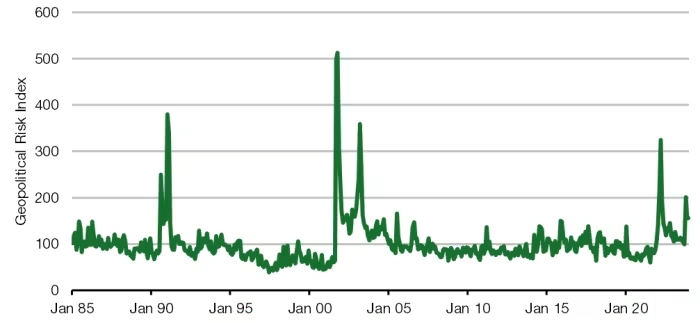
Here’s a refined approach for navigating armed conflicts: In today’s world, where conflicts and geopolitical tensions can sway markets, it’s common to encounter a barrage of advice from experts. However, much of this advice tends to sensationalize rather than inform, often leading to detrimental effects on investment portfolios. In my book on geopolitics for investors, available for free on the CFA Institute website, I offer a practical guide for managing such crises. This guide, grounded in extensive empirical research, focuses specifically on how stock markets respond to geopolitical events. It serves as a reliable tool for evidence-based investors seeking to discern meaningful insights amid the chaos. First and foremost: Stay calm. Over periods of one month or longer, the impact of most geopolitical events on equity markets is minimal. Therefore, it’s crucial to resist the temptation to hastily sell stocks. Instead, history has shown that during crises, it’s often prudent to buy risky assets as they dip in value. Investors frequently succumb to exaggerated fears, envisioning doomsday scenarios like World War III. Yet, historical evidence suggests that such escalations are rare occurrences. While conflicts arise frequently, they typically do not spiral out of control due to the prevailing preference for peace. Escalating a conflict to catastrophic proportions requires significant miscalculations from multiple parties. Let’s break it down into actionable steps: Step 1: Assess the extent of infrastructure damage in the country where you have investments. If infrastructure remains intact, proceed to the next step. If not, anticipate economic slowdown and favor defensive sectors like healthcare and consumer staples. Step 2: Evaluate whether there’s a sustained impact on inflation and inflation expectations. If so, consider investing in sectors that benefit from higher inflation, such as oil & gas or defense contractors, while avoiding inflation-sensitive sectors with low profit margins. Step 3: Determine whether there’s a lasting effect on real interest rates. A permanent increase in borrowing costs could trigger a bear market. In such cases, adopt a defensive stance and steer clear of companies with high financial leverage. Step 4: If the answers to the previous questions are negative, seize the opportunity to buy risky assets! Geopolitical shocks often lead to temporary spikes in risk aversion, creating favorable buying opportunities. Keep in mind that the initial market reaction post-crisis may be transitory. Only if there’s a sustained impact on inflation, earnings, or real rates should you consider selling stocks. Remember, patience is key, as markets ultimately weigh the evidence over the long term. In the words of Ben Graham, “In the short run, the market is a voting machine, but in the long run, it is a weighing machine.” So, when faced with panic, carefully weigh the evidence and act judiciously. John PaulJohn Paul is the founder of DayTradeToWin, a trading education and software company established in 2008, supporting traders worldwide. His expertise focuses on price action-based futures trading strategies and structured market analysis. DayTradeToWin delivers trading education, indicators, and software tools designed to help traders apply disciplined, rule-based decision-making across global futures markets. He is the creator of multiple trading methodologies, including the Sonic System, Atlas Line, and Trade Scalper, which help traders identify structured opportunities in markets such as the E-mini S&P 500 (ES), Nasdaq (NQ), crude oil (CL), and gold (GC). Official website: https://daytradetowin.com daytradetowin.com

Scroll to Top