DayTradeToWin Review

In-Depth Review of Trading Signals – Atlas Line, ATO 2, and Trade Scalper

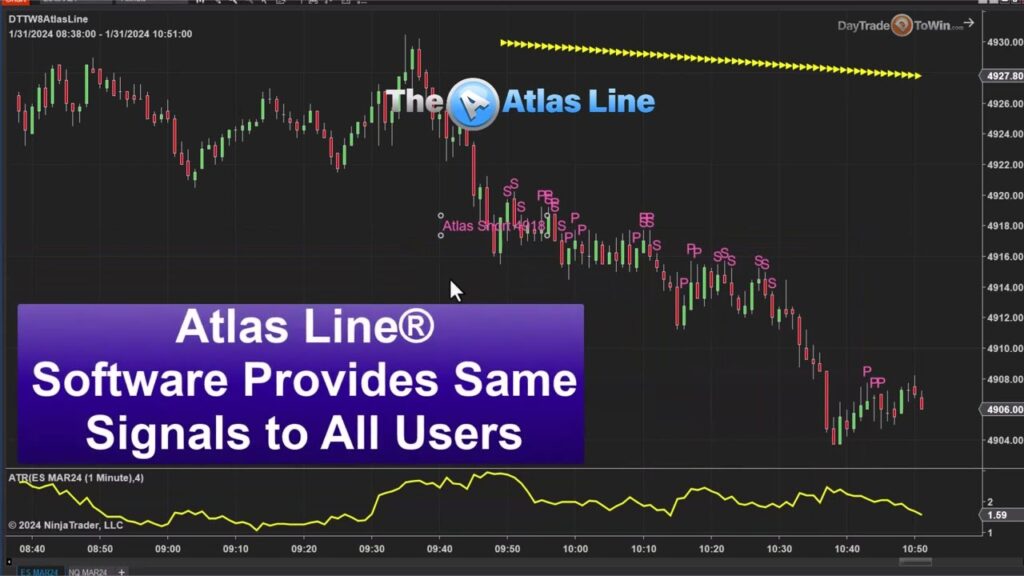
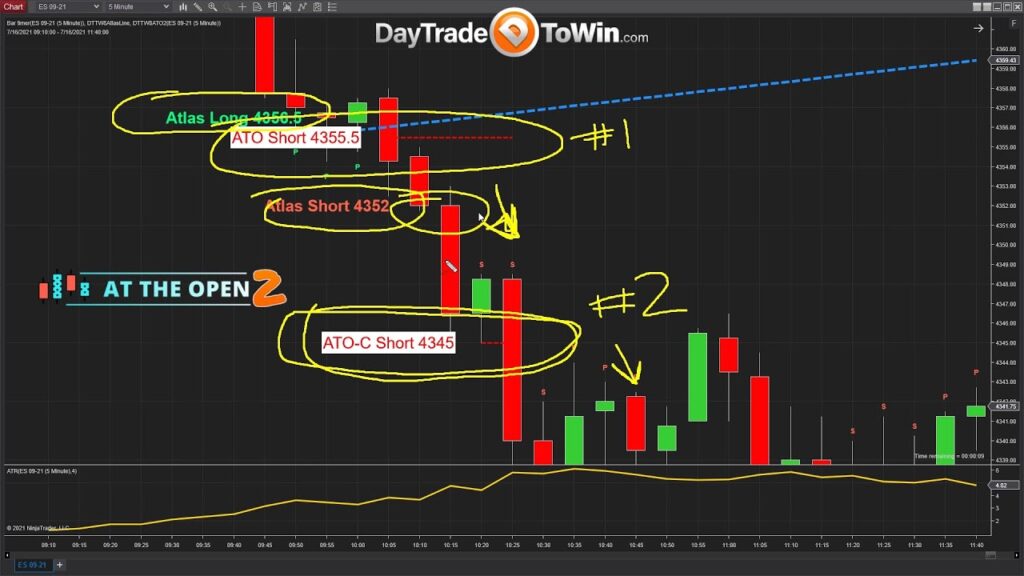
Hello traders! Today we’re delving into the world of trading signals. In this video, we’ll thoroughly examine signals from three distinct trading systems: the Atlas Line, ATO 2, and Trade Scalper. Before we begin, please take a moment to review the disclaimers both on our website and in this video for a well-informed trading experience. Let’s start by analyzing the E-mini S&P 500 chart on the NinjaTrader platform, utilizing a 5-minute timeframe. Our focus will be on the time span between 9:10 AM and 11:40 AM Eastern Time on July 16th, 2021. Atlas Line Signals The initial signals from the Atlas Line may seem small, but after adjusting their size, we can better evaluate their significance. For instance, a long signal is triggered when two closing bars appear above the Atlas Line. However, not every signal turns out to be a winner, as we’ll discover later. ATO 2 Signals Moving on to the ATO 2 system, representing At The Open. While it doesn’t display a long signal, it indicates potential short positions. ATO 2, being a time-tested method, serves as a valuable complement to other systems, offering additional confirmation, as we’ll explore shortly. Trade Scalper Signals Our final focus is on the Trade Scalper signals. By applying this system to the chart, we can identify short signals that align with the ATO 2 signals, presenting a reinforced bearish perspective. Analyzing Signal Performance As we delve into the analysis, it becomes evident that not every signal is foolproof. Despite a losing Atlas Line signal, the ATO 2 and Trade Scalper short signals present an opportunity to minimize losses. Combining signals from different systems enhances confidence in the overall trade direction. Building Confidence with Diverse Systems The key takeaway is the significance of using multiple systems to confirm trade directions. While individual signals may encounter challenges, a convergence of signals from different systems can provide a more robust foundation for making informed trading decisions. Summary and Considerations To sum up, today’s chart serves as a prime example of the importance of filtering signals through multiple systems. Combining the Atlas Line, ATO 2, and Trade Scalper can offer a comprehensive and reliable approach to trading. Remember, this analysis provides just a glimpse of what our eight-week mentorship program covers, offering a holistic understanding of these systems.

Market News

Microsoft’s Impact: S&P 500 Futures Stand Strong Near Record Levels

Early on Tuesday, U.S. stock index futures hovered near their record highs in anticipation of an upcoming earnings report from the widely acclaimed Microsoft. Current Stock-Index Futures Trading: On Monday, the Dow Jones Industrial Average (DJIA) recorded a gain of 224 points, or 0.59%, closing at 38333. The S&P 500 (SPX) experienced an increase of 37 points, or 0.76%, reaching 4928, and the Nasdaq Composite (COMP) gained 173 points, or 1.12%, closing at 15628. Key Drivers in the Market: The U.S. corporate earnings reporting season for the fourth quarter of 2023 is entering a crucial phase on Tuesday, with investors cognizant of the recent surge in stocks to new heights, allowing little room for disappointment. On Monday, the S&P 500 achieved its sixth record of 2024, marking a 17.5% rally in the last three months. This surge has been driven by significant gains in large technology stocks, especially those expected to benefit from the sales of AI-related technology, including hardware like chip-maker Nvidia (NVDA, +2.35%) and software like Microsoft (MSFT, +1.43%). This narrative has propelled Microsoft’s market value beyond $3 trillion, following an impressive 65% surge in the past 12 months. It has also elevated its next-12-month price/earnings ratio to 33.4, a multiple notably higher than in recent years. Investors eagerly await Microsoft’s results and forecasts, slated for after Tuesday’s closing bell, seeking validation for the prevailing market optimism, particularly given its substantial 7.3% weighting in the S&P 500. Option pricing suggests Microsoft shares may experience a movement of approximately ±2.5% by the end of the week, according to MarketWatch calculations. Other Noteworthy Earnings Reports: In the next few days, earnings reports from four other influential stocks, referred to as the ‘Magnificent 7,’ are expected. This includes Alphabet (GOOG, +0.68%) on Tuesday, followed by Apple (AAPL, -0.36%), Amazon (AMZN, +1.34%), and Meta (META, +1.75%) on Thursday. “The price reaction to 5 of the ‘Mag 7’ reports…[is] critical for overall market direction,” emphasized Julian Emanuel, a strategist at Evercore ISI. Additional companies releasing results on Tuesday include Pfizer (PFE, +0.04%), General Motors (GM, +0.60%), UPS (UPS, -0.80%), and HCA Healthcare (HCA, +1.16%) before the opening bell on Wall Street, followed by Advanced Micro Devices (AMD, +0.33%), Starbucks (SBUX, +1.08%), Electronic Arts (EA, -0.60%), and Juniper Networks (JNPR, +0.08%) after the close. Supporting market sentiment on Tuesday are softer Treasury yields. The benchmark 10-year yield (BX:TMUBMUSD10Y) has retraced toward the 4% mark after the Treasury announced reduced borrowing needs for the first quarter on Monday. The Federal Reserve commences its two-day policy meeting on Tuesday, with no anticipated changes in interest rates this month. Scheduled U.S. economic updates on Tuesday include the S&P Case-Shiller home price index for November at 9 a.m. Eastern, followed by the December job openings report and January consumer confidence at 10 a.m.

Market News

Critical Crossroads: Stock-Market Rally Faces Decisive Week with Fed and Tech in Focus

The upcoming week is poised to be a critical juncture for stock-market dynamics, with investors closely monitoring key events such as the Federal Reserve’s monetary-policy meeting, a pivotal December employment report, and a wave of earnings reports from major technology players. These events are expected to provide vital insights into the economic landscape and shape expectations regarding interest rates. A surge in U.S. stocks during the past week was fueled by encouraging data indicating a moderation in inflationary pressures for December. The S&P 500 marked its longest streak of record highs since November 2021, closing at an all-time high for five consecutive days. While the index experienced a slight dip on Friday, it still secured a weekly gain of 1.1%, accompanied by positive gains in the Nasdaq Composite and Dow Jones Industrial Average. Market participants appear to be catching up with the trends of 2023, strategically deploying funds into the market to seize short-term opportunities. Robert Schein, Chief Investment Officer at Blanke Schein Wealth Management, observes the market’s focus on swift gains until significant market-moving events unfold. One such potential event is a Federal Reserve speech, capable of influencing market sentiment. Anticipations of the Fed initiating rate cuts as early as March, following a rapid tightening cycle, have propelled a rally in U.S. stock and bond markets. Investors are now expecting several quarter-point rate cuts by December, aiming to bring the fed-funds rate down to the 4-4.25% range. However, the upcoming news conference with Fed Chair Jerome Powell could challenge these expectations and resist forecasts of a March cut. Thierry Wizman, a strategist at Macquarie, suggests that a more dovish stance from the Fed, a robust stock-market rally, a resilient labor market, and geopolitical tensions could prompt Powell to maintain a monetary tightening bias. Concerns about renewed inflation due to conflicts in the Middle East may further dissuade the Fed from implementing immediate rate cuts. The spotlight also falls on labor-market data, particularly the January employment report, identified as a significant factor influencing U.S. financial markets. Investors are keenly awaiting signs of a labor market slowdown that could prompt rate cuts. Economists project a gain of 180,000 jobs in January, with slight upticks in the unemployment rate and a moderation of wage gains. The week also promises earnings reports from major technology companies, the so-called “Magnificent 7,” including Alphabet, Microsoft, Apple, Amazon.com, and Meta Platforms. These reports are expected to wield influence over the S&P 500’s value, given the substantial role these tech giants have played in the recent stock-market rally. Collectively, these companies are projected to drive significant year-over-year earnings growth for the fourth quarter of 2023, offsetting declines in other S&P 500 companies. The overall blended earnings decline for the entire S&P 500 for Q4 2023 is estimated at 1.4%.

DayTradeToWin Review

Strategic Scalping: Embracing the Power of Singular Trades using Trade Scalper ✅

Greetings, fellow traders! Today, let’s delve into the dynamics of the afternoon trading session as we explore the capabilities of the Trade Scalper software. Before we immerse ourselves in the signals, it’s crucial to underscore the significance of comprehending the inherent risks associated with trading. While the potential for profits is evident, managing potential losses is equally vital. Always engage in discussions with your broker and approach trading with a sense of responsibility. The versatility of the Trade Scalper software shines through, catering to a spectrum of markets, including oil, gold, Nasdaq, and the E-mini S&P. Numerous traders have found success utilizing this tool, particularly on Nasdaq and crude oil. Now, let’s closely examine the E-mini S&P chart. The signals generated by the Trade Scalper software are clear, featuring both long and short trades. These trades have consistently proven successful, yielding three, four, or even five ticks on each occasion. While dissecting the chart, it’s imperative to address a common pitfall – the inclination to re-enter a trade. Should you miss an opportunity, resist the urge to hastily re-engage. Each trade has its unique moment, and attempting to replicate it can be precarious. Furthermore, in the event of the market moving against you, prompt loss-cutting is advised. Clinging to losing trades can compromise overall success. A specific trade at 44.04 warrants special attention for its intricacies. If you’ve successfully navigated this trade and secured a profit, it’s prudent to avoid a second entry. Endeavoring to re-enter a trade that has already reached its target is a risky proposition and is generally discouraged. Discipline remains paramount in your trading strategy. If a trade doesn’t unfold in your favor and begins to move against you, consider a prompt exit. Time-based factors often influence outcomes, making a swift exit from a trade that hasn’t met its target a wise decision. Conclusion: In the realm of day trading, consistency and discipline stand as the cornerstones of success. For those new to this thrilling venture, focusing on price action is essential. Explore the advantages of trading various markets and contemplate joining mentorship classes. Day Trade to Win, with its dedicated focus on new and beginner traders, provides invaluable insights and guidance. To stay abreast of trading tips, subscribe to the Day Trade to Win YouTube channel and visit daytradetowin.com. The next mentorship class is on the horizon, offering an excellent opportunity to deepen your understanding of trading strategies and thrive in the market. Until our next encounter, may your trades be prosperous and your journey in the market be fulfilling!

Market News

Unlocking the Secrets: How January Predicts the Future of U.S. Stocks in 2024

Bespoke Investment Group’s analysis suggests that the S&P 500 index is poised for continued upward momentum in 2024, building on its strong January performance. The research team at Bespoke observed a historical trend wherein, if the S&P 500 maintains positive gains through a certain point in January, it tends to further climb during the final four trading days of the month. When the index concludes January with a positive performance, the probability of sustained growth throughout the year significantly improves. According to Bespoke’s analysis spanning from 1953 to 2023, when the S&P 500 exhibited a 2% or more gain in January, the median performance for the rest of the year averaged an impressive 13.5%. Additionally, positive returns were recorded for the remainder of the year in 84% of such instances. Conversely, when the S&P 500 finishes January with gains of less than 2% or in negative territory, the median performance for the rest of the year drops to 6.4%, with positive returns occurring in only 68% of cases. Presently, FactSet data indicates a 2.5% increase in the S&P 500 since the start of January. Although the index is set to finish slightly lower on Friday, down 0.1% at 4,887 in the final 90 minutes of trading for the week, historical trends suggest an optimistic outlook for the rest of the year based on the January performance.

Market News

Record-Breaking S&P 500, Yet Other Indexes Face Market Challenges

Thursday is poised to mark the fifth consecutive record close for the S&P 500, underscoring its sustained robust performance. Nevertheless, alternative metrics in the U.S. stock market paint a less sanguine picture. The Value Line Geometric Index (VALUG), an equal-weighted gauge monitoring the median performance of approximately 1,700 major listed companies in North America, significantly trails its November 2021 record highs—approximately 17% lower, as per FactSet data. The contrast between the Value Line Geometric Index and the S&P 500, identified by the tickers VALUG and SPX, respectively, provides insightful observations. It illuminates how a select group of mega-cap technology stocks has been the driving force behind much of the S&P 500’s gains over the past year. Steve Sosnick, Chief Market Strategist at Interactive Brokers, underscores that this discrepancy underscores the heightened concentration in large-cap stocks. Further insights emerge from comparing the Russell 2000 index of small-cap stocks to the expansive Wilshire 5000, encompassing around 3,500 actively traded U.S. stocks. While the Wilshire 5000 hovers near its recent record high from January 3, 2022, the Russell 2000 lags by approximately 20% from its November 2021 record closing high. Sosnick emphasizes that this incongruity underscores the prevailing dynamic of small caps versus large caps in the market. An examination of the S&P 500 growth index versus the S&P 500 value index reveals a recent resurgence by high-quality value stocks in catching up to the dominant tech sector. Over the past three months, the S&P 500 value index has experienced a rise of around 14%, slightly trailing the 17% increase in the S&P 500 growth-factor index. However, the performance gap widens over the past 52 weeks, with a 29% gain for the S&P 500 growth index compared to a 13% gain for large-cap value stocks. As of Thursday afternoon, the S&P 500 was up 0.2%, poised to conclude around 4,877 according to FactSet data.

Scroll to Top