Market News

The 4 Vital Orders Every Trader Should Master

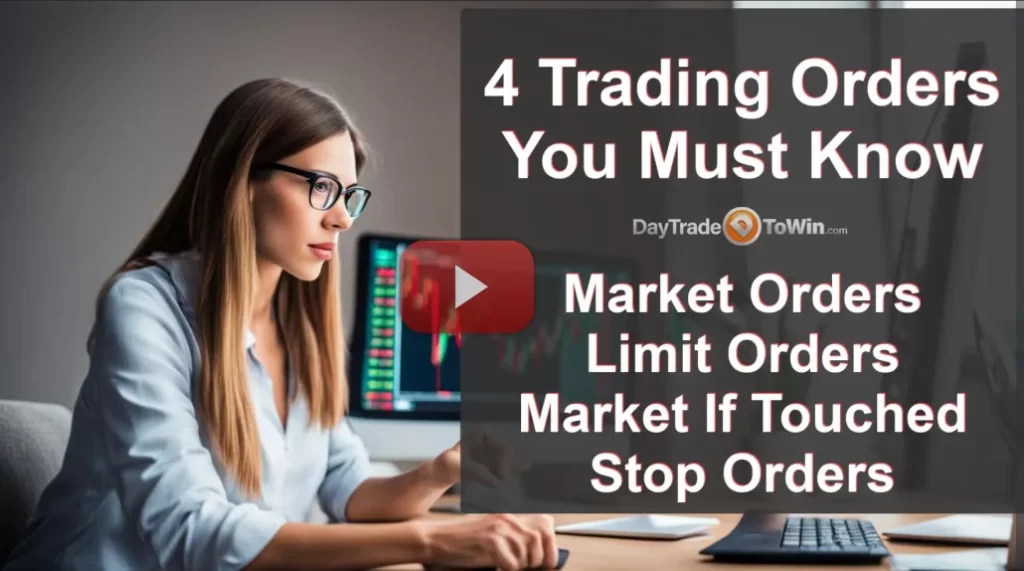
Embarking on this exploration, our mission is to demystify the intricacies of various order types that hold the power to shape the trajectory of your trading endeavors. With a surge in inquiries about the distinctions between market orders, limit orders, stop orders, and MIT (Market If Touched) orders, this blog post is designed to shed light on their nuances. Its goal is to provide guidance on the best practices for incorporating these orders into your trading strategy. Before delving into the details, here’s a crucial reminder: Trading carries inherent risks, so only deploy funds you can afford to lose. Commencing our journey, let’s turn our attention to a fundamental chart featuring the renowned trade scalper software in a one-minute timeframe. Traders frequently grapple with whether to employ market orders, limit orders, or stop orders when executing trades based on price action. Market Orders: For those craving immediacy, market orders are the go-to choice. Initiating a ‘buy’ or ‘sell’ at market means diving into the action at the current market price. However, be vigilant about potential slippage, especially in fast-paced markets. Limit Orders: Conversely, limit orders offer greater control. Specify the exact price you desire, and the order will only execute at that price or a more favorable one. This method minimizes slippage, and stay tuned for a handy trick to optimize your entries. Strategically placing limit orders can be a game-changer. By setting your limit order slightly below (for buys) or above (for sells) the current market price, you can anticipate market movements and potentially secure more favorable entries. Stop Orders: Enter the versatile stop order, serving as both an entry and exit strategy. In a market rally, a buy stop order above the current price can be employed. Conversely, a sell stop order below the market price acts as a protective exit strategy. MIT (Market If Touched) Orders: Blending the best of both worlds, MIT orders operate similarly to limit orders. You set a specific price, and once the market touches that price, it seamlessly converts to a market order, ensuring a swift execution. MIT orders shine in slower markets where securing fills can be challenging. By strategically placing MIT orders, you can capitalize on precise entries or exits, enhancing your trading efficiency. Conclusion Mastering these diverse order types is a pivotal step in honing your trading skills. Whether you favor the immediacy of market orders, the precision of limit orders, the strategic nature of stop orders, or the versatility of MIT orders, understanding when and how to use each is paramount to success. If you’ve navigated through this content, you’re on the right path. However, this is merely the beginning. Consider joining our upcoming mentorship class to gain access to advanced strategies and software tools that can elevate your trading acumen. Visit daytradetowin.com, subscribe to our YouTube channel, and always bear in mind: Successful trading is a journey, not a destination. Until next time, happy trading!

Market News

2024 Market Projections: Wall Street Bank Anticipates Dip-Buying Bonanza for Investors

In the near future, we can expect to witness how Nvidia’s financial performance affects the market, as historical evidence suggests that these numbers have influenced bond yields and the S&P 500. Many investors and even Wall Street strategists may have inaccurately anticipated an economic decline this year, only to be proven wrong when it did not happen. This is particularly relevant regarding the end-of-year predictions made for the S&P 500. Société Générale is unique compared to other banks because the S&P is currently 4% lower than their target of 4,750, which they aim to reach by 2024. Forecasters from Swiss banks predict a promising year ahead and suggest getting ready to exploit a decline in the market as the S&P 500 is anticipated to hit its lowest level in this current cycle. They expect the Federal Reserve to implement approximately 150 basis points of interest rate reductions, a decrease in GDP growth, and improved comprehension of the political cycle by the conclusion of 2024. This insight is provided by analysts Manish Kabra and Charles de Boissezon. In order to prepare for the year 2024, they outline their plan by dividing it into four separate quarters. A2) The value of the S&P 500 has risen as bond yields have declined. Moreover, the global economy is getting better, and the index is experiencing more positive earnings than in the previous year. The period that poses the greatest difficulty is marked by a clear decrease in consumer engagement and the mounting uncertainty in politics. The third quarter has presented difficulties because earnings have decreased and there is a growing sense of uncertainty in the political sphere, despite substantial cuts made by the Federal Reserve. In order to improve the S&P 500 index, it will be necessary to see gains across various sectors, as comparing earnings for the Nasdaq-100 has become more challenging. However, these gains are not anticipated to happen right away. After the U.S. elections conclude, reshoring stocks have a benefit, and the market breadth starts displaying indications of enhancement as focus moves towards strong economic expansion. What is the investor’s plan for this particular scenario? They offer four forecasts for the performance of U.S. stocks in the upcoming year. Buy the dip in the S&P 500. The emergence of improved indicators for profit potential will present opportunities for purchasing, even though there will be difficulties in the upcoming year. A mild economic downturn is predicted for the middle of 2024, followed by a sell-off in the credit market in the second quarter, and a continued decrease in quantitative easing measures. Investors looking to diversify their portfolio and seek exposure to big-cap growth and earnings momentum may consider the long equal-weighted version of the Nasdaq-100 compared to the Russell 2000. SocGen remains cautious despite the recent surge in small-cap stocks due to the high number of companies refinancing and facing losses. The First Trust Nasdaq-100 Equal Weighted Index Fund tracks this particular index. The reestablishment of U.S. stocks has seen a notable rise. Since the implementation of the Inflation Reduction Act, the market has experienced an influx of over $500 billion in new investments. Stocks related to reshoring have particularly thrived in the industrial sector, unaffected by the changing administrations of both Trump and Biden. Two notable options for investors in this category are the Transform Supply Chain and ProShares Supply Chain Logistics. Furthermore, there are various other American Revival stocks that center around this concept and could be worth considering for investment purposes. Societe Generale anticipates a substantial increase in the worldwide generative AI market, projecting a compound annual growth rate of 31.4% between 2023 and 2032. Nvidia’s remarkable success this year, seeing a rise of around 244%, has highlighted the importance of AI among investors. For those looking to invest in this field, possible choices are Cathie Wood’s ARK Autonomous Technology & Robotics ETF and the iShares Robotics and Artificial Intelligence Multisector ETF.

DayTradeToWin Review

Strategic Showdown: Analyzing the Tactics of Two Struggling Traders Against a Successful Day Trading System

Hello Traders! As we eagerly anticipate the thrill of Black Friday deals, we’re excited to unveil something extraordinary just for you. Today marks the announcement of the much-anticipated version four of our autopilot trading system – a game-changer for our traders with lifetime or yearly licenses! Get ready for a wave of enhanced features and performance as version four takes center stage. Stay tuned for the imminent release on your member accounts. Now, let’s embark on a journey to explore the autopilot system and delve into some essential strategies for achieving trading success. This video will guide you through the pivotal features designed to minimize risks and propel your trading endeavors to new heights. Autopilot System Upgrade: AutoPilot trades take place during specific time periods throughout the day, which is ideal because we have identified particular time frames that work best for trading. This helps reduce the exposure of your trading account to risk. Unlike other automated systems that trade around the clock, AutoPilot ensures that your account is not subjected to increased risk. Before diving into the autopilot system’s intricacies, let’s underscore the paramount importance of risk management. Trading is inherently risky, demanding a cautious and calculated approach. Understanding Losing Trades: Fear not, as we confront losing trades head-on, viewing them as valuable opportunities for growth and improvement. Setting Profit Targets and Maximum Loss: Key to triumph in trading is the establishment of crystal-clear profit targets and maximum loss thresholds. Join us as we detail our approach, with a keen focus on reaching a daily goal of $500. Witness how our system autonomously closes positions upon hitting these targets, embodying a disciplined and systematic trading approach. In this video, we’re not merely discussing theories – we’re immersing you in live trades, showcasing the autopilot system in action. While our autopilot system operates seamlessly, it doesn’t strip you of control. Discover how, even in automated trading, you retain the ability to close positions at your discretion, providing unparalleled flexibility and autonomy. As we conclude, bear in mind that successful trading is an amalgamation of strategy, discipline, and continuous learning. For inquiries or to explore our autopilot trading system, visit daytradetwin.com. Seize the opportunity to leverage our special Black Friday discounts, and join us on the path to mastering the art of day trading. Happy trading, and may your Black Friday be filled with prosperous deals!

Market News

2023 Highs on the Horizon: Can Holiday Shopping Push the Stock Market Even Higher?

Goldman Sachs predicts that the consumption rate is likely to see a decline, yet it will persistently expand at a satisfactory pace. American stocks have seen a considerable increase and are now nearing the highest levels reached in the summer. This remarkable rebound coincides with investors preparing for the holiday season, with the eagerly awaited Black Friday just around the corner. The expected surge in shopping on the day after Thanksgiving marks the beginning of a season of higher spending for the holidays. This has the possibility of boosting the stock market after its recent growth. Yardeni Research analysts have stated that the beginning of the holiday sales season seems optimistic, as consumers are currently employed and have a positive view of their finances. Although there is a concern that high interest rates might impact purchases of expensive items that require financing, the strong sales numbers in October indicate a promising start to the holiday shopping season. However, investors are worried that the rise in U.S. stocks in November might have been too much. The S&P 500 index is set to record its largest monthly increase this year due to the strong performance of both bonds and equities. However, it is important to note that the S&P 500 is still 1.6% lower than its highest closing point in July 2023. In just this month, the index has surged by 7.6% following three weeks of positive outcomes according to Dow Jones Market Data. In a telephone interview, Bob Elliott, the co-founder and CEO of investment company Unlimited Funds, shared his view that the situation is being overstated and that there has been a noticeable enhancement in financial circumstances. Elliott states that the enhancement in financial circumstances can be attributed to the U.S. Treasury Department’s recent decision to issue a smaller amount of long-term Treasury bonds than what was anticipated by the market. This action has relieved concerns among investors regarding the demand for long-duration U.S. government debt, which was worried due to the substantial quantity of Treasurys entering the market. Stock prices have risen as a result of the decrease in yields caused by the increase in prices of long-term Treasury bonds. Elliott stated that the Treasury’s decision to enact a policy that lessens constraints is advantageous for the economy as a whole, effectively postponing the implementation of more stringent measures. The Federal Reserve has taken steps to lower inflation, which is currently higher than its desired level of 2%, by increasing interest rates to slow down economic growth. In October, inflation, as measured by the consumer-price index, remained stable at 3.2% compared to the previous year. This is a decline from 3.7% in September and a significant decrease from the peak of 9.1% in June 2022. Investors were hopeful after the consumer-price-index report was made public on November 14th, as it resulted in a sharp decrease in treasury yields. This decline in yields continued throughout the month, while there was an upward trend in stocks. In November, the prices of stocks and long-term Treasury bonds have been rising at the same time. Data from FactSet shows that both the Vanguard Total Stock Market ETF VTI and the Vanguard Long-Term Treasury ETF VGLT have seen a notable rise of more than 7% this month until the end of last week. Based on Dow Jones Market Data, the interest rate for the 10-year Treasury note (BX:TMUBMUSD10Y) stayed relatively consistent at 4.441% on Friday. However, it has fallen by about 43 basis points this month, considering the levels at 3 p.m. Eastern Time. In an interview with MarketWatch, Don McCree, the vice chairman of Citizens Financial Group, mentioned that with the decline in Treasury yields, it would be beneficial for the bank’s corporate clients to take advantage of the opportunity to tap into the debt markets if they expect to refinance in the next three years. This is because borrowing expenses have become cheaper. McCree, who holds the position of commercial banking leader at Citizens, further disclosed that corporations he serves are carefully keeping track of consumer expenditure, particularly throughout the period of holiday shopping. Yardeni Research’s report states that Home Depot and Target have both experienced a decline in their revenue recently. Despite this, their actual performance surpassed the expectations set by analysts. In contrast, TJX, the most successful retailer among the three, saw a notable increase in their quarterly results and expressed optimism for the upcoming holiday season. Consumer savings Jan Hatzius, the chief economist at Goldman Sachs Group, stated during a virtual media briefing on November 16th that the surplus savings of consumers were instrumental in the events of 2022. This can be partially explained by a notable drop in real disposable personal income, which can be attributed to the increase in inflation. Hatzius made these remarks while discussing the future prospects of the bank’s global investment research group in 2024. According to Hatzius, the decline in excess savings has been accompanied by a significant rise in real disposable income, with an estimated growth rate of 4% in 2023. He further added that they expect a similar rate of growth, around 3%, in 2024, which should be sufficient to maintain a decent pace of consumption at approximately 2%. In October, there was a 0.1% decrease in retail sales in the United States – the first decline in seven months, as per Yardeni analysts. However, they mentioned that not every sector saw a decrease. They pointed out that the most recent data indicates that consumers are still spending more on eating out at restaurants compared to last year. Currently, the United States is experiencing a low unemployment rate of 3.9% as of October. During the press conference, Hatzius stated that our goal is to prevent a notable increase in the unemployment rate in the coming year. Moreover, he mentioned that there is a mere 15% possibility of a recession taking place within the following year. Elliott holds the belief that employment is the paramount concern for consumers. He argues that

Market News

Resilient Rise: Wall Street Wraps Up Third Winning Week with Modesty

Wall Street quietly concluded another week of growth, marking its third consecutive week of positive performance. Stocks maintained a steady upward trajectory, further adding to their already significant gains achieved during November. The S&P 500 went up by 5.78 points, equivalent to a 0.1% increase, reaching a level near its highest point within the past three months. The Dow Jones Industrial Average had a small increase of 1.81 points, less than 0.1%, reaching 34,947.28, while the Nasdaq composite had a gain of 11.81 points, or 0.1%, reaching 14,125.48. Several retail businesses saw substantial growth after surpassing analysts’ predictions in their quarterly earnings. Gap’s stock price skyrocketed by 30.6% when it disclosed a profit that exceeded Wall Street’s expectations, resulting in a year-to-date increase that is more than twice its previous gains. In a similar fashion, Ross Stores witnessed a 7.2% surge in its stock price after revealing stronger-than-anticipated profit and revenue figures. Despite exceeding expectations, BJ’s Wholesale Club faced a decline of 4.8%, which analysts believe was due to the exclusion of new store openings in the underlying sales figure. Regrettably, the company did not meet expectations. Retailers are wrapping up a summer season of revealing their earnings, which have surpassed expectations. According to FactSet, the companies in the S&P 500 are expected to announce their first overall growth in a year. Nevertheless, the primary factor behind the substantial increase in stock prices this week is the perception that inflation has declined sufficiently for the Federal Reserve to halt its ongoing interest rate hikes, which have been adversely impacting the market. In order to control inflation while avoiding a major economic decline, the Federal Reserve has recently raised its main interest rate to its highest level since 2001. This action is intended to stabilize the economy and lessen the effects on financial markets. On Tuesday, a new report showed that consumer inflation was not as high as originally expected in the previous month. This information led to hope that the Federal Reserve would be able to maintain a stable situation effectively. Additional readings supported this positive outlook by suggesting that both inflation and the overall economy might be experiencing a decrease in growth. At present, traders are trying to predict when the Federal Reserve will begin lowering interest rates. This move could potentially increase investment prices and offer support to the financial system. Although the Federal Reserve plans to keep interest rates high for a prolonged period to ensure they effectively combat inflation, traders are considering the chance of rate cuts starting in the summer of 2024. Over the past weeks, there has been a decline in worries over inflation as the price of oil has experienced a substantial decrease. This drop can be attributed to concerns about an imbalance between an excessive supply of crude oil and a lack of demand for it. The price of American crude oil for December delivery rose by $2.99 on Friday, resulting in a settlement price of $75.89. This increase helped to partially regain some of the significant losses experienced earlier in the week. However, it is worth mentioning that the current price is still significantly lower compared to its previous peak of $93 in late September. The price of Brent crude, the global benchmark, rose by $3.19 on Friday, reaching $80.61 per barrel. On Thursday, there was a small drop in the yield of the 10-year Treasury in the bond market, going from 4.44% to 4.43%. Just a few weeks prior to this, it had been even higher, reaching 5%, which was the highest it had been since 2007. This increase had a negative impact on stock and other investment prices. If Treasury bond yields go down a lot and stocks go up a lot, it could have a bad effect on Wall Street. After the Federal Reserve’s recent meeting about interest rates, Jerome Powell, the Chair, said they might not keep raising rates if Treasury yields keep going up and stocks keep going down like they did over the summer. This is because these pressures could serve as substitutes for more rate increases. Since that time, there has been a significant decline in profits, and it appears that November will be the most successful month for the S&P 500 in the past year. Economists from Deutsche Bank suggest that this indicates a relaxation of financial conditions by approximately fifty percent compared to the restrictions seen in October. Nevertheless, Justin Weidner, along with other economists, opines that the Federal Reserve can alleviate its concerns about this relaxation as a result of recent encouraging updates regarding inflation and the economy. The Hang Seng index in Hong Kong saw a noteworthy decrease of 2.1% in global stock markets. Similarly, Alibaba, a major Chinese e-commerce company, faced a significant decline in its stock prices when it decided to cancel its cloud computing unit’s spin-off plan. The company attributed this cancellation to the uncertainties caused by the United States’ chip restrictions. In different regions of Asia, the stock indexes had different performances, while in Europe, they saw a more notable rise.

Market News

Options Showdown: $2.4 Trillion Set to Expire, Igniting Bullish Stock Outlook

Traders swiftly entered the arena of call options linked to popular U.S. equity exchange-traded funds, capitalizing on the upswing in U.S. stocks following Tuesday’s release of the consumer-price index. Analysts specializing in options markets suggest that this influx could contribute to further upward movement in stocks in the days to come. Data compiled by Rocky Fishman, the founder of Asym50, indicates that options tied to a significant $2.4 trillion in stocks, exchange-traded funds, and equity indexes are slated to expire on Friday. Analysts at Goldman Sachs Group highlighted a marked increase in call buying associated with well-known index-tracking exchange-traded funds this week. This trend resulted in a decrease in the ratio of outstanding calls to puts, commonly referred to as “skew,” for the SPDR S&P 500 ETF Trust (SPY), the Invesco QQQ ETF (QQQ), and the iShares Russell 2000 ETF (IWM). Traders shifted their focus from puts to calls, signaling a heightened sense of optimism in the market. Goldman’s data reveals that skew for calls tied to the IWM, which tracks the Russell 2000 index of small-cap stocks, has reached its lowest level on record. This suggests a surge in bullish sentiment in a market segment that was previously less favored. Brent Kochuba, the founder of SpotGamma, noted the intriguing shift in small-cap skew, emphasizing that with approximately one-third of IWM calls expiring on Friday, the recent momentum in small caps might wane if traders opt not to extend their positions. However, the increased demand for call options could also indicate that more traders are entering the small-cap arena, hoping for a sustained upward trajectory. This shift occurs as segments of the U.S. market, which have trailed Big Tech throughout the year, strive to catch up. Call options symbolize optimistic wagers on an underlying security or index in the options market, while put options represent the opposite outlook. Options serve various purposes, including speculation on market direction or hedging an investor’s portfolio.

Scroll to Top