stock chart
Market News

Brace for Impact: Jeremy Grantham Forecasts a 70% Market Crash

Jeremy Grantham, celebrated investor and co-founder of GMO, has prognosticated a 70% probability of a stock market crash in the near future. Drawing similarities between the current condition of the market and historical economic downfalls, Grantham accentuates the potential vulnerability of the market. Initially, Grantham had calculated an 85% chance of the market bubble about to burst. However, the enthusiastic tech rally driven by AI has influenced his revision of the likelihood to 70%. Echoing the sentiments of past market bubbles such as 1929, 2000, and potentially 2021, he expressed his concerns regarding the market’s unstable footing in a recent WealthTrack interview, warning about the threatening slump in stocks. Grantham discusses the economic environment of the past decade that has been extremely favorable to stocks; however, he sees eerie similarities with past crashes hinting at a significant decline. “There’s a hint of a mini-bubble forming in AI which is a slight worry,” Grantham commented. He remains unsure if the current hype around generative AI has the capacity to counteract the final stretch of the stock market‘s bubble. “There’s a likelihood that this has already stretched out the process. A minor possibility exists that it might water down the crash,” he surmised. In terms of a longer timeframe, Grantham acknowledged the potential drastic implications that AI developments might have and supports regulatory steps for AI. However, he differentiates these long-term dangers from his immediate forecast for the stock market, “The risks linked to AI do not coincide with the timeline of this bubble,” he elaborated. He predicts traditional bubble deflation, a forthcoming recession, and foreseeable shrinkage in profit margins leading to unrest in the stock market; all of this, he believes, may occur prior to us experiencing any real consequences of AI. With other Wall Street analysts similarly foreseeing a recession that could potentially halt the present stock rally, HSBC strategists are predicting a tougher second half of 2023 owing to a recession tempering the AI boom.

Roadmap
DayTradeToWin Review

Master the Market: Utilize Roadmap Alerts to Beat Market Manipulation in Day Trading

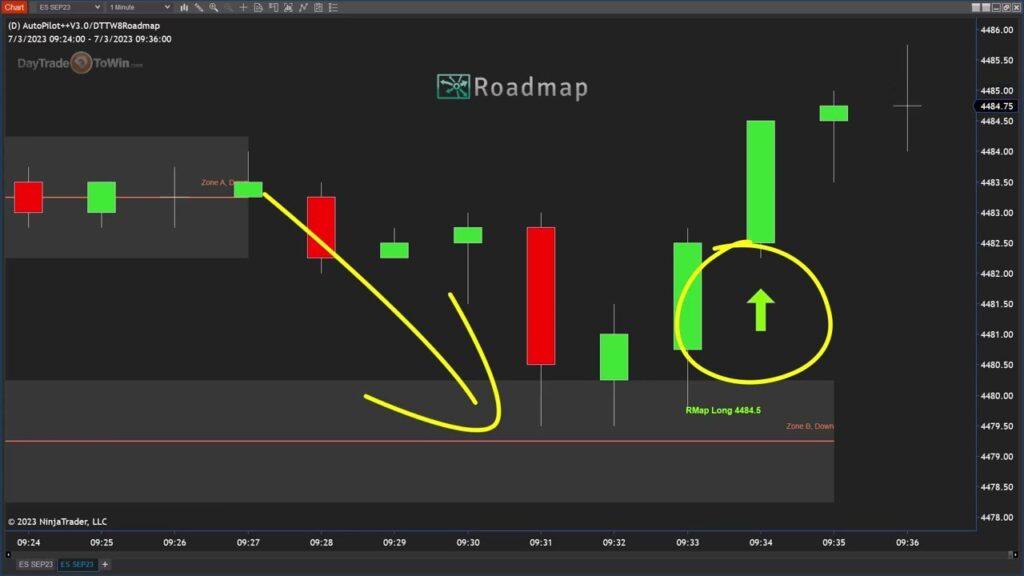
Here, you are witnessing the utilization of roadmap software. This innovative software strategically positions zones on your chart, serving two main functions: to act as a filter and to direct you on initiating long or short entries. Fundamentally, it is a counter-trend strategy at its core. The Roadmap is a prominent trading method featured in our comprehensive DayTradeToWin Accelerated Mentorship Program. Generally, the only way to access the Roadmap is by enrolling in the Mentorship program. The complete Roadmap system is now available for standalone use or to enhance your existing trading strategies. Upon examining the display, you can notice the software signal suggesting a “long” position based on the roadmap. When trading activity reaches the pre-determined zone and bounces off of it, that’s the signal you should look out for. Alternatively, you could consider moving in that direction if the trading activity breaks through the designated zone. However, in this example, the trading activity rebounded from the zone and assumed a long position, generating a signal at 4484.50 to enter long. This precise signal would have been presented to those using roadmap software on the E-mini S&P this morning at approximately 9:35. An additional zone can be found above, indicating either to avoid holding a long position when arriving at this zone or to employ it as a profit target. These roadmap zones benefit those pursuing funding through funding account programs. The zones guide whether to enter long or short positions.

stock market
Market News

Recession Canceled? S&P 500’s Record Half-Year Revives U.S. Stock Market

The S&P 500 index had a strong start to the year, making it the best first half since 2019. Despite concerns about a possible recession in the United States, it now appears that the likelihood of that happening is decreasing. Therefore, there is uncertainty about whether the stock market rally will continue for the remainder of 2023. According to José Torres, a senior economist at Interactive Brokers, determining when the US government’s pandemic-related liquidity measures will run out is difficult. He specifically referred to the fiscal and monetary stimulus implemented from 2020 to 2021. Despite the Federal Reserve’s attempts to control inflation by raising interest rates since 2022, their intervention in March, which occurred after regional bank failures, added more liquidity to the financial system. According to Torres, the stage was set for risky investments to flourish, leading to increased assets. Moreover, the current surge in artificial intelligence has further stimulated the upward movement of American stocks. Torres anticipates a subsequent decrease in the market from now on. During the middle of March, the S&P 500 was trading at a comparable level to the start of 2023. However, the performance of stocks was adversely impacted by issues in regional banks until the Federal Reserve stepped in. On March 12, the central bank’s introduction of a program for funding terms for banks assisted and increased trust in the banking system. This alleviated the major strain on financial circumstances, marked by Torres. Based on information from Dow Jones Market Data, the S&P 500 achieved its strongest performance in the first half of the year since 2019, with a notable 15.9% rise within the initial six months of 2023. In June, all 11 index sectors saw growth, a situation not observed since November. Although the Federal Reserve raised interest rates quickly in 2022, aiming to reduce inflation and demand, the U.S. economy has proven to be resilient. Investors do not appear worried about a potential economic downturn because recent indicators have been positive. On June 29, Bernard Baumohl, the chief global economist at the Economic Outlook Group, sent out an email declaring that the recession had come to an end effectively. The writer highlights that despite the strong performance of the economy in the initial quarter, prices have continued to decline. The writer proposes that all inflation indicators have shown a decrease, and if inflation stays low, the Federal Reserve should maintain its current pause. The Federal Reserve has decided to lower the frequency of raising interest rates this year. They temporarily stopped increasing rates during their meeting in June, but they have suggested that there might be more rate increases later on. Currently, traders predict that there will be a quarter-point increase in the Federal Reserve’s benchmark rate in July, based on the Federal-funds futures. This increase would result in a targeted range of 5.25% to 5.5%, according to the CME FedWatch Tool. Numerous investors are satisfied with the Federal Reserve’s choice to halt temporarily, as they interpret it as an indication that the period of increasing interest rates is nearing its end. This particular period had previously inflicted substantial damages on stocks and bonds in the preceding year. During the past week, several economic indicators in the United States brought pleasant surprises. The revised estimate for the country’s economic growth in the first quarter exceeded what was expected. Moreover, the orders for durable goods from manufacturers in May demonstrated increased strength compared to previous predictions. The sales of newly built homes in the same month exceeded economists’ forecasts. Additionally, consumer confidence reached its highest level in 17 months in June, based on a survey conducted by the Conference Board. Lastly, there was a decrease in the number of people filing for initial jobless claims for the week ending on June 24. Investors were additionally satisfied to observe indications of a decline in inflation. As per a government report disclosed on Friday, inflation in the United States, as measured by the personal-consumption-expenditures price index, decreased to 3.8% in May compared to the corresponding period last year. This signifies the least rapid rate of growth since April 2021. Nevertheless, Torres voiced worries about the possibility of the American economy growing too rapidly for the Federal Reserve to combat inflation effectively. This scenario may lead to the central bank taking a tougher approach by implementing tighter monetary measures. ‘Shocked’ The speaker states that there is a noticeable disparity between the current yield of two-year Treasury bonds, which is at 4.925%, and the rate that the Federal Reserve has indicated as their intended target after finishing their series of interest rate hikes. This discrepancy has emerged following a recent rise in two-year yields, which had previously decreased during a period of difficulty for regional banks. The Federal Reserve recently published a report in June which outlined economic projections, suggesting that its policy rate may potentially reach a high of 5.6% by the year’s end. Presently, the targeted range lies between 5% and 5.25%. Based on information from Dow Jones Market Data, the interest rate on the two-year Treasury note rose by 81.7 basis points in the second quarter, reaching 4.877% on Friday. This is the highest level seen since March 9, as indicated by data collected at 3 p.m. Eastern Time. Torres was taken aback by how rapidly the market adapted to the rise in yields. He also thinks that there is room for yields to go even higher. Torres pointed out that the two-year Treasury rates are often used to gauge the Federal Reserve’s position on interest rates. The stock market in the United States had a positive day on Friday, bringing the month of June to a close with overall gains for the week, month, and quarter. According to information from Dow Jones Market Data, the S&P 500 and Nasdaq Composite have recently reached their highest closing levels since April 2022. Furthermore, both indexes have had their longest consecutive months of wins since 2021. In the first half of 2023, the Nasdaq,

Fireworks
Market News

Is the U.S. Stock Market Operational on the 4th of July?

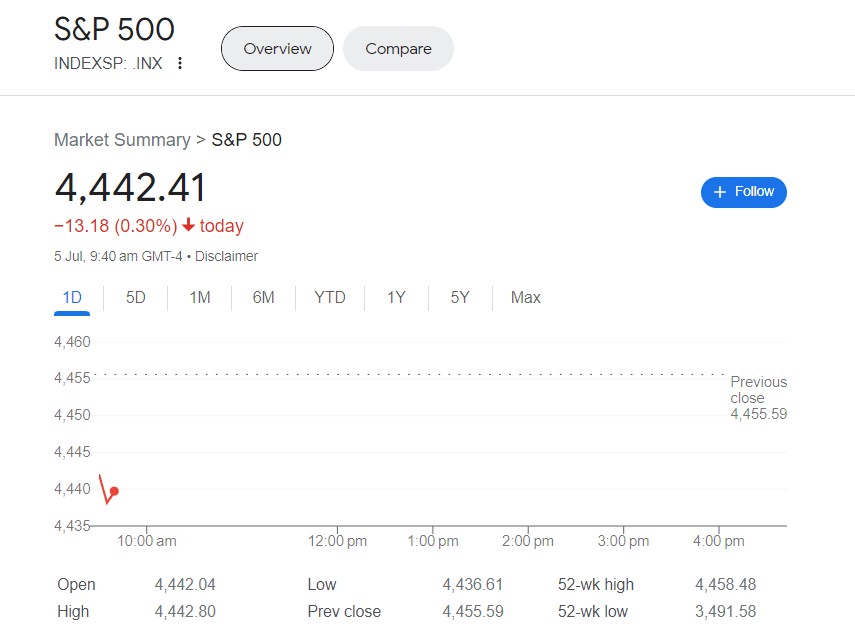
The New York Stock Exchange and Nasdaq, the two biggest stock-trading venues in the U.S., have declared that they will be closed on Tuesday in recognition of the Fourth of July holiday. Furthermore, Monday’s trading, which marks the start of the second half of 2023, will end three hours early at 1 p.m. Eastern Time, giving equity traders a brief respite. Sifma, the Securities Industry, and Financial Markets Association, advises bond traders to acknowledge the Fourth of July with an early closure in the fixed-income trading sector, recommending trading to end at 2 p.m. Eastern Time on Monday. Friday saw U.S. stocks wrap up the first half of 2023 at 14-month highs. According to Dow Jones Market Data, the S&P 500 SPX touched its highest close since April 20, 2022, going up by 53.94 points, or 1.2%, to 4,450.38. Meanwhile, the Nasdaq Composite COMP celebrated June by registering its most significant first-half gain since 1983. The Dow Jones Industrial Average DJIA also ended on a high note on Friday, finishing the first half at 34,407.60, its highest closing point since June 15, with an increase of 285.18 points, or 0.8%. Treasury yields saw minimal changes on Friday. However, the day prior saw the 2-year and 10-year Treasury yields reach their highest closing levels in more than three months, according to FactSet data. It’s noteworthy that bond yields inversely reflect prices. The yield on the 2-year Treasury note TMUBMUSD02Y finished almost unchanged on Friday at 4.877% compared to 4.876% on Thursday. The yield on the 10-year Treasury note TMUBMUSD10Y, on the other hand, fell by 3.5 basis points to conclude Friday at 3.818%, compared with 3.853% on Thursday afternoon. As Tuesday marks the 247th year of ratifying the Declaration of Independence, Charles Passy from MarketWatch has put together a guide of what will be open and closed.

stock money
Market News

Decoding the Paradox: Big Tech’s Defiance to Traditional Market Theories

Delving into a volatile market—both high-risk and high-quality stocks have experienced surges this year. This typically isn’t the norm, but there’s a logical explanation backing it. Usually, when investors choose high-volatility stocks, thereby increasing their prices, they commonly sell their high-quality stocks. The objective is to benefit from increased earnings as the economy stages a comeback—a scenario favoring volatile stocks. Contrarily, to shield their portfolios from economic strife, investors generally invest in high-quality stocks, sometimes by selling off the more economically sensitive and volatile ones. High-quality stocks usually exhibit a mix of steady earnings and sturdy cash reserves. However, this year’s market dynamics don’t seem to follow this trend. Take, for instance, the Invesco S&P 500 High Beta ETF (ticker: SPHB)—a fund that handpicks the 100 most volatile stocks within the S&P 500—it has enjoyed almost a 20% increase this year. Remarkably, the Invesco S&P 500 Quality ETF (SPHQ)—which selects companies based on various parameters such as high return on equity—is nearly 13% up. The simultaneous gains of both funds is intriguing. To make sense of this irregularity, let’s start with the high-volatility aspect. Stocks that are susceptible to economic fluctuations are climbing, stemming from the market’s confidence in an impending uplift in demand for goods and services. The underlying premise is the Federal Reserve is nearing its cycle of increasing interest rates, intended to suppress inflation by curbing demand. Spearheading these economically sensitive stocks, Generac (GNRC), Royal Caribbean Group (RCL), Norwegian Cruise Line (NCLH), and Caesars Entertainment (CZR) have all witnessed marked increases this year. Additional stocks, including those from Big Tech, are contributing to these gains. Nvidia (NVDA), the fund’s most significant holding, almost tripled its value, indicating a rising market appetite for future profits. The unexpected parity performance of high-quality stocks compared to high-volatility ones can be attributed to the influence of Big Tech in the quality category. As a persistently high-growth sector, Big Tech benefits from stable rates. Victor Cossel, Macro Strategist at Seaport Global Securities, explains, “When you unwind recession, and you unwind inflation, that’s why you can have beta and quality working simultaneously.” Prominent Big Tech companies like Apple (AAPL), Microsoft (MSFT,) and Alphabet (GOOGL) have recorded significant growth this year. Collectively, these stocks account for nearly 30% of the quality fund. If this fund were equal-weighted, it would record gains under 9% for the year, which is less than half the gains of high-volatility stocks, according to Dow Jones Market Data. Tech stocks are categorized as high-quality because, despite having their own volatile triggers, they have redeeming features, such as, Apple’s vast cash reserves and Microsoft’s impressive return on equity in 2022, which significantly trumps the S&P 500’s average. In essence, there are times when high-volatility and high-quality stocks rally simultaneously, thereby challenging conventional market theory.

stock market
Market News

Years of Subpar Stock Market Returns Ahead, Warns Fed Economist: Two Key Tailwinds Fade ??

US stock investors may need to prepare for potential disappointments, as recent warnings from a Federal Reserve researcher suggest. Corporate tax reductions and interest-rate cuts have been driving stock returns for a prolonged period, according to Federal Reserve economist Michael Smolyansky. Smolyansky foresees a rather challenging future for stocks, characterized by slowing earnings growth and dissipating tailwinds. US stock investors have enjoyed strong tailwinds for years, but their fortunes may soon change, according to a Federal Reserve researcher. Smolyansky recently published a research paper titled “End of an Era: The Coming Long-run Slowdown in Corporate Profit Growth and Stock Returns.” In the paper, he concludes that the S&P 500’s real return of 5.5% (excluding dividends) from 1989 to 2019 was mainly due to declines in interest rates and corporate tax, a trend unlikely to continue in future years. Stock prices generally rise when corporate profits grow, or P/E multiples expand. Smolyansky’s research found that more than 40% of the real corporate profit growth between 1989 and 2019 can be attributed to reductions in corporate tax and interest rates. Additionally, the lowered interest rates led to decreased risk-free rates (the guaranteed return from assets such as US Treasuries), accounting for the P/E multiples expansion during this period. Smolyansky states, “Investors, therefore, got lucky. I argue that this streak of good luck is likely over.” Even before the 2020 COVID-19 pandemic, interest rates were historically low, leaving little room for further reductions, particularly given the reemerging inflation risks. Simultaneously, the effective corporate tax rate for S&P 500 non-financial firms declined from 34% in 1989 to 15% by 2019. Further cuts seem unlikely given the current near-record levels of the US debt-to-GDP ratio and the Biden administration’s implementation of a 15% minimum tax rate last year. Smolyansky contends that if corporate tax and interest rates remain around their 2019 lows in the future, corporate profits will grow only at the same pace as EBIT. He cites a lag in EBIT growth compared to US GDP growth between 1962 and 2019, suggesting that it is unlikely to exceed a growth rate of 2% annually in the long term. Limitless expansion of P/E multiples also appears improbable. “This scenario carries serious implications for stock returns,” says the economist. “If actual earnings growth fails to surpass 2% per annum in the long run, then the stock prospects are grim.” “Expect future stock returns and corporate profit growth to be significantly lower,” he warns, describing the continuous boost to earnings growth from tax reductions and interest rate cuts as “a trend that has now reached its limit.” Smolyansky cautions that his pessimistic outlook could be seen as conservative. If the stock market hasn’t already priced in slower earnings growth, P/E multiples could rapidly contract once it does. Moreover, the reduction in interest and corporate tax rates may have artificially stimulated EBIT growth in recent decades, paving the way for an even greater slowdown than anticipated. “The risks associated with this forecast, if anything, lean towards the downside,” he concludes.

Scroll to Top