wall street
Market News

Why Wall Street Fear Is Fueling the Next Bull Run

Wall Street Fear Could Push Stocks Higher, Says Popular Newsletter Editor Stock futures slipped as the fourth quarter begins under a government shutdown and without key jobs data. But one closely watched market voice says nervous investors may actually be setting the stage for more gains. The anonymous author of Lord Fed’s Gazette — Substack’s 13th most popular finance blog — argues that Wall Street’s so-called “smart money” remains too skittish. That hesitation, he says, will only give the S&P 500 more room to run. Lord Fed’s calls have been on point before. In August, he predicted the index’s move to 6,500 would launch a new leg higher. By September, the S&P had logged eight record closes in a month and 23 for the quarter. But hedge funds are still blinking. Goldman data shows managers cut tech exposure at the fastest pace since August as the S&P neared 6,700 — even after sitting out most of the rally. “They’re selling into strength because they’re convinced this is the top,” Lord Fed wrote. “That’s not how tops happen. That’s how bull markets extend.” His bottom line: fear is fuel. And after the latest round of selling, his 7,000 target for the S&P looks more likely than ever.

S&P 500
Market News

S&P 500 Rally: History Points to More Upside

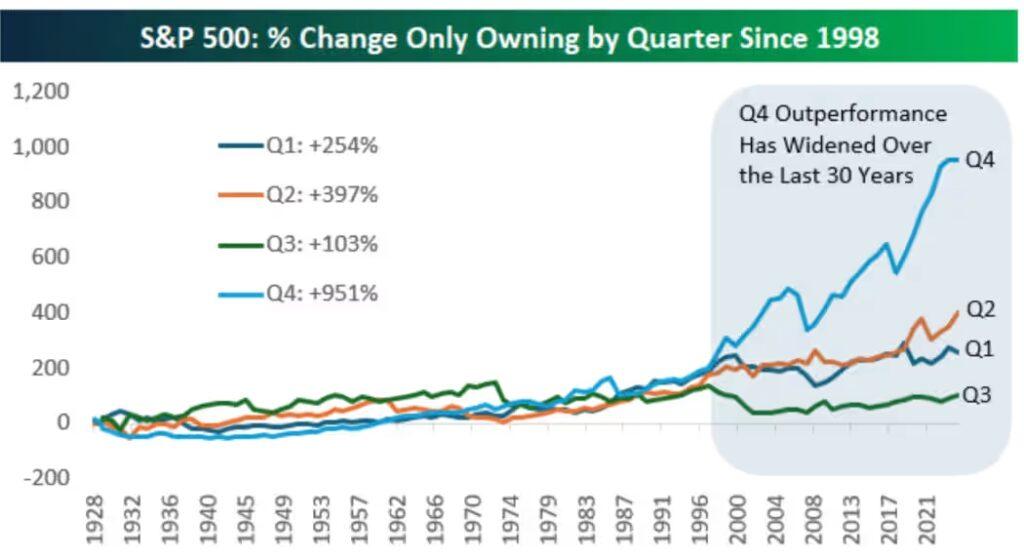
S&P 500 Heads Into Historically Strong Fourth Quarter The S&P 500 is closing out the third quarter with a 13% year-to-date gain and record highs, setting the stage for what has historically been its strongest stretch of the year, according to Bespoke Investment Group. Since 1928, the index has averaged a 2.1% return per quarter, but fourth-quarter gains have been higher at 2.9%. When the S&P enters Q4 already in positive territory, average returns jump to 4.4%, with gains in more than 83% of those years. Bespoke noted that this trend has become even more pronounced over the past 30 years. So far, 2025 has delivered steady momentum, with the benchmark on track for a fifth straight monthly gain and a third-quarter advance of over 7%. Investors are also monitoring broader economic signals: the Fed resumed rate cuts this month, GDP growth was revised up to 3.8% for Q2, and a possible government shutdown threatens to delay key labor market data. Markets started the week higher, with the S&P 500 up 0.3%, the Nasdaq Composite climbing 0.5%, and the Dow adding 0.1%, per Dow Jones Market Data.

sonic
DayTradeToWin Review

Master the Market with the Sonic Trading System

It’s the start of a new trading week, and the Sonic Trading System has already delivered a string of winning trades. Early in the session, traders saw multiple short setups—each worth about $200 per contract. Stack up just a few of these, and you’re looking at a solid day’s profit without spending hours glued to the screen. What Makes Sonic Different? The Sonic system is built around precision entries, clear risk controls, and consistent profits. Here’s why traders love it: Trade Smarter, Not Longer Great trades don’t take hours to play out. With Sonic, you’ll learn to recognize when a trade should hit your profit target quickly—or when it’s time to cut it loose. This built-in discipline keeps you from making costly mistakes like holding onto losers or moving stops in the wrong direction. Start with Confidence Whether you’re a new trader starting with one contract or an experienced trader scaling up, Sonic adapts to your goals. You don’t need dozens of trades a day—just a handful of quality setups can hit your daily profit target. Take the Next Step The Sonic Trading System isn’t just a strategy—it’s your entry point into professional day trading education. 👉 Visit daytradetowin.com and create your free member account today. You’ll gain access to trial software, including Sonic, plus other proven price action tools. Ready to go all-in? Join our Accelerated Mentorship Program to unlock full access to proprietary software, training, and community support. It’s time to trade with confidence. Let the Sonic Trading System show you how.

fed pivot
Market News

Fed Pivot Fuels Market Frenzy

Fed Pivot Sparks Speculative Surge, Analyst Cautions Stocks are starting the week on firm footing, with futures higher as investors brush off last week’s modest pullback. The Cboe Volatility Index (VIX) sits under 16, reflecting calm despite looming catalysts like fresh labor data and the risk of a government shutdown that could delay Friday’s jobs report. According to Wedbush analyst Seth Basham, markets appear “fearless.” Low volatility, narrow credit spreads, optimism over AI monetization, and hopes for a Fed easing cycle are keeping sentiment constructive. He also cites housing strength — August new home sales jumped nearly 20% on lower mortgage rates — and recent tax relief measures that could meaningfully boost household refunds starting in 2026. Basham notes valuations in areas such as healthcare, staples, real estate, and materials remain reasonable compared with history. And unlike the dot-com bubble, fewer than half of today’s IPOs are unprofitable, and no mega-mergers on the scale of AOL–Time Warner have yet emerged. Still, he warns that liquidity-driven psychology is fueling speculative risk-taking. High short-interest stocks have staged sharp rallies — a classic sign of “animal spirits” — while momentum trades are overheating, hinting at a potential interim peak. “The Fed’s pivot has amplified speculation,” Basham says. “It’s powerful in the short term, but rarely sustainable.”

investors
Market News

Investors Rethink the Cost of Chasing AI Dreams

Investors Are Rethinking AI’s Trillion-Dollar Spending Spree Stocks opened the week at record highs, but momentum has faltered. The S&P 500 (SPX -0.50%) has now dropped three straight sessions, down 1.3% overall. Some of the weakness can be traced to stronger economic data that pushed bond yields higher, along with Fed Chair Jerome Powell’s cautious stance on rate cuts and his warning about lofty equity valuations. But there’s also a bigger question hanging over the bull market: whether Wall Street’s AI boom has gone too far. That mood shift may have started Monday, when Nvidia’s Jensen Huang and OpenAI’s Sam Altman unveiled plans for a $100 billion investment during a CNBC interview. By Thursday, hedge-fund billionaire David Einhorn gave voice to growing unease. Speaking at the New York Stock Exchange, the Greenlight Capital founder warned that the enormous sums earmarked for AI infrastructure—hundreds of billions annually—risk destroying vast amounts of capital, even if the technology itself proves transformative. “The numbers being thrown around are so extreme that it’s really hard to understand them,” Einhorn said, according to Bloomberg. “There’s a reasonable chance that a tremendous amount of capital destruction is going to come through this cycle.” His skepticism mirrors his long-running complaints about market inefficiency, from frenzied crypto bets—he once called it the “fartcoin stage” of the cycle—to today’s AI arms race. Einhorn also flagged faltering U.S. job growth and shrinking workweeks as signs the economy may already be in recession. And the shift in AI sentiment is spreading. On Friday, CNBC’s Jim Cramer wrote on X that while he once saw endless praise for the data center buildout, he now sees only warnings of bubbles, waste, and an impending crash.

market
Market News

Market Mania: Oklo’s $20B Story Stock Surge

Oklo Becomes the Largest Pre-Revenue Company in the U.S. With a $20 Billion Valuation Oklo Inc. has surged to a $20 billion valuation, earning the title of the largest pre-revenue company listed on a U.S. exchange. Its rise highlights just how far investors are willing to stretch in search of the next big AI play. Shares of Oklo (OKLO) trade around $131, up more than 500% in 2025 and nearly 1,500% over the past year. All of this despite the company never generating a dollar in sales. The attraction isn’t about numbers — it’s about narrative. Oklo is developing small modular reactors (SMRs) designed to supply the immense power demands of AI data centers. The story is boosted by Sam Altman, OpenAI’s CEO, who took Oklo public via his SPAC AltC Acquisition in 2024. Altman served as chairman until April and still owns 5.5% of the company. Retail investors have embraced the stock. On StockTwits, message volume has been flagged as “extremely high,” with overall sentiment marked “bullish.” “It’s a speculative, growth-driven environment, fueled by lower interest rates, strong market and increased retail participation,” said Chris Tessin of Acuitas Investments. Earlier this week, Oklo broke ground on its first commercial SMR at Idaho National Laboratory under the Department of Energy’s Reactor Pilot Program. Still, analysts don’t expect revenue until late 2027. Much like biotech firms awaiting FDA approval, Oklo faces a binary outcome: either successful commercialization or failure that renders its technology worthless. Other SMR competitors are slightly ahead. NuScale Power (SMR) has posted limited revenue since 2022, though mostly from engineering and licensing services, not actual nuclear energy sales. Wall Street’s view of Oklo remains divided. Bank of America initiated coverage with a buy rating and a $92 target, calling it the best-positioned company in the SMR market. Wedbush’s Dan Ives is more bullish, lifting his target to $150. UBS took a cautious stance with a $65 hold rating, warning that steady growth may not come until 2034. Seaport’s Jeff Campbell downgraded Oklo to neutral this week, arguing the valuation is too stretched. For now, Oklo epitomizes the “story stock” — its valuation fueled by AI hype, nuclear optimism, and investor enthusiasm. The real test will be whether investors have the patience to wait nearly a decade for the company to turn promise into profit.

Scroll to Top