roadmap
DayTradeToWin Review

Roadmap Zones: Predict Market Reversals

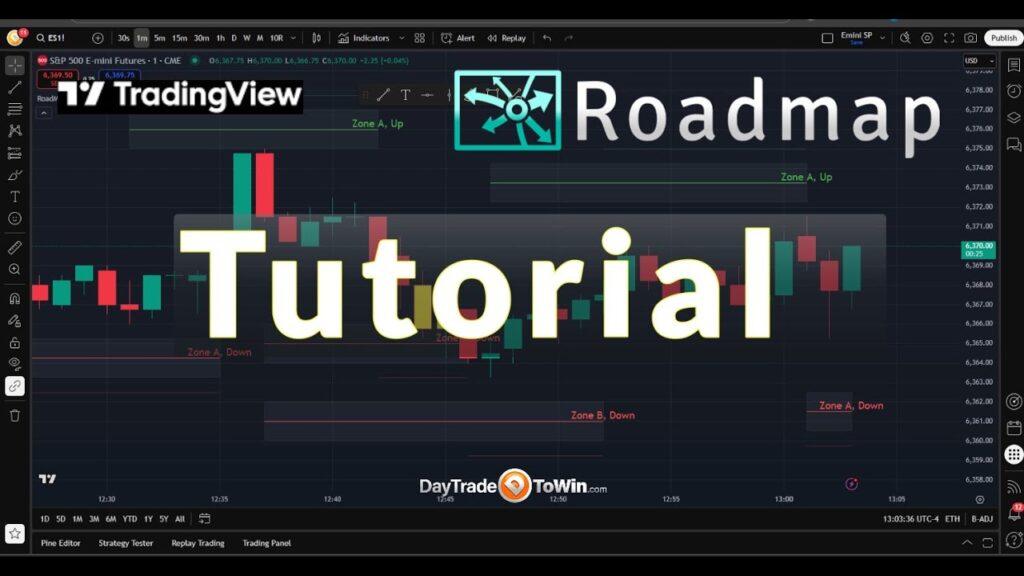
Struggling to find reliable entry and exit points in fast-moving markets? The Roadmap software for TradingView helps traders pinpoint high-probability areas where price is likely to stall, reverse, or break out. These “zones” highlight manipulation points where institutions take profits or trap retail traders — giving you a serious trading edge. Whether you’re a new trader exploring a trial or part of the DayTradeToWin community, this guide will show you exactly how to set up, interpret, and trade Roadmap zones for better results. What Is the Roadmap Indicator? Roadmap is a proprietary invite-only tool that overlays color-coded zones on your chart, showing where significant price action is expected. These zones are based on average true range (ATR) and historical price behavior, helping traders anticipate where the market might pivot or accelerate. How the Zones Work In trending markets, the first zone is often ignored — traders focus on deeper zones for higher-probability trades. Step-by-Step: Trading Roadmap Zones Customizing Your Setup Why Traders Use Roadmap Join the DayTradeToWin Community Want daily trade room access, live training, and mentorship on how to master Roadmap?Visit daytradetowin.com for exclusive discounts and community support. Quick Recap Ready to trade smarter? Activate the Roadmap indicator today and take control of your trades with precision and confidence.

market
Market News

Charts Hint at Bigger Market Decline

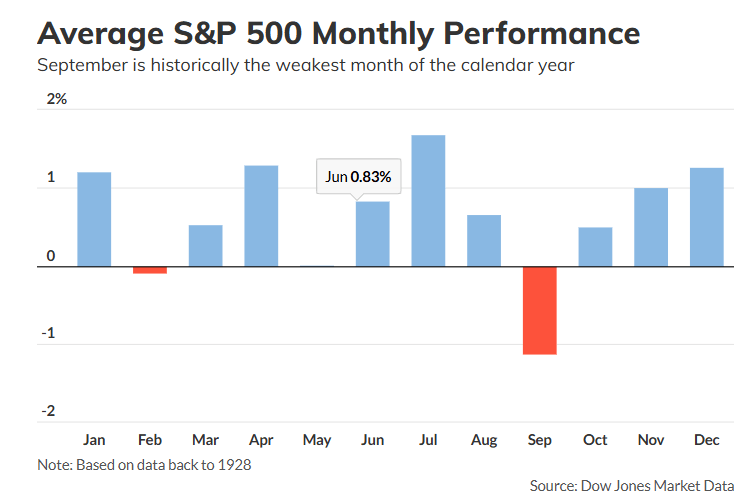
Stock Valuations Soar as Market Faces Historically Weak Season U.S. stocks have stumbled since early August, and Wall Street strategists are warning the slide may deepen. Julian Emanuel, chief equity and quantitative strategist at Evercore ISI, expects a 7% to 15% pullback by mid-October. Deutsche Bank strategists also foresee weakness, though they anticipate a more moderate decline. Despite near-term risks, Emanuel believes the long-term bull market remains intact and says deeper drops could attract dip buyers. Instead of selling outright, he recommends investors consider hedging strategies to protect portfolios. Valuations Back at Extreme Levels The Shiller CAPE ratio — a cyclically adjusted P/E metric — recently topped 38, its highest since late 2021. That previous peak preceded the S&P 500’s worst year since 2008 as the Federal Reserve’s aggressive rate hikes triggered a market rout. While Emanuel doesn’t expect a repeat, elevated valuations leave stocks vulnerable to negative surprises. Seasonal Weakness Ahead The stretch from August to October is historically the weakest for U.S. equities, according to BTIG’s Jonathan Krinsky. Although the relative strength index has cooled from overbought territory, it remains elevated — a signal that the current downturn could extend, noted Mark Hackett of Nationwide. Volatility Starting to Rise Wall Street’s “fear gauge,” the Cboe Volatility Index (VIX), is rebounding from its lowest level since January. Emanuel sees this as mean reversion, implying volatility could continue climbing in the weeks ahead.

atlas line
DayTradeToWin Review

Atlas Line = Clean, Clear Signals

Ready to Trade Smarter — Not Harder? Tired of second-guessing every move? The Atlas Line gives you clear, real-time signals — so you can trade with precision, confidence, and speed. 🚀 What Is the Atlas Line? A powerful price action tool for NinjaTrader and TradingView, the Atlas Line helps you: ✔ Know exactly when to buy or sell✔ Spot trend continuation with Strength (S) and Pullback (P) signals✔ Manage risk with automatic stop placement logic It works on any market — futures, forex, CFDs — and fits any session, including London open and after-hours. 🧠 Simple Rules. Serious Edge. 📈 Above the Atlas Line? Go long.📉 Below it? Go short.✅ Confirm with built-in S and P signals🚫 Skip high-risk trades using pivot-based stops — if the stop’s too wide, the system says don’t trade. Smart and simple. 🔍 What We Saw in Real Time: ✅ Clear short trades across Dow, NASDAQ, and E-mini✅ Setups confirmed on both 1-min and 5-min charts✅ Audio + visual alerts for easy entries✅ Clear rules to help you avoid bad trades No lagging indicators. Just real price action. 🎁 Get Started — Free Access! Create a free member account at DayTradeToWin.com and get: 🎯 Trial versions of the Atlas Line, ABC, and more📚 Free access to price action lessons📈 Details on the Accelerated Mentorship Program🚀 Instant entry to bonus systems like the Sonic Strategy No credit card. No commitment. Just real tools to help you trade better. 📌 Why Atlas Line? Clarity. Speed. Confidence.If you’re done with guessing and indicators that lag, the Atlas Line is for you. ✅ Live signals in real time✅ Built-in risk management✅ Works on any market or timeframe 🎯 Stop chasing trades. Start seeing them clearly. Try the Atlas Line today

market
Market News

Hidden Market Forces at Play

Jim Paulsen Says the Bull Market Is Just Getting Started — If the Fed Cuts Rates Stocks snapped back on Monday, with investors shaking off last week’s selloff and betting on Federal Reserve rate cuts ahead. But according to veteran strategist Jim Paulsen, the real rally hasn’t even started yet. In a new Substack post, the former chief investment strategist — now heading Paulsen Perspectives — says Wall Street is underestimating how much firepower this bull market still has. And the key to unlocking it? Rate cuts from the Fed. “This bull market has been running on fumes,” Paulsen writes. “Imagine what it could do if the Fed actually helped.” He points out that the current rally began and has matured while the Fed has kept interest rates high, the yield curve inverted, and money supply growth unusually weak — all hallmarks of a restrictive monetary environment. Typically, that kind of setup would slow the economy and limit market gains. Paulsen argues the Fed’s “chronic” tight policy has kept longer-term bond yields elevated, strengthened the dollar, and weighed down consumer confidence — all factors that have held stocks back. But if the Fed begins a sustained rate-cutting cycle? “It would trigger far more support for equities than most realize,” Paulsen says. Falling rates would likely weaken the dollar, ease bond and mortgage rates, boost the money supply, and lift consumer sentiment. He backs up his claim with a historical comparison: Since 1960, the S&P 500 has delivered annualized returns 10.5 percentage points higher during months when the Fed was cutting rates versus when it was hiking. Consumer confidence plays a major role too. When it rises, the average annualized gain in the S&P 500 jumps to 15.8%. But when confidence falls, that drops to just 1.5%. With sentiment currently near historic lows, Paulsen believes it’s more likely to rebound than fall further in the year ahead — a shift that could act as a powerful tailwind for stocks. “If confidence improves, it would be a rare and potent force that investors have barely benefited from during this entire bull run,” he notes. Of course, not everyone is as optimistic. Bank of America warned Monday that the market may be misreading the signals — confusing recession risks with stagflation — and that the Fed might keep rates unchanged until 2026. Still, Paulsen’s message is clear: this bull market isn’t running out of steam — it’s waiting for a green light from the Fed.

Big tech
Market News

Big Tech on Thin Ice

Jefferies: Fed Cuts May Spark Shift Away from Big Tech The S&P 500 fell 1.6% on Friday—its worst session since May—after soft jobs data and renewed tariff concerns rattled markets. But U.S. stock futures on Monday hint at a partial rebound, and some strategists remain optimistic despite near-term headwinds. According to Jefferies, investors now face a roughly seven-week period marked by a weakening labor market and limited central bank support. The Fed is widely expected to cut interest rates by 25 basis points at its September 17 meeting, lowering the target range to 4.00%–4.25%. Still, Jefferies remains positive. “It’s a tougher sell after this week, but we still believe equities are heading higher,” they wrote over the weekend. Strong second-quarter earnings are one reason: two-thirds of S&P 500 companies have reported so far, and 85% have beaten expectations—lifting earnings forecasts and supporting stock prices. But Jefferies is growing cautious on Big Tech. The sector now makes up a record 44% of the S&P 500 by weight—surpassing the 2000 dot-com peak. While still delivering solid results and acting as a defensive play, Jefferies questions how much longer that leadership can last. They’re not calling it a bubble, but note that valuations are stretched. The premium on tech versus the cheapest stocks is in the 87th percentile historically—making the trade look “long in the tooth.” More importantly, Jefferies notes that rate cuts tend to favor the equal-weighted S&P 500, which gives more influence to smaller names outside tech. Historically, most periods of outperformance for equal-weighted stocks have come when the Fed is easing policy. “We’re not predicting a major tech selloff,” Jefferies says. “But with the Fed turning dovish, history suggests a rotation may be starting. Friday’s payroll data could be the signal: it might finally be time to shift out of large-cap tech.”

S&P 500
DayTradeToWin Review

S&P 500 Forecast 2025: Price Action Trading Setup

The S&P 500 forecast for 2025 remains bullish, but the path to higher prices rarely comes without pullbacks. For traders, these retracements aren’t red flags — they’re opportunities. In this guide, we’ll explore: Whether you trade E-mini S&P futures, Nasdaq, or Dow Jones, this approach applies across markets. 1. January Close: The Yearly Directional Signal One of the most reliable indicators for the S&P 500 is the January barometer: When January closes higher than it opens, the market often finishes the year higher as well. 2025 Outlook 2. The 50% Retracement Rule Markets frequently retrace about half of a prior move before resuming their trend. The 50% level is a key decision point for traders. How to Trade It 3. April 2025: A Textbook Example Earlier this year, the S&P 500 sold off sharply into April. Once price closed above the 50% retracement level, it rallied to retest — and eventually surpass — prior highs. This pattern provides a blueprint for current conditions. 4. Current Setup: August 2025 Market Snapshot What to Watch 5. Using ATR for Profit Targets The Average True Range (ATR) helps traders align targets with volatility: This method avoids unrealistic targets and keeps risk-reward ratios balanced. 6. Integrating Our Trading Systems Our proprietary systems — Atlas Line, Sonic, Trade Scalper, Roadmap, and Blueprint — follow these same price action principles: Key Takeaways Next Steps for Traders Want to learn how to apply this in real time? Final Word The bullish framework for 2025 remains intact. The current pullback could set up one of the best long opportunities of the year — provided you wait for confirmation above the 50% retracement level and manage risk with ATR-based targets.

Scroll to Top