market
Market News

Market Volatility Looms, But Bull Case Remains Strong

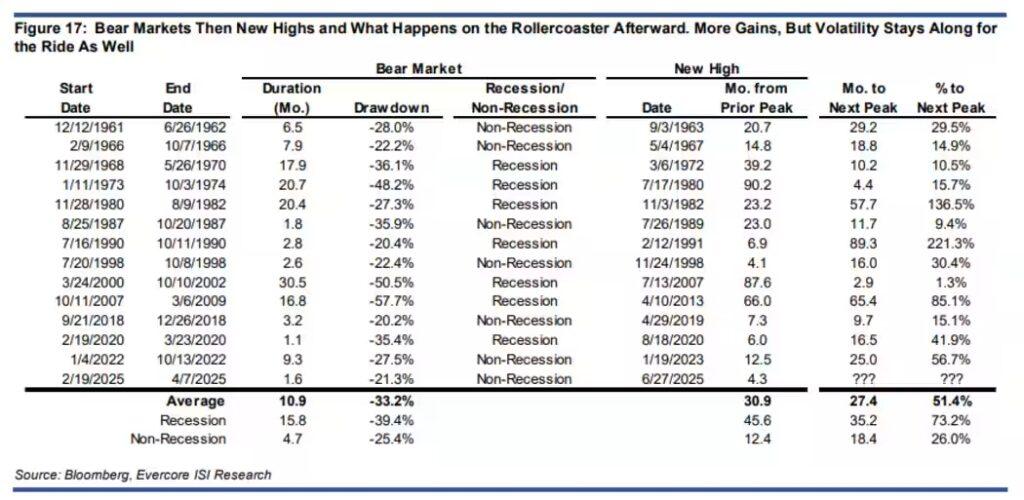
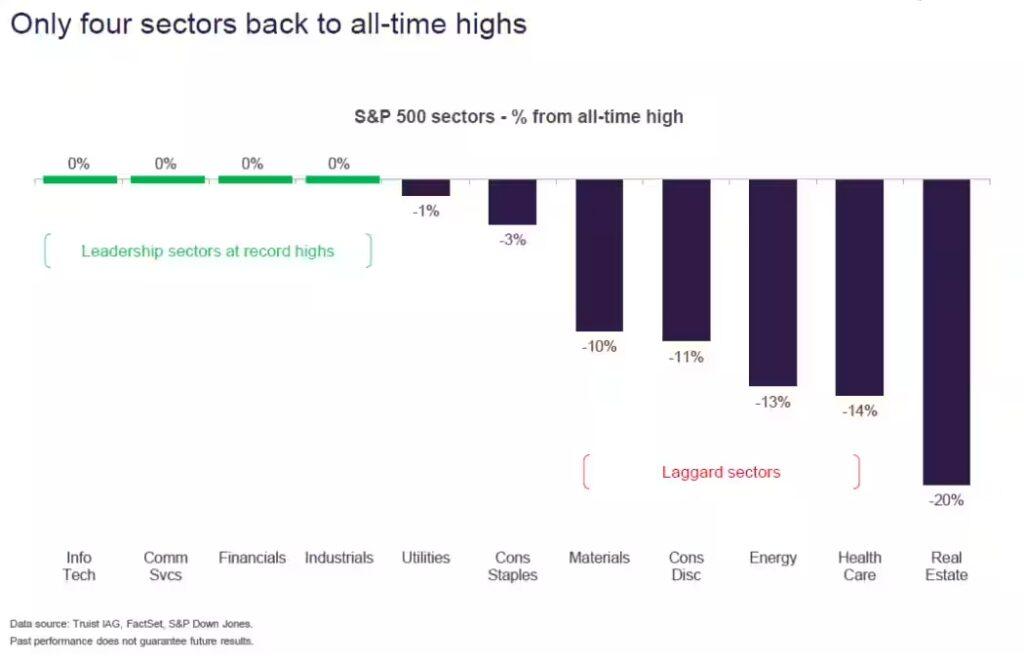
Truist’s Lerner: Sharp V-Shaped Recoveries Often Signal More Market Gains It’s “Jobs Thursday” instead of the usual Friday, with the nonfarm payrolls report moved up due to the July 4 holiday. The New York Stock Exchange will also close early, giving investors just half a session to react. But so far, the shortened week hasn’t slowed the bull market. The S&P 500 closed Wednesday at a new record, now up 25% from its April low. Keith Lerner, chief market strategist at Truist, says this rally is one of the fastest rebounds on record. “Despite a carousel of concerns — tariffs, geopolitical tensions, policy uncertainty — the market has powered through with a V-shaped recovery, reclaiming all-time highs,” he wrote in a note Wednesday. Lerner believes the trend has more room to run, but warns that the second half of the year may bring a rougher ride. “The bar for positive surprises has risen, and crosscurrents remain.” Why He’s Still Optimistic Despite the uncertainty, Lerner maintains a cautiously positive outlook. His key points: Valuation & Breadth: Mixed Signals Valuations are stretched, with the S&P 500 trading at 22 times forward earnings — the highest of this cycle. Still, the equal-weighted index is closer to historical norms, and forward earnings estimates have improved. Technically, the market’s breakout to new highs is encouraging, but underlying participation is weak. Only four sectors — tech, communication services, industrials, and financials — have reached record highs. Small caps, mid caps, and the equal-weighted S&P 500 remain below past peaks. “The question is whether market breadth can broaden in the second half,” says Lerner. “We’re open to that possibility but will wait for confirmation before shifting our stance.” For now, Truist continues to favor large-cap growth stocks. Other Market Calls History Is on the Bulls’ Side Lerner notes that sharp recoveries like this one tend to have strong follow-through. “When the S&P 500 rallies more than 20% in two months or less — as it just did — it has been higher one year later in all 10 prior instances, with an average gain of 24%,” he writes. Despite some warning signs, history suggests this market strength could carry through — especially if economic and earnings data start to broaden out.

S&P 500
Market News

Is a New S&P 500 Rally Starting?

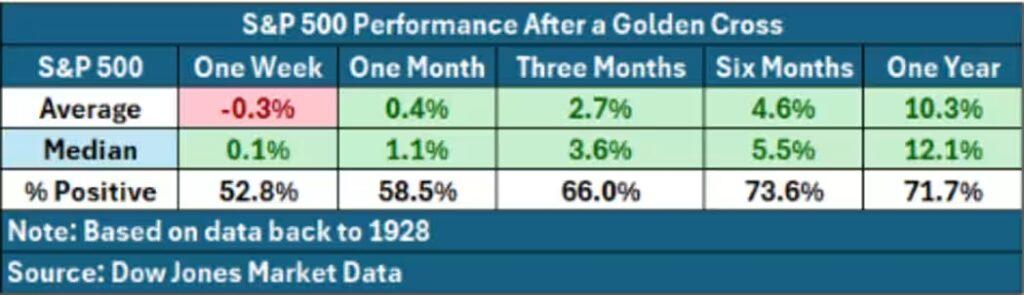
Bullish Signal: Golden Cross Points to More Market Gains Ahead The S&P 500 is kicking off the second half of 2025 on a strong note, flashing a bullish technical signal for the first time in more than two years. On Tuesday, the index formed a golden cross, where the 50-day moving average moves above the 200-day average—a widely followed momentum indicator that often signals a strong uptrend. The last golden cross for the S&P 500 appeared in February 2023. Since then, the index has climbed over 48%, according to FactSet. This latest signal adds to a series of bullish developments, including a Zweig Breadth Thrust back in April—a rare indicator with a flawless track record of forecasting gains since 1982. Craig Johnson, chief market technician at Piper Sandler, said the golden cross, combined with broadening market participation, points to a “healthy setup” for the second half of the year. He sees the S&P 500 finishing 2025 around 6,600. Historical data backs him up. Since 1928, the S&P 500 has posted positive one-year returns 71% of the time following a golden cross, averaging over 10%. More recent signals have been even stronger, with the past 20 crosses delivering average gains of 13% and an 85% success rate. This time around, the golden cross comes as the S&P hovers just below Monday’s record close, adding momentum to a market already pushing all-time highs. Mark Arbeter of Arbeter Investments said golden crosses have been far more reliable than death crosses, which occur when the 50-day average dips below the 200-day. The most recent death cross happened back in April—after much of the downturn had already played out. Other major indexes and stocks are also flashing green lights. The Nasdaq Composite saw a golden cross on Monday, and Nvidia (NVDA) joined in on Friday, signaling continued strength in the AI-driven tech sector. Meanwhile, small- and mid-cap stocks have started to rise—another sign that the rally is broadening. Still, not all signs are rosy. Some indicators, like the gold-platinum price ratio, have turned bearish, suggesting the possibility of a short-term pullback. On Tuesday, markets were mixed: the S&P 500 and Nasdaq slipped modestly after recent highs, while the Dow and Russell 2000 moved higher.

apple
Market News

Apple: Tech’s Hidden Catalyst

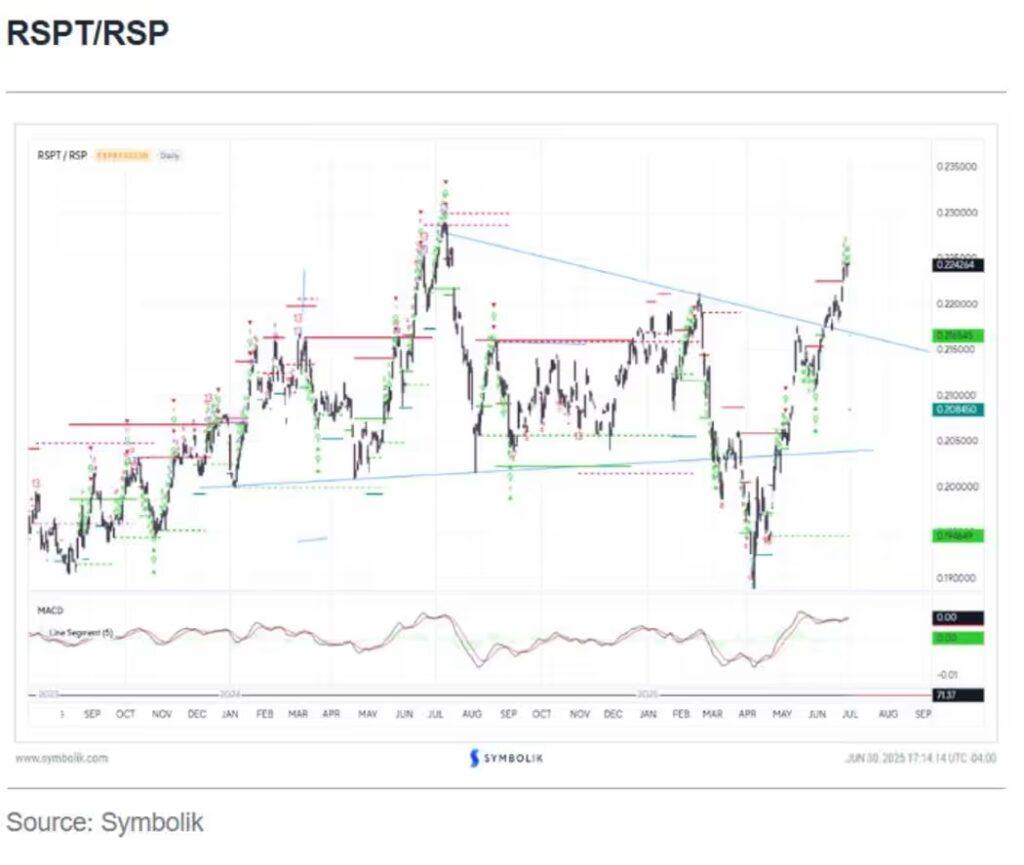
Why Apple Is the Tech Stock to Watch This July, According to Fundstrat’s Mark Newton Following two record-breaking sessions for the S&P 500 and Nasdaq, markets are easing into the new quarter with signs of weakness. It’s a short, holiday-trimmed week, and investor fatigue is understandable amid political distractions like Trump’s tax and spending bill making its way through the Senate. But historically, July has been a strong month for stocks in post-election years — and Fundstrat’s head of technical strategy, Mark Newton, sees that pattern possibly repeating. In a new client note, Newton says the rally could continue into July before cooling in August. He sees the market broadening, with breakouts in the Dow and the Invesco S&P 500 Equal Weight ETF (RSP) adding confirmation. One stock he’s watching closely: Apple (AAPL). Apple, down 18% year-to-date, has underperformed major tech peers — with only Tesla faring worse. Investors have been wary over weak AI progress and trade tensions. But Newton flags a potential shift. On Monday, Apple shares jumped over 2%, breaking out of a month-long slump and closing at their highest level since mid-May. The bounce followed reports that Apple may adopt third-party AI tools for a new version of Siri, signaling a possible strategy pivot away from its in-house development — something Newton calls a “significant reversal.” While it’s just one day of gains, Newton believes this move could be meaningful. Apple needs to rise above $214 to confirm a stronger rally, he says. So far, it hasn’t participated much in the S&P 500’s 27% rally since April. Meanwhile, broader tech looks poised to test all-time highs. Newton points to bullish signs in the Invesco S&P 500 Equal-Weight Technology ETF (RSPT), which has rebounded from key 2024 support levels. His forecast: tech may outperform through August, face resistance in September, then mount another leg higher in Q4. As for Apple, Newton says its performance in July could determine whether tech’s recent momentum continues. “Any strength from Apple here could extend tech’s lead,” Newton concludes.

stocks
Market News

Stocks Are Surging — And It’s Not Over Yet

Stocks May Already Be Pricing In More Fed Rate Cuts The S&P 500 is heading into the second half of 2025 near record highs—up nearly 24% from its mid-April low. But with summer often bringing volatility, many investors are wondering: is this rally justified? Morgan Stanley’s chief equity strategist Mike Wilson says yes. In a note Monday, he laid out three reasons why he remains bullish over the next 6 to 12 months. 1. Stronger Earnings Momentum Wilson highlights a major shift in earnings sentiment. Forecasts for S&P 500 company profits have improved sharply as concerns over the Trump-era trade war fade. More importantly, optimism is expanding beyond just Big Tech. A key metric, earnings revision breadth (ERB), has risen from -25% in mid-April to -5%. Historically, such turnarounds have preceded strong market gains. Wilson notes that this earnings growth is expected to outpace economic growth, thanks to a weaker dollar and pro-business tax incentives in the Trump administration’s proposed “Big, Beautiful Bill.” 2. The Market Is Getting Ahead of the Fed Wilson believes the Fed could cut interest rates seven times in 2026, as unemployment becomes more pressing than inflation. And he says the market is already moving in anticipation of that pivot. “Stocks won’t wait for a clear signal from the Fed—they’re already pricing in easier policy,” he writes. That said, the biggest threat to this outlook would be a sharp rise in unemployment and weak jobs data—though that’s not Morgan Stanley’s base-case scenario. 3. Resilience in the Face of Risks Stocks are also showing their usual ability to absorb geopolitical shocks. As tensions between Israel and Iran cool, oil prices have eased, reducing fears of an energy-driven slowdown. Wilson adds that the proposed ‘revenge tax’—which had threatened to slow investment—is likely to be dropped from the final version of the “Big, Beautiful Bill.” Lastly, the term premium on U.S. Treasurys has declined in recent weeks, signaling reduced investor anxiety about the government’s fiscal position. With 10-year yields holding below 4.5%, Wilson sees diminished interest rate risk for now. He maintains a 12-month S&P 500 target of 6,500.

market
Market News

Cautious Investors Are a Bullish Market Signal

High Sector Correlations Reveal Underlying Market Caution The S&P 500 may be on track for another record high by Friday, but not all is calm beneath the surface. According to Nicholas Colas, co-founder of DataTrek Research, unusually high sector correlations point to lingering investor caution. Colas examines how closely different stock sectors move in tandem with the broader market as a way to gauge sentiment. While all sectors tend to show some correlation over short periods — since they’re ultimately tied to the same economic forces — spikes in correlation often signal elevated uncertainty. To track this, Colas looked at the 30-day trailing correlations between the S&P 500 and five key sectors: consumer discretionary, financials, health care, industrials, and technology. The average of these correlations currently sits at 0.86, above the long-term norm of 0.81. Historically, high correlation levels have coincided with macro stress — such as the Fed’s 2018 policy misstep or the tariff shock in April 2025, when correlations surged to 0.95. Colas draws three conclusions from today’s elevated readings: “The S&P 500’s price action may suggest stability,” Colas notes, “but correlations are flashing caution.” Still, he sees a silver lining: as macro uncertainties clear, investor confidence — and sector selectivity — could return.

JPMorgan
Market News

JPMorgan New Market Signal Defies Expectations

Attractive Valuations for the S&P 500 Could Spell Trouble for Future Returns Markets took a breather on Wednesday as attention shifted from geopolitical tensions to upcoming economic data, interest rate expectations, and tariff developments. With a busy slate of economic reports due over the next two days, investor sentiment may shift quickly. But economic indicators aren’t the only thing guiding markets. Strategists at JPMorgan, led by Nikolaos Panigirtzoglou, have developed a six-month forecasting model for the S&P 500 that incorporates six signals: volume, valuation, investor positioning, fund flows, economic momentum, and price momentum. Each factor is measured relative to its historical average using z-scores. Trained on data through late 2022 and tested with more recent figures, the model prioritizes predicting downturns—since simply being long equities would have been correct over 90% of the time. In testing, the model accurately predicted market declines 76% of the time in its training sample and 63% of the time in out-of-sample data—significantly outperforming other models, which tended to miss downside risks. Among its insights: The most surprising takeaway? Attractive valuations often precede weaker returns. The strategists suggest this is because valuations are closely tied to shifts in the 10-year Treasury yield—so when yields fall, it may be a signal of economic weakness ahead. Despite that, the model’s current reading is optimistic: it sees a 96% chance the S&P 500 will rise over the next six months.

Scroll to Top