apple
Market News

AI Wars: OpenAI vs Apple

Apple Risks Falling Behind in the AI Race as Rivals Push Ahead While investors worry about tariffs impacting Apple’s hardware-driven business, a more pressing threat may be going unnoticed: Apple’s slow progress in artificial intelligence. As rivals rapidly innovate, Apple’s lack of AI infrastructure could put its dominance at risk. AI tools are already transforming smartphones. In March alone, ChatGPT’s mobile app was downloaded 64.3 million times globally—up from just 4.3 million a year earlier, according to Statista. But app downloads are only the first step in what experts say is a deeper AI integration process. According to analysts at TD Cowen, the future of AI on mobile devices involves four stages: from basic apps, to integration in native tools like search and voice assistants, and ultimately embedding AI into the operating system itself. Apple, they say, is behind in the latter two stages. Currently, Apple Intelligence—Apple’s AI suite—isn’t yet meeting user expectations. And as AI models become more powerful, they’ll demand stronger hardware. TD Cowen estimates that newer AI tools could boost smartphone power consumption by over 30%, meaning major hardware upgrades will be needed. That’s an expensive challenge for Apple, which has yet to fully prepare. More critically, Apple lacks the data center infrastructure needed to run these advanced models. Competitors like Alphabet (Google) and Meta have already made massive investments in this space. Ted Mortonson, technology strategist at Baird, warns that without its own robust AI infrastructure, Apple could lose its competitive edge. “Apple’s OS is excellent for yesterday’s world,” Mortonson said. “But that won’t be enough in a future dominated by generative AI.” New challengers are emerging too. OpenAI CEO Sam Altman and former Apple design chief Jony Ive are building AI-native devices through a newly acquired startup. Their goal: develop a new class of products designed entirely around AI. If successful, they could pose a direct threat to Apple’s iPhone dominance. Apple’s dependence on outside AI providers like OpenAI adds another layer of vulnerability. If those companies build their own hardware—like Google has with its Pixel phones or Meta with Ray-Ban smart glasses—Apple could struggle to keep users in its ecosystem. Mortonson also pointed to changing consumer behavior, especially among younger buyers who may opt for more AI-centric devices from other brands. Influencers switching to Android or AI-powered alternatives could signal a shift in loyalty. This poses a broader risk for Apple. About 72% of its revenue comes from hardware, with iPhones alone making up 49%. But its services business, which includes subscriptions and cloud storage, is also tied to hardware sales. If users abandon iPhones, both revenue streams could suffer. TD Cowen analysts outlined three key actions Apple could take to regain ground: If Apple meets these milestones, TD Cowen estimates its stock could rise to $275. If not, it could fall to $160. The stock recently closed near $203 and is down 19% for the year—lagging behind other Big Tech names. Mortonson believes Apple is currently overpriced, trading at 26 times forward earnings with a projected two-year sales growth of just 5.8%. In comparison, Alphabet trades at 17.7 times earnings with expected growth of 10.6%. In short, Apple’s historical strengths—design, stability, and integration—may not be enough in the new AI-driven tech landscape. To stay competitive, it will need to move faster, invest more, and start leading—not following—on AI.

sonic
DayTradeToWin Review

Why Summer Sonic Works

Summer trading has officially kicked off, and the markets are moving with energy. Today’s Sonic Signals are all about long setups—a strong bullish bias across the board. If you’re part of our trading community, you already received today’s signals and have the tools to take full advantage. If not, keep reading—you’ll want in on this. 🚀 Today’s Signals: All Systems Go for Longs The Sonic System is showing a high-confidence, long-biased day. Everything is aligning to the upside, and we’re seeing clean entries with strong potential. Here’s what’s in play: Want to go for more profit? Simply adjust your target to 2x or even 3x ATR. Whether you’re looking for quick wins or extended trades, the Sonic System adapts to your style. 📈 A Closer Look at the Trade Process Here’s how it works in real time: What makes this so powerful? You’re never guessing. Each trade comes with clearly defined risk and reward—often a solid 50/50 ratio, and sometimes better. 🧠 Why Trade Smarter with Sonic? One of the biggest advantages of the Sonic System is transparency. You know: You can even display text and markers right on your NinjaTrader chart to track entries and exits. This is great for reviewing your trades and developing discipline. If you’re overtrading, it becomes clear instantly. We recommend keeping it tight: 5 to 7 trades a day is usually plenty—especially in the morning when markets are most active. ⏱ Fast Charts, Faster Decisions We use 1-minute charts to keep things simple and fast. Each candle represents just one minute of price action—perfect for day trading. Prefer something else? You can use: Sonic works across the board, but for quick decision-making, the 1-minute chart keeps you sharp and focused. 🎯 Hitting the Target (or Knowing When to Exit) Today’s live example was a great case study. The market pushed toward the profit target, pulled back, and tried again. On the second attempt, the target was hit and the trade closed in profit. Here’s the pro tip:If price fails to break through on the second or third attempt, consider exiting early. This smart management style helps you lock in gains and minimize unnecessary exposure. 🎓 Join the Live Trading Room Everything we teach—Sonic, Trade Scalper, Atlas Line, and more—is covered in our Accelerated Mentorship Program. You’ll learn: Plus, you’ll get access to live training, real-time coaching, and all of our proprietary tools. ✅ Start Trading the Right Way Ready to step up your trading?Head over to DayTradeToWin.com to: ✅ Create a free member account✅ Access trial versions of our systems✅ Start learning with price action, not lagging indicators We don’t rely on flashy indicators or overcomplicated setups. Instead, we focus on what works: clear, reliable price movement. Let’s get you trained, equipped, and trading like a pro.See you in class!

small caps
Market News

Small Caps Keep Falling Short

U.S. Small Caps Stocks Likely to Remain Behind Large Caps, Even as Economic Concerns Ease Small cap stocks in the U.S. have spent much of the past decade trailing their large-cap peers—and that underperformance looks set to continue, even if concerns about the U.S. economy begin to fade. While there have been brief periods of outperformance—such as last summer’s unexpected “great rotation”—these rallies have not been sustained. According to John Higgins, chief markets economist at Capital Economics, large-cap stocks are still positioned to outperform over the near term. “Small-cap equities might enjoy some relief if economic fears diminish, which we expect despite possible disruptions from trade tensions,” Higgins said in a note. “Still, that alone is unlikely to spark a lasting shift in their relative performance.” Supporters of small caps often cite their attractive valuations, but Higgins cautioned that valuation metrics are not reliable short-term signals. Right now, investor interest is heavily tilted toward high-growth themes like artificial intelligence, where leadership is concentrated in megacap names such as Nvidia (NVDA). Higgins also challenged the idea that big tech gains are distorting performance comparisons. Even on an equal-weighted basis, small caps have consistently underperformed. This weakness, however, appears to be largely confined to the U.S. In contrast, European small-cap stocks have held up better relative to their large-cap peers in 2025. Despite bouncing back somewhat from the tariff-driven selloff in April, U.S. small-cap benchmarks like the Russell 2000 and S&P 600 remain down nearly 6% and 8% for the year, respectively. Meanwhile, the S&P 500 has posted a gain of more than 1.5%, according to FactSet. Decades of academic research, including work by Nobel laureates Eugene Fama and Kenneth French, have suggested that small-cap stocks can outperform over the long run due to their higher risk profile. But in the current market, large caps continue to dominate—and that trend may not change anytime soon.

stocks
Market News

Why These Underdog Stocks Will Sizzle This Summer

Evercore Strategist: June Could Be Prime Time for Small-Cap Stocks Stocks continue to face pressure from lingering trade concerns, but Monday’s rebound showed that investors are still willing to look past the noise. That resilience could carry over into Tuesday—and according to Evercore ISI, it might be small-cap stocks’ time to shine. Despite strong gains from large caps, the S&P 500 is only 3.78% below its February peak after a record-breaking May. But while the broader index has managed to stay afloat, small-cap stocks have struggled. The Russell 2000 is down 7.17% so far in 2025 and remains over 15% below its all-time high from November 2021. In contrast, the S&P is up nearly 1% year to date. This underperformance sets the stage for Evercore ISI’s latest call. Led by strategist Julian Emanuel, the team sees June as a key seasonal window for small caps to outperform. Large-cap names have beaten small caps by 9% through May, a wide gap driven by factors such as trade tensions, higher interest rates, and weakening consumer sentiment—issues that tend to hit smaller, U.S.-focused companies harder. However, Evercore notes that June’s historical trends, coinciding with the annual Russell Index rebalancing, typically favor small caps. “When large-cap outperformance through May has been this strong, June has historically delivered a sharp reversal in favor of small-cap stocks,” the team wrote. Beyond seasonality, Evercore sees strong fundamentals supporting the case. Small caps are trading at attractive valuations relative to large caps, and with the Federal Reserve expected to cut rates as economic growth continues at a modest pace, the macro backdrop may finally start to tilt in their favor. To gain exposure, the team recommends the iShares Russell 2000 ETF (IWM). While small caps overall have underperformed, there are standout names in the index: Though the call on small caps remains a contrarian one—most major Wall Street firms have largely ignored the sector—Evercore isn’t alone. Tom Lee of Fundstrat Global Advisors also sees opportunity. He believes that once investors look past the current tariff pressures and anticipate a more accommodative Fed in 2026, small-cap stocks could see a major rebound.

Goldman
Market News

Goldman Case for More S&P Gains

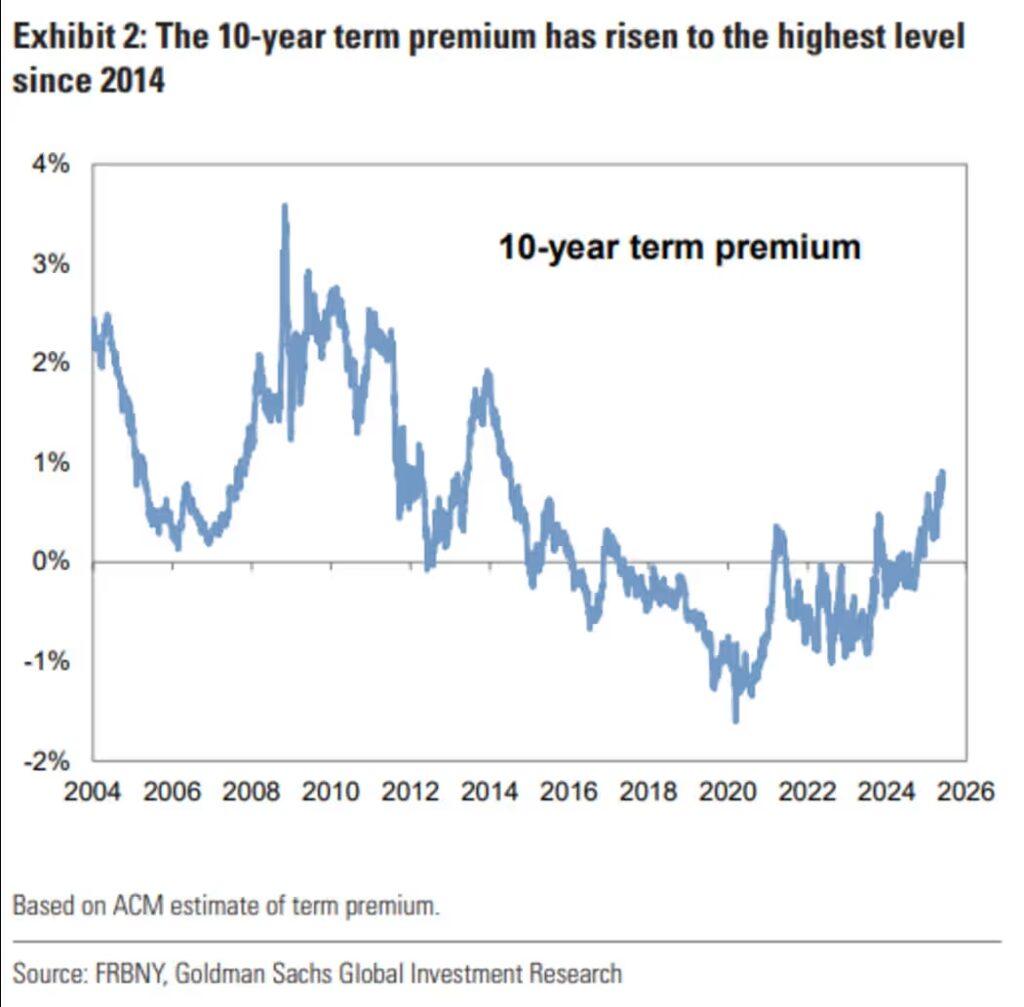
Goldman Sachs Holds 6,500 S&P 500 Target Despite Rising Yields Goldman Sachs is maintaining its 12-month S&P 500 target of 6,500, even as bond yields rise. The yield on the 10-year U.S. Treasury has jumped from 4% in late April to 4.43%, fueled by concerns over tariffs, inflation, and increased term premia—investors demanding higher returns for longer-term debt. In a note released Friday, strategists led by David Kostin analyzed the impact of higher yields on equities. They forecast the 10-year yield will end 2025 at 4.5%, rising slightly to 4.55% in 2026. Goldman emphasized that for equities, the drivers and speed of rate changes matter more than the actual yield level. Markets typically react better when yields rise due to stronger growth expectations. However, if inflation or fiscal risks are behind the increase—or if yields rise sharply in a short time—a market correction becomes more likely. Since U.S.-China tariff tensions escalated on April 2, investors have become more focused on the connection between yields and stock returns, though Goldman notes there’s no consistent historical relationship. Goldman expects the S&P 500’s forward P/E ratio—currently near fair value—to remain stable over the next year. Large-cap companies with long-term, fixed-rate debt are less exposed to rate volatility. Small caps, by contrast, are more vulnerable due to their reliance on shorter-term, floating-rate borrowing. Given this outlook, Goldman continues to recommend investors prioritize companies with strong balance sheets.

market
Market News

Hold Tight: 5 Pillars for the Bull Market

Jim Paulsen Sees More Market Tailwinds Ahead Tariffs and trade tensions continue to shape market sentiment, but despite the noise, the S&P 500 remains just 3.8% below its February 19 closing high. Still, with trade policy grabbing most of the headlines, it’s worth asking: What other forces might drive the market from here? According to veteran Wall Street strategist Jim Paulsen, now retired and writing on his Paulsen Perspectives blog, several key indicators could begin offering much stronger support for equities in the coming months. Paulsen points to five main pillars: the Fed funds rate, the 10-year Treasury yield, inflation, M2 money supply growth, and consumer confidence. Based on historical analysis going back to the 1960s, he finds that the S&P 500 tends to perform significantly better when these factors are moving in a favorable direction. For example, when M2 money supply is expanding, the S&P 500 has returned an average of 12.7% annually, compared to just 2.2% during periods of slowing growth. Similarly, the index has gained an average of 10.5% more during times when the Fed is cutting rates rather than hiking them. Each of the five factors individually correlates with stronger market performance, but the real kicker comes when all five are aligned. In such cases, Paulsen says, the S&P 500 has posted an average annual gain of 16.3%. So where does that leave investors now? Paulsen believes the market setup is turning more favorable. He notes that this bull market, which began in October 2022, has unfolded largely without help from the usual supports. The Fed has maintained a tight policy stance, and money supply growth has been unusually weak—just 0.8% annually, with real M2 contracting at a rate of -2.2%. Long-term bond yields haven’t provided much relief either. The 10-year Treasury yield has hovered between 3.5% and 4.75%, lacking the kind of downward trend that typically bolsters stocks. The one clear tailwind has been inflation. Since the rally began, inflation has dropped from 7.75% to 2.3%. And while new tariffs could cause a modest uptick, Paulsen expects inflation to remain stable—or even drift lower—over the next year. Consumer confidence, meanwhile, has been weak but is showing early signs of recovery. Paulsen concedes that some investors view this bull run as overstretched, especially given high valuations. But he argues that as economic growth slows and inflation remains tame, the environment could shift in favor of equities. “If sentiment moves toward a low-inflation, sluggish-growth outlook,” he writes, “the market could benefit from multiple supports working in its favor. Investors should think twice before abandoning this bull market—it’s not out of fuel yet.

Scroll to Top