market
Market News

Wall Street Giant Calls Market Bottom

Morgan Stanley Sees S&P 500 Climbing to 7,100 as Market Outlook Brightens Stocks faced pressure on Wednesday as rising bond yields stirred investor nerves ahead of a key Treasury auction. But Morgan Stanley took a bullish stance, upgrading its outlook on U.S. equities and bonds. The firm now favors U.S. assets across the board, citing “slow-but-not-dire” global growth. “We’re neutral on global equities but more optimistic on fixed income, with a strong regional preference for the U.S.,” said a team of strategists led by Mike Wilson. Previously targeting 6,500 for the S&P 500 by the end of 2025, the bank now sees that as a baseline for Q2 2026. Their bull case points to a 21% rally to 7,200, while the bear case sees a dip to 4,900—all based on the index’s May 19 level of 5,964. Why the Optimism? Morgan Stanley argues that much of the equity market has already endured “rolling earnings recessions” over the last three years, setting up easier comparisons and a broad-based earnings rebound. They expect EPS growth to be supported by expected Fed rate cuts in 2026, a weaker dollar, and greater productivity driven by AI adoption. The strategists also believe the worst is behind us. The sharp market reaction to the recent “Liberation Day” tariff announcements marked what they call a capitulation phase. “Assuming no deep recession, we believe the lows are in,” they said. Over the next 6 to 12 months, they foresee a shift toward more market-friendly policies — infrastructure spending, tax incentives, deregulation, and rate cuts — that could further lift equities. Additionally, a pause in U.S.-China tariffs has helped reduce recession risks. Their economic team now expects seven Fed rate cuts in 2026, which they say will support higher valuations. Near-Term Risks, Long-Term Drivers The 10-year Treasury yield — recently at 4.55% — remains a short-term concern. Morgan Stanley sees yields staying rangebound through year-end before dropping to 3.45% by Q2 2026 as expectations for Fed easing build. These elevated yields may keep equity valuations in check near term, with the S&P 500 expected to remain between 5,500 and 6,100 through the first half of 2025. After that, the path toward 6,500 becomes more likely. That 6,500 forecast is built on a 21.5x P/E multiple and 12-month forward earnings of $302. The strategists see this as more realistic by mid-2026, considering recent market weakness and delayed effects from trade uncertainty. Where to Invest Morgan Stanley continues to recommend high-quality cyclical stocks — companies with strong balance sheets, consistent returns, and lower leverage. They’ve upgraded industrials from neutral to overweight, citing benefits from increased infrastructure investment. Utilities have also been moved to overweight, reflecting a reduced focus on defensive sectors. The strategists favor large-caps over small-caps and U.S. stocks over international names, as earnings momentum builds domestically. They also forecast a 9% drop in the U.S. dollar (ICE Dollar Index) over the next year, driven by easing U.S. rates and a shift toward defensive currencies like the euro, Swiss franc, and Japanese yen.

stocks
Market News

3 Red Flags as Stocks Near Bull Market

Stocks Are Booming — But Bonds, the Dollar, and Gold Tell a Different Story The S&P 500 is flirting with bull market territory, ending Monday just shy of the 20% gain mark from its April low. Investors appear to have shrugged off Moody’s recent U.S. credit downgrade, pushing equities higher in what looks like a broad risk-on rally. But beneath the surface, not all is well. JPMorgan CEO Jamie Dimon warned Monday of “an extraordinary amount of complacency” in markets, and Lisa Shalett, Chief Investment Officer at Morgan Stanley Wealth Management, agrees. In a note to clients, she highlighted three major market signals that are diverging sharply from the bullish sentiment in stocks — and could spell trouble ahead. 1. Treasury Yields Are Flashing Caution While short-term Treasury yields reflect growing confidence in the economy, longer-term yields tell a more complex story. The 10-year yield is inching toward 4.5%, a level that reflects not just growth optimism, but also concern over rising real rates and growing U.S. debt burdens. With Congress considering new tax, spending, and budget packages that could add $2 trillion in debt, Shalett warns this could drive interest costs sharply higher over the next decade. That means structurally higher rates — and lower valuations for stocks. 2. The Dollar’s Weakness Defies the Rally Since peaking in January, the U.S. dollar has fallen 8% against major currencies, despite the surge in equities. Even more puzzling: the dollar is now moving with oil prices, reversing a long-standing inverse relationship. Shalett suggests this signals a shift in global capital flows and reserve allocations. A weaker dollar could lead to diminished foreign investment in U.S. assets — another potential headwind for equities. 3. Gold Is Outperforming — and That’s Unusual Gold, typically a hedge against turmoil, has been outperforming U.S. stocks since 2022. That’s not typical during a stock market boom. Shalett sees this as another sign that global investors — including central banks — are seeking alternatives to dollar-denominated assets. “Strength in gold, disconnected from traditional safe-haven behavior, hints at structural shifts in global reserves and risk perceptions,” she said. Not the Time for Complacency Investors hoping for a repeat of the “Goldilocks” environment of 2023–2024 — falling real rates and a resilient dollar — may be in for disappointment. Shalett forecasts more modest average returns for U.S. equities (5%–10%) amid increased volatility, tighter financial conditions, and a weaker dollar. Her advice: use the current rally to rebalance. She recommends increasing exposure to international equities, commodities, energy infrastructure, hedge funds, and shorter-duration investment-grade and municipal bonds. “This is not the time to rely on valuation expansion,” she warned.

market
Market News

Investor Sees Bear Market Coming

Tariffs Could Cut S&P 500 Market EPS by 30 Cents, Warns David Kotok While many market watchers are brushing off Moody’s recent downgrade of U.S. debt, both stocks and bonds slipped to start the week — suggesting investors may be more concerned than they let on. In the background, longtime investor David Kotok is sounding the alarm on a different issue: tariffs. In a new note to clients, Kotok estimates that tariffs alone could reduce S&P 500 earnings per share by 30 cents over the next year — from $2.60 to $2.30. “These are my own estimates — and yes, they’re wrong. But they’re a reasonable place to start,” says Kotok, who co-founded Cumberland Advisors and is known for hosting the annual “Camp Kotok” retreat for top economists and investors. His projection is based on models that convert tariff levels into equivalent changes in corporate tax rates. Even if the Trump administration succeeds in lowering the current 21% corporate tax rate, Kotok notes, each percentage point cut would only boost S&P 500 EPS by about 2 cents — not nearly enough to offset the impact of new tariffs. Looking beyond tariffs, Kotok warns that a slowing economy could further pressure corporate earnings, potentially bringing S&P 500 EPS down to a range of $200 to $220. At a valuation of 20 times earnings, that would imply an index level between 4,000 and 4,400. But if Treasury yields continue to rise — as they did Monday — that multiple could contract, pulling the index even lower. “The worst-case scenario puts the S&P 500 below 4,000,” Kotok says. A more moderate case, assuming lighter tariffs and limited retaliation against U.S. services, would see the index closer to 5,000. Still, he emphasizes that the outlook could shift quickly. “A Trump policy reversal or a financial crisis that forces the Fed to step in could dramatically alter the path forward,” he notes.

Investor
Market News

GE, Microsoft & the Investor Behind the Moves

Alphabet Is TCI’s Riskiest Bet, Says Chris Hohn Alphabet is “maybe our most risky investment,” according to Chris Hohn, founder of The Children’s Investment Fund (TCI). Despite its strengths in YouTube and cloud services, Hohn cautioned that Alphabet faces significant risks — particularly the potential fragmentation of its core search business. It’s also the smallest U.S.-listed holding in TCI’s latest 13-F filing. Hohn, who was knighted in the U.K. and recently hailed as “Europe’s best investor” by Norway’s sovereign wealth fund chief Nicolai Tangen, shared his views during an interview and a conference hosted by the fund. TCI’s top U.S. holding is GE Aerospace, a business Hohn favors for its exceptionally high barriers to entry. The firm also holds a stake in Safran, GE’s French partner in jet engine manufacturing, which doesn’t appear in the U.S. filing due to its foreign listing. “We like that space because it’s extremely hard to enter,” Hohn said. “It’s so complex that there have been no new competitors for 50 years. And the real profits come from spare parts, not the engines themselves.” Hohn also pointed to Visa and Meta Platforms as companies benefiting from strong network effects, calling them key holdings. TCI also increased its position in Microsoft, its second-largest U.S. investment, by 24% in the first quarter. Hohn noted Microsoft’s ability to bundle services, such as Teams, gave it an edge over competitors like Zoom, even if the rival’s product was technically better. Long-term holding is another core part of TCI’s strategy. The average investment remains in the portfolio for eight years — far longer than most institutional funds. Hohn cited Moody’s, which he has owned off and on since the financial crisis, as a prime example of a company that compounds value over time. “If you have a great company, it will grow intrinsic value,” he said. “Multiples matter less than growth over the long run.” TCI also holds both Moody’s and S&P Global, citing their stable, recurring revenue from credit ratings — a critical financial service. Despite his focus on strong, growing businesses, Hohn isn’t afraid to avoid sectors he sees as flawed. The airline industry, he noted, has suffered from “profitless growth” for over a century due to low barriers to entry.

market
Market News

How Far Must Market Fall for a ‘Trump Put’?

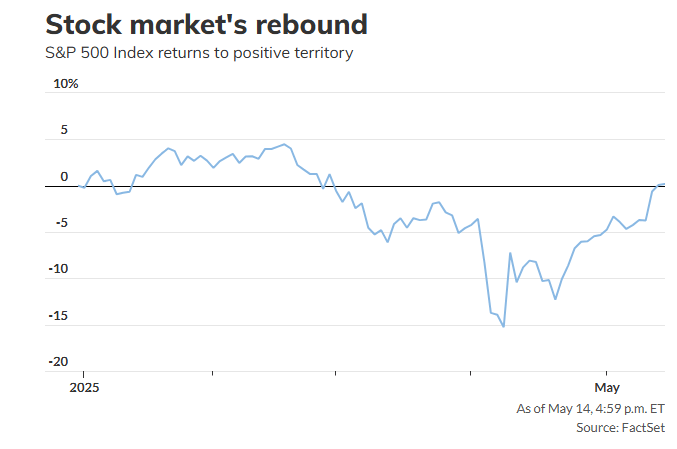
Trump’s Tariff Pause May Signal Market Floor—but Investors Should Stay Alert President Trump’s recent decision to partially pause tariffs may indicate where equities need to fall before prompting a White House policy reversal. But investors shouldn’t assume this marks a reliable safety net. The stock market’s sharp rebound—following steep losses tied to trade tensions—suggests a new threshold for how far Wall Street can drop before Trump steps in. The S&P 500 turned positive for the year on Tuesday after the U.S. and China agreed to pause certain tariffs. That recovery from the April 8 low of 4,982.77 suggests an informal “Trump put” may kick in after a drop of around 18.5%. Trump’s re-election in November triggered a surge in U.S. equities, with indexes hitting new highs through February. Wharton finance professor Jeremy Siegel even called Trump the most “pro-stock-market president” in U.S. history, as noted by MarketWatch’s Joseph Adinolfi. But by January, optimism had faded. Trump’s aggressive trade stance toward China rattled markets and raised recession fears. The turbulence eased only after reciprocal tariffs (excluding China) were paused on April 9, followed by a suspension of tit-for-tat measures with Beijing on May 12. “The ‘Trump put’ is alive and well,” said Tom Lee, head of research at Fundstrat, in a recent podcast. “The White House doesn’t want the stock market to go down.” Still, Trump offered little indication this spring that he was concerned about falling markets, casting doubt on the immediacy of any protective pivot. Meanwhile, Fed Chair Jerome Powell dismissed the idea that monetary policy would be used as a market backstop. “Investors were spooked in early April because they feared the Trump put wouldn’t activate until the S&P 500 dropped deep into the 4,000s,” noted Tom Essaye, president of Sevens Report Research. Now, he says, the threshold appears closer to the mid-to-low 5,000s. As of Tuesday, the S&P 500 sat 4.2% below its record close of 6,144.15 on February 19, according to Dow Jones Market Data. Stocks gained further ground on Wednesday, pushing closer to those highs. Steven Blitz, chief U.S. economist at GlobalData TS Lombard, said he wasn’t surprised by Trump’s 90-day tariff pause on China, given the severity of the recent selloff. But he remains cautious about future reversals. “I’m skeptical of how Trump’s trade rhetoric evolves after the budget is passed,” Blitz told MarketWatch, referring to the GOP’s proposed budget bill. “It’s unclear whether market volatility or political strategy drove the tariff pause. He needs congressional votes to move the bill forward.” As of Wednesday, the S&P 500 was up 0.2% for the year. The Dow was down 1%, while the Nasdaq had slipped 0.9%, according to FactSet.

sonic
DayTradeToWin Review

Perfect Long Setup in Today’s Market: Sonic System

Today is Tuesday, and it was a textbook day for long trades on the E-mini S&P 500, guided by price action and confirmed with the Sonic System. In this post, I’ll walk you through the reasoning, execution, and results of multiple live trades—all focused on the upside. The Technical Picture: Why Long? This morning, the market showed a classic reversal setup: This isn’t about predicting the market. It’s about reacting to what price is telling us in real time. Trade Breakdown: Live with the Sonic System All trades were taken using the Sonic System on a 1-minute chart, starting 15 minutes after the open—a time when volatility begins to settle and price becomes more reliable. ✅ Trade #1 Entry: 5878Strategy: Waited for the market to stabilize post-openResult: Target hit with no re-entry📌 Tip: Avoid taking the same trade twice once the move is complete. ✅ Trade #2 Entry: 5889.75Approach: Waited for a better price to improve the risk-to-reward ratioResult: Target hit cleanly📌 Tip: Be patient. Let the trade come to you. ✅ Trade #3 Setup: Fast, clean signalExecution: 50/50 risk-to-reward objectiveResult: Target hit within minutes📌 If price tries and fails multiple times to hit your target, exit early. Don’t wait for a reversal. ✅ Trade #4 Another strong long signalTarget: $125 using 1x ATR (Sonic System default)Total trades taken: 3All profitable At this point, it was clear—the market was trending up, and the Sonic System kept us in sync with that movement. Why the Sonic System Delivers The Sonic System offers: Whether you trade E-mini, NASDAQ, micros, oil, or even crypto, it adapts to your style. Know When to Call It a Day One of the biggest traps in trading is overtrading. After hitting your goal—$500 to $1,000 or more depending on contract size—shut it down. “Take a few solid trades, hit your goal, and protect your profits.” Want to Learn the System? If you’re not yet part of the Day Trade to Win community, now’s a great time to join. Sign up for a free member account at daytradetowin.com and get access to: Start learning price action the right way, without relying on outdated indicators. Ready to take your trading to the next level?🔗 Join now at daytradetowin.com

Scroll to Top