Tariffs
Market News

Apple, Nvidia Avoid Tariffs (Temporarily)

Smartphones and Laptops Spared from China Tariffs—for Now, Says Commerce Secretary Smartphones and laptops were among a range of consumer electronics spared from the latest round of U.S. tariffs on Chinese imports, offering what initially appeared to be a reprieve for tech giants like Apple Inc. and Nvidia Corp. But that relief may be short-lived. Commerce Secretary Howard Lutnick said Sunday that more targeted tariffs are on the horizon. Speaking on ABC’s This Week, Lutnick explained that while items like smartphones, laptops, integrated circuits, and semiconductor manufacturing equipment were excluded from the recently announced 145% “reciprocal” tariffs, they’re not off the hook. Instead, these products will likely face a separate set of semiconductor-focused tariffs as the administration seeks to boost domestic chip production. “The exemption was not a pass,” Lutnick clarified. “These technology products are simply being moved into a different, more specific tariff category.” President Donald Trump added further confusion in a Sunday social media post, stating, “NOBODY is getting ‘off the hook.’” He insisted that no tariff exception had been granted on Friday—only a shift to a different tariff strategy. The evolving policy has left markets rattled. Wedbush analyst Daniel Ives said Sunday that the constant stream of conflicting messages from the White House is creating “massive uncertainty and chaos” for companies trying to manage their supply chains and inventory planning. Still, Ives noted the outlook had improved slightly since last week, calling the current situation “a much better spot than Friday and last week heading into this Sunday night.” Apple, which relies heavily on Chinese manufacturing, has been particularly vulnerable to tariff concerns. Its shares had dropped 11% between Trump’s initial tariff announcement on April 2 and the end of last week. The company had previously received tariff exemptions during Trump’s first term. Analyst Stacy Rasgon of Bernstein, who covers Nvidia and other semiconductor firms, wrote Sunday that the exemptions could signal a willingness to negotiate. “It seemed last week that Trump was looking for an excuse to engage with China,” Rasgon wrote. “Exempting these products—many of which are crucial Chinese imports—could be interpreted as a gesture toward renewed talks. Time will tell.”

investors
Market News

Are Investors Wrong About the U.S.?

Trade Relief and Pessimism Make the S&P 500 Look More Attractive U.S. stock futures were pointing up early Friday, setting the stage for a stronger finish to a rollercoaster week. Much of the optimism stems from President Trump’s unexpected midweek shift on tariffs. Markets are reading that as a sign trade tensions may have peaked — investors see it, at least for now. Still, plenty of caution remains. Skeptics argue that the 90-day tariff pause just delays uncertainty, especially with Chinese imports still facing a steep 145% tariff. Conflicting takes like these are what drive the market — and they’re even showing up within the same firms. Case in point: On Thursday, UBS strategist Bhanu Baweja warned investors to sell into rallies, saying the S&P 500 could fall below 5,000 if the economic impact of tariffs worsens. But on Friday, a different UBS team — led by Global Wealth Management CIO Mark Haefele — took a more bullish stance, upgrading U.S. equities to “attractive” and offering three main reasons why: Adding fuel to the contrarian fire: investor sentiment is deeply bearish. The latest AAII survey shows 58.9% of investors expect stocks to keep falling. That’s down slightly from last week’s peak but still unusually high. UBS points out that such pessimism has often preceded big market rallies, with the S&P 500 posting an average 27% gain in the year following similar sentiment extremes. While UBS still sees risks if tariffs stay in place, they now think the odds of a major economic downturn have dropped. They’ve revised their worst-case S&P 500 target up from 4,000 to 4,500 — a level more in line with a normal recession, rather than a full-blown crisis.

markets
Market News

Markets Soar as Trump Hits the Brakes on Tariffs

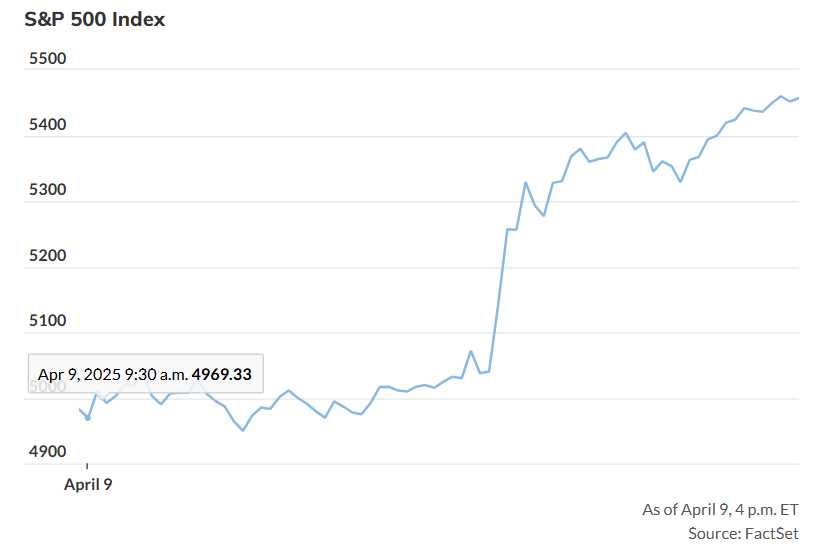
Wall Street bounced back in dramatic fashion Wednesday after President Donald Trump announced a 90-day delay on certain tariffs—excluding those targeting China. The move sparked a massive relief rally in markets that had been battered by trade war fears. The S&P 500 jumped 9.5%, posting its best one-day percentage gain since October 2008. The Dow Jones Industrial Average surged 2,962 points, or 7.9%, in its strongest performance since March 2020. The Nasdaq Composite led the pack, skyrocketing 12.2%—its biggest single-day gain since January 2001. Markets had been under intense pressure since Trump unveiled sweeping tariffs on April 2. With stocks deeply oversold, investors were quick to seize on the shift in tone from the White House. “New U.S. tariff rates were not sustainable, and today, the Trump administration finally admitted it,” said Michael Arone, chief investment strategist at State Street Global Advisors. “Investors got their first piece of good news in over a week.” Trump’s social media post outlined the new approach: China would face a steep tariff hike to 125%, up from 104%, while other countries would see a reduced baseline rate of 10% for the next 90 days. This update came just 15 hours after “liberation day” tariffs kicked in, which had imposed a 20% rate on EU imports, 24% on Japanese goods, and 25% on South Korean products. The decision appeared to single out China as the main adversary in Trump’s trade war, a stance markets seemed more comfortable with after a previous round of China-focused tariffs earlier in his presidency. Tuesday’s S&P 500 close at 4,982.77, the lowest since April 19, had brought the index to the brink of a bear market, setting the stage for Wednesday’s rebound. “This is the biggest rally I’ve ever seen—and it’s stunning,” said Louis Navellier, founder of Navellier & Associates. “Will we revisit the lows? Probably not. This looks decisive. Clearly, Trump is watching the markets—and he reacted.” Behind the scenes, many believe mounting pressure in the bond market also influenced the policy reversal. A surge in Treasury yields, with the 10-year climbing to 4.293%, signaled investors were abandoning the usual safe-haven trade, raising fears of a liquidity crunch that could force Federal Reserve intervention. While the rollback eased immediate recession concerns, risks remain. Stocks had plunged after the initial April 2 announcement on fears the tariffs would tip the economy into a downturn. Economists at Goldman Sachs briefly made recession their base-case scenario Wednesday morning—only to revise that call after Trump’s announcement. Volatility is likely to persist, said State Street’s Arone. “The trade war isn’t over,” he said, “but at least for today, investors have won a round.”

fed
Market News

How the Fed Could Respond to the Selloff

Fed Weighs Emergency Rate Cut and Bond Market Intervention The Federal Reserve had intended to hold steady and observe how an economy already facing high inflation would react to sweeping tariffs introduced by the Trump administration. But escalating market volatility may not allow for patience. Yields on the 10-year Treasury surged to 4.52% as the new tariffs — the most severe in a century — took effect at midnight, up sharply from 4% just a week ago. Early signs of dialogue between the U.S. and China calmed markets slightly, but uncertainty remains high. Traders are now factoring in the possibility of an emergency rate cut. Federal funds futures for April suggest roughly a 20% chance of a move before the Fed’s next scheduled meeting. Other measures are also under consideration. When the U.K. bond market collapsed following Liz Truss’s 2022 mini-budget, the Bank of England stepped in with temporary purchases of long-term government debt — precisely the area now under stress in the U.S. That intervention worked. Thirty-year gilt yields had surged 130 basis points in just three days but stabilized after the Bank’s action. It even ended up turning a £3.5 billion profit on £19.3 billion in bond purchases, which were later unwound. TS Lombard’s Dario Perkins noted the Bank of England was still able to raise rates by 300 basis points and resume quantitative tightening after the intervention. “You can intervene briefly in bonds and stay hawkish on inflation,” he said. The Fed could also opt for a more technical move — targeting the overnight funding market. The swap rate between SOFR (Secured Overnight Financing Rate) and comparable Treasury maturities has been falling, a signal that liquidity is drying up and interbank lending is weakening.

market
Market News

When This Is Over,’ Market Falls 80%

Spitznagel: This Market Drop Is Just a ‘Trap’ — The Real Crash Is Still Ahead Mark Spitznagel, one of Wall Street’s most bearish and accurate investors, says the recent stock market drop isn’t the big crash he’s been warning about — it’s just a setup. “I’m expecting an 80% crash eventually. But this isn’t it. This is a trap,” Spitznagel told MarketWatch. “When the real thing hits, you’ll know.” Spitznagel is the founder and CIO of Universa Investments, a hedge fund built to thrive during extreme market shocks. Universa follows a “Black Swan” strategy, inspired by Nassim Taleb, focusing on rare, devastating events — and profiting from them. The fund made headlines in early 2020, returning over 4,100% as COVID fears tanked the market. Today, Spitznagel says Universa is still positioned as if a crash is coming — even though he doesn’t think it’s here yet. “This is another shakeout. Not the end. The real reckoning will come when this bubble truly bursts,” he said. “It’s a deeply contrarian view, but I stand by it.” Markets were volatile Monday. The Dow dropped more than 200 points (down 0.57%), the S&P 500 gained 0.35%, and the Nasdaq slipped 0.84%. Last week’s steep losses, sparked by new tariffs from President Trump, marked the S&P’s worst two-day slide since March 2020. Spitznagel has long predicted a massive downturn, one potentially worse than 1929. He’s not trying to time it exactly but warns the U.S.’s mounting debt poses serious risk. Earlier this year, he urged investors not to get caught off guard: “Don’t be the sucker who sells low and buys high.” His advice? Be positioned to weather chaos — easier said than done for most. “Our clients have stayed long through this bull market,” he said. “The doomsayers think they’ve nailed it. Take it from an actual doomer — they haven’t. And they’re not ready for what’s coming.” Still, Spitznagel believes retail investors can keep it simple. In a 2023 Fortune interview, he recommended low-cost index funds and disciplined investing — especially during downturns. His key point: stay invested, don’t overextend, and avoid panic selling.

S&P 500
Market News

Morgan Stanley Predicts Further S&P 500 Losses

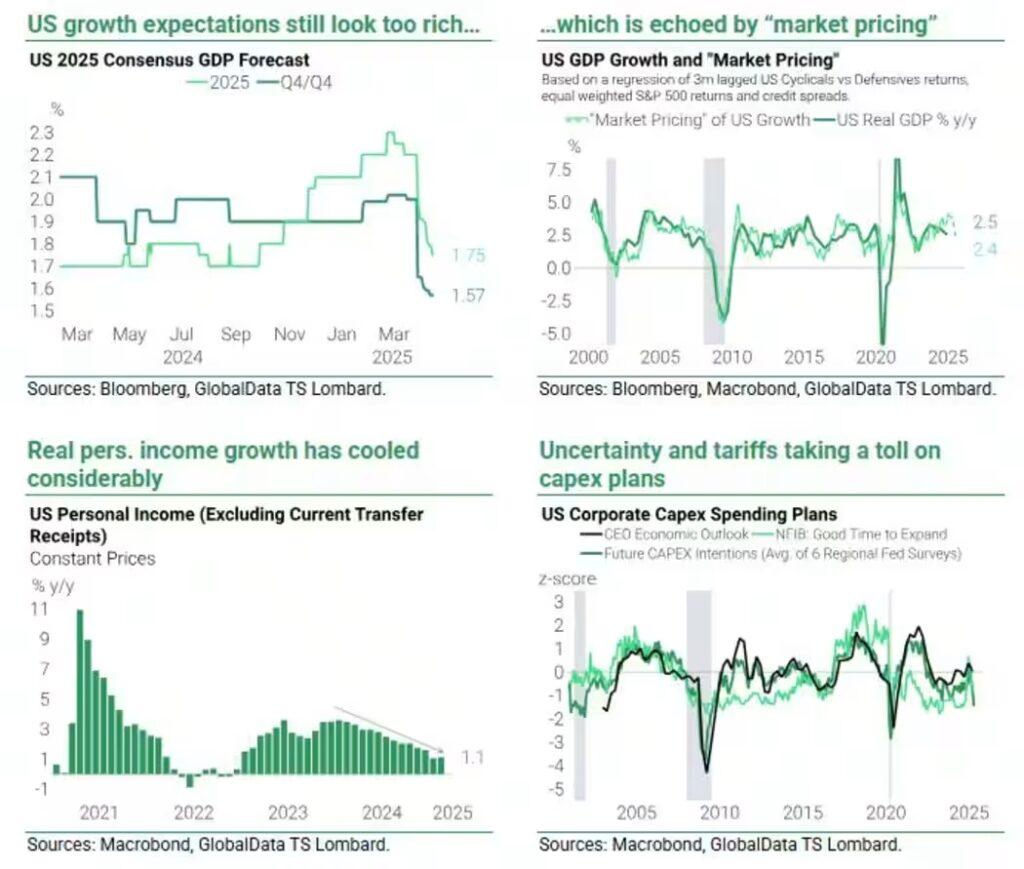
Mike Wilson, the lead strategist at Morgan Stanley, is warning investors to prepare for a potential 7% to 8% further drop in the S&P 500 unless there’s a reversal in the White House’s tariff plans or a change in the Federal Reserve’s stance. Wilson’s team, in a note sent to clients on Monday, stated that the next major support level for the S&P 500 — where buyers may step in — is at 4,700. This level aligns with the 200-week moving average, a key long-term technical indicator, which they believe offers strong support. The S&P 500 closed last week at 5,074.08, experiencing a 9% decline, its steepest weekly drop since March 2020. This was sparked by a sharp two-day selloff after President Trump announced global reciprocal tariffs. While Morgan Stanley had previously set 5,100 as a critical support level, they adjusted it to 4,700 given the continued downward pressure on the market, with S&P 500 futures showing a potential 3% loss and Dow futures dropping over 1,200 points. Trump’s administration has not shown any signs of backing down on the tariffs, and Federal Reserve Chairman Jerome Powell suggested the central bank would adopt a “wait and see” approach, assessing the economic impact of the tariffs. Wilson’s team pointed out that many stocks have struggled throughout the year, despite the broader indexes holding up until mid-February. This underperformance has been primarily driven by the broad trend of negative earnings revisions, with more companies lowering earnings expectations than those raising them. As the tariffs weigh on market sentiment, further negative earnings revisions are expected. “The question now is how much of this has been priced in, and which sectors and stocks are either attractive or at risk,” said Wilson. Cyclical stocks, which are closely tied to the economy, have underperformed defensive stocks by over 40% in the past year, particularly from April to September last year. For Morgan Stanley, this suggests that concerns over economic growth have persisted for some time, reinforcing their view that the economy has been in a prolonged struggle. The strong performance of defensive stocks has highlighted their dominance, and Wilson’s team believes the recent selloff in these stocks signals forced liquidation and signs of exhaustion in the correction. The strategists are sticking with their preference for high-quality, large-cap, and defensive stocks, emphasizing that these are the types of investments that are likely to weather the current environment best. One such stock is American Tower REIT, which has been upgraded to overweight and added to their Fresh Money Buy list, replacing Eaton Corp. Wilson’s team sees American Tower as a defensive stock with growth potential, particularly as interest rates are expected to decrease, in line with their forecast. Also on the list are CenterPoint Energy, Coca-Cola, Colgate-Palmolive, McDonald’s, Northrop Grumman, Progressive Corp., Public Service Enterprise, and Walmart. Wilson’s team also expects small-cap stocks to continue underperforming due to their greater exposure to economic uncertainty, weakening earnings projections, and historical trends of underperformance in later market cycles. While there are opportunities beneath the surface in the small-cap sector, they believe it’s too early to start picking bottoms. Among small-caps, they favor high-quality stocks in financial services, software, telecom services, biotech, and household products.

Scroll to Top