markets
Market News

If Trump Fires Powell: 3 Markets Plays

Markets Tumble as Trump Threatens to Fire Fed Chair Powell A rare and unsettling selloff hit U.S. markets on Monday after President Donald Trump renewed attacks on Federal Reserve Chair Jerome Powell, raising fears about the central bank’s independence. All three major indexes plunged— the Dow fell 2.48%, the S&P 500 dropped 2.36%, and the Nasdaq slid 2.55%. At the same time, the yield on the 30-year Treasury spiked to 4.91%, while the U.S. dollar dropped to a three-year low. The coordinated decline in stocks, bonds, and the dollar reflects deep investor concern that Trump could attempt to remove Powell before his term ends in 2026. While it remains legally unclear whether the president can do so, the mere threat has rattled markets. Michael Brown, a strategist at Pepperstone, said firing Powell would spark “the most dramatic rush to the exit from U.S. assets that it is possible to imagine.” He warned that such a move would undermine global confidence in the U.S. financial system, potentially ending the dollar’s reserve currency status and Treasurys’ role as a safe haven. Even without actual dismissal, some analysts argue the damage is already done. Will Compernolle of FHN Financial noted that legal battles over Powell’s position could erode market trust in the Fed’s independence. “If it reaches the courts, credibility may already be lost,” he said. Trump has made no secret of his dissatisfaction with Powell, calling him “Mr. Too Late” and publicly suggesting that he should be removed. Reports indicate the president has discussed possible replacements, including former Fed Governor Kevin Warsh. While many strategists still doubt Trump will move forward, the risk alone is enough to shift market sentiment. Evercore ISI analysts warned that even floating the idea of firing Powell adds political risk to U.S. assets and could accelerate a move toward stagflation trades—marked by higher inflation and slower growth. As investors seek safety, gold prices have climbed and foreign assets are drawing renewed interest, signaling a growing unease with the direction of U.S. economic policy.

market
Market News

Why Extreme Market Gloom Might Be a Bullish Signal

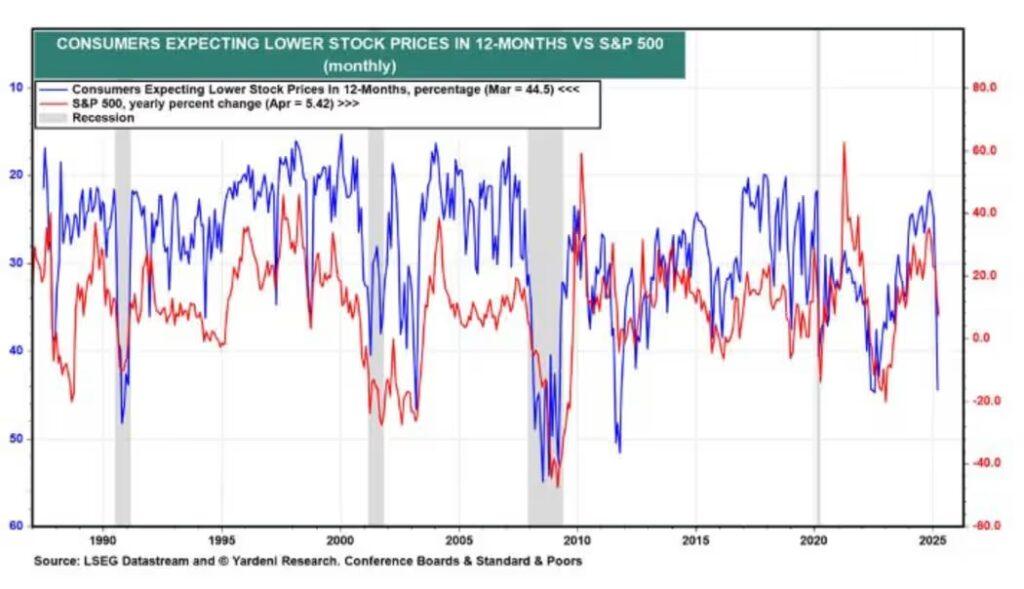
Yardeni: Market Are So Bearish, Only a Lehman-Level Crash Would Make Sense Stocks stumbled out of the gate after the holiday weekend, with renewed trade tensions around China and uncertainty over Fed Chair Jerome Powell weighing on sentiment. The dollar is slumping, and earnings season is heating up—buckle up. Despite all the negativity, Ed Yardeni, president of Yardeni Research, says the market may be overdoing it. In fact, the mood is so dark, he argues it would take a full-blown financial crisis to justify all the doom and gloom. “We’d need something on par with the 2008 Lehman collapse to match this level of panic,” Yardeni said. “And there’s no real sign of that happening.” Still, Yardeni himself has turned more cautious, cutting his S&P 500 target twice this year—from 7,000 to 6,000—as recession fears grow. The S&P is already down 10% in 2025, with Trump’s tariff threats fueling anxiety. But there are reasons for hope. Recent signs that China may be open to negotiations could give Trump room to dial back his 145% tariff threat—possibly to a market-friendly double-digit figure. That said, recession concerns are rising. Prediction markets now peg the odds at 56%, up from 20% at the start of the year. Yardeni sees a 45% chance of either a recession or stagflation. Investor sentiment has cratered. Yardeni points to surveys showing a collapse in bullish views, with nearly half of consumers expecting stocks to fall over the next year. Among investors under 40, only 32% see the market rising. Still, Yardeni warns against giving up on 2025 too soon: “If we see some early signs of recovery, writing off the year entirely could be a costly mistake.” Backing that view, Evercore ISI strategists, led by Julian Emanuel, argue that investor pessimism might be overblown. With 90 days for trade talks to unfold, even a small positive headline could spark a rally—especially in small caps. Their play? Use options on the iShares Russell 2000 ETF (IWM) to capture both upside and downside. Buy a call at $204 and a put at $170—profit either way if volatility hits. For gold, Evercore suggests shorting the SPDR Gold Shares ETF (GLD), or using a collar strategy: sell a call at $323, buy a put at $297, and protect against a reversal.

markets
Market News

Why Firing Powell Could Shake Markets

Firing the Fed Chair Would Shake Markets and Undermine U.S. Economy, Experts Warn As President Donald Trump approaches his second term, renewed speculation about the future of Federal Reserve Chairman Jerome Powell is sending tremors through financial markets. Trump has long criticized Powell for not cutting interest rates aggressively enough and has publicly floated the idea of removing him. While no formal move has been made, strategists warn that such a decision would severely damage market confidence and U.S. economic stability. “He would very much like to fire Powell and lower interest rates—that’s very clear,” said Kathy Jones, chief fixed-income strategist at the Schwab Center for Financial Research. “I wouldn’t be surprised if he ignores the advice he’s been given and tries to make it happen.” The independence of the Federal Reserve has traditionally been a cornerstone of U.S. economic policy, and any attempt to politicize it could have far-reaching consequences. On Thursday, Trump renewed his attacks on Powell via social media, dubbing him “Too Late Jerome” for refusing to follow the European Central Bank’s lead in cutting rates. Powell, however, has reiterated the Fed’s cautious approach, saying the central bank will monitor the effects of tariffs and other economic pressures before deciding on further rate moves. When asked whether the Fed would intervene if markets plunged, Powell was direct: “No.” The Fed cut interest rates in September 2024 for the first time since the pandemic began, but has kept them steady throughout 2025. Following Powell’s comments, markets ended Thursday mixed, with the Nasdaq falling slightly and the S&P 500 inching higher. Behind the scenes, White House officials have reportedly advised Trump against removing Powell. Politico reported that Treasury Secretary Scott Bessent warned the move could rattle markets. Legally, the president’s authority to remove the Fed chair remains unclear. Powell has said the law protects the Fed from politically motivated firings. However, a pending Supreme Court case, Trump v. Wilcox, could shift that balance. A ruling in Trump’s favor might expand presidential power and erode protections for independent agencies, potentially clearing the path for Powell’s removal. Despite these developments, some on Wall Street are still brushing off the threat. “Are they taking him seriously or just ignoring the potential problem? Seems like the latter,” said Steve Sosnick, chief strategist at Interactive Brokers. Others, including Democratic Senator Elizabeth Warren, have warned that firing Powell could crash the markets. While Sosnick didn’t go that far, he emphasized the importance of institutional credibility. “We underestimate how vital institutions like a nonpartisan judiciary and an independent Fed are to foreign investors,” he said. Jay Hatfield, portfolio manager at Infrastructure Capital, argued that Trump may have grounds to fire Powell, citing the Fed’s delayed response to surging inflation in 2021. “He absolutely can fire him, and Powell can sue,” Hatfield said. Still, most analysts agree the fallout from such a move would be severe. Jones warned that removing Powell would likely trigger a sharp selloff in both Treasurys and the dollar—behavior more typical of emerging markets than the U.S. “It’s just not something that happens in major developed economies,” she said. “Even if a new chair is well-received, the damage to credibility would already be done. Bond yields would spike, the dollar would fall—you lose the trust of global markets.” U.S. stocks have already been volatile in 2025. On Thursday, the Nasdaq Composite slipped 0.1% to 16,286.45. The S&P 500 rose 0.1% to 5,282.70, while the Dow Jones Industrial Average dropped 1.3% to close at 39,142.23.

risks
Market News

The Hidden Risks Markets Are Ignoring

Tariff Relief Buoys Markets for Now, but Recession Risks Remain President Trump’s recent tariff adjustments have offered temporary relief to U.S. financial markets, but underlying economic risks are far from resolved. Daniel von Ahlen, senior macro strategist at GlobalData TS Lombard, warns that investors may be underestimating the threat of a recession, which could result in more severe market volatility later this year. In a report shared with MarketWatch, von Ahlen highlighted several troubling indicators. Federal workforce layoffs could strain the job market at a time when hiring has already slowed. Tariffs are expected to raise consumer prices just as income growth loses momentum, potentially weakening household spending power. Additional risks include Chinese retaliatory tariffs that could harm U.S. exports, a shrinking labor force due to tighter immigration policies, and potential fiscal drag if spending cuts are implemented to extend Trump’s first-term tax cuts. “Taken together, these forces may be strong enough to tip the U.S. economy into recession,” von Ahlen wrote, noting that declining real personal income growth leaves little room for policy missteps. Despite lowered growth forecasts from Wall Street economists, market pricing still reflects expectations for robust economic expansion. At the same time, earnings projections remain optimistic, with analysts calling for 8.9% growth in 2025—a figure that would be unlikely in a downturn, where corporate earnings typically stagnate or decline. Further stock market weakness could also weigh on consumer spending, given the growing role equities play in household wealth. Von Ahlen isn’t alone in his caution. Michael Brown, senior research strategist at Pepperstone, echoed similar concerns, pointing to continued trade uncertainty. He noted that new tariffs on sectors like semiconductors and pharmaceuticals are looming, and the broader U.S.–China trade relationship remains tense. Beijing recently halted Boeing jet deliveries, and reciprocal tariff negotiations have made little progress. “I worry markets are underpricing the risks,” Brown said. “We haven’t fully accounted for the inflationary or growth-related consequences these tariffs could trigger, both domestically and globally.” To prepare for a potential recession, von Ahlen recommends rotating into defensive assets. He suggests gaining exposure to utilities through ETFs like the Utilities Select Sector SPDR Fund (XLU), while reducing exposure to cyclical sectors such as financials via the Financial Select Sector SPDR Fund (XLF). Long-term inflation-protected bonds—like those in the Pimco 15+ Year U.S. TIPS Index ETF (LTPZ)—may also offer downside protection. Additionally, he advocates using the Mexican peso to fund long positions in the Japanese yen (MXNJPY), citing the yen’s safe-haven status and relative undervaluation despite recent appreciation. Markets showed renewed volatility midweek. After the White House blocked Nvidia from exporting more AI chips to China without a license, and Beijing suspended Boeing aircraft deliveries, stocks fell sharply. The S&P 500 dropped 1.3%, the Nasdaq declined over 2%, and Nvidia shares plunged nearly 7%.

wall street
Market News

Wall Street Bold Call: Time to Be Cautious

Wall Street S&P 500 Price Targets: A Market Thermometer, Not a Crystal Ball Wall Street S&P 500 targets are often viewed as forecasts — but in reality, they function more like a real-time mood gauge for the market than a reliable prediction tool, according to one strategist. The recent selloff caught many of Wall Street’s top minds off guard. President Trump’s shifting tariff strategy triggered a sharp downturn, forcing at least a dozen major firms — including JPMorgan, BofA, Goldman Sachs, and RBC — to swiftly revise their year-end S&P 500 forecasts downward. The median target now sits at 5,950, suggesting a more than 10% gain from Monday’s close of 5,405.97. But that’s a far cry from the 6,600 consensus forecast from just a few weeks ago. The tariff shock pulled that estimate down nearly 10% in under two weeks, marking one of the most abrupt sentiment resets in recent memory. Earlier in the year, projections were tightly clustered between 6,400 and 7,100. Today, they’ve blown open to a range of 5,200 to 7,000 — and several firms, including Deutsche Bank and Morgan Stanley, haven’t updated their calls at all. So, can traders rely on these revised targets? Nationwide’s Mark Hackett argues they should tread carefully. “The chances these forecasters get whipsawed are pretty high,” he said. “We saw about a 10% to 11% drop in consensus in a week, and that is very unusual.” Hackett compares S&P 500 targets to a “temperature check” — not a precision instrument. Historical data backs him up: since 2000, Wall Street has, on average, missed the S&P’s year-end level by nearly 14%. The standard method for calculating these targets — multiplying expected earnings per share by the forward P/E ratio — is looking shaky too. Tom Bruce of Tanglewood Total Wealth notes that it’s tough to project earnings right now, with tariffs muddying the waters. “The 90-day tariff pause offers a little clarity,” Bruce said, “but anything beyond that is anyone’s guess. Corporate earnings projections are shaky at best right now.” Indeed, earnings estimates have already softened. The consensus for 2025 full-year S&P 500 EPS now sits at $268.49, down from $271.05 a month ago, according to FactSet. On Tuesday, markets closed lower as traders digested Q1 bank earnings and waited for the next chapter in U.S. trade policy. The Dow dipped 0.4%, the S&P 500 slipped 0.2%, and the Nasdaq finished flat. Bottom Line: For traders, these shifting targets can offer a useful read on sentiment — but leaning too heavily on them for positioning might leave you vulnerable when the market rewrites the script. Watch the fundamentals, track the policy shifts, and treat forecasts like suggestions — not certainties.

S&P 500
Market News

S&P 500 Flashes Bearish Signal

S&P 500 Flashes First ‘Death Cross’ Since 2022, But Signals Remain Unclear The S&P 500 reached a key technical milestone on Monday, marking its first “death cross” since March 2022 — even as the broader market extended gains from last week’s rebound. A death cross occurs when the 50-day moving average falls below the 200-day moving average, often interpreted as a sign that short-term momentum is weakening and a deeper downturn may be forming. This latest signal reflects broader market turbulence in 2025. The Russell 2000 and Tesla Inc. have already triggered similar patterns, reinforcing concerns about market breadth and investor sentiment. However, history suggests the impact of a death cross isn’t always bearish. According to Dow Jones Market Data, the S&P 500 has typically moved higher three, six, and twelve months after previous death crosses — suggesting short-term volatility doesn’t always lead to prolonged declines. Paul Ciana, chief technical strategist at BofA Securities, advises watching whether the 200-day average has fallen over the past five sessions. If so, it may indicate further downside and a potential retest of the recent 2025 low. Others, like Craig Johnson of Piper Sandler, argue that death crosses are lagging indicators. In many cases, they signal that most of the damage has already been done and that a rally may be near. Indeed, recent history paints a mixed picture: the S&P 500 was down a year after the March 2022 death cross, but surged 50% following the same signal in March 2020. For now, markets remain resilient. On Monday, the S&P 500 gained 0.8%, while the Nasdaq Composite and Dow Jones Industrial Average also closed in the green.

Scroll to Top