bond market
Uncategorized

How Bonds Are Pricing a Trump Comeback

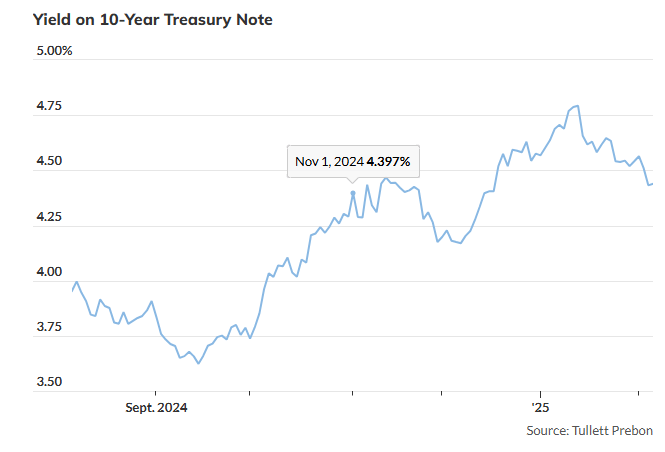
Stick with Short-Term Bonds, but Growth Concerns Persist President Trump’s trade-war policies continue to pose challenges for investors, as market volatility underscores uncertainty alongside mixed signals from the bond market. On Tuesday, 2-year Treasury yields hovered around 4.21%, just below their 200-day moving average, according to FactSet data. Meanwhile, 10-year yields stood at approximately 4.51%, significantly above their average over the same period. Tracking yield trends over time offers key insights, yet both short- and long-term yields remain elevated compared to late August—when Federal Reserve Chair Jerome Powell signaled an impending shift toward rate cuts. This pattern persists despite previous Wall Street warnings to lock in yields before anticipated rate reductions. Since September, the Fed has lowered its short-term policy rate by 1 percentage point. “There are two narratives the bond market is grappling with,” said Lawrence Gillum, chief income strategist at LPL Research, in a phone interview on Tuesday. Short-term Treasury yields reflect inflation concerns and the Fed’s cautious approach to rate cuts, Gillum noted. Another key factor is tariffs—while they elevate prices, they also dampen economic growth. Gillum expects Trump’s tariffs to put downward pressure on 10-year yields, likely bringing them into the low 4% range later this year as investors react to slowing growth. Investment Strategy: Where to Focus For fixed-income investors, Gillum recommends focusing on shorter-duration bonds. “The biggest ‘bang for your buck’ in terms of yield per duration is in the short end of the Bloomberg Corporate Index,” he said. Examining different bond maturity segments within the index helps assess how a portfolio might respond to interest rate fluctuations over time. “Right now, the economy is in good shape, but it probably won’t be toward the end of the year,” Gillum told MarketWatch. He advises those managing fixed-income portfolios against taking excessive rate risk until economic data weakens. “There’s still a lot of value in the front-end,” Gillum added, noting that shorter-duration bonds continue to offer yields around 4.5%—higher than most of the past decade. Trump’s unpredictable tariff policies introduce additional risks. BofA analysts estimate that the S&P 500 could face an 8% hit to earnings per share if 25% tariffs on Mexico and China, along with incremental 10% tariffs on China, are implemented. While concerns over market volatility strengthen the case for bond investments, waiting too long for aggressive Fed rate cuts amid economic downturns carries its own risks. “The key takeaway,” Gillum emphasized, “is that volatility in fixed-income markets isn’t going away.” On Tuesday, the S&P 500 rose 0.8%, the Dow Jones Industrial Average gained 0.4%, and the Nasdaq Composite increased 1.2%, according to FactSet data.

sonic
Market News

Banking 6 Trades Fast – My Sonic System Review

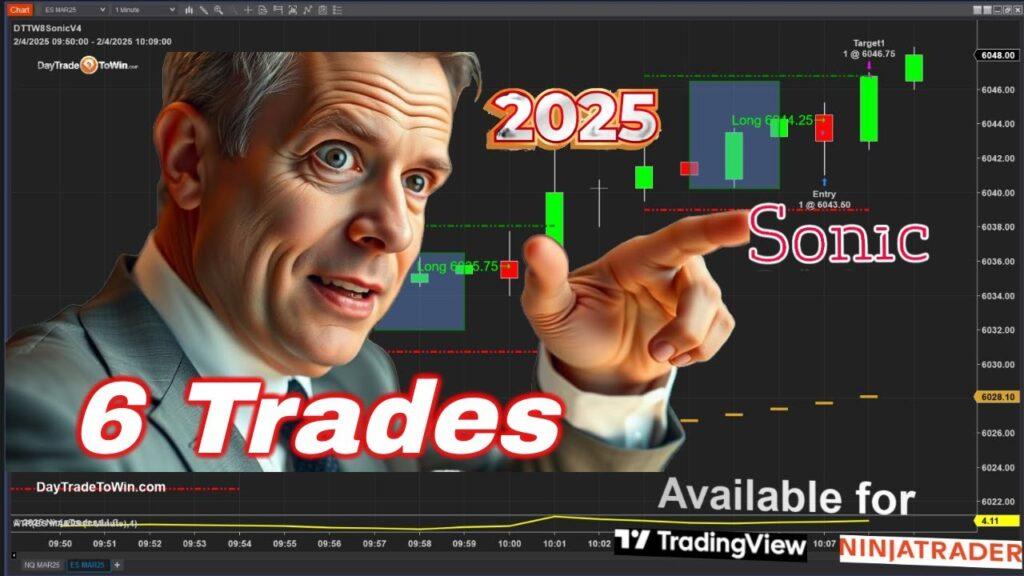
Hello, Traders! Today is February 4th, and I’m excited to share a live trading session using the Sonic Trading System by Day Trade to Win. Before we dive in, remember that trading involves risk—never trade with funds you cannot afford to lose. Navigating Market Open Volatility At 9:30 AM New York time, the market opens with a surge of volatility as traders flood in—whether on Nasdaq (NDAQ), E-mini, or Micro contracts. Overnight traders close their positions, and many jump in impulsively. I recommend waiting at least 5 to 10 minutes before taking your first trade for a higher probability setup. Live Trading Insights with the Sonic Trading System First Trade Signal – A Cautious Start The first trade signal was a long entry at 6024.50, which quickly hit its profit target. However, I typically advise waiting for a more stable setup before executing a trade. Smart Trade Entries and Exits The next signal appeared at 6029.50, offering a better opportunity. A key tactic: wait for a pullback to improve your entry price. If the trade reaches the profit target before entry, simply cancel the order—this is crucial for solid risk management. After securing an entry, I maintained my stop-loss level and avoided making impulsive exits. Many traders panic and exit too soon, but if your stop is intact and the market is still in play, patience is key. Using Time-Based Stops for Efficiency One effective technique is the time-based stop—if a trade doesn’t move in 15 to 20 minutes, I consider exiting to avoid stagnation. In this instance, my trade took about 10-12 minutes to reach the target, which was within my planned timeframe. Trend Confirmation & Winning Streaks Throughout the session, all signals pointed long, reinforcing a strong trend. If multiple trades align in one direction, this is a powerful confirmation to stick with the trend. At one point, I missed a winning trade due to an outside distraction (a phone call). Missing trades is okay—never chase the market! Opportunities arise frequently. The Importance of Risk-Reward Management Each trade must have a logical risk-to-reward ratio. If the stop-loss is too wide compared to the target, I skip the trade. It’s far better to wait for the right conditions than to force a risky trade. A Profitable Session Wrapped Up After 30-40 minutes of trading, I secured multiple winning trades. With just one contract per trade, I was already up several hundred dollars. Scaling up to two, three, or four contracts can easily lead to $1,000+ profits per session using the Sonic System. Key Takeaways for Traders Get Started with the Sonic Trading System Want to learn more? Visit DayTradeToWin.com and sign up for a free member account. Gain access to trial software, including the ABC system, and experience the power of price action trading. Join our Accelerated Mentorship Program for instant access to all trading strategies and software. Let’s get you started on the right path in the next live training session! Happy trading! 🚀

markets
Market News

Markets at Risk? Tudor Jones Weighs in on Trade War

Paul Tudor Jones Warns: “It Will Take a Maestro to Pull This Off” Legendary investor Paul Tudor Jones believes navigating today’s financial markets will require extraordinary skill. Speaking to CNBC on Monday, the billionaire trader—who famously predicted the 1987 stock market crash—warned that the economic landscape is more precarious than ever. “I don’t think we’ve ever seen so many interconnected risks that could go wrong at the same time,” Jones said. “It’s going to take a maestro to manage this without disrupting major asset classes.” Jones pointed to key shifts since President Donald Trump’s first term, including a record surge in Treasury debt issuance—now double what it was in 2017. He also noted that foreign ownership of U.S. assets, including stocks, real estate, and debt, has grown significantly as a share of GDP. Meanwhile, the S&P 500’s price-to-earnings ratio has climbed to 25 from 19 in 2017, suggesting that even a 30% correction would leave stocks slightly overvalued. “Trump being Trump, I’m not sure things will play out as smoothly as they did before,” Jones added. “There’s no room for error this time.” Markets React to Tariff Uncertainty Investor anxiety surged as markets digested fresh tariff announcements. Stocks tumbled after Trump revealed new levies: a 25% tariff on imports from Mexico and Canada, a 10% tariff on Canadian energy, and an additional 10% tariff on Chinese goods. However, markets clawed back some losses after diplomatic breakthroughs. Mexican President Claudia Sheinbaum and Trump both announced a one-month delay on Mexico tariffs following productive discussions. A similar agreement with Canadian Prime Minister Justin Trudeau postponed tariffs on Canadian imports for at least 30 days. The Dow Jones Industrial Average (DJIA) dropped 123 points, or 0.3%, after rebounding from an earlier 665-point plunge. The S&P 500 declined 0.8%, while the Nasdaq Composite fell 1.2%, both recovering from steeper session lows. Top Investors Urge Caution Hedge fund manager Dan Loeb also weighed in, warning of unprecedented market complexity. In a post on X, he emphasized the need for deep strategic thinking, calling the current climate “unlike anything we’ve seen before.” He urged investors to stay “levelheaded and unemotional” as markets adjust to new risks.

Trade war
Market News

Trump Trade War Sparks Retaliation

New Tariffs Surpass First-Term Levels, Escalating Trade Tensions The U.S. will impose sweeping new tariffs starting Tuesday, with a 25% levy on imports from Canada and Mexico and an additional 10% on Chinese goods. The move significantly expands Trump-era trade policies, heightening tensions with key allies and rivals alike. To ease consumer impact, Canadian energy imports—including oil, gas, and electricity—will face a lower 10% tariff. However, Canada swiftly retaliated with matching 25% tariffs on $155 billion worth of U.S. goods, including alcohol and fruit. Mexico also announced countermeasures, while China condemned the move, promising legal action and further retaliation. President Trump signed the tariff orders on Saturday, tying their removal to resolving illegal immigration and drug trafficking concerns at U.S. borders. Critics Question Strategy as Markets React While some China hawks support the tough stance, critics argue that Trump’s approach lacks a clear strategy. “There’s no coherent plan on tariffs,” said Derek Scissors, a former Trump trade advisor and senior fellow at the American Enterprise Institute. “He’s winging it—misstating trade deficits and blaming Canada for fentanyl smuggling.” The markets reacted negatively, with the Dow dropping 0.8%, the S&P 500 down 0.5%, and the Nasdaq slipping 0.3%. “We expected tariffs—but not Canada and Mexico first,” wrote Chris Krueger, a policy strategist at TD Cowen. “The chaos premium is real.” Legal Challenges and Economic Uncertainty The tariffs will be enforced under the International Emergency Economic Powers Act, requiring a national emergency declaration. While legal challenges are expected, courts generally defer to the president on national security issues. Brad Setser, a former senior U.S. trade advisor, warned on X that these tariffs represent a “massive shock” to the U.S. economy, describing them as “a bigger move in one weekend than all of Trump’s first-term trade actions combined.” Despite Trump’s tough talk on China, Setser argues his policies suggest a different goal—redirecting Chinese demand toward U.S. goods rather than cutting ties. Trump’s unpredictable trade policies, including his reversal on banning TikTok, have left investors struggling to anticipate the next move. “Investors have whiplash,” said Tobin Marcus, head of U.S. policy at Wolfe Research. “It’s exhausting trying to plan beyond the next two days.”

IBM
Market News

Why IBM Just Had Its Best Trading Day Since the 1990s Tech Boom

IBM’s AI-Powered Consulting Growth Sparks Market Optimism IBM is making a comeback, and Wall Street is taking notice. Evercore ISI analyst Amit Daryanani sees a bright future for International Business Machines Corp. (IBM), following its latest earnings report. Investor enthusiasm has sent IBM’s stock soaring, making it the top performer in both the S&P 500 and the Dow Jones Industrial Average. The stock is on track for its best single-day gain ever. What’s driving this rally? Confidence in IBM’s consulting business. “We believe IBM’s unique position across software and consulting is starting to inflect higher, with AI and potential mergers & acquisitions acting as key catalysts,” Daryanani wrote. IBM’s software revenue jumped 11.5% on a currency-neutral basis last quarter, showing strong momentum. Although consulting revenue declined by 1%, the company expects growth to accelerate, backed by $5 billion in AI-related contracts that can be converted into sales. Shares of IBM surged 12.5% in afternoon trading, marking their biggest one-day gain since a 13% rise on July 20, 2000. IBM’s revenue grew just 1% last year, but the company is now targeting at least 5% growth in 2025 after currency adjustments. Ben Reitzes of Melius Research emphasized that consulting is playing a critical role in this turnaround. “Shifting consulting from a headwind to a tailwind—along with an expected boost from the mainframe cycle later this year—enabled IBM to project 5%+ constant currency revenue growth for 2025,” Reitzes wrote. “For long-time IBM watchers, this level of growth is rare.” And the outlook could improve further. Will next week’s analyst day reveal a roadmap for even faster expansion? “We believe IBM has the potential to accelerate from 5%+ to 7% growth over the next few years as it shifts further toward Red Hat and other high-growth software segments like HashiCorp and automation,” Reitzes added. Morgan Stanley’s Erik Woodring noted that IBM’s stock momentum suggests the market views the 2025 outlook as conservative, with room for upside in areas like organic software growth. “There’s also a belief that IBM could be gearing up for more M&A activity (which we agree with), potentially driving even stronger results in 2025,” Woodring wrote. “At this point, the burden is on the skeptics to explain why IBM’s momentum won’t continue beyond next week’s analyst day.” IBM’s AI-driven transformation is gaining traction, and investors are betting this is just the beginning.

meta
Market News

Meta AI Investment: A Game Changer

Meta CEO Calls Consumer AI ‘One of the Most Transformative Products We’ve Made’ Meta Platforms Inc. isn’t backing down from its aggressive spending, even after the DeepSeek news. The company reaffirmed its forecast of $60 billion to $65 billion in capital expenditures for the year—an outlook CEO Mark Zuckerberg first shared on Facebook last week. Furthermore, Meta remains committed to massive investments in artificial intelligence for the long haul. During the earnings call, Zuckerberg emphasized that Meta plans to pour “hundreds of billions of dollars” into AI infrastructure over time. Following the earnings announcement, Meta’s stock climbed 2.3% in after-hours trading, despite a mixed financial report. Zuckerberg acknowledged that he often describes each year as critical for Meta, but this time, he believes “the trajectory for most of our long-term initiatives will become much clearer by the end of the year.” A key focus is Meta AI, the company’s consumer AI platform, which he aims to roll out to over a billion users by the end of 2025. “I continue to think that this is going to be one of the most transformative products that we’ve made,” Zuckerberg stated. Meta’s optimistic outlook on AI helped offset concerns about its first-quarter guidance. A strong U.S. dollar poses challenges for multinational corporations, and Meta anticipates significant currency-related headwinds. The company projects Q1 revenue between $39.5 billion and $41.8 billion, with the midpoint slightly below analysts’ expectations of $41.7 billion, according to FactSet. Despite this cautious forecast, it delivered solid fourth-quarter results. Revenue surged 21% year-over-year to $48.4 billion, surpassing the $47.0 billion analysts had expected. The company also reported a 6% increase in ad impressions and a 14% rise in the average price per ad. In a separate development, The Wall Street Journal reported that Meta reached a $22 million settlement with former President Donald Trump over the suspension of his account following the January 2021 U.S. Capitol riot. According to a Meta spokesperson, most of the settlement funds will go toward Trump’s presidential library.

Scroll to Top