S&P 500
Market News

S&P 500 Rises: Key Indicators to Watch

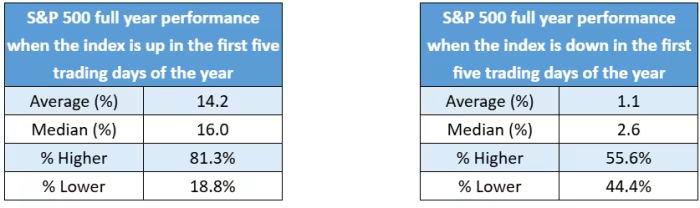
The Santa Claus Rally, known for the S&P 500 (SPX) tendency to rise during the final five trading days of a year and the first two of the new year, failed to materialize this time, with the index dropping 0.53%. In contrast, the first-five-days indicator offered a more positive outlook, as the S&P 500 posted a 0.62% gain in the first five trading days of 2025. Stock Investors Stuck as Key Indicators Diverge—January Holds the Answer Stock investors are caught in a bind after two widely followed market indicators delivered conflicting signals about the year ahead. With uncertainty growing, all eyes are on the next key marker to break the tie. “Now that the S&P 500 has logged a decline during the Santa Claus rally while managing a slight gain in the first five trading days, investors are frozen by indecision,” said Sam Stovall, chief investment strategist at CFRA, in a post-market note. What History Suggests Historical trends hint at brighter prospects if the first-five-days indicator holds true. Data from Dow Jones Market Data shows that since 1950, the S&P 500 has achieved a median full-year gain of 16% when the first five trading days were positive, with gains in 81.3% of those years. A negative first-five-days performance, however, has led to a median annual gain of just 2.6%, with the index rising in only 55.6% of instances. Still, the decisive signal may come from the January barometer, which tracks the S&P 500’s performance for the entire month. Jeff Hirsch, editor of the Stock Trader’s Almanac, emphasized its significance, noting that it has historically been a strong predictor of full-year trends. Since 1950, in seven years where the Santa Claus rally failed but January ended on a positive note, the S&P 500 delivered full-year gains six times, with an average increase of 18.2%. The sole exception occurred in 1994, when the index posted a modest 1.5% decline. The Next Big Test With the first indicators of the year split, investors are left waiting for January’s performance to provide clarity. While past patterns offer guidance, the market’s final verdict for 2025 remains uncertain, leaving participants watching closely for the tiebreaker.

market
Market News

Exhausted Market Timers Signal a Stock Rally

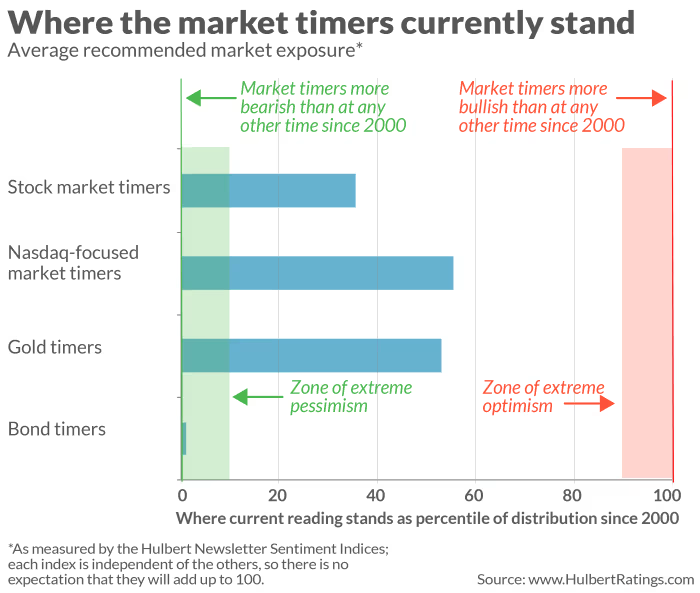
Beware When Market Timers Stay Bullish After a Sharp Downturn Recent shifts in market sentiment underscore a critical lesson for investors: sustained bullishness after a market downturn can be a red flag. In early December, stock-market timers exhibited extraordinary optimism, with the Hulbert Stock Newsletter Sentiment Index (HSNSI) reaching a record high of 92.8%—the highest since the index was created in 2000. Such exuberance often signals that a market pullback is imminent, and December’s turbulence quickly followed. Since then, the HSNSI has dropped sharply, falling 63 percentage points to 29.3%. This decline in equity exposure reflects a marked shift in sentiment. Historically, if a bull market had truly ended, market timers would have shown far less caution—or might have even increased their bullish bets. At the start of past bear markets, timers have often clung stubbornly to optimism, a pattern that was evident during the bursting of the internet bubble in March 2000. After an initial 10% decline from the market high, short-term timers became even more bullish, with disastrous results. Contrarian analysis views today’s cautious sentiment as a positive sign. The lack of persistent bullishness suggests that the bull market may still have room to run. Broader Sentiment Signals Beyond equities, sentiment in other markets offers additional insights. My firm tracks sentiment for Nasdaq-focused stocks, gold, and U.S. bonds, in addition to the HSNSI. The bond sentiment index currently sits at extremely bearish levels, mirroring the HSNSI’s December exuberance—but in reverse. This suggests that bonds may have stronger near-term potential than Wall Street anticipates. In conclusion, investors should remain wary when market timers hold stubbornly bullish positions after a significant downturn. Such behavior often precedes deeper declines. In contrast, the current caution among timers might be a foundation for short-term market strength.

stock
Market News

The Fed vs. Stock Market Reality

Federal Reserve Governor Lisa Cook issued a stark warning on Monday about risks in the financial market, delivering one of the most candid assessments from a central bank official in recent years. Cook stated that “valuations are elevated in a number of asset classes, including equity and corporate debt markets, where estimated risk premia are near the bottom of their historical distributions.” This, she cautioned, suggests markets may be “priced to perfection” and thus highly susceptible to significant declines in response to bad economic news or shifts in investor sentiment. Cook’s comments drew comparisons to former Fed Chair Alan Greenspan’s 1996 warning about “irrational exuberance,” a phrase that famously highlighted speculative market behavior. Unlike Greenspan’s remarks, which caused immediate volatility in global markets, Cook’s warning seemed to fall on deaf ears. The S&P 500 briefly surged past 6,000, nearing record highs, and closed the session up 0.6%, despite trimming some of its earlier gains. Market indicators further illustrate the current lack of investor caution. The New York Fed’s corporate-bond-market distress index remains at historically low levels, and the S&P 500 has logged two consecutive years of gains exceeding 20%. According to Goldman Sachs, the index’s price-to-book and price-to-sales ratios are two standard deviations above their 10-year averages. Meanwhile, economist Robert Shiller’s cyclically adjusted price-to-earnings (CAPE) ratio, a long-term valuation metric, stands near 37—levels not seen since the dot-com bubble. While such metrics signal overvaluation, they offer little predictive power for market timing. Greenspan’s 1996 warning, for instance, did not halt the dot-com boom, which continued until early 2000. This historical precedent may explain why investors remain largely unfazed by Cook’s remarks. “Greenspan wasn’t wrong, but he was four years early,” said Art Hogan, chief market strategist at B. Riley Wealth. “Since then, Fed officials have generally avoided direct commentary on valuations.” Despite concerns about stretched valuations, market sentiment remains buoyant. Five of the S&P 500’s 11 sectors outperformed the broader index in 2024, suggesting the rally may be broadening beyond the dominance of mega-cap tech stocks—the so-called “Magnificent Seven.” Such diversification could help ease worries about overconcentration in a few high-growth names. Fueling this optimism are advancements in artificial intelligence and expectations of regulatory rollbacks under a potential second Trump administration. Even so, high valuations leave the market vulnerable to downside risks, particularly if economic fundamentals weaken. Upcoming corporate earnings reports could provide a key test. “Consensus for 2025 EPS growth is close to 15% — more than double the historical average,” noted Kevin Simpson, CEO of Capital Wealth Planning, in a Monday note. “If earnings season reveals any red flags, especially from mega-cap tech companies, it could amplify concerns about valuations.” While Wall Street strategists largely expect continued gains, some, like Stifel’s Barry Bannister, believe a correction is more likely to be triggered by an economic downturn or other external shocks rather than valuation concerns alone. Elevated market levels, however, mean that any negative surprise could have outsized consequences.

market
Market News

Surviving a Stock Market Downturn

Are You an Optimist or a Pessimist? Try This Market Investing Test Investing like Warren Buffett doesn’t have to be overly complex. His tried-and-true approach is simple: buy shares of well-run, undervalued companies and hold them for decades. However, there’s a less-discussed element to his success: his optimistic outlook. Buffett’s optimism has helped him weather market ups and downs with confidence. For pessimists, however, even a strong investment strategy can be undermined by a negative mindset. If you’re unsure whether your outlook is helping or hurting your investment decisions, here’s a quick experiment to try. Step 1: Assess Your Market Sentiment John Hancock Investment Management recently offered insights on U.S. stock performance:“We just witnessed one of the best two-year returns for the S&P 500 in history. The only other period of comparable returns was in the late 1990s. Some see that era as a boom for stock investors, while others remember it as a bubble that led to the ‘lost decade’ of 2000 to 2010.” Now ask yourself:“After this strong market performance, am I optimistic about the future?” A long-term investor might answer: “I can’t predict the next few years, but I’m confident in the market’s long-term growth.”Still, it’s natural for even seasoned investors to feel unsettled, especially when imagining potential downturns. Step 2: Gauge Your Tolerance for Risk Paul A. Merriman, writing for MarketWatch, shared this perspective:“I am pretty sure the market will eventually drop by 30% to 50%. It will likely happen when no one expects it, triggered by an unforeseen event.” Can you read that statement calmly, or does it spark worry? If you’re unfazed, you’re likely equipped to handle volatility. If it raises your anxiety, you might struggle to stay composed during significant market declines—even if you know the importance of avoiding panic selling. Managing Pessimism in Your Investments If you lean toward pessimism but want to remain rational, the key is preparation. “It’s about setting expectations rather than focusing on potential negatives,” says Matt Miskin, co-chief investment strategist at John Hancock Investment Management. A clear plan helps investors stay disciplined and ride out market cycles. While markets may offer less upside after years of gains, history shows that maintaining a long-term view is often rewarding. Here’s how to keep pessimism in check: Conclusion Whether you’re naturally optimistic or cautious, your attitude toward the market can significantly impact your investment outcomes. By maintaining perspective, diversifying wisely, and committing to a disciplined approach, you can overcome doubts and build a brighter financial future—just like Buffett.

market
Market News

What 2024’s Market Crash Means for 2025

The S&P 500 experienced a historically poor market close to 2024, according to Bespoke Investment Group, ending an otherwise strong year on a downbeat note. U.S. stocks stumbled into 2025, with the S&P 500 SPX -0.22% slipping 0.2% during Thursday’s opening trading session of the new year. This followed a 2.6% decline from Christmas Eve to the end of 2024, marking “the worst year-end performance since at least 1952,” Bespoke noted in a Thursday report. “December wasn’t kind to bulls,” the firm said, adding that “the last several days were bad to a historic degree.” Despite the rough finish, Bespoke highlighted that it might not spell trouble for 2025. Historically, the S&P 500 often rebounds after year-end losses exceeding 1%, with January consistently ranking as one of its strongest months, according to Renaissance Macro Research. The firm’s data shows January’s average returns since 1928 have been among the highest of any month. Investors are also watching for a potential “Santa Claus rally,” a seasonal trend where U.S. stocks typically rise during the last five trading days of the year and the first two of the new year. After the S&P 500 fell 1.6% during the final stretch of 2024, the rally’s prospects remain uncertain as the period extends through Friday. On Thursday, broader market followed the S&P 500’s decline. The Nasdaq Composite COMP -0.16% dipped 0.2%, while the Dow Jones Industrial Average DJIA -0.36% fell 0.4%. Despite the late-year slump, the S&P 500 closed 2024 with an impressive 23.3% gain for the year.

Dow
Market News

Why the Dow Struggled This December

The Dow Jones Industrial Average entered December hoping for a “Santa Claus rally” to counter its weak start to the month. But for the second consecutive year, Wall Street’s holiday cheer failed to arrive. By the end of December, the Dow had dropped 5.3%, marking its worst December performance since 2018 and its steepest monthly decline since September 2022, according to Dow Jones Market Data. In comparison, the S&P 500 fell a milder 2.5%, while the Nasdaq Composite managed to gain 0.5%, leaving the Dow trailing behind. Early Optimism Fades December began on a strong note for the Dow, buoyed by a post-Election Day rally that propelled the index past the 45,000 mark for the first time on December 4. “We’ve had a pretty tremendous run-up,” said Charlie Ripley, senior investment strategist at Allianz Investment Management, suggesting the rally may have made a pullback inevitable. However, the momentum didn’t last. While the S&P 500 remained flat and the Nasdaq continued climbing, the Dow started slipping mid-month. The downward trend accelerated on December 18 after the Federal Reserve’s policy meeting. Despite announcing another rate cut, Fed Chair Jerome Powell’s forecast of only two 25-basis-point cuts in 2025 and his warnings about persistent inflation rattled investors. “We got that negative shock from Powell,” said Steve Sosnick, chief strategist at Interactive Brokers. Although Powell’s comments were consistent with expectations, they were more hawkish than the market’s most optimistic players had hoped. Thin Holiday Trading Exacerbates Losses The Fed-induced downturn extended into the holiday season, a period typically characterized by lighter trading volumes. While this time of year often boosts stocks, the thin liquidity amplified market volatility. “When people are taking profits or cutting losses, the reduced volume can lead to more exaggerated moves,” Ripley explained. Why the Dow Struggled More The Dow’s underperformance in December stemmed largely from its structure and composition. Unlike the market-cap-weighted S&P 500 and Nasdaq Composite, the Dow is price-weighted, meaning that higher-priced stocks carry more influence over its movements. For instance, Apple’s 4% gain in December had less impact than Microsoft’s losses. Meanwhile, top-performing tech stocks like Alphabet (+10%) and Tesla (+16%)—neither of which are part of the Dow—bolstered the Nasdaq but had no effect on the Dow’s performance. “Tech is driving the market,” Sosnick said. “And the Dow just isn’t tech-heavy.” The Dow also faced company-specific challenges. UnitedHealth Group, the index’s second-most influential stock, struggled after the tragic death of CEO Brian Thompson on December 4. Other blue-chip names like Caterpillar, Home Depot, and Sherwin-Williams also posted significant losses, further dragging the index down. A Mixed Year-End Despite its December slump, the Dow ended 2024 with a 12.9% annual gain and a 28.4% increase over the past two years. However, this performance lagged behind the S&P 500, which gained 53.2%, and the Nasdaq Composite, which surged 84.5% over the same period. The Dow’s December downturn highlights its limitations as a barometer of market health. Its price-weighted structure and narrower sector representation can lead to significant disparities compared to broader indexes. As Ripley pointed out, “There are months when the Dow just doesn’t align with the rest of the market.” For investors, this serves as a reminder to focus on a diversified portfolio rather than relying on any single index to gauge market performance.

Scroll to Top