
A team of U.S. equity analysts at Goldman Sachs has unveiled the secret underpinning the consistent outperformance of the U.S. stock market compared to international counterparts.
The concept is elegantly simple: U.S. corporate managers possess a unique skill in maximizing returns from each dollar of equity investment. This performance metric, referred to as “return on equity” (ROE), involves dividing a company’s net income by its shareholders’ equity.
Headed by Goldman’s chief U.S. equity strategist, David Kostin, the team has presented data illustrating that U.S. companies consistently surpass their peers in Japan, Europe, and Asia in terms of ROE.
In the first quarter’s conclusion, the trailing return on equity for S&P 500 index companies stood at an impressive 20.4%, placing it in the 97th percentile since 1975. However, the true significance lies in the changes observed over the past decade. Here, the U.S. market truly shines: during this period, the S&P 500 has elevated its ROE by a substantial 480 basis points, compared to 370 basis points for European stocks in the Stoxx 600 and 310 basis points for Japanese stocks in the TOPIX index.
The Goldman Sachs team highlights the substantial progress made by U.S. publicly-traded companies in enhancing shareholder returns over the past decade, outpacing their European, Japanese, and Asian counterparts.
This remarkable rate of expansion has enabled the S&P 500 to achieve annualized total returns of 7% since 2000, while Japan and Europe have achieved only 3% and 4%, respectively.
However, while Goldman foresees continued U.S. equity dominance over the long term, a surge in valuations this year has introduced certain complexities into the near-term outlook.
As U.S. equity prices have surged relative to projected earnings, portfolio managers find themselves grappling with what Goldman terms “the triumph of hope over experience,” reminiscent of the dotcom boom era.
The team underscores the importance of generative Artificial Intelligence (AI) and its potential for disruption, noting that while certain firms may yield substantial AI profits, the returns on AI capital expenditure for many others remain uncertain.
Goldman’s projection suggests that due to the significant contribution of AI-related stocks to this year’s multiple expansion, the S&P 500’s performance will deviate from its historical pattern and underperform in the next 12 months.
“While a high starting valuation is often perceived as an obstacle to robust future returns, our 12-month global equity forecasts indicate that the U.S. will trail other regions. Nevertheless, the persistent focus on enhancing ROE implies that over time, U.S. stocks should outperform their global peers,” affirms the Goldman team.
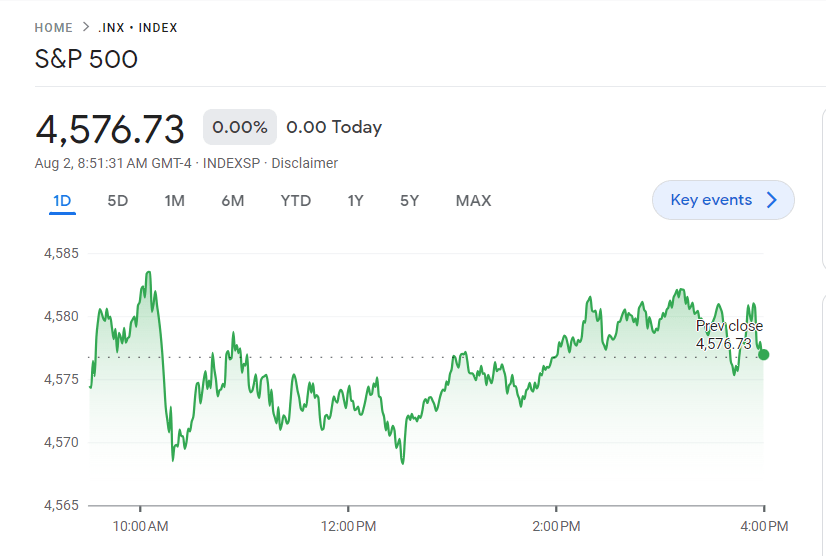
As August commences, U.S. stocks are experiencing a dip, with the S&P 500 down 0.2% at 4,579. The Nasdaq Composite has also decreased by 0.5% to 14,269. In contrast, the Dow Jones Industrial Average is performing relatively well, having gained 72 points or 0.2%, reaching 35,634 during the initial half-hour of U.S. trading.

John Paul is the founder of DayTradeToWin, a trading education and software company established in 2008, supporting traders worldwide. His expertise focuses on price action-based futures trading strategies and structured market analysis.
DayTradeToWin delivers trading education, indicators, and software tools designed to help traders apply disciplined, rule-based decision-making across global futures markets.
He is the creator of multiple trading methodologies, including the Sonic System, Atlas Line, and Trade Scalper, which help traders identify structured opportunities in markets such as the E-mini S&P 500 (ES), Nasdaq (NQ), crude oil (CL), and gold (GC).
Official website: https://daytradetowin.com