
Byron Wien, who died in 2023, was one of Wall Street’s most influential strategists. During his long tenure at Morgan Stanley, he became famous for his annual “10 Surprises” list — predictions he believed had better than a 50% chance of happening, even though the market assigned them odds below one-third.
Several firms have attempted to continue Wien’s legacy, and U.K. research house Variant Perception has now embraced the tradition for a second straight year, sticking to Wien’s original 50% likelihood vs. 33% consensus framework.
Their big-picture view for next year: the economy should hold up reasonably well. Variant Perception expects U.S. nominal GDP to grow more than 5%, a mix of real growth and inflation.
Historically, that environment has supported equities, put a floor under yields, and boosted the U.S. dollar — trends already visible over the past two months.
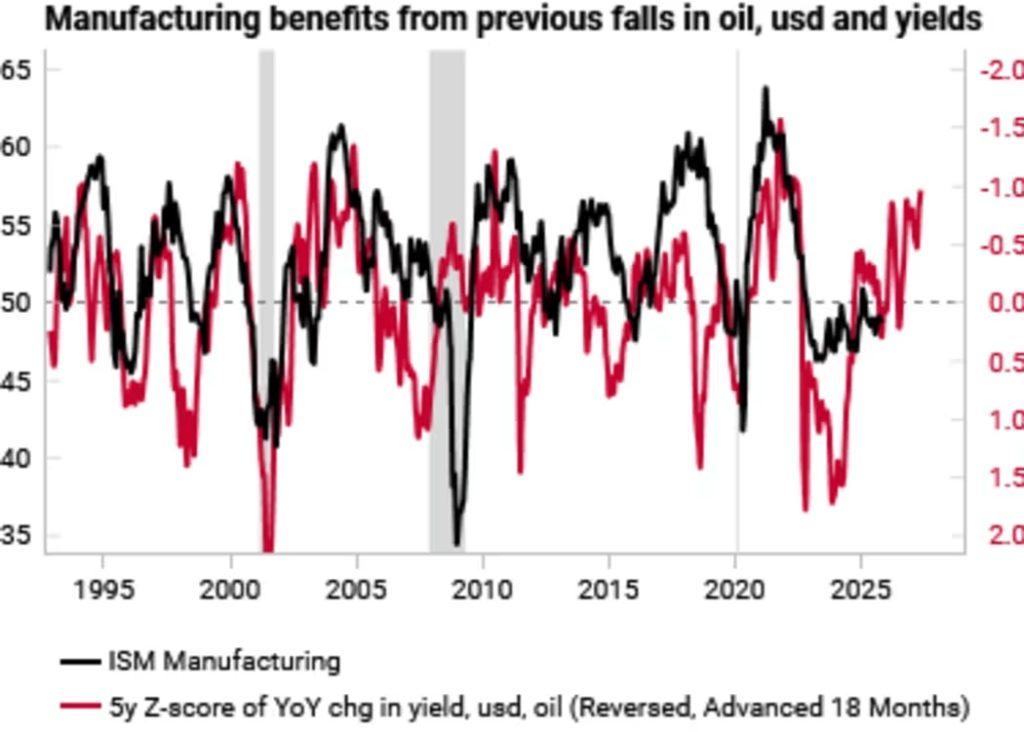
This also tends to be the point in the cycle where earlier declines in oil, the dollar, and yields begin to revive manufacturing. Still, despite a constructive macro backdrop, Variant Perception warns that stretched valuations and thin risk premiums in both credit and equities are a challenge.
That’s why they favor rotations into emerging markets, value stocks, and other laggards. In their words: there’s a “valuation problem,” not a “macro problem.”
Here are their ten surprises for the coming year:
- Trump’s capex boom arrives a year late and spreads beyond AI
- U.S. growth beats expectations even with a muted labor market
- Housing disinflation challenges the narrative of sticky inflation
- The U.S. 10-year yield stays anchored near 4% in a tight range
- Value stocks outperform growth
- G10 FX split: AUD and NZD outperform EUR and GBP
- Emerging-market equities outpace developed markets, led by Brazil
- Oil swings between below $50 and above $75 during the year
- Chinese tech stocks outperform U.S. tech
- Capital cycle winners emerge: regional banks and energy services outperform
The capex story is especially noteworthy. With tariff policies mostly set, bank lending surveys show easier commercial lending standards and stronger loan demand. Corporates may also tap newly favorable tax rules — including full bonus depreciation and immediate R&D expensing.
Combined with last year’s declines in oil, the dollar, and yields, these factors typically provide a tailwind for manufacturing.
But this rebound may not lift employment. Variant Perception sees similarities to the 2002–2003 era, when productivity gains and easy Fed policy drove a “jobless recovery.”
Their oil outlook also deserves attention. While consensus expects a supply glut, the firm believes the balance of risks points to a highly volatile oil market in 2026. They stress that this isn’t contrarian for its own sake — just where the data leads.

John Paul is the founder of DayTradeToWin, a trading education and software company established in 2008, supporting traders worldwide. His expertise focuses on price action-based futures trading strategies and structured market analysis.
DayTradeToWin delivers trading education, indicators, and software tools designed to help traders apply disciplined, rule-based decision-making across global futures markets.
He is the creator of multiple trading methodologies, including the Sonic System, Atlas Line, and Trade Scalper, which help traders identify structured opportunities in markets such as the E-mini S&P 500 (ES), Nasdaq (NQ), crude oil (CL), and gold (GC).
Official website: https://daytradetowin.com