
A new research paper asserts that demand, rather than supply, was the primary driver of post-pandemic inflation in both the U.S. and Europe.
At the European Central Bank’s annual gathering in Sintra, Portugal, economists Domenico Giannone from the International Monetary Fund and Giorgio Primiceri from Northwestern University challenged the widely held belief that supply-chain disruptions were the main cause of inflation. “This popular narrative is difficult to square with all the evidence,” they stated in their presentation, held at the same conference where Federal Reserve Chair Jerome Powell is scheduled to speak.
According to the economists, both the U.S. Federal Reserve and the European Central Bank are effective at targeting inflation, leading to a flat aggregate demand curve. They argued that for inflation to rise, the demand curve must shift upwards due to demand shocks or deviations from previous monetary policy.
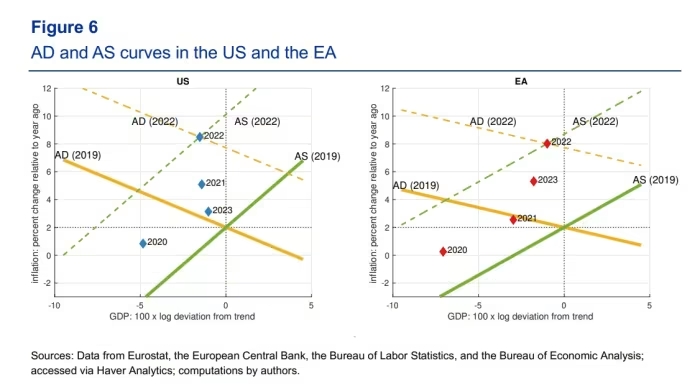
Their research indicated that in the U.S., more than half of the rise and fall in inflation could be attributed to demand disturbances. In Europe, while supply factors had a significant impact on GDP, demand shocks played a larger role in inflation.
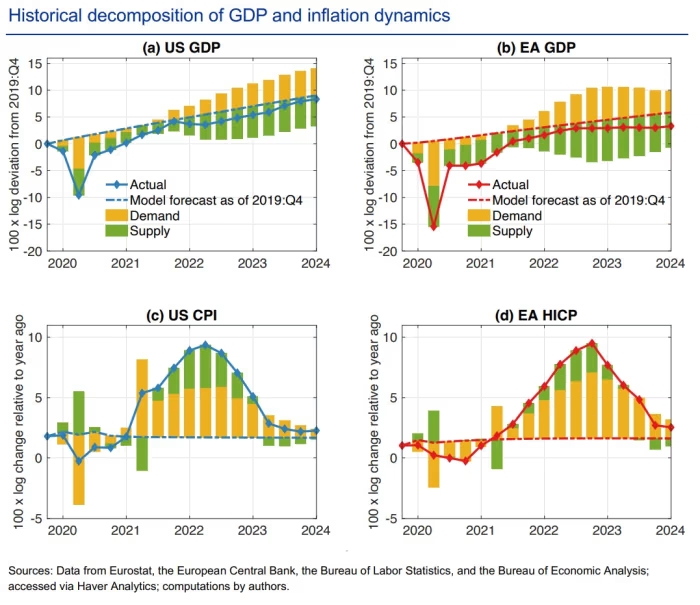
The researchers emphasized that their findings held true across various models and measures, including energy prices and monetary variables. They also referenced a separate study by former Fed Chairman Ben Bernanke and former International Monetary Fund chief economist Olivier Blanchard, which highlighted the impact of food and energy prices on inflation. Giannone and Primiceri noted that their conclusions were not contradictory, as energy prices are driven by fluctuations in aggregate demand.
The study simulated the potential impact of stricter ECB policies. If the ECB had neutralized all demand shocks, inflation would have peaked at 3%, but GDP would have suffered a cumulative loss of 4%. Raising interest rates earlier would have resulted in a 6% inflation peak with a 1% output loss. The researchers did not conduct a similar analysis for U.S. monetary policy.
Currently, their model predicts an “easy last kilometer” in reducing inflation. They found that the ECB has not experienced significant damage or loss of credibility from its pandemic policies, with public perception returning to pre-Covid norms.
Recent data from Eurostat showed annual inflation easing to 2.5% in June from 2.6% in May, meeting economist estimates. The ECB made its first interest rate cut of the cycle in June.

John Paul is the founder of DayTradeToWin, a trading education and software company established in 2008, supporting traders worldwide. His expertise focuses on price action-based futures trading strategies and structured market analysis.
DayTradeToWin delivers trading education, indicators, and software tools designed to help traders apply disciplined, rule-based decision-making across global futures markets.
He is the creator of multiple trading methodologies, including the Sonic System, Atlas Line, and Trade Scalper, which help traders identify structured opportunities in markets such as the E-mini S&P 500 (ES), Nasdaq (NQ), crude oil (CL), and gold (GC).
Official website: https://daytradetowin.com