

daytrading

market
Market News

Market Mania: Oklo’s $20B Story Stock Surge

Oklo Becomes the Largest Pre-Revenue Company in the U.S. With a $20 Billion Valuation Oklo Inc. has surged to a $20 billion valuation, earning the title of the largest pre-revenue company listed on a U.S. exchange. Its rise highlights just how far investors are willing to stretch in search of the next big AI play. Shares of Oklo (OKLO) trade around $131, up more than 500% in 2025 and nearly 1,500% over the past year. All of this despite the company never generating a dollar in sales. The attraction isn’t about numbers — it’s about narrative. Oklo is developing small modular reactors (SMRs) designed to supply the immense power demands of AI data centers. The story is boosted by Sam Altman, OpenAI’s CEO, who took Oklo public via his SPAC AltC Acquisition in 2024. Altman served as chairman until April and still owns 5.5% of the company. Retail investors have embraced the stock. On StockTwits, message volume has been flagged as “extremely high,” with overall sentiment marked “bullish.” “It’s a speculative, growth-driven environment, fueled by lower interest rates, strong market and increased retail participation,” said Chris Tessin of Acuitas Investments. Earlier this week, Oklo broke ground on its first commercial SMR at Idaho National Laboratory under the Department of Energy’s Reactor Pilot Program. Still, analysts don’t expect revenue until late 2027. Much like biotech firms awaiting FDA approval, Oklo faces a binary outcome: either successful commercialization or failure that renders its technology worthless. Other SMR competitors are slightly ahead. NuScale Power (SMR) has posted limited revenue since 2022, though mostly from engineering and licensing services, not actual nuclear energy sales. Wall Street’s view of Oklo remains divided. Bank of America initiated coverage with a buy rating and a $92 target, calling it the best-positioned company in the SMR market. Wedbush’s Dan Ives is more bullish, lifting his target to $150. UBS took a cautious stance with a $65 hold rating, warning that steady growth may not come until 2034. Seaport’s Jeff Campbell downgraded Oklo to neutral this week, arguing the valuation is too stretched. For now, Oklo epitomizes the “story stock” — its valuation fueled by AI hype, nuclear optimism, and investor enthusiasm. The real test will be whether investors have the patience to wait nearly a decade for the company to turn promise into profit. John PaulJohn Paul is the founder of DayTradeToWin, a trading education and software company established in 2008, supporting traders worldwide. His expertise focuses on price action-based futures trading strategies and structured market analysis. DayTradeToWin delivers trading education, indicators, and software tools designed to help traders apply disciplined, rule-based decision-making across global futures markets. He is the creator of multiple trading methodologies, including the Sonic System, Atlas Line, and Trade Scalper, which help traders identify structured opportunities in markets such as the E-mini S&P 500 (ES), Nasdaq (NQ), crude oil (CL), and gold (GC). Official website: https://daytradetowin.com daytradetowin.com


stocks
Market News

Stocks Rally as AI Spending Surges

US stocks edged higher before the bell Wednesday, with Alibaba’s (BABA) ramped-up AI spending plans and Micron Technology’s (MU) earnings boosting sentiment around the sector. Nasdaq 100 futures (NQ=F) rose about 0.3%, S&P 500 contracts (ES=F) gained 0.2%, and Dow Jones Industrial Average futures (YM=F) ticked up 0.1%. The rebound comes after Tuesday’s slip, when losses among the “Magnificent Seven” tech giants snapped the market’s winning streak. Alibaba jumped more than 9% in premarket trading after pledging to expand its AI investment beyond $50 billion, as its CEO warned that keeping pace is critical with global AI spending on track to hit $4 trillion. Micron added modest gains after posting stronger-than-expected results, another positive signal for the AI trade. Still, rate-cut uncertainty capped broader gains. Fed officials have shown increasing division over policy, pointing to labor market weakness even as Chair Jerome Powell on Tuesday stressed a cautious approach. He also noted stocks remain “fairly highly valued.” Investors are now focused on Friday’s release of the Fed’s preferred inflation gauge, the Personal Consumption Expenditures index, for clues on whether two more cuts this year are realistic. In the meantime, housing data due Wednesday — mortgage applications and August home sales — will provide another read on the economy’s health. John PaulJohn Paul is the founder of DayTradeToWin, a trading education and software company established in 2008, supporting traders worldwide. His expertise focuses on price action-based futures trading strategies and structured market analysis. DayTradeToWin delivers trading education, indicators, and software tools designed to help traders apply disciplined, rule-based decision-making across global futures markets. He is the creator of multiple trading methodologies, including the Sonic System, Atlas Line, and Trade Scalper, which help traders identify structured opportunities in markets such as the E-mini S&P 500 (ES), Nasdaq (NQ), crude oil (CL), and gold (GC). Official website: https://daytradetowin.com daytradetowin.com
recurring revenue
Market News

Recurring Revenue Stocks Every Investor Should Watch

Joseph Shaposhnik Bets on Recurring Revenue and Fanatical CEOs Joseph Shaposhnik, veteran investor and founder of Rainwater Equity, says the world of actively managed funds is “broken”—but he’s convinced it can be fixed. His answer: back predictable businesses led by exceptional managers. This summer he launched the Rainwater Equity ETF (RW), with early support from legendary value investor Bill Miller. Before that, Shaposhnik spent 13 years at TCW, where he ran the TCW Compounders ETF (GRW), the top-ranked U.S. large-cap core equity fund in its class. The key lesson from those years? Companies with recurring revenue deliver the strongest long-term results. “Recurring revenue gives management the confidence to invest in growth,” he said. “That translates into stronger earnings, higher free cash flow, and better performance for shareholders.” The ETF reflects that philosophy with holdings like: Shaposhnik looks for what Warren Buffett once called “fanatical managers”—leaders who are fully committed to their companies and skilled at reinvesting free cash flow. He dislikes dividends, seeing them as capital better used to compound growth inside the business. Why invest in his fund? He points to diversification, a record of outperformance, and resilience in downturns thanks to durable, recurring-revenue businesses. “Benchmarks today are more concentrated than ever,” he said. “We’re building something designed to endure in both bull and bear markets.” John PaulJohn Paul is the founder of DayTradeToWin, a trading education and software company established in 2008, supporting traders worldwide. His expertise focuses on price action-based futures trading strategies and structured market analysis. DayTradeToWin delivers trading education, indicators, and software tools designed to help traders apply disciplined, rule-based decision-making across global futures markets. He is the creator of multiple trading methodologies, including the Sonic System, Atlas Line, and Trade Scalper, which help traders identify structured opportunities in markets such as the E-mini S&P 500 (ES), Nasdaq (NQ), crude oil (CL), and gold (GC). Official website: https://daytradetowin.com daytradetowin.com

equities
Market News

Equities vs. Liquidity: What’s the Real Risk?

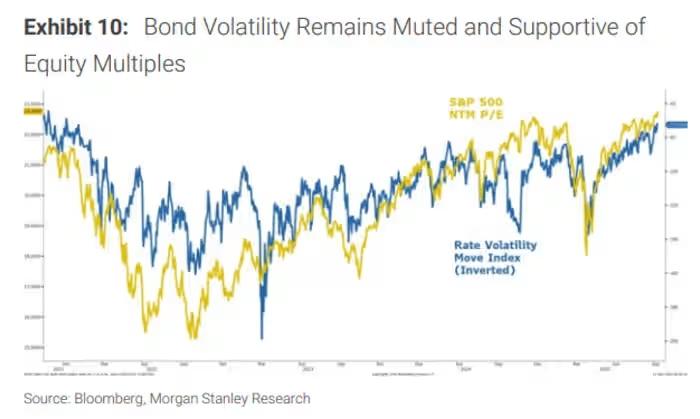
Mike Wilson Warns: Equities at Risk Amid Potential Liquidity Stress The S&P 500, Dow, and Nasdaq all closed last week at fresh record highs. The S&P 500 has jumped 33.75% since its April low, and it’s up 13.3% year-to-date, as the market becomes increasingly immune to White House policy uncertainty and continues to ride the wave of optimism around the AI boom. On top of that, the Federal Reserve has introduced another round of monetary easing, which is helping to support market sentiment. However, Mike Wilson and his team at Morgan Stanley are raising a red flag about the potential risks ahead for equities. The concern: if the Fed doesn’t meet market expectations, it could lead to a market shake-up. Currently, traders are pricing in a strong likelihood of a 50 basis point rate cut from the Fed this year, which would lower the current range of 4.00% to 4.25%. By this time next year, the fed funds futures market anticipates the rate dropping to around 3%. Wilson, however, believes the economy may not actually need such drastic cuts. “We still maintain our view that the rolling recession ended with ‘Liberation Day,’ and that we’re now entering an early-cycle recovery phase, where earnings growth is likely to outperform expectations,” he explains. This outlook is backed by a rise in analysts’ earnings revisions, as well as improving economic indicators like the ISM Purchasing Managers’ Index, which Wilson expects to strengthen further. He points out that pent-up demand is increasingly evident in sectors that have lagged for the past few years, including housing, consumer goods, industrials, transportation, and commodities. Against this backdrop, Wilson argues that the Fed isn’t as accommodative as it would usually be at this point in the cycle. That’s because, while the labor market is holding up, inflation remains persistently above the Fed’s 2% target. “The tension between the Fed’s cautious stance and the market’s expectation of quick rate cuts is a key risk for equities, especially with the historically weak seasonal period ahead,” Wilson says. He notes that the market’s growing correlation between poor economic data and rising stock prices suggests that investors are betting on more rate cuts. The real risk, however, is that the Fed may recognize the ongoing recovery and decide that the economy doesn’t require such aggressive easing. While this may be the right decision from an economic standpoint, it could disappoint markets that have already priced in more cuts. This could also prevent a full early-cycle rotation, leaving lower-quality stocks and small caps to outperform. Wilson also warns about the potential for liquidity stress as the Fed continues with its quantitative tightening, alongside increased Treasury bond issuance and high levels of corporate debt. Liquidity pressure may show up first in the spread between the Secured Overnight Financing Rate (SOFR) and the Fed Funds rate, Wilson says. Traders should also keep an eye on the BofA Merrill Lynch MOVE index, which tracks Treasury volatility. A meaningful rise in the MOVE, currently near a four-year low at 72.5, could signal growing strain in the Treasury market. “Although it’s not a concern yet, we think liquidity stress could surface here first,” Wilson says. “If the Fed doesn’t address these risks, it could trigger a sharp correction in the equity market.” John PaulJohn Paul is the founder of DayTradeToWin, a trading education and software company established in 2008, supporting traders worldwide. His expertise focuses on price action-based futures trading strategies and structured market analysis. DayTradeToWin delivers trading education, indicators, and software tools designed to help traders apply disciplined, rule-based decision-making across global futures markets. He is the creator of multiple trading methodologies, including the Sonic System, Atlas Line, and Trade Scalper, which help traders identify structured opportunities in markets such as the E-mini S&P 500 (ES), Nasdaq (NQ), crude oil (CL), and gold (GC). Official website: https://daytradetowin.com daytradetowin.com
tesla
Market News

Why Tesla’s Future May Ride on Robots, Not Cars

Tesla’s Next Act: From Cars to “Physical AI” The rally is spreading. The Russell 2000 (+2.51%) just hit its first record since 2021, joining the S&P 500, Dow, and Nasdaq at fresh highs. But while the market broadens, Tesla remains in the spotlight. Shares are up 22.6% in the past month, and Baird’s Ben Kallo just upgraded the stock to outperform, hiking his target from $320 to $548. His bullish view isn’t about cars. With EV sales slowing, Kallo says Tesla’s future lies in robots and robotaxis — the foundation of what Elon Musk calls a “physical AI” company. Baird’s 10-year framework (2026–2035) envisions: If Tesla clears those milestones, Baird sees a path to a $5.5T market cap and a $1,412 share price. In a “bull case,” doubling those volumes could lift Tesla to $12T in value, with shares soaring to $3,043. Kallo stresses these are stretch scenarios — not his base case. Still, he argues Tesla is evolving from a carmaker into the leader of a new era: physical AI. John PaulJohn Paul is the founder of DayTradeToWin, a trading education and software company established in 2008, supporting traders worldwide. His expertise focuses on price action-based futures trading strategies and structured market analysis. DayTradeToWin delivers trading education, indicators, and software tools designed to help traders apply disciplined, rule-based decision-making across global futures markets. He is the creator of multiple trading methodologies, including the Sonic System, Atlas Line, and Trade Scalper, which help traders identify structured opportunities in markets such as the E-mini S&P 500 (ES), Nasdaq (NQ), crude oil (CL), and gold (GC). Official website: https://daytradetowin.com daytradetowin.com

markets
Market News

Markets Eye Jobs & Inflation Data for Next Big Move

Markets Eye Two Big Data Points Next Month After Wednesday’s modest pullback in the S&P 500 (-0.10%) and Nasdaq (-0.33%), investors appear ready to step back in, despite a Fed decision that some viewed as less dovish than expected. Much of the rebound is tied to Fed Chair Jerome Powell’s comment that the 25 bps rate cut was “risk management.” While some saw that as a signal of fewer cuts ahead, Goldman Sachs argues Powell effectively hinted at another move in October. From JPMorgan’s trading desk comes the call of the day: buy the dips. Led by Andrew Tyler, the team sees the potential for an “explosive” rally if the right data hits. The two numbers to watch: If hiring rebounds after two soft reports and inflation remains under control, JPMorgan expects stocks to surge, boosted further by what could be a strong Q3 earnings season. With the S&P 500 just 4% away from 7,000, they say this data could be the spark. A rally wouldn’t just lift U.S. stocks — JPMorgan also sees upside for the dollar and emerging markets. Even acknowledging Powell’s slightly hawkish tone, Tyler’s team insists: “Any and all dips should be bought,” with only limited risk of weakness into month- or quarter-end. Historically, September has been a tough month, but the S&P 500 is already up 2.17% — pacing for its best September since 2025. Retail investors jumped into April’s selloff with success, and institutions may still be catching up. For now, all eyes are on early October data — the potential trigger for JPMorgan’s bullish scenario. John PaulJohn Paul is the founder of DayTradeToWin, a trading education and software company established in 2008, supporting traders worldwide. His expertise focuses on price action-based futures trading strategies and structured market analysis. DayTradeToWin delivers trading education, indicators, and software tools designed to help traders apply disciplined, rule-based decision-making across global futures markets. He is the creator of multiple trading methodologies, including the Sonic System, Atlas Line, and Trade Scalper, which help traders identify structured opportunities in markets such as the E-mini S&P 500 (ES), Nasdaq (NQ), crude oil (CL), and gold (GC). Official website: https://daytradetowin.com daytradetowin.com

Scroll to Top