
daytrading

market
Market News

Good News for Investors Amid Market Turmoil

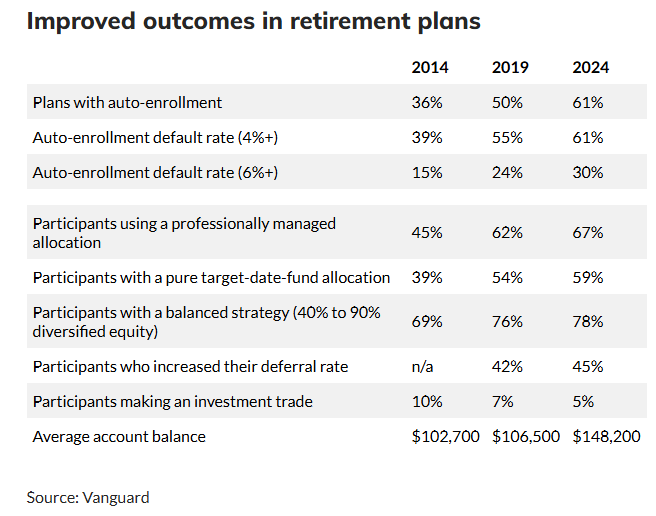
With market volatility making headlines, discussing retirement optimism might feel out of place. Put Aside Your 401(k) Statement—These Retirement Trends Paint a Brighter Picture However, David Stinnett, Vanguard’s head of strategic retirement consulting, remains hopeful. Despite inflation worries, federal job losses, and slow GDP growth, Stinnett points to positive shifts among retirement savers. “You can have years of double-digit negative returns, high inflation, and unemployment — all of which we’ve seen recently — yet people are steadily improving their investing habits, participation rates, and savings contributions,” Stinnett said. “This week’s market fluctuations don’t worry me in the context of long-term savings.” A Steady Climb Financial advisers often urge clients to stay the course during market downturns, and Vanguard’s early look at the 2024 “How America Saves” report backs up that advice. The report, which examines five million participants in Vanguard’s retirement plans, shows how American workers are building retirement savings consistently — and how the system is evolving to address key vulnerabilities. Auto-enrollment has been a game-changer. Ten years ago, just 36% of retirement plans had automatic enrollment. Today, that number has jumped to 61%, helping more lower-income workers start saving. Default contribution rates are also rising, with more companies enrolling workers at 4% and a growing number starting at 6%. Additionally, 45% of participants increased their savings rates in 2024. Overcoming Roadblocks Despite these gains, many workers face setbacks. Job changes often reset contribution rates to lower default levels, slowing savings progress. “We need a smarter 401(k) system that ensures savings continue rather than restart,” Stinnett said. Positive Balance Growth Average account balances climbed 10% in 2024 to $148,200, while median balances rose 8% to $38,176. However, hardship withdrawals also increased. Only 5% of participants took such withdrawals, which Stinnett attributed to regulatory changes and greater participation by lower-income workers. While the trend warrants attention, Stinnett does not see it threatening overall retirement readiness. A Brighter Future Despite short-term economic uncertainty, Stinnett remains optimistic. “Our voluntary retirement system differs from the global norm, and employers, policymakers, and record keepers are continuously adopting best practices. These improvements are gradual but steady — in both good and bad years. That’s a message worth sharing.” By focusing on consistent contributions and long-term strategies, American workers are proving that even in turbulent times, retirement goals can stay on track. John PaulJohn Paul is the founder of DayTradeToWin, a trading education and software company established in 2008, supporting traders worldwide. His expertise focuses on price action-based futures trading strategies and structured market analysis. DayTradeToWin delivers trading education, indicators, and software tools designed to help traders apply disciplined, rule-based decision-making across global futures markets. He is the creator of multiple trading methodologies, including the Sonic System, Atlas Line, and Trade Scalper, which help traders identify structured opportunities in markets such as the E-mini S&P 500 (ES), Nasdaq (NQ), crude oil (CL), and gold (GC). Official website: https://daytradetowin.com daytradetowin.com
nasdaq
Market News

Nasdaq Nears Correction as S&P 500 Slumps

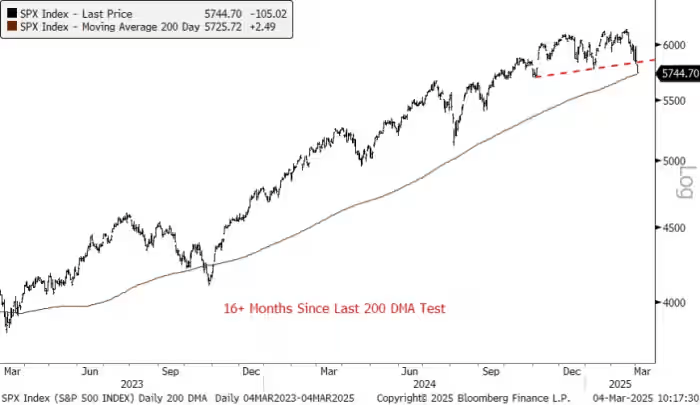
The S&P 500 benchmark index closed Tuesday at its lowest level since November 4, wiping out gains accumulated since President Donald Trump’s November 5 election victory. Investor anxiety surged over concerns that the administration’s sweeping tariffs could dampen economic growth. The tech-heavy Nasdaq Composite briefly dipped into correction territory—defined as a 10% decline from its recent peak—before rebounding slightly. The index closed down 0.4% at 18,285.16, its lowest finish since November 4, after hitting an intraday low of 17,956.60. “Tariffs are likely to exert upward pressure on inflation and weigh on economic growth at the margin—an unfavorable combination for risk assets broadly,” said Josh Jamner, senior investment analyst at ClearBridge Investments. On Tuesday, the U.S. imposed 25% tariffs on imports from China and Mexico, along with an additional 10% tariff on Chinese goods, adding to last month’s 10% levy. China and Canada retaliated with their own measures, while Mexico is expected to announce its response by Sunday. After markets closed, Commerce Secretary Howard Lutnick suggested in a television interview that President Trump might be open to meeting Canada and Mexico halfway, potentially easing tariffs as early as Wednesday. A Nasdaq close below 18,156.50 would confirm a correction, reflecting a 10% drop from its record close of 20,173.89 on December 16. If the index falls 20% from its high, it would enter a bear market. The Nasdaq reclaimed its 200-day moving average of 18,376.37 after closing just below the level on Monday—a key technical indicator often seen as a gauge of the market’s long-term direction. The Dow Jones Industrial Average finished down 670.25 points, or 1.6%, at 42,520.99, after sliding as much as 843 points intraday. A close below 40,512.64 would confirm a correction from its record high of 45,014.04 set on December 4. The S&P 500 dropped 71.57 points, or 1.2%, to 5,778.15—its lowest close since November 4. A decline below 5,529.74 would confirm a correction from its February 19 record close of 6,144.15. The index flirted with its 200-day moving average of 5,725, a level not tested since November 2023. Jonathan Krinsky, chief market technician at BTIG, suggested this level could spark a short-term rebound, but warned that the market might require a more complex bottoming process. “The question isn’t whether we bounce at the 200-day moving average—it’s what happens after the bounce,” Krinsky wrote. “Investors are accustomed to ‘V-shaped’ recoveries, but we need to consider the possibility of a ‘W-shaped’ bottom, with a bounce followed by a re-test later this month.” Escalating trade tensions have heightened fears of a slowdown or recession, further unsettling markets. Nancy Tengler, chief executive and chief investment officer at Laffer Tengler Investments, believes the market is sliding into a correction. “Corrections always feel painful in the moment, and I believe we’re in one now,” Tengler wrote. She noted that corrections typically occur every 12 months and are often triggered by catalysts that seem dire at the time. “This time, it’s tariffs,” Tengler said. “The key is not just assessing the tariffs themselves, but their duration. If they’re short-lived, this could present a prime buying opportunity for long-term investors.” John PaulJohn Paul is the founder of DayTradeToWin, a trading education and software company established in 2008, supporting traders worldwide. His expertise focuses on price action-based futures trading strategies and structured market analysis. DayTradeToWin delivers trading education, indicators, and software tools designed to help traders apply disciplined, rule-based decision-making across global futures markets. He is the creator of multiple trading methodologies, including the Sonic System, Atlas Line, and Trade Scalper, which help traders identify structured opportunities in markets such as the E-mini S&P 500 (ES), Nasdaq (NQ), crude oil (CL), and gold (GC). Official website: https://daytradetowin.com daytradetowin.com

market
Market News

Market Highs: Why Diversification Still Works

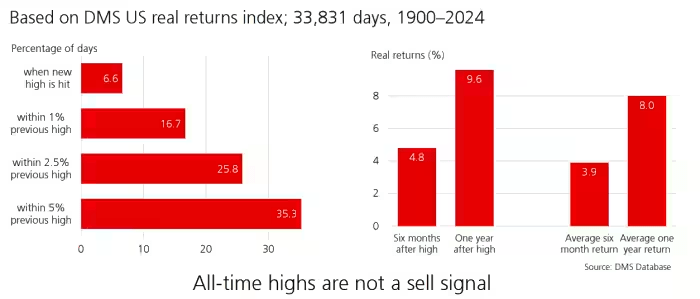
Global Investment Returns Yearbook Reveals Profitable Yet Volatile Stock Market A viral clip from Ferris Bueller’s Day Off, featuring economist Ben Stein’s monotone explanation of the Smoot-Hawley Act, has sparked renewed interest in economic history. The Act, which aimed to raise tariffs but inadvertently deepened the Great Depression, raises questions about its relevance in today’s economic landscape. On Tuesday, UBS released its Global Investment Returns Yearbook, offering a comprehensive analysis of 125 years of market performance. Compiled by Paul Marsh and Mike Staunton from the London Business School, along with Elroy Dimson from Cambridge University, the report highlights the long-term profitability of stock investing alongside its inherent volatility. Since 1900, U.S. stocks have delivered 6.6% annualized inflation-adjusted returns, significantly outperforming bonds at 1.6% and bills at 0.5%. Global markets outside the U.S. averaged 4.3% annually, reflecting consistent U.S. market outperformance—though recent months have shown a shift in this trend. The study emphasizes the volatile nature of stock markets, noting that recovery from major downturns often takes years. Investors waited 15.5 years to recover from the Great Depression, 10 years following the 1970s oil shock, 7.5 years after the dot-com crash, and four years post-global financial crisis. International diversification, a strategy popularized in 1974, has delivered mixed results. While most countries benefited, U.S. investors have seen little improvement in returns. The authors still advocate for diversification, cautioning that while it enhances the likelihood of better outcomes, success is not guaranteed. Cross-asset diversification has also shown long-term benefits, despite recent inflationary periods challenging its effectiveness. The 60/40 portfolio model (60% stocks, 40% bonds) remains a reliable strategy, offering better risk-adjusted returns than stocks or bonds alone. Stock market diversification pays off as well. Analyzing 64,738 companies across 42 countries from 1990 to 2020, the report found that 57% of stocks underperformed Treasury bills, and 71% trailed the index. However, gains from top-performing stocks more than compensated for these losses. Timing the market is notoriously difficult. Avoiding the worst 20 months over the past 125 years would have boosted returns by over 3% annually, but missing the best 20 months would have reduced returns by nearly 3% annually. The authors advise broad diversification unless one possesses exceptional stock-picking skills. Despite concerns about investing at market highs, historical data shows they are not reliable sell signals. Elroy Dimson remarked that investors who exited the U.S. market fearing overconcentration missed out on significant gains. Paul Marsh’s advice for investors is straightforward: “Don’t check your portfolio too often. Stay invested.” This timeless strategy remains particularly relevant amid today’s market uncertainties. John PaulJohn Paul is the founder of DayTradeToWin, a trading education and software company established in 2008, supporting traders worldwide. His expertise focuses on price action-based futures trading strategies and structured market analysis. DayTradeToWin delivers trading education, indicators, and software tools designed to help traders apply disciplined, rule-based decision-making across global futures markets. He is the creator of multiple trading methodologies, including the Sonic System, Atlas Line, and Trade Scalper, which help traders identify structured opportunities in markets such as the E-mini S&P 500 (ES), Nasdaq (NQ), crude oil (CL), and gold (GC). Official website: https://daytradetowin.com daytradetowin.com
stocks
Market News

Defense Stocks Surge After EU’s Zelensky Meeting Shock

JPMorgan Boosts European Defense Companies’ Price Targets by 25% Amid Rising Military Budgets European defense stocks experienced a significant rally as JPMorgan raised price targets for key companies by an average of 25%, driven by escalating defense spending across the continent. The market surge followed a diplomatic confrontation between President Donald Trump, Vice President J.D. Vance, and Ukrainian President Volodymyr Zelensky. The tense exchange, coupled with growing fears of reduced U.S. security support, spurred European governments to accelerate defense spending commitments. On Monday, several European defense companies posted double-digit gains. Germany’s Rheinmetall jumped 10.3%, the U.K.’s BAE Systems climbed 14.1%, Italy’s Leonardo advanced 9.1%, France’s Dassault Aviation surged 14.9%, and German radar systems maker Hensoldt soared 19.3%. The Stoxx aerospace and defense index rose by 7%, marking its best day in years. In Germany, media reports suggest that centrist parties are discussing the creation of two special fiscal funds, totaling at least €200 billion ($208 billion), to bypass constitutional debt limits and bolster defense capabilities. Estimates indicate that Germany may require €400 billion in defense investment and €500 billion in public infrastructure spending. A summit in London, attended by U.K. Prime Minister Keir Starmer and French President Emmanuel Macron, further reinforced commitments to increased defense spending among European nations. Robin Winkler, Deutsche Bank’s chief German economist, highlighted that the upper range of the proposed German funds could equate to 2% of GDP — similar to the investments made in East Germany following reunification. JPMorgan analysts predict that by 2026, leading European defense companies — BAE, Thales, Leonardo, and Rheinmetall — could be trading at 20 times earnings, up from the current 16 times. They anticipate NATO’s European members will raise defense spending to at least 2.5% of GDP, with approximately 40% directed towards equipment development, procurement, and maintenance. “As budgets expand, the proportion allocated to equipment typically rises,” the analysts noted, adding that European defense stocks companies are likely to secure a larger share of contracts. Despite the positive outlook, the analysts cautioned that immediate revenue and earnings upgrades might be delayed as budget approvals and contract negotiations take time. John PaulJohn Paul is the founder of DayTradeToWin, a trading education and software company established in 2008, supporting traders worldwide. His expertise focuses on price action-based futures trading strategies and structured market analysis. DayTradeToWin delivers trading education, indicators, and software tools designed to help traders apply disciplined, rule-based decision-making across global futures markets. He is the creator of multiple trading methodologies, including the Sonic System, Atlas Line, and Trade Scalper, which help traders identify structured opportunities in markets such as the E-mini S&P 500 (ES), Nasdaq (NQ), crude oil (CL), and gold (GC). Official website: https://daytradetowin.com daytradetowin.com

market
Market News

Will Trump Step In to Stop the Market Selloff?

Market analysts suggest that the S&P 500 would need to experience a decline of at least 10% to activate the so-called ‘Trump put.’ The recent downturn in the U.S. stock market has been modest, with the S&P 500 still only 3% below its record closing high from the previous week. Nevertheless, speculation persists on Wall Street about whether the Trump administration would intervene if the selloff were to intensify. Michael Hartnett, a strategist at Bank of America, shared his perspective on Bloomberg TV, suggesting that intervention would likely occur “if things go haywire.” He estimated that action might be triggered if the S&P 500 drops to around 5,600 or 5,700, possibly through fiscal policy adjustments or relaxing the Department of Government Efficiency (DOGE) spending cuts. The concept of the ‘Trump put’ originates from the belief that Trump perceives the stock markets as a barometer of his administration’s success. This notion is similar to the earlier ‘Fed put,’ where investors anticipated the Federal Reserve would intervene to mitigate market volatility. During Trump’s first term, he frequently touted stock market gains as evidence of his policies’ effectiveness. However, the administration’s responses to market volatility were mixed. In late 2018, amid a nearly 20% market drop driven by the trade war with China and Federal Reserve rate hikes, Trump’s efforts to reassure investors had limited success. Conversely, the aggressive fiscal stimulus and Federal Reserve actions during the COVID-19 market crash in 2020 helped stocks recover quickly. Whether the administration would take similar action this time remains uncertain. Some analysts believe Trump’s current focus on spending cuts and trade tariffs might make him more accepting of market fluctuations. Recent statements from Trump and his team suggest that any economic pain from tariffs and budget reductions could be seen as necessary sacrifices. There is also speculation that Trump’s new ‘put’ might prioritize the bond market over stocks. Treasury Secretary Scott Bessent and Elon Musk, a special government employee, have emphasized the administration’s commitment to reducing the U.S. budget deficit—a strategy that could boost demand for bonds. Musk recently remarked that betting against bonds could be an unwise move. While the notion of a ‘Trump put’ remains speculative, some experts argue that any substantial market downturn might attract buyers without requiring government intervention. If the S&P 500 were to decline by 10% or more, investors will closely monitor both market developments and the administration’s response. John PaulJohn Paul is the founder of DayTradeToWin, a trading education and software company established in 2008, supporting traders worldwide. His expertise focuses on price action-based futures trading strategies and structured market analysis. DayTradeToWin delivers trading education, indicators, and software tools designed to help traders apply disciplined, rule-based decision-making across global futures markets. He is the creator of multiple trading methodologies, including the Sonic System, Atlas Line, and Trade Scalper, which help traders identify structured opportunities in markets such as the E-mini S&P 500 (ES), Nasdaq (NQ), crude oil (CL), and gold (GC). Official website: https://daytradetowin.com daytradetowin.com

bitcoin
Market News

Bitcoin, XRP Rise – Will This Trigger a Crypto Surge?

Bitcoin, XRP, and other cryptocurrencies showed signs of recovery early Thursday following a sharp selloff that rattled the digital asset market. Bitcoin (BTC) extended its losing streak to four days on Wednesday, briefly plunging to $82,200 after an earlier attempt at a rebound failed to hold. By Thursday morning, Bitcoin climbed 2.3% to $86,164, according to CoinDesk, though the cryptocurrency remains down 17% from its recent high of $99,000 last Friday. XRP also faced significant losses, dropping 17% from $2.71 on Friday to $2.24. However, the popular altcoin edged up 1.5% Thursday, hinting that selling pressure could be easing. The recent selloff was triggered by a $1.5 billion hack on Dubai-based crypto exchange Bybit, which shook investor confidence. Broader market uncertainty, fueled by a tech stock selloff in the U.S., further weighed on sentiment. Cryptocurrencies had surged in the wake of Donald Trump’s Nov. 5 election victory, as traders bet on a more crypto-friendly administration. However, most of those gains have evaporated, with Bitcoin now trading at levels last seen on Nov. 11. “The rapid selloff leaves a steep climb ahead, despite a modest recovery,” said Susannah Streeter, an analyst at Hargreaves Lansdown. “Without clear signals of support from Trump, market nervousness is likely to persist.” While a statement from Trump could bolster sentiment, the market is still searching for a catalyst to spark a broader recovery. John PaulJohn Paul is the founder of DayTradeToWin, a trading education and software company established in 2008, supporting traders worldwide. His expertise focuses on price action-based futures trading strategies and structured market analysis. DayTradeToWin delivers trading education, indicators, and software tools designed to help traders apply disciplined, rule-based decision-making across global futures markets. He is the creator of multiple trading methodologies, including the Sonic System, Atlas Line, and Trade Scalper, which help traders identify structured opportunities in markets such as the E-mini S&P 500 (ES), Nasdaq (NQ), crude oil (CL), and gold (GC). Official website: https://daytradetowin.com daytradetowin.com

Scroll to Top