
market news

Goldman Sachs
Market News

Goldman Sachs Cautions on Market Concentration Risks

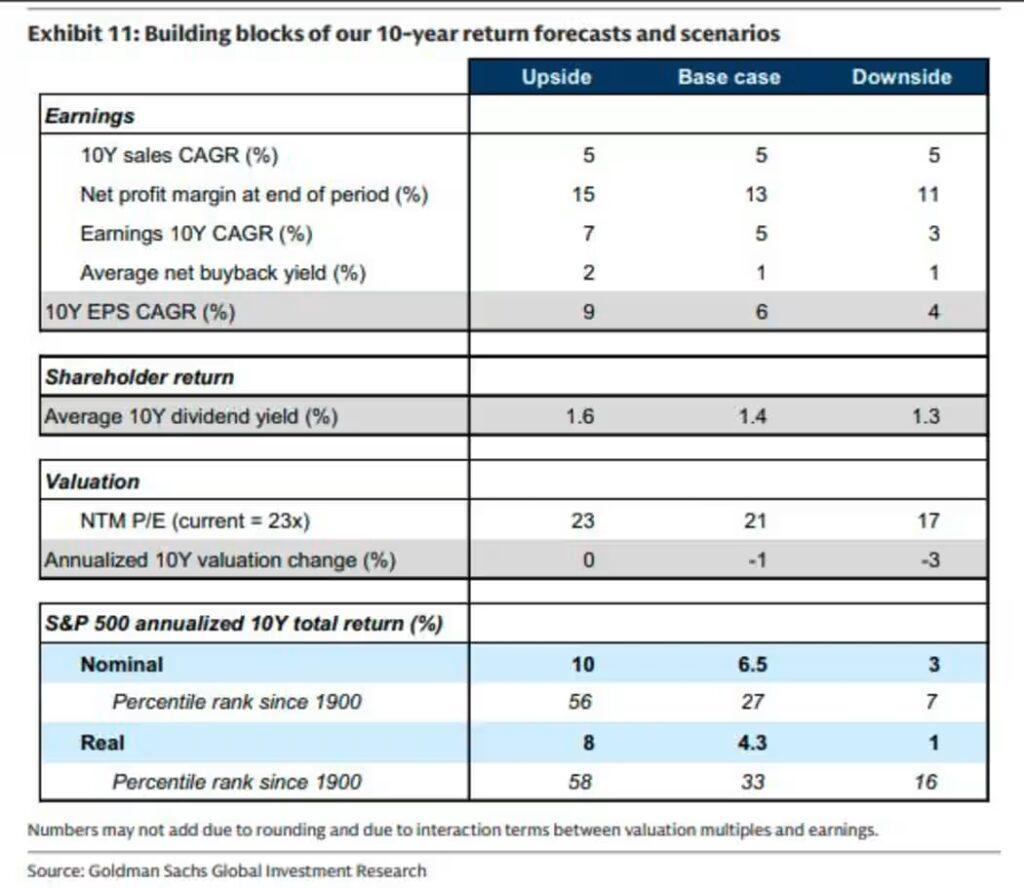
Goldman Sachs Sees S&P 500 at 7,600 by 2026, But Warns of Tech Fatigue Goldman Sachs strategists are sounding a cautious note on Wall Street’s biggest winners, warning that the “superstar” tech stocks driving recent gains may eventually lose momentum. In one of the first forecasts for next year, Goldman projects the S&P 500 to reach 7,600 by the end of 2026, an 11% rise from current levels. Looking further out, the bank expects the index to deliver a 6.5% annualized return over the next decade — slightly below its 7.7% forecast for global equities and near the 27th percentile of historical returns since 1990. Their 10-year outlook includes a range of 3% to 10% annualized returns. The base case reflects 6% earnings-per-share growth, offset by a 1% drop in valuations and a 1.4% dividend yield, with revenue growth expected to track nominal GDP. A softer U.S. dollar could also provide a modest lift. Goldman notes that corporate profit margins remain near record highs at 13%, up from 5% in 1990, thanks to globalization, lower interest rates, and reduced corporate taxes — tailwinds that may not repeat in the next decade. The bank’s valuation forecast assumes a 4.5% nominal Treasury yield by 2035 and a forward P/E of 21, down roughly 10% from current levels. Still, the strategists see a major wild card in market concentration. The dominance of a few mega-cap tech firms has powered the market higher, but if their profitability or valuations falter — and no new leaders emerge — broader returns could suffer. On the upside, AI could prove to be a powerful growth engine, potentially lifting earnings-per-share growth to 9%, well above Goldman’s base forecast. John PaulJohn Paul is the founder of DayTradeToWin, a trading education and software company established in 2008, supporting traders worldwide. His expertise focuses on price action-based futures trading strategies and structured market analysis. DayTradeToWin delivers trading education, indicators, and software tools designed to help traders apply disciplined, rule-based decision-making across global futures markets. He is the creator of multiple trading methodologies, including the Sonic System, Atlas Line, and Trade Scalper, which help traders identify structured opportunities in markets such as the E-mini S&P 500 (ES), Nasdaq (NQ), crude oil (CL), and gold (GC). Official website: https://daytradetowin.com daytradetowin.com
wells fargo
Market News

Wells Fargo Says Tech Rally Looks Too Hot to Handle

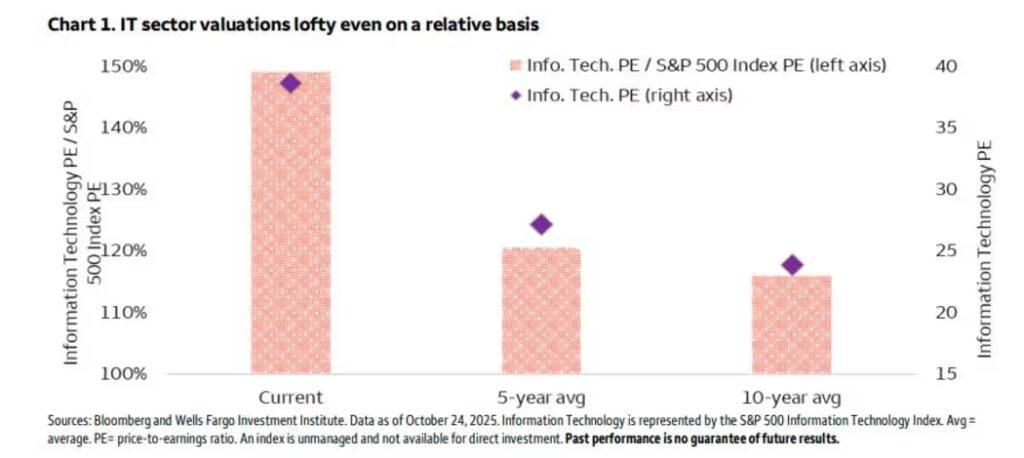
Wells Fargo Warns: Tech Sector’s Sky-High Expectations Could Lead to Trouble The AI trade — powered by heavyweights like Nvidia — bounced back to start the week, but renewed concerns over CoreWeave are cooling the excitement. Investors now find themselves torn between chasing the AI boom and fearing another bubble, reminiscent of the dot-com era. That uneasy balance prompted the Wells Fargo Investment Institute (WFII) to downgrade the S&P 500 Information Technology sector — home to Nvidia, Microsoft, Broadcom, and other AI leaders — from favorable to neutral. The main reason: valuations have gotten too rich. According to Douglas Beath, WFII’s global investment strategist, the sector surged nearly 60% since April, outperforming the broader S&P 500 by over 25%. While AI momentum continues to drive sales, profits, and cash flow, Beath warns that overly optimistic sentiment makes the sector susceptible to disappointment if earnings results fall even slightly short of expectations. Beath also points to lingering U.S.–China trade tensions and growing concerns over the payoff from massive AI capital spending. Investors are becoming uneasy about whether these record-level investments will deliver the returns needed to justify lofty stock prices. Although a correction may be temporary, WFII advises taking some profits and trimming tech exposure back to market weight. Instead, the firm recommends rotating into industrials, utilities, and financials — three sectors that can still benefit from the AI infrastructure boom but come with more reasonable valuations. In Beath’s view, the message is clear: AI’s growth story remains intact — but investors may want to cool their enthusiasm for tech stocks. John PaulJohn Paul is the founder of DayTradeToWin, a trading education and software company established in 2008, supporting traders worldwide. His expertise focuses on price action-based futures trading strategies and structured market analysis. DayTradeToWin delivers trading education, indicators, and software tools designed to help traders apply disciplined, rule-based decision-making across global futures markets. He is the creator of multiple trading methodologies, including the Sonic System, Atlas Line, and Trade Scalper, which help traders identify structured opportunities in markets such as the E-mini S&P 500 (ES), Nasdaq (NQ), crude oil (CL), and gold (GC). Official website: https://daytradetowin.com daytradetowin.com

stocks
Market News

Why Stocks With Momentum Are Back in Charge

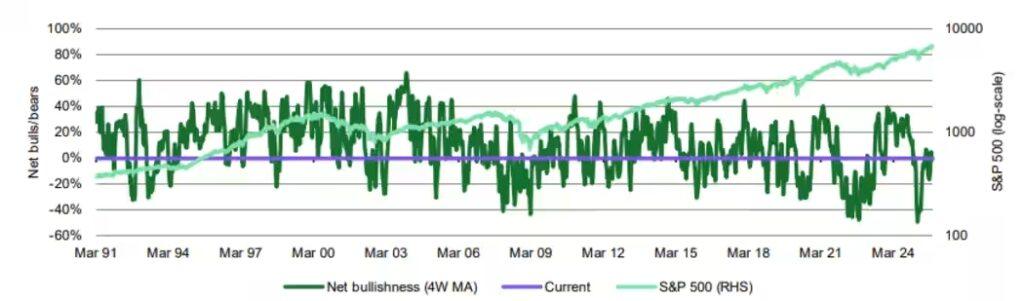
In October, investors turned back toward strategies favoring fast-growing companies instead of those with cheaper valuations. As government bond yields declined across Europe, the U.K., and the U.S., the preference for growth stocks became clear. According to Panmure Liberum strategist Joachim Klement, growth stocks are poised to lead performance in 2026 across all three markets, with bond yields—rather than earnings growth—remaining the primary driver. Klement noted that from 2012 onward, U.S. value stocks endured a “lost decade” amid near-zero interest rates, as policymakers kept borrowing costs artificially low to stimulate post-crisis growth. However, following the inflation surge and rate hikes of 2022, value stocks had a strong rebound. That momentum faded in October when U.S. 10-year bond yields slipped below 4%, causing value stocks to lag by 1.9%, regardless of whether measured by price-to-earnings or price-to-book ratios. Income stocks also fell behind by 1.5%, while companies with strong earnings momentum gained 1.4%. Despite the S&P 500 reaching new all-time highs during the month, Klement reported no evidence of market exuberance or excessive optimism. His firm’s sentiment indicator returned to neutral levels, suggesting the U.S. market remains slightly undervalued relative to its fundamentals. Looking ahead, Klement sees growth stocks leading not only in the U.S. but also in Europe and the U.K. The sectors with the most upward earnings revisions in October included resources, banks, and financial services. Taking a longer-term view, he pointed out that historically, the cheapest U.K. stocks and those with high dividend yields have produced stronger returns, though that advantage reversed last month as yields fell. He also highlighted encouraging signs from the U.K.’s IPO market, which is showing life after years of stagnation. In 2025, three IPOs raised £850 million, already surpassing 2024’s total of £600 million. This recovery supports renewed optimism for growth-oriented companies, reinforced by the 1.2% outperformance of momentum stocks in October. In Europe, easing rates—particularly after recent volatility in France—caused value stocks to underperform growth by 80 basis points in October, marking a reversal of the trend that began in late 2021. John PaulJohn Paul is the founder of DayTradeToWin, a trading education and software company established in 2008, supporting traders worldwide. His expertise focuses on price action-based futures trading strategies and structured market analysis. DayTradeToWin delivers trading education, indicators, and software tools designed to help traders apply disciplined, rule-based decision-making across global futures markets. He is the creator of multiple trading methodologies, including the Sonic System, Atlas Line, and Trade Scalper, which help traders identify structured opportunities in markets such as the E-mini S&P 500 (ES), Nasdaq (NQ), crude oil (CL), and gold (GC). Official website: https://daytradetowin.com daytradetowin.com
S&P 500
Market News

S&P 500 Hits Record Concentration — Déjà Vu of 2000?

The largest companies in the S&P 500 are seeing their market weight surge faster than their actual earnings — a growing imbalance that’s starting to raise eyebrows on Wall Street. Lori Calvasina, head of U.S. equity strategy at RBC Capital Markets, has often dismissed talk of an AI-fueled market bubble. Yet in her latest report shared with MarketWatch, she pointed to one chart that’s giving her some concern. It compares the top 10 stocks’ weighting in the S&P 500 to their share of total corporate profits. According to Calvasina, those companies now make up more than 44% of the entire index — the highest level since at least 1990 — while accounting for just 34.3% of total net income. That nearly 10-point gap echoes levels seen at the height of the dot-com bubble in 2000. “While we haven’t agreed that the market is in an AI bubble like the old TIMT era, the risk has definitely grown,” she said, referring to the Technology, Internet, Media, and Telecommunications boom that preceded the early 2000 crash. The top 10 stocks — including Nvidia, Meta, Broadcom, Microsoft, Amazon, Alphabet (both share classes), Apple, Tesla, and Berkshire Hathaway — dominate the AI narrative. Apart from Berkshire, all are deeply tied to the technology driving the latest market enthusiasm. This trend isn’t entirely new. Since 2021, the biggest companies’ market weight has consistently grown faster than their earnings share, fueled by investor optimism about long-term AI-driven growth — especially since ChatGPT ignited the frenzy in late 2022. But lately, that gap has been widening even faster. The imbalance has resurfaced bubble talk, particularly after recent earnings from AI heavyweights. Meta’s stock plunged last week, wiping out over $200 billion in market value as investors balked at its expanding AI spending plans. Still, strength from other tech giants — most notably Amazon — has helped offset the declines. Amazon’s latest deal to provide cloud power to OpenAI added fresh fuel to the market rally as November began. By Monday’s close, the S&P 500 and Nasdaq finished higher, while the Dow and Russell 2000 slipped modestly — a reminder that Wall Street’s momentum remains powered by its biggest, most AI-focused names. John PaulJohn Paul is the founder of DayTradeToWin, a trading education and software company established in 2008, supporting traders worldwide. His expertise focuses on price action-based futures trading strategies and structured market analysis. DayTradeToWin delivers trading education, indicators, and software tools designed to help traders apply disciplined, rule-based decision-making across global futures markets. He is the creator of multiple trading methodologies, including the Sonic System, Atlas Line, and Trade Scalper, which help traders identify structured opportunities in markets such as the E-mini S&P 500 (ES), Nasdaq (NQ), crude oil (CL), and gold (GC). Official website: https://daytradetowin.com daytradetowin.com
nvidia
Market News

Nvidia Stays on Top as AI Budgets Explode

Nvidia Rides Big Tech’s AI Spending Wave The AI race among Big Tech giants is intensifying — and Nvidia looks like the biggest winner. After Amazon’s strong cloud results and upbeat guidance last week, Wall Street’s attention shifted to Nvidia, which hasn’t even reported earnings yet. The surge in AI spending from Amazon, Meta, Alphabet, and Microsoft points to a flood of demand for Nvidia’s chips and computing power. “Companies are going to keep spending on compute,” said Matt Stucky of Northwestern Mutual. “And Nvidia is the best supplier in the market right now.” Big Tech Opens the Wallet Meta now expects to spend $70–72 billion on capital projects this year, nearly double its 2023 total. Amazon plans to invest $125 billion, while Alphabet lifted its capex target to $92 billion. Microsoft, meanwhile, is forecasting even faster spending growth than last year’s already massive 58% jump. All those billions are flowing into AI infrastructure — and straight toward Nvidia’s ecosystem. CEO Jensen Huang recently hinted that analysts are underestimating the company’s growth potential by about $100 billion, suggesting Nvidia could generate well over $300 billion in data-center revenue next year. Bubble or Boom? With AI investments skyrocketing, some on Wall Street are questioning if we’re in a bubble. The main concern is whether companies like OpenAI can monetize their technologies fast enough to justify the spending. “For every dollar OpenAI takes in, $2 goes out the door,” Stucky noted. Still, confidence remains high — Oracle’s recent bond sale to fund OpenAI infrastructure was heavily oversubscribed, signaling continued investor optimism. Market Perception Shifts While Nvidia remains the core beneficiary, Amazon’s resurgence is reshaping investor sentiment. Its cloud business accelerated to over 20% growth in Q3, reinforcing its leadership in AI infrastructure. Investors seem more comfortable with heavy AI budgets at Amazon and Alphabet than at Meta, given that the hyperscalers can directly monetize compute services. Meta, on the other hand, relies on advertising and longer-term AI ambitions that may take years to pay off. As Mizuho’s Jordan Klein put it, many investors may “look elsewhere for near-term catalysts,” but Nvidia and the major cloud providers still stand at the center of the AI gold rush. John PaulJohn Paul is the founder of DayTradeToWin, a trading education and software company established in 2008, supporting traders worldwide. His expertise focuses on price action-based futures trading strategies and structured market analysis. DayTradeToWin delivers trading education, indicators, and software tools designed to help traders apply disciplined, rule-based decision-making across global futures markets. He is the creator of multiple trading methodologies, including the Sonic System, Atlas Line, and Trade Scalper, which help traders identify structured opportunities in markets such as the E-mini S&P 500 (ES), Nasdaq (NQ), crude oil (CL), and gold (GC). Official website: https://daytradetowin.com daytradetowin.com

market
Market News

Volatile Week: Market Swings on Big Tech’s AI Bets

AI-Fueled Market Euphoria Faces Test as Tech Spending Turns to Debt The stock market’s AI-driven rally is showing signs of strain. With megacap tech companies steering market direction, this week’s earnings have brought volatility — and fresh worries that investor optimism may be overextended. Disappointing results from Meta (-11.33%) and Microsoft (-2.92%) sparked a broad selloff Thursday, while Amazon (-3.23%) and Apple (+0.63%) helped stabilize futures on Friday. The whipsaw action reflects how sensitive investors have become to any weakness in the AI narrative powering today’s exuberance. Among those flashing warning signals is Michael Burry, the famed “Big Short” investor. Posting on X, Burry wrote: While often seen as a pessimist, Burry’s trading history shows nuance. Scion Asset Management’s filings have alternated between bullish and defensive stances — from long positions in Alibaba, Baidu, and JD.com, to put options on Nvidia, and later calls on Meta, ASML, and UnitedHealth. His next quarterly filing, due in mid-November, may reveal whether his tone has turned defensive again. What’s fueling this growing caution is a notable shift in how Big Tech is funding AI investments. Until recently, the AI spending surge was largely powered by cash flow — a reassuring sign of financial discipline. But Meta’s $30 billion Hyperion data center project in Louisiana marks a turning point. The company used a special purpose vehicle (SPV) to issue most of the debt, keeping it off Meta’s balance sheet and preserving its credit rating. This kind of off-balance-sheet financing — dubbed “quantum debt,” because it’s both present and hidden — has raised eyebrows. If other tech giants follow suit, it could introduce new layers of financial risk into an already overheated market. Reports from Bloomberg and the Financial Times indicate Meta may also be exploring a $25 billion bond sale, reinforcing the trend. As the AI gold rush shifts from cash to credit, investors are asking a crucial question: Is this innovation-fueled rally sustainable — or the early stage of another bubble? John PaulJohn Paul is the founder of DayTradeToWin, a trading education and software company established in 2008, supporting traders worldwide. His expertise focuses on price action-based futures trading strategies and structured market analysis. DayTradeToWin delivers trading education, indicators, and software tools designed to help traders apply disciplined, rule-based decision-making across global futures markets. He is the creator of multiple trading methodologies, including the Sonic System, Atlas Line, and Trade Scalper, which help traders identify structured opportunities in markets such as the E-mini S&P 500 (ES), Nasdaq (NQ), crude oil (CL), and gold (GC). Official website: https://daytradetowin.com daytradetowin.com

Scroll to Top