
stock market

S&P 500
Market News

Trump Reversals Spark S&P 500 Rebound

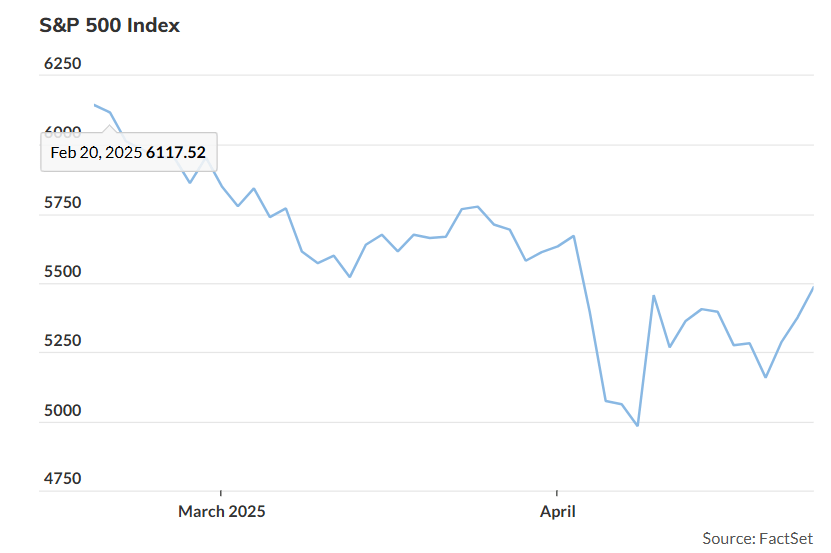
What It Will Take for the S&P 500 to Reclaim Record Highs—and for Other Indexes to Recover Wall Street isn’t known for subtle reactions, and the recent market swings are a case in point. The S&P 500 rallied sharply on Thursday, officially climbing out of correction territory by closing more than 10% above its April 8 low—reached shortly after President Trump’s April 2 tariff announcement, which rattled global markets. That low marked the bottom of a sharp selloff driven by renewed trade tensions and fears of economic fallout. A key turning point came when the Trump administration paused new tariffs for most countries (excluding China), calming market nerves. From that April low to Thursday’s close, the S&P 500 recovered an eye-popping $4.253 trillion in market value, according to Dow Jones Market Data. Still, the index remains 10.7% below its February record high, and broader uncertainty continues to hang over the markets. Jamie Cox, managing partner at Harris Financial Group, attributed much of the volatility to the surge and subsequent decline in the Cboe Volatility Index (VIX)—Wall Street’s “fear gauge”—which soared above 50 during the worst of the selloff but has since retreated to around 20. “When volatility unwinds, stocks tend to rebound just as dramatically,” he noted. Adding to the bullish momentum was Trump’s recent softening tone toward Federal Reserve Chair Jerome Powell, saying he doesn’t plan to remove him before his term ends in 2026. That reassurance helped settle investor jitters about central bank independence. Pimco’s Libby Cantrill and Tiffany Wilding cautioned in a client note that firing Powell could actually hinder Trump’s goal of lower interest rates. Markets seemed to agree, as the 10-year Treasury yield fell six basis points Thursday to 4.32%, following its largest weekly move since 1987 just two weeks ago. “The Fed’s direction weighs heavily on markets,” said Cox. “Removing uncertainty around Powell is a big stabilizing factor.” Looking ahead, Cox said that progress on trade deals and a cooling of Fed tensions could help push stocks back toward record highs. With Congress returning next week, a breakthrough on budget negotiations and the debt ceiling could further lift investor confidence. Still, much hinges on how the global trade landscape evolves. Cox expects negotiations with China to drag on, while deals with Europe and others may come together more quickly. Where the major indexes stand now: John PaulJohn Paul is the founder of DayTradeToWin, a trading education and software company established in 2008, supporting traders worldwide. His expertise focuses on price action-based futures trading strategies and structured market analysis. DayTradeToWin delivers trading education, indicators, and software tools designed to help traders apply disciplined, rule-based decision-making across global futures markets. He is the creator of multiple trading methodologies, including the Sonic System, Atlas Line, and Trade Scalper, which help traders identify structured opportunities in markets such as the E-mini S&P 500 (ES), Nasdaq (NQ), crude oil (CL), and gold (GC). Official website: https://daytradetowin.com daytradetowin.com


gold
Market News

Gold Hit Hard: Bull Run Ending?

Gold Suffers Sharpest Drop Since 2021 as Trade Tensions Ease and Fed Uncertainty Fades Gold prices saw their steepest single-day drop in nearly four years on Wednesday, as a shift in U.S. trade policy rhetoric and reduced fears over the Federal Reserve’s leadership deflated the metal’s momentum. After a blistering rally that saw gold top $3,500 an ounce earlier this week, prices tumbled $125.30, or 3.7%, to close at $3,294.10 — the biggest one-day percentage drop since June 2021, according to Dow Jones Market Data. Tuesday’s session had already hinted at weakness, with gold futures pulling back from a record intraday high of $3,509.90 to settle at $3,419.40. The decline followed signs that the White House may ease tariffs on Chinese imports, according to reports, and a softening stance from former President Trump toward Fed Chair Jerome Powell. That double shift eased fears that had fueled gold’s rally and reduced demand for the metal as a safe-haven asset. “Gold’s been riding the trade-war narrative, and that leg just got wobbly,” said Stephen Innes, managing partner at SPI Asset Management. He added that the rally had been driven more by headlines and speculation than fundamentals, and with those headlines cooling, the rally is deflating fast. Jonathan Krinsky of BTIG noted that gold had climbed to more than 27% above its 200-day moving average — a historically extreme level that often signals overbought conditions and a potential “blow-off” top. When that threshold has been reached in the past, gold has typically pulled back toward its average in the following months. Despite the sharp correction, many analysts see this as a healthy pause rather than a definitive peak. “There’s nothing indicating that $3,500 is a hard top,” said Michael Armbruster of Altavest. “We’re still in an uptrend — this looks like a standard correction within a bull market.” Jim Wyckoff of Kitco.com agreed, suggesting the rally may be near the end of its cycle in terms of timing, but not necessarily in price. “Markets often experience larger swings near the end of a bull phase, but gold could still surprise to the upside before it’s over.” Gold had been on a tear since 2022, rising from around $1,600 an ounce on the back of geopolitical turmoil, high inflation, and fears over global economic stability. Even after this week’s drop, the metal remains up significantly, with gains of over 25% year to date. “This correction doesn’t change the underlying bullish thesis,” said Trevor Yates, senior investment analyst at Global X ETFs. “It’s more about investor positioning than any shift in fundamentals.” He noted continued demand from central banks and ongoing economic uncertainty as key supports for gold. With the metal still outperforming equities in 2025 and broader market volatility persisting, analysts suggest the recent dip may offer a strategic entry point for long-term investors John PaulJohn Paul is the founder of DayTradeToWin, a trading education and software company established in 2008, supporting traders worldwide. His expertise focuses on price action-based futures trading strategies and structured market analysis. DayTradeToWin delivers trading education, indicators, and software tools designed to help traders apply disciplined, rule-based decision-making across global futures markets. He is the creator of multiple trading methodologies, including the Sonic System, Atlas Line, and Trade Scalper, which help traders identify structured opportunities in markets such as the E-mini S&P 500 (ES), Nasdaq (NQ), crude oil (CL), and gold (GC). Official website: https://daytradetowin.com daytradetowin.com

amazon
Market News

Amazon Looks Cheap—Here’s Why

Amazon vs. Walmart: Which Stock Is the Better Bet in a Slowing Economy? When times get tough, shoppers tighten their budgets—except when it comes to essentials like groceries and household goods. That’s where Amazon and Walmart shine, making both strong candidates for investors looking to ride out an economic slowdown. But here’s the twist: one stock looks undervalued, the other overvalued. Walmart and Amazon continue to compete for cost-conscious consumers. But they offer very different investment profiles. Amazon is a tech-driven powerhouse with major exposure to artificial intelligence through its cloud business. That innovation edge, however, means it’s often grouped with Big Tech—making its stock more volatile in uncertain markets. In contrast, Walmart is seen as a safe, reliable retailer. It’s performed well in past downturns and continues to attract investors seeking stability. The market has rewarded that perception: Walmart shares are up 6% this year, trading at a forward price-to-earnings (P/E) ratio of about 34. Meanwhile, Amazon’s stock is down nearly 20%, bringing its forward P/E down to 25. Compared to their historical norms, these valuations tell a different story. Walmart’s average forward P/E since 2005 is about 18, making today’s valuation look expensive. Amazon’s long-term average forward P/E is a lofty 93—so by that measure, it’s now trading at a steep discount. “It really comes down to how investors classify Amazon,” says Dan Romanoff, a senior analyst at Morningstar. “It’s lumped in with tech stocks, while Walmart is viewed as a defensive play.” That classification may be holding Amazon back—creating opportunity for long-term investors. Amazon’s earnings are still on a growth path. Analysts expect its earnings per share (EPS) to rise from $5.53 in 2024 to $7.47 in 2026. Walmart’s EPS growth is more muted, moving from $2.51 in fiscal 2025 to $2.93 by 2027. Yes, Amazon has faced margin pressure from massive investments in AI infrastructure like data centers. But Morningstar believes that demand will soon catch up, especially as Amazon continues to lead in e-commerce, fulfillment, and online advertising—giving it one of the strongest moats in retail. Walmart isn’t without its own strengths. About 60% of its revenue comes from grocery sales—a stable and recession-resistant source. It’s also aggressively growing its digital sales, which are expanding at over 20% annually. Analysts see big potential for margin gains through automation and logistics improvements. What do the analysts say? Amazon’s average price target sits at $215, with 93% of analysts rating it a “Buy.” That implies a 24% upside from recent levels. Walmart’s price target is $107, offering a potential 12.6% gain, with 86% of analysts bullish. However, Morningstar’s valuation models suggest Amazon has even more room to run—assigning a fair value of $240 per share. Walmart, on the other hand, may be overpriced, with a fair value estimate of just $63. Bottom line: Walmart offers defensive stability—but much of that may already be priced in. Amazon, while riskier in the short term, could offer long-term upside at a relative discount. The better pick depends on whether you’re playing it safe—or looking for a smart contrarian play. John PaulJohn Paul is the founder of DayTradeToWin, a trading education and software company established in 2008, supporting traders worldwide. His expertise focuses on price action-based futures trading strategies and structured market analysis. DayTradeToWin delivers trading education, indicators, and software tools designed to help traders apply disciplined, rule-based decision-making across global futures markets. He is the creator of multiple trading methodologies, including the Sonic System, Atlas Line, and Trade Scalper, which help traders identify structured opportunities in markets such as the E-mini S&P 500 (ES), Nasdaq (NQ), crude oil (CL), and gold (GC). Official website: https://daytradetowin.com daytradetowin.com
markets
Market News

If Trump Fires Powell: 3 Markets Plays

Markets Tumble as Trump Threatens to Fire Fed Chair Powell A rare and unsettling selloff hit U.S. markets on Monday after President Donald Trump renewed attacks on Federal Reserve Chair Jerome Powell, raising fears about the central bank’s independence. All three major indexes plunged— the Dow fell 2.48%, the S&P 500 dropped 2.36%, and the Nasdaq slid 2.55%. At the same time, the yield on the 30-year Treasury spiked to 4.91%, while the U.S. dollar dropped to a three-year low. The coordinated decline in stocks, bonds, and the dollar reflects deep investor concern that Trump could attempt to remove Powell before his term ends in 2026. While it remains legally unclear whether the president can do so, the mere threat has rattled markets. Michael Brown, a strategist at Pepperstone, said firing Powell would spark “the most dramatic rush to the exit from U.S. assets that it is possible to imagine.” He warned that such a move would undermine global confidence in the U.S. financial system, potentially ending the dollar’s reserve currency status and Treasurys’ role as a safe haven. Even without actual dismissal, some analysts argue the damage is already done. Will Compernolle of FHN Financial noted that legal battles over Powell’s position could erode market trust in the Fed’s independence. “If it reaches the courts, credibility may already be lost,” he said. Trump has made no secret of his dissatisfaction with Powell, calling him “Mr. Too Late” and publicly suggesting that he should be removed. Reports indicate the president has discussed possible replacements, including former Fed Governor Kevin Warsh. While many strategists still doubt Trump will move forward, the risk alone is enough to shift market sentiment. Evercore ISI analysts warned that even floating the idea of firing Powell adds political risk to U.S. assets and could accelerate a move toward stagflation trades—marked by higher inflation and slower growth. As investors seek safety, gold prices have climbed and foreign assets are drawing renewed interest, signaling a growing unease with the direction of U.S. economic policy. John PaulJohn Paul is the founder of DayTradeToWin, a trading education and software company established in 2008, supporting traders worldwide. His expertise focuses on price action-based futures trading strategies and structured market analysis. DayTradeToWin delivers trading education, indicators, and software tools designed to help traders apply disciplined, rule-based decision-making across global futures markets. He is the creator of multiple trading methodologies, including the Sonic System, Atlas Line, and Trade Scalper, which help traders identify structured opportunities in markets such as the E-mini S&P 500 (ES), Nasdaq (NQ), crude oil (CL), and gold (GC). Official website: https://daytradetowin.com daytradetowin.com

market
Market News

Why Extreme Market Gloom Might Be a Bullish Signal

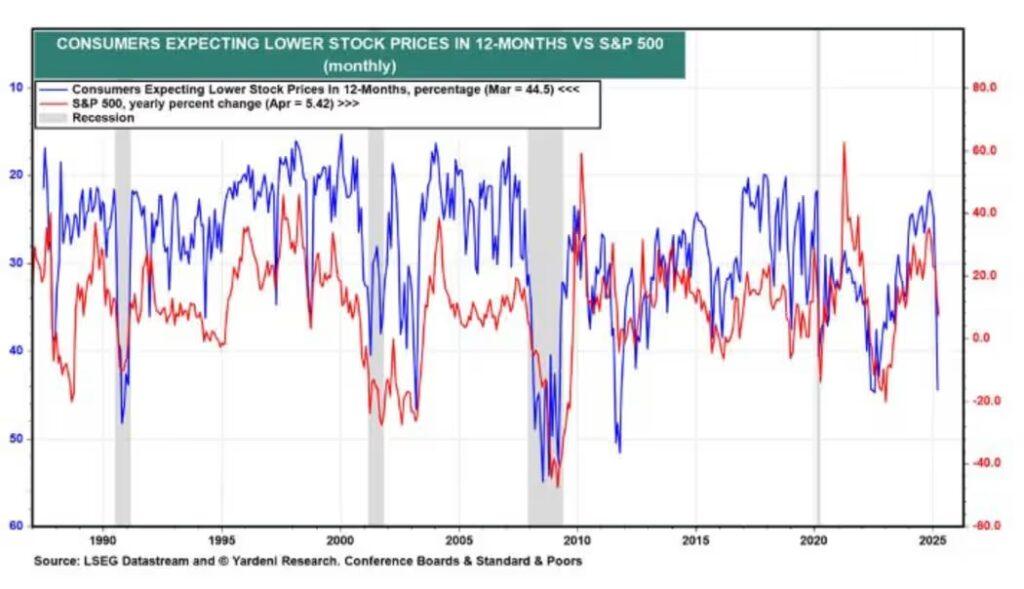
Yardeni: Market Are So Bearish, Only a Lehman-Level Crash Would Make Sense Stocks stumbled out of the gate after the holiday weekend, with renewed trade tensions around China and uncertainty over Fed Chair Jerome Powell weighing on sentiment. The dollar is slumping, and earnings season is heating up—buckle up. Despite all the negativity, Ed Yardeni, president of Yardeni Research, says the market may be overdoing it. In fact, the mood is so dark, he argues it would take a full-blown financial crisis to justify all the doom and gloom. “We’d need something on par with the 2008 Lehman collapse to match this level of panic,” Yardeni said. “And there’s no real sign of that happening.” Still, Yardeni himself has turned more cautious, cutting his S&P 500 target twice this year—from 7,000 to 6,000—as recession fears grow. The S&P is already down 10% in 2025, with Trump’s tariff threats fueling anxiety. But there are reasons for hope. Recent signs that China may be open to negotiations could give Trump room to dial back his 145% tariff threat—possibly to a market-friendly double-digit figure. That said, recession concerns are rising. Prediction markets now peg the odds at 56%, up from 20% at the start of the year. Yardeni sees a 45% chance of either a recession or stagflation. Investor sentiment has cratered. Yardeni points to surveys showing a collapse in bullish views, with nearly half of consumers expecting stocks to fall over the next year. Among investors under 40, only 32% see the market rising. Still, Yardeni warns against giving up on 2025 too soon: “If we see some early signs of recovery, writing off the year entirely could be a costly mistake.” Backing that view, Evercore ISI strategists, led by Julian Emanuel, argue that investor pessimism might be overblown. With 90 days for trade talks to unfold, even a small positive headline could spark a rally—especially in small caps. Their play? Use options on the iShares Russell 2000 ETF (IWM) to capture both upside and downside. Buy a call at $204 and a put at $170—profit either way if volatility hits. For gold, Evercore suggests shorting the SPDR Gold Shares ETF (GLD), or using a collar strategy: sell a call at $323, buy a put at $297, and protect against a reversal. John PaulJohn Paul is the founder of DayTradeToWin, a trading education and software company established in 2008, supporting traders worldwide. His expertise focuses on price action-based futures trading strategies and structured market analysis. DayTradeToWin delivers trading education, indicators, and software tools designed to help traders apply disciplined, rule-based decision-making across global futures markets. He is the creator of multiple trading methodologies, including the Sonic System, Atlas Line, and Trade Scalper, which help traders identify structured opportunities in markets such as the E-mini S&P 500 (ES), Nasdaq (NQ), crude oil (CL), and gold (GC). Official website: https://daytradetowin.com daytradetowin.com

markets
Market News

Why Firing Powell Could Shake Markets

Firing the Fed Chair Would Shake Markets and Undermine U.S. Economy, Experts Warn As President Donald Trump approaches his second term, renewed speculation about the future of Federal Reserve Chairman Jerome Powell is sending tremors through financial markets. Trump has long criticized Powell for not cutting interest rates aggressively enough and has publicly floated the idea of removing him. While no formal move has been made, strategists warn that such a decision would severely damage market confidence and U.S. economic stability. “He would very much like to fire Powell and lower interest rates—that’s very clear,” said Kathy Jones, chief fixed-income strategist at the Schwab Center for Financial Research. “I wouldn’t be surprised if he ignores the advice he’s been given and tries to make it happen.” The independence of the Federal Reserve has traditionally been a cornerstone of U.S. economic policy, and any attempt to politicize it could have far-reaching consequences. On Thursday, Trump renewed his attacks on Powell via social media, dubbing him “Too Late Jerome” for refusing to follow the European Central Bank’s lead in cutting rates. Powell, however, has reiterated the Fed’s cautious approach, saying the central bank will monitor the effects of tariffs and other economic pressures before deciding on further rate moves. When asked whether the Fed would intervene if markets plunged, Powell was direct: “No.” The Fed cut interest rates in September 2024 for the first time since the pandemic began, but has kept them steady throughout 2025. Following Powell’s comments, markets ended Thursday mixed, with the Nasdaq falling slightly and the S&P 500 inching higher. Behind the scenes, White House officials have reportedly advised Trump against removing Powell. Politico reported that Treasury Secretary Scott Bessent warned the move could rattle markets. Legally, the president’s authority to remove the Fed chair remains unclear. Powell has said the law protects the Fed from politically motivated firings. However, a pending Supreme Court case, Trump v. Wilcox, could shift that balance. A ruling in Trump’s favor might expand presidential power and erode protections for independent agencies, potentially clearing the path for Powell’s removal. Despite these developments, some on Wall Street are still brushing off the threat. “Are they taking him seriously or just ignoring the potential problem? Seems like the latter,” said Steve Sosnick, chief strategist at Interactive Brokers. Others, including Democratic Senator Elizabeth Warren, have warned that firing Powell could crash the markets. While Sosnick didn’t go that far, he emphasized the importance of institutional credibility. “We underestimate how vital institutions like a nonpartisan judiciary and an independent Fed are to foreign investors,” he said. Jay Hatfield, portfolio manager at Infrastructure Capital, argued that Trump may have grounds to fire Powell, citing the Fed’s delayed response to surging inflation in 2021. “He absolutely can fire him, and Powell can sue,” Hatfield said. Still, most analysts agree the fallout from such a move would be severe. Jones warned that removing Powell would likely trigger a sharp selloff in both Treasurys and the dollar—behavior more typical of emerging markets than the U.S. “It’s just not something that happens in major developed economies,” she said. “Even if a new chair is well-received, the damage to credibility would already be done. Bond yields would spike, the dollar would fall—you lose the trust of global markets.” U.S. stocks have already been volatile in 2025. On Thursday, the Nasdaq Composite slipped 0.1% to 16,286.45. The S&P 500 rose 0.1% to 5,282.70, while the Dow Jones Industrial Average dropped 1.3% to close at 39,142.23. John PaulJohn Paul is the founder of DayTradeToWin, a trading education and software company established in 2008, supporting traders worldwide. His expertise focuses on price action-based futures trading strategies and structured market analysis. DayTradeToWin delivers trading education, indicators, and software tools designed to help traders apply disciplined, rule-based decision-making across global futures markets. He is the creator of multiple trading methodologies, including the Sonic System, Atlas Line, and Trade Scalper, which help traders identify structured opportunities in markets such as the E-mini S&P 500 (ES), Nasdaq (NQ), crude oil (CL), and gold (GC). Official website: https://daytradetowin.com daytradetowin.com

Scroll to Top