
stock market

risks
Market News

The Hidden Risks Markets Are Ignoring

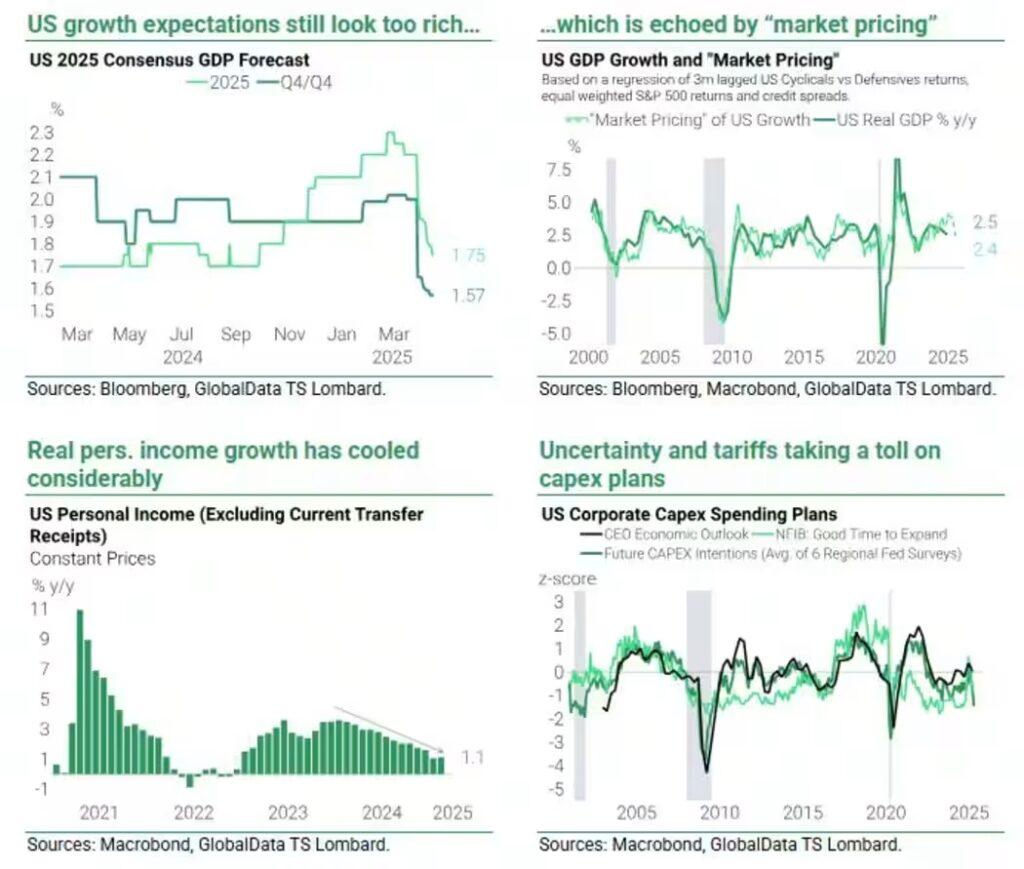
Tariff Relief Buoys Markets for Now, but Recession Risks Remain President Trump’s recent tariff adjustments have offered temporary relief to U.S. financial markets, but underlying economic risks are far from resolved. Daniel von Ahlen, senior macro strategist at GlobalData TS Lombard, warns that investors may be underestimating the threat of a recession, which could result in more severe market volatility later this year. In a report shared with MarketWatch, von Ahlen highlighted several troubling indicators. Federal workforce layoffs could strain the job market at a time when hiring has already slowed. Tariffs are expected to raise consumer prices just as income growth loses momentum, potentially weakening household spending power. Additional risks include Chinese retaliatory tariffs that could harm U.S. exports, a shrinking labor force due to tighter immigration policies, and potential fiscal drag if spending cuts are implemented to extend Trump’s first-term tax cuts. “Taken together, these forces may be strong enough to tip the U.S. economy into recession,” von Ahlen wrote, noting that declining real personal income growth leaves little room for policy missteps. Despite lowered growth forecasts from Wall Street economists, market pricing still reflects expectations for robust economic expansion. At the same time, earnings projections remain optimistic, with analysts calling for 8.9% growth in 2025—a figure that would be unlikely in a downturn, where corporate earnings typically stagnate or decline. Further stock market weakness could also weigh on consumer spending, given the growing role equities play in household wealth. Von Ahlen isn’t alone in his caution. Michael Brown, senior research strategist at Pepperstone, echoed similar concerns, pointing to continued trade uncertainty. He noted that new tariffs on sectors like semiconductors and pharmaceuticals are looming, and the broader U.S.–China trade relationship remains tense. Beijing recently halted Boeing jet deliveries, and reciprocal tariff negotiations have made little progress. “I worry markets are underpricing the risks,” Brown said. “We haven’t fully accounted for the inflationary or growth-related consequences these tariffs could trigger, both domestically and globally.” To prepare for a potential recession, von Ahlen recommends rotating into defensive assets. He suggests gaining exposure to utilities through ETFs like the Utilities Select Sector SPDR Fund (XLU), while reducing exposure to cyclical sectors such as financials via the Financial Select Sector SPDR Fund (XLF). Long-term inflation-protected bonds—like those in the Pimco 15+ Year U.S. TIPS Index ETF (LTPZ)—may also offer downside protection. Additionally, he advocates using the Mexican peso to fund long positions in the Japanese yen (MXNJPY), citing the yen’s safe-haven status and relative undervaluation despite recent appreciation. Markets showed renewed volatility midweek. After the White House blocked Nvidia from exporting more AI chips to China without a license, and Beijing suspended Boeing aircraft deliveries, stocks fell sharply. The S&P 500 dropped 1.3%, the Nasdaq declined over 2%, and Nvidia shares plunged nearly 7%. John PaulJohn Paul is the founder of DayTradeToWin, a trading education and software company established in 2008, supporting traders worldwide. His expertise focuses on price action-based futures trading strategies and structured market analysis. DayTradeToWin delivers trading education, indicators, and software tools designed to help traders apply disciplined, rule-based decision-making across global futures markets. He is the creator of multiple trading methodologies, including the Sonic System, Atlas Line, and Trade Scalper, which help traders identify structured opportunities in markets such as the E-mini S&P 500 (ES), Nasdaq (NQ), crude oil (CL), and gold (GC). Official website: https://daytradetowin.com daytradetowin.com
wall street
Market News

Wall Street Bold Call: Time to Be Cautious

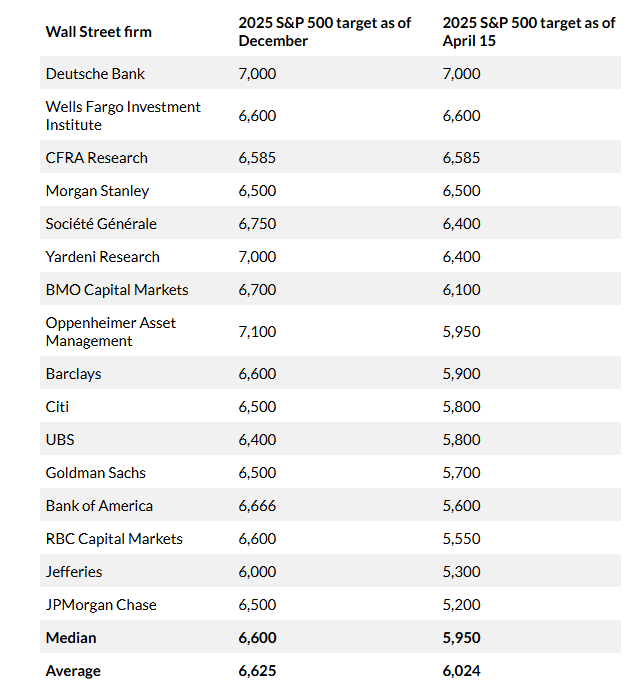
Wall Street S&P 500 Price Targets: A Market Thermometer, Not a Crystal Ball Wall Street S&P 500 targets are often viewed as forecasts — but in reality, they function more like a real-time mood gauge for the market than a reliable prediction tool, according to one strategist. The recent selloff caught many of Wall Street’s top minds off guard. President Trump’s shifting tariff strategy triggered a sharp downturn, forcing at least a dozen major firms — including JPMorgan, BofA, Goldman Sachs, and RBC — to swiftly revise their year-end S&P 500 forecasts downward. The median target now sits at 5,950, suggesting a more than 10% gain from Monday’s close of 5,405.97. But that’s a far cry from the 6,600 consensus forecast from just a few weeks ago. The tariff shock pulled that estimate down nearly 10% in under two weeks, marking one of the most abrupt sentiment resets in recent memory. Earlier in the year, projections were tightly clustered between 6,400 and 7,100. Today, they’ve blown open to a range of 5,200 to 7,000 — and several firms, including Deutsche Bank and Morgan Stanley, haven’t updated their calls at all. So, can traders rely on these revised targets? Nationwide’s Mark Hackett argues they should tread carefully. “The chances these forecasters get whipsawed are pretty high,” he said. “We saw about a 10% to 11% drop in consensus in a week, and that is very unusual.” Hackett compares S&P 500 targets to a “temperature check” — not a precision instrument. Historical data backs him up: since 2000, Wall Street has, on average, missed the S&P’s year-end level by nearly 14%. The standard method for calculating these targets — multiplying expected earnings per share by the forward P/E ratio — is looking shaky too. Tom Bruce of Tanglewood Total Wealth notes that it’s tough to project earnings right now, with tariffs muddying the waters. “The 90-day tariff pause offers a little clarity,” Bruce said, “but anything beyond that is anyone’s guess. Corporate earnings projections are shaky at best right now.” Indeed, earnings estimates have already softened. The consensus for 2025 full-year S&P 500 EPS now sits at $268.49, down from $271.05 a month ago, according to FactSet. On Tuesday, markets closed lower as traders digested Q1 bank earnings and waited for the next chapter in U.S. trade policy. The Dow dipped 0.4%, the S&P 500 slipped 0.2%, and the Nasdaq finished flat. Bottom Line: For traders, these shifting targets can offer a useful read on sentiment — but leaning too heavily on them for positioning might leave you vulnerable when the market rewrites the script. Watch the fundamentals, track the policy shifts, and treat forecasts like suggestions — not certainties. John PaulJohn Paul is the founder of DayTradeToWin, a trading education and software company established in 2008, supporting traders worldwide. His expertise focuses on price action-based futures trading strategies and structured market analysis. DayTradeToWin delivers trading education, indicators, and software tools designed to help traders apply disciplined, rule-based decision-making across global futures markets. He is the creator of multiple trading methodologies, including the Sonic System, Atlas Line, and Trade Scalper, which help traders identify structured opportunities in markets such as the E-mini S&P 500 (ES), Nasdaq (NQ), crude oil (CL), and gold (GC). Official website: https://daytradetowin.com daytradetowin.com

S&P 500
Market News

S&P 500 Flashes Bearish Signal

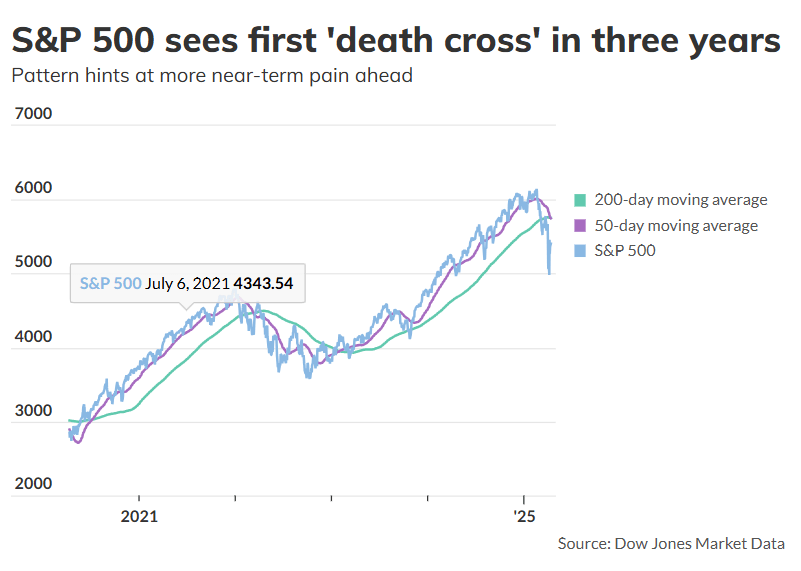
S&P 500 Flashes First ‘Death Cross’ Since 2022, But Signals Remain Unclear The S&P 500 reached a key technical milestone on Monday, marking its first “death cross” since March 2022 — even as the broader market extended gains from last week’s rebound. A death cross occurs when the 50-day moving average falls below the 200-day moving average, often interpreted as a sign that short-term momentum is weakening and a deeper downturn may be forming. This latest signal reflects broader market turbulence in 2025. The Russell 2000 and Tesla Inc. have already triggered similar patterns, reinforcing concerns about market breadth and investor sentiment. However, history suggests the impact of a death cross isn’t always bearish. According to Dow Jones Market Data, the S&P 500 has typically moved higher three, six, and twelve months after previous death crosses — suggesting short-term volatility doesn’t always lead to prolonged declines. Paul Ciana, chief technical strategist at BofA Securities, advises watching whether the 200-day average has fallen over the past five sessions. If so, it may indicate further downside and a potential retest of the recent 2025 low. Others, like Craig Johnson of Piper Sandler, argue that death crosses are lagging indicators. In many cases, they signal that most of the damage has already been done and that a rally may be near. Indeed, recent history paints a mixed picture: the S&P 500 was down a year after the March 2022 death cross, but surged 50% following the same signal in March 2020. For now, markets remain resilient. On Monday, the S&P 500 gained 0.8%, while the Nasdaq Composite and Dow Jones Industrial Average also closed in the green. John PaulJohn Paul is the founder of DayTradeToWin, a trading education and software company established in 2008, supporting traders worldwide. His expertise focuses on price action-based futures trading strategies and structured market analysis. DayTradeToWin delivers trading education, indicators, and software tools designed to help traders apply disciplined, rule-based decision-making across global futures markets. He is the creator of multiple trading methodologies, including the Sonic System, Atlas Line, and Trade Scalper, which help traders identify structured opportunities in markets such as the E-mini S&P 500 (ES), Nasdaq (NQ), crude oil (CL), and gold (GC). Official website: https://daytradetowin.com daytradetowin.com
Tariffs
Market News

Apple, Nvidia Avoid Tariffs (Temporarily)

Smartphones and Laptops Spared from China Tariffs—for Now, Says Commerce Secretary Smartphones and laptops were among a range of consumer electronics spared from the latest round of U.S. tariffs on Chinese imports, offering what initially appeared to be a reprieve for tech giants like Apple Inc. and Nvidia Corp. But that relief may be short-lived. Commerce Secretary Howard Lutnick said Sunday that more targeted tariffs are on the horizon. Speaking on ABC’s This Week, Lutnick explained that while items like smartphones, laptops, integrated circuits, and semiconductor manufacturing equipment were excluded from the recently announced 145% “reciprocal” tariffs, they’re not off the hook. Instead, these products will likely face a separate set of semiconductor-focused tariffs as the administration seeks to boost domestic chip production. “The exemption was not a pass,” Lutnick clarified. “These technology products are simply being moved into a different, more specific tariff category.” President Donald Trump added further confusion in a Sunday social media post, stating, “NOBODY is getting ‘off the hook.’” He insisted that no tariff exception had been granted on Friday—only a shift to a different tariff strategy. The evolving policy has left markets rattled. Wedbush analyst Daniel Ives said Sunday that the constant stream of conflicting messages from the White House is creating “massive uncertainty and chaos” for companies trying to manage their supply chains and inventory planning. Still, Ives noted the outlook had improved slightly since last week, calling the current situation “a much better spot than Friday and last week heading into this Sunday night.” Apple, which relies heavily on Chinese manufacturing, has been particularly vulnerable to tariff concerns. Its shares had dropped 11% between Trump’s initial tariff announcement on April 2 and the end of last week. The company had previously received tariff exemptions during Trump’s first term. Analyst Stacy Rasgon of Bernstein, who covers Nvidia and other semiconductor firms, wrote Sunday that the exemptions could signal a willingness to negotiate. “It seemed last week that Trump was looking for an excuse to engage with China,” Rasgon wrote. “Exempting these products—many of which are crucial Chinese imports—could be interpreted as a gesture toward renewed talks. Time will tell.” John PaulJohn Paul is the founder of DayTradeToWin, a trading education and software company established in 2008, supporting traders worldwide. His expertise focuses on price action-based futures trading strategies and structured market analysis. DayTradeToWin delivers trading education, indicators, and software tools designed to help traders apply disciplined, rule-based decision-making across global futures markets. He is the creator of multiple trading methodologies, including the Sonic System, Atlas Line, and Trade Scalper, which help traders identify structured opportunities in markets such as the E-mini S&P 500 (ES), Nasdaq (NQ), crude oil (CL), and gold (GC). Official website: https://daytradetowin.com daytradetowin.com
investors
Market News

Are Investors Wrong About the U.S.?

Trade Relief and Pessimism Make the S&P 500 Look More Attractive U.S. stock futures were pointing up early Friday, setting the stage for a stronger finish to a rollercoaster week. Much of the optimism stems from President Trump’s unexpected midweek shift on tariffs. Markets are reading that as a sign trade tensions may have peaked — investors see it, at least for now. Still, plenty of caution remains. Skeptics argue that the 90-day tariff pause just delays uncertainty, especially with Chinese imports still facing a steep 145% tariff. Conflicting takes like these are what drive the market — and they’re even showing up within the same firms. Case in point: On Thursday, UBS strategist Bhanu Baweja warned investors to sell into rallies, saying the S&P 500 could fall below 5,000 if the economic impact of tariffs worsens. But on Friday, a different UBS team — led by Global Wealth Management CIO Mark Haefele — took a more bullish stance, upgrading U.S. equities to “attractive” and offering three main reasons why: Adding fuel to the contrarian fire: investor sentiment is deeply bearish. The latest AAII survey shows 58.9% of investors expect stocks to keep falling. That’s down slightly from last week’s peak but still unusually high. UBS points out that such pessimism has often preceded big market rallies, with the S&P 500 posting an average 27% gain in the year following similar sentiment extremes. While UBS still sees risks if tariffs stay in place, they now think the odds of a major economic downturn have dropped. They’ve revised their worst-case S&P 500 target up from 4,000 to 4,500 — a level more in line with a normal recession, rather than a full-blown crisis. John PaulJohn Paul is the founder of DayTradeToWin, a trading education and software company established in 2008, supporting traders worldwide. His expertise focuses on price action-based futures trading strategies and structured market analysis. DayTradeToWin delivers trading education, indicators, and software tools designed to help traders apply disciplined, rule-based decision-making across global futures markets. He is the creator of multiple trading methodologies, including the Sonic System, Atlas Line, and Trade Scalper, which help traders identify structured opportunities in markets such as the E-mini S&P 500 (ES), Nasdaq (NQ), crude oil (CL), and gold (GC). Official website: https://daytradetowin.com daytradetowin.com

markets
Market News

Markets Soar as Trump Hits the Brakes on Tariffs

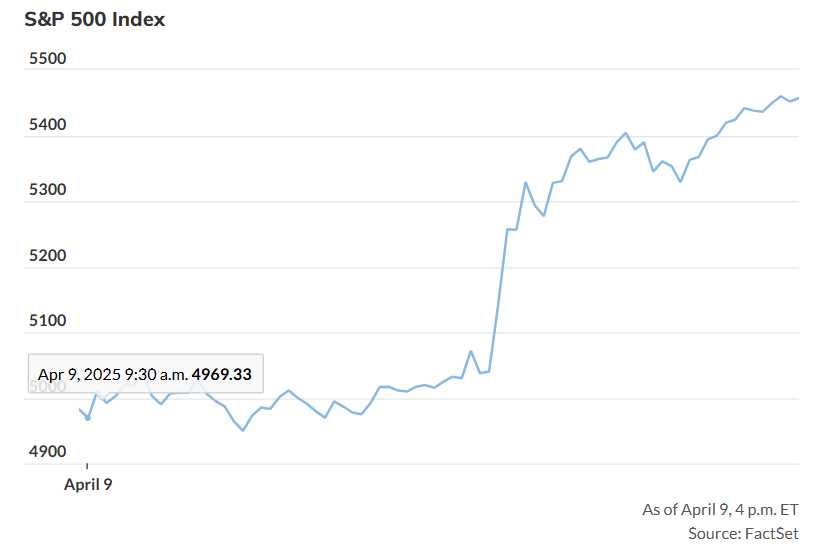
Wall Street bounced back in dramatic fashion Wednesday after President Donald Trump announced a 90-day delay on certain tariffs—excluding those targeting China. The move sparked a massive relief rally in markets that had been battered by trade war fears. The S&P 500 jumped 9.5%, posting its best one-day percentage gain since October 2008. The Dow Jones Industrial Average surged 2,962 points, or 7.9%, in its strongest performance since March 2020. The Nasdaq Composite led the pack, skyrocketing 12.2%—its biggest single-day gain since January 2001. Markets had been under intense pressure since Trump unveiled sweeping tariffs on April 2. With stocks deeply oversold, investors were quick to seize on the shift in tone from the White House. “New U.S. tariff rates were not sustainable, and today, the Trump administration finally admitted it,” said Michael Arone, chief investment strategist at State Street Global Advisors. “Investors got their first piece of good news in over a week.” Trump’s social media post outlined the new approach: China would face a steep tariff hike to 125%, up from 104%, while other countries would see a reduced baseline rate of 10% for the next 90 days. This update came just 15 hours after “liberation day” tariffs kicked in, which had imposed a 20% rate on EU imports, 24% on Japanese goods, and 25% on South Korean products. The decision appeared to single out China as the main adversary in Trump’s trade war, a stance markets seemed more comfortable with after a previous round of China-focused tariffs earlier in his presidency. Tuesday’s S&P 500 close at 4,982.77, the lowest since April 19, had brought the index to the brink of a bear market, setting the stage for Wednesday’s rebound. “This is the biggest rally I’ve ever seen—and it’s stunning,” said Louis Navellier, founder of Navellier & Associates. “Will we revisit the lows? Probably not. This looks decisive. Clearly, Trump is watching the markets—and he reacted.” Behind the scenes, many believe mounting pressure in the bond market also influenced the policy reversal. A surge in Treasury yields, with the 10-year climbing to 4.293%, signaled investors were abandoning the usual safe-haven trade, raising fears of a liquidity crunch that could force Federal Reserve intervention. While the rollback eased immediate recession concerns, risks remain. Stocks had plunged after the initial April 2 announcement on fears the tariffs would tip the economy into a downturn. Economists at Goldman Sachs briefly made recession their base-case scenario Wednesday morning—only to revise that call after Trump’s announcement. Volatility is likely to persist, said State Street’s Arone. “The trade war isn’t over,” he said, “but at least for today, investors have won a round.” John PaulJohn Paul is the founder of DayTradeToWin, a trading education and software company established in 2008, supporting traders worldwide. His expertise focuses on price action-based futures trading strategies and structured market analysis. DayTradeToWin delivers trading education, indicators, and software tools designed to help traders apply disciplined, rule-based decision-making across global futures markets. He is the creator of multiple trading methodologies, including the Sonic System, Atlas Line, and Trade Scalper, which help traders identify structured opportunities in markets such as the E-mini S&P 500 (ES), Nasdaq (NQ), crude oil (CL), and gold (GC). Official website: https://daytradetowin.com daytradetowin.com

Scroll to Top