

stock market

deepseek
Market News

DeepSeek AI: A New Stock Market Disruptor?

DeepSeek’s Impact on U.S. Stocks Yet to Be Fully Realized, Says Conning’s Don Townswick The rise of Chinese AI startup DeepSeek, which promises more affordable and energy-efficient artificial intelligence solutions, has yet to be fully reflected in U.S. equity markets. That’s the assessment of Don Townswick, director of equity strategies at Conning Asset Management, which oversees $170 billion in assets. “If DeepSeek’s technology turns out to be less groundbreaking than anticipated, the ‘Magnificent Seven’ stocks will likely retain their dominance,” Townswick told MarketWatch. Conversely, if DeepSeek delivers a truly cost-effective AI alternative, it could level the playing field. “This would make AI adoption much more accessible for a broader range of companies, driving efficiency gains and boosting earnings beyond the current tech giants,” he said. AI Spending Continues to Surge DeepSeek’s chatbot launch earlier this month sent shockwaves through Wall Street, triggering a staggering $600 billion market wipeout for AI chip leader Nvidia (NVDA). The event also heightened scrutiny over the massive capital investments in AI infrastructure by U.S. tech giants. However, instead of pulling back, companies are doubling down. Meta Platforms (META) CEO Mark Zuckerberg recently spoke of investing “hundreds of billions of dollars” in AI over the coming years, with $60 billion to $65 billion allocated for this year alone. Alphabet (GOOGL) followed suit, forecasting $75 billion in capital expenditures for 2025—surpassing analysts’ expectations. Meanwhile, Microsoft (MSFT) reported a 95% year-over-year surge in AI and cloud-related spending, reaching $22.6 billion in its fiscal second quarter. “Investors are wondering how much more needs to be spent before AI investments start to slow,” said Robert Pavlik, senior portfolio manager at Dakota Wealth Management. “When is enough, enough?” Nvidia shares rebounded on fresh AI spending commitments, but declines in Tesla (TSLA), Apple (AAPL), and Amazon (AMZN) suggest growing concerns over President Donald Trump’s trade war. The U.S. recently imposed a new 10% tariff on Chinese goods, while threats of 25% tariffs on Canada and Mexico were postponed by a month. Market Rotation and Growth Challenges Despite the continued focus on AI stocks, investors are beginning to shift their attention to other sectors. “We’re seeing some rotation,” said Garrett Melson, portfolio strategist at Natixis Investment Managers. “While tech stocks have been under pressure, defensive and interest-rate-sensitive sectors are gaining traction.” Townswick remains cautious, noting that the once-explosive earnings growth of the “Magnificent Seven” has slowed from 61% in Q4 2023 to a projected 16%–18% by the end of this year. While still robust, this decline brings their growth rate closer to the broader S&P 500’s expected 12%–13%, potentially making their high valuations harder to justify. Despite market turbulence, Melson sees reasons for optimism. “The most surprising takeaway from the past few weeks—despite DeepSeek’s emergence and trade tensions—is that stocks are still near all-time highs,” he said. “That speaks to the resilience of this market.” John PaulJohn Paul is the founder of DayTradeToWin, a trading education and software company established in 2008, supporting traders worldwide. His expertise focuses on price action-based futures trading strategies and structured market analysis. DayTradeToWin delivers trading education, indicators, and software tools designed to help traders apply disciplined, rule-based decision-making across global futures markets. He is the creator of multiple trading methodologies, including the Sonic System, Atlas Line, and Trade Scalper, which help traders identify structured opportunities in markets such as the E-mini S&P 500 (ES), Nasdaq (NQ), crude oil (CL), and gold (GC). Official website: https://daytradetowin.com daytradetowin.com


markets
Market News

Markets at Risk? Tudor Jones Weighs in on Trade War

Paul Tudor Jones Warns: “It Will Take a Maestro to Pull This Off” Legendary investor Paul Tudor Jones believes navigating today’s financial markets will require extraordinary skill. Speaking to CNBC on Monday, the billionaire trader—who famously predicted the 1987 stock market crash—warned that the economic landscape is more precarious than ever. “I don’t think we’ve ever seen so many interconnected risks that could go wrong at the same time,” Jones said. “It’s going to take a maestro to manage this without disrupting major asset classes.” Jones pointed to key shifts since President Donald Trump’s first term, including a record surge in Treasury debt issuance—now double what it was in 2017. He also noted that foreign ownership of U.S. assets, including stocks, real estate, and debt, has grown significantly as a share of GDP. Meanwhile, the S&P 500’s price-to-earnings ratio has climbed to 25 from 19 in 2017, suggesting that even a 30% correction would leave stocks slightly overvalued. “Trump being Trump, I’m not sure things will play out as smoothly as they did before,” Jones added. “There’s no room for error this time.” Markets React to Tariff Uncertainty Investor anxiety surged as markets digested fresh tariff announcements. Stocks tumbled after Trump revealed new levies: a 25% tariff on imports from Mexico and Canada, a 10% tariff on Canadian energy, and an additional 10% tariff on Chinese goods. However, markets clawed back some losses after diplomatic breakthroughs. Mexican President Claudia Sheinbaum and Trump both announced a one-month delay on Mexico tariffs following productive discussions. A similar agreement with Canadian Prime Minister Justin Trudeau postponed tariffs on Canadian imports for at least 30 days. The Dow Jones Industrial Average (DJIA) dropped 123 points, or 0.3%, after rebounding from an earlier 665-point plunge. The S&P 500 declined 0.8%, while the Nasdaq Composite fell 1.2%, both recovering from steeper session lows. Top Investors Urge Caution Hedge fund manager Dan Loeb also weighed in, warning of unprecedented market complexity. In a post on X, he emphasized the need for deep strategic thinking, calling the current climate “unlike anything we’ve seen before.” He urged investors to stay “levelheaded and unemotional” as markets adjust to new risks. John PaulJohn Paul is the founder of DayTradeToWin, a trading education and software company established in 2008, supporting traders worldwide. His expertise focuses on price action-based futures trading strategies and structured market analysis. DayTradeToWin delivers trading education, indicators, and software tools designed to help traders apply disciplined, rule-based decision-making across global futures markets. He is the creator of multiple trading methodologies, including the Sonic System, Atlas Line, and Trade Scalper, which help traders identify structured opportunities in markets such as the E-mini S&P 500 (ES), Nasdaq (NQ), crude oil (CL), and gold (GC). Official website: https://daytradetowin.com daytradetowin.com

Trade war
Market News

Trump Trade War Sparks Retaliation

New Tariffs Surpass First-Term Levels, Escalating Trade Tensions The U.S. will impose sweeping new tariffs starting Tuesday, with a 25% levy on imports from Canada and Mexico and an additional 10% on Chinese goods. The move significantly expands Trump-era trade policies, heightening tensions with key allies and rivals alike. To ease consumer impact, Canadian energy imports—including oil, gas, and electricity—will face a lower 10% tariff. However, Canada swiftly retaliated with matching 25% tariffs on $155 billion worth of U.S. goods, including alcohol and fruit. Mexico also announced countermeasures, while China condemned the move, promising legal action and further retaliation. President Trump signed the tariff orders on Saturday, tying their removal to resolving illegal immigration and drug trafficking concerns at U.S. borders. Critics Question Strategy as Markets React While some China hawks support the tough stance, critics argue that Trump’s approach lacks a clear strategy. “There’s no coherent plan on tariffs,” said Derek Scissors, a former Trump trade advisor and senior fellow at the American Enterprise Institute. “He’s winging it—misstating trade deficits and blaming Canada for fentanyl smuggling.” The markets reacted negatively, with the Dow dropping 0.8%, the S&P 500 down 0.5%, and the Nasdaq slipping 0.3%. “We expected tariffs—but not Canada and Mexico first,” wrote Chris Krueger, a policy strategist at TD Cowen. “The chaos premium is real.” Legal Challenges and Economic Uncertainty The tariffs will be enforced under the International Emergency Economic Powers Act, requiring a national emergency declaration. While legal challenges are expected, courts generally defer to the president on national security issues. Brad Setser, a former senior U.S. trade advisor, warned on X that these tariffs represent a “massive shock” to the U.S. economy, describing them as “a bigger move in one weekend than all of Trump’s first-term trade actions combined.” Despite Trump’s tough talk on China, Setser argues his policies suggest a different goal—redirecting Chinese demand toward U.S. goods rather than cutting ties. Trump’s unpredictable trade policies, including his reversal on banning TikTok, have left investors struggling to anticipate the next move. “Investors have whiplash,” said Tobin Marcus, head of U.S. policy at Wolfe Research. “It’s exhausting trying to plan beyond the next two days.” John PaulJohn Paul is the founder of DayTradeToWin, a trading education and software company established in 2008, supporting traders worldwide. His expertise focuses on price action-based futures trading strategies and structured market analysis. DayTradeToWin delivers trading education, indicators, and software tools designed to help traders apply disciplined, rule-based decision-making across global futures markets. He is the creator of multiple trading methodologies, including the Sonic System, Atlas Line, and Trade Scalper, which help traders identify structured opportunities in markets such as the E-mini S&P 500 (ES), Nasdaq (NQ), crude oil (CL), and gold (GC). Official website: https://daytradetowin.com daytradetowin.com
IBM
Market News

Why IBM Just Had Its Best Trading Day Since the 1990s Tech Boom

IBM’s AI-Powered Consulting Growth Sparks Market Optimism IBM is making a comeback, and Wall Street is taking notice. Evercore ISI analyst Amit Daryanani sees a bright future for International Business Machines Corp. (IBM), following its latest earnings report. Investor enthusiasm has sent IBM’s stock soaring, making it the top performer in both the S&P 500 and the Dow Jones Industrial Average. The stock is on track for its best single-day gain ever. What’s driving this rally? Confidence in IBM’s consulting business. “We believe IBM’s unique position across software and consulting is starting to inflect higher, with AI and potential mergers & acquisitions acting as key catalysts,” Daryanani wrote. IBM’s software revenue jumped 11.5% on a currency-neutral basis last quarter, showing strong momentum. Although consulting revenue declined by 1%, the company expects growth to accelerate, backed by $5 billion in AI-related contracts that can be converted into sales. Shares of IBM surged 12.5% in afternoon trading, marking their biggest one-day gain since a 13% rise on July 20, 2000. IBM’s revenue grew just 1% last year, but the company is now targeting at least 5% growth in 2025 after currency adjustments. Ben Reitzes of Melius Research emphasized that consulting is playing a critical role in this turnaround. “Shifting consulting from a headwind to a tailwind—along with an expected boost from the mainframe cycle later this year—enabled IBM to project 5%+ constant currency revenue growth for 2025,” Reitzes wrote. “For long-time IBM watchers, this level of growth is rare.” And the outlook could improve further. Will next week’s analyst day reveal a roadmap for even faster expansion? “We believe IBM has the potential to accelerate from 5%+ to 7% growth over the next few years as it shifts further toward Red Hat and other high-growth software segments like HashiCorp and automation,” Reitzes added. Morgan Stanley’s Erik Woodring noted that IBM’s stock momentum suggests the market views the 2025 outlook as conservative, with room for upside in areas like organic software growth. “There’s also a belief that IBM could be gearing up for more M&A activity (which we agree with), potentially driving even stronger results in 2025,” Woodring wrote. “At this point, the burden is on the skeptics to explain why IBM’s momentum won’t continue beyond next week’s analyst day.” IBM’s AI-driven transformation is gaining traction, and investors are betting this is just the beginning. John PaulJohn Paul is the founder of DayTradeToWin, a trading education and software company established in 2008, supporting traders worldwide. His expertise focuses on price action-based futures trading strategies and structured market analysis. DayTradeToWin delivers trading education, indicators, and software tools designed to help traders apply disciplined, rule-based decision-making across global futures markets. He is the creator of multiple trading methodologies, including the Sonic System, Atlas Line, and Trade Scalper, which help traders identify structured opportunities in markets such as the E-mini S&P 500 (ES), Nasdaq (NQ), crude oil (CL), and gold (GC). Official website: https://daytradetowin.com daytradetowin.com
barclays
Market News

Barclays: Fed Rate Hikes Unlikely, But Risks Remain

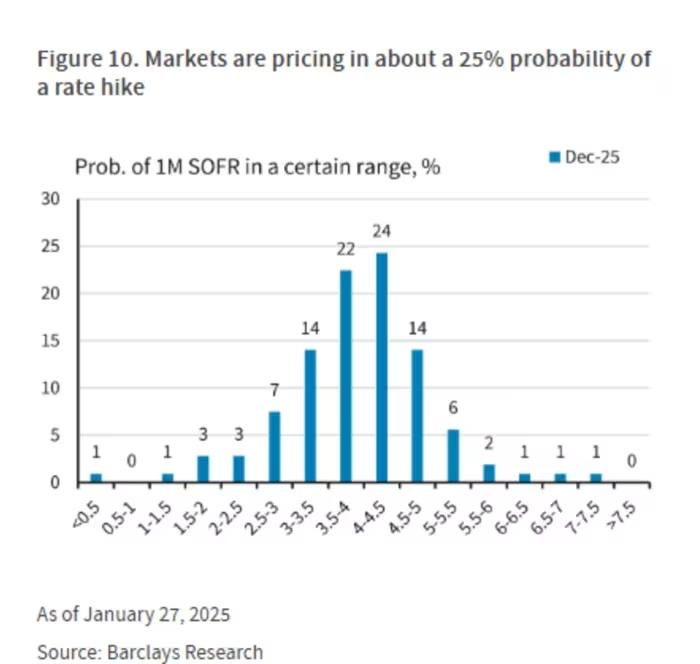
While the Federal Reserve is expected to keep interest rates steady on Wednesday, speculation about potential hikes has resurfaced. Analysts at Barclays still anticipate a gradual decline in rates through 2025 but acknowledge that a rate hike isn’t entirely off the table. Options markets currently price in a 25% chance of an increase. “The threshold for the Fed to reverse its rate-cutting course is high,” Barclays’ macro research team noted in a client report Tuesday. “Such a move could damage the Fed’s credibility.” However, they warned that a shift in economic conditions—such as a renewed surge in inflation, rising inflation expectations, or a sharp drop in unemployment—could prompt policymakers to reconsider. Lessons from Past Fed Reversals Barclays examined three historical cases where the Fed reversed course and raised rates: In all instances, labor market strength and a steepening yield curve were major drivers. Market Implications The 10-year Treasury yield (4.52%) has already climbed above the 3-month yield (4.29%), reflecting confidence in economic resilience but also concerns over potential inflationary pressures under a second Trump administration. Short-term yields initially declined when the Fed began cutting rates in September and December, bringing its policy rate to 4.25%–4.50%—a full percentage point below its peak. If the Fed signals a possible hike, Barclays expects the 2-year and 10-year Treasury yields to exceed 5%, which could weigh on equities. The bank previously warned that a 10-year yield at 5% could be problematic for stocks. Treasury Market & Liquidity Shifts A shift toward rate hikes could trigger a repricing in short-term Treasury rates, further expanding the $7 trillion money-market fund industry while pressuring bank deposits. The Road Ahead Despite the uncertainty, market sentiment still leans toward additional rate cuts in 2025. As of Tuesday, Fed-funds futures traders were pricing in a 50-basis-point cut this year, up from 25 basis points the prior week, per the CME FedWatch Tool. Investors will be closely watching Fed Chair Jerome Powell’s press conference on Wednesday and Friday’s release of the December personal consumption expenditures (PCE) index, the Fed’s preferred inflation gauge. John PaulJohn Paul is the founder of DayTradeToWin, a trading education and software company established in 2008, supporting traders worldwide. His expertise focuses on price action-based futures trading strategies and structured market analysis. DayTradeToWin delivers trading education, indicators, and software tools designed to help traders apply disciplined, rule-based decision-making across global futures markets. He is the creator of multiple trading methodologies, including the Sonic System, Atlas Line, and Trade Scalper, which help traders identify structured opportunities in markets such as the E-mini S&P 500 (ES), Nasdaq (NQ), crude oil (CL), and gold (GC). Official website: https://daytradetowin.com daytradetowin.com

stocks
Market News

Skip Expensive Stocks: Bet on These Sectors

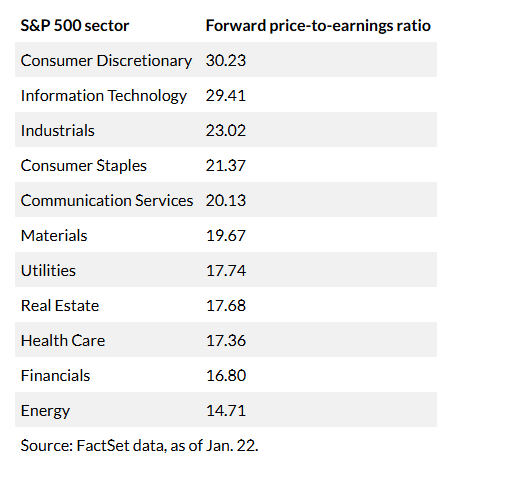
The start of President Donald Trump’s second term has sparked a robust rally, driving the S&P 500 stocks to record highs and stretching market valuations to historic levels. Investors are now exploring alternatives to megacap technology stocks, seeking more affordable opportunities that could still benefit from the administration’s early policy actions. This week, the forward price-to-earnings (P/E) ratio of the S&P 500 rose above 22, nearing its highest point in nearly four years. The last time it exceeded this level was in November, when the ratio reached 22.34, the highest since December 2020, according to Dow Jones Market Data. The P/E ratio—a key metric that compares a stock’s price to its earnings per share—can signal overvaluation. A high ratio suggests that stock prices may have outpaced their underlying earnings, raising concerns about sustainability. Elevated Valuations Raise Questions Jamie Dimon, CEO of JPMorgan Chase, expressed caution about current market conditions. In an interview with CNBC during the World Economic Forum in Davos, Switzerland, he remarked that asset prices are “in the top 10% or 15%” of historical valuations, describing them as “kind of inflated, by any measure.” Given these lofty valuations, analysts suggest turning to less speculative, fundamentally strong sectors that could thrive under a Trump-led economy. With a resilient U.S. economy and optimism surrounding advancements in artificial intelligence, certain areas of the market may offer attractive opportunities. Promising Market Sectors Financials Financial stocks, though no longer as inexpensive as earlier in 2024, still hold appeal. With solid economic prospects, analysts anticipate increased bank loan activity, mergers and acquisitions, and IPOs. These trends, combined with Trump’s deregulation agenda, create a favorable environment for the financial sector, which was one of 2024’s top performers. Industrials Industrial stocks are gaining momentum, with Wall Street forecasting double-digit earnings growth in 2025. Additionally, economic stimulus measures in China are expected to boost demand within this cyclical sector. Utilities The utilities sector also looks compelling, driven by the administration’s $500 billion Stargate initiative aimed at supporting AI infrastructure. This project is expected to drive significant electricity demand, providing a tailwind for utility companies. The Role of Big Tech in 2025 Despite their elevated valuations, megacap technology stocks remain a focal point for investors. The so-called “Magnificent Seven” are projected to continue delivering strong earnings growth, albeit at a slower pace compared to recent years. According to Mark Luschini, chief investment strategist at Janney Montgomery Scott, these tech giants will likely remain the primary drivers of market performance in 2025. However, for the broader S&P 500 to advance, the market must rely on actual earnings growth rather than further expansion of already high valuations. Katie Nixon, CIO at Northern Trust, noted that while robust earnings growth is expected in 2025, high interest rates could act as a headwind, potentially offsetting some of the market’s gains. Market Snapshot On Thursday, U.S. stocks delivered mixed results. The S&P 500 edged up 0.2% to another record high, while the Dow Jones Industrial Average gained 0.8%. Meanwhile, the Nasdaq Composite dipped 0.2%, according to FactSet data. President Trump’s calls for lower interest rates and reduced oil prices continue to influence market sentiment. John PaulJohn Paul is the founder of DayTradeToWin, a trading education and software company established in 2008, supporting traders worldwide. His expertise focuses on price action-based futures trading strategies and structured market analysis. DayTradeToWin delivers trading education, indicators, and software tools designed to help traders apply disciplined, rule-based decision-making across global futures markets. He is the creator of multiple trading methodologies, including the Sonic System, Atlas Line, and Trade Scalper, which help traders identify structured opportunities in markets such as the E-mini S&P 500 (ES), Nasdaq (NQ), crude oil (CL), and gold (GC). Official website: https://daytradetowin.com daytradetowin.com

Scroll to Top