

stock market

stocks
Market News

Stocks Set for a Dot-Com Bubble-Like Shift

This raises concerns about how much longer the rally can maintain its current momentum. The S&P 500 is nearing a rare milestone: a 20% or greater rise in two consecutive calendar years. As of Tuesday’s close, the index had crossed the 20% year-to-date mark, hitting its 41st record high of the year. Although the S&P 500 saw a slight pullback by the end of Wednesday, it remains near its peak. Following the Federal Reserve’s substantial interest rate cut, many investors are hopeful the index will push higher. It’s been a long time since the market experienced consecutive years of such strong performance. The last time was in 1998, during the dot-com boom, when the index posted four straight years of 20%-plus gains, starting in 1995. Before that, stocks hadn’t seen two consecutive years of such gains since 1955, before the S&P 500 was introduced. With the S&P 500 up 60% from its October 2022 low, according to FactSet data, investors are beginning to wonder how much further large-cap U.S. stocks can rise and whether this remarkable bull market may be nearing its peak. Some have suggested shifting away from large-cap stocks in favor of small- and mid-caps or looking for bargains abroad. Others argue that large-cap stocks still offer the best potential for returns, even as valuations have climbed to historically high levels. The comparison to the dot-com era is hard to ignore. While many experts are quick to point out the differences, it’s notable that technology stocks are once again leading the charge. Information technology and communication services now represent a significant share of the S&P 500’s market value, and valuations relative to sales are even higher than they were in 1999, according to FactSet. However, today’s companies are much more profitable than they were in the late 1990s. Recently, the S&P 500’s forward price-to-earnings ratio was 21.6, lower than the 24 times earnings seen in late 1999. Some analysts caution that high valuations could set the stage for below-average returns over the next decade. But others, like those at Yardeni Research, believe that strong earnings growth and improving productivity will continue to support the market, pushing it higher through at least 2030. While tech stocks may not dominate the market as much as they did earlier in this rally, other sectors—such as financials, industrials, and utilities—have begun to play a larger role. If these lagging sectors continue to gain momentum, the broader market could sustain its upward trajectory. Historically, following a 20% return, the S&P 500 has averaged a 9% gain the following year. While the pace may slow, history suggests that the rally could still continue. John PaulJohn Paul is the founder of DayTradeToWin, a trading education and software company established in 2008, supporting traders worldwide. His expertise focuses on price action-based futures trading strategies and structured market analysis. DayTradeToWin delivers trading education, indicators, and software tools designed to help traders apply disciplined, rule-based decision-making across global futures markets. He is the creator of multiple trading methodologies, including the Sonic System, Atlas Line, and Trade Scalper, which help traders identify structured opportunities in markets such as the E-mini S&P 500 (ES), Nasdaq (NQ), crude oil (CL), and gold (GC). Official website: https://daytradetowin.com daytradetowin.com
market
Market News

Reliable Market Signal Says It’s Time to Buy

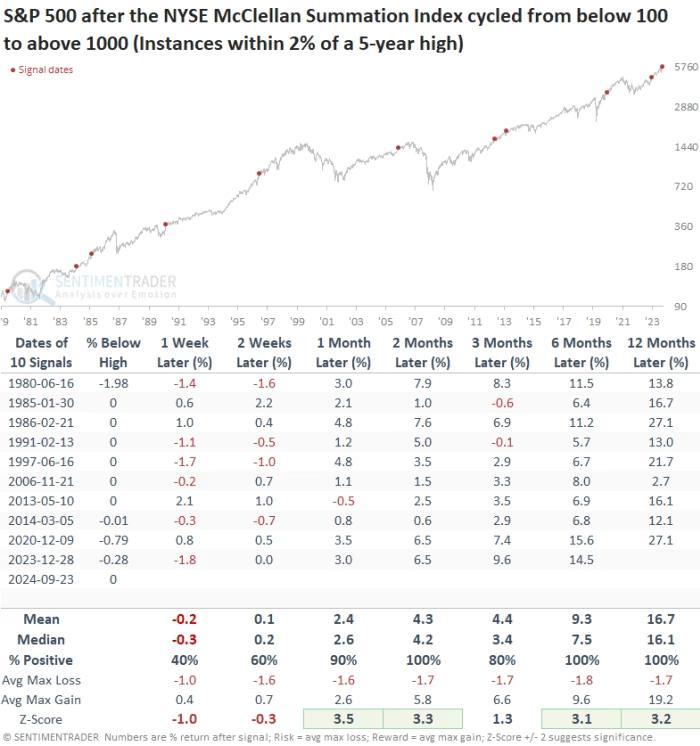
A closely-watched stock-market indicator is flashing a strong buy signal as more companies’ shares join the rally. The McClellan Summation Index, which tracks market breadth, has sharply increased, signaling more gains for the S&P 500 with near-perfect accuracy, according to Dean Christians, a senior research analyst at SentimenTrader. The McClellan Index measures how many stocks are participating in a markets move. When it’s rising, more stocks are rallying, signaling stronger market breadth. When it’s falling, market breadth is weakening, often indicating a broader market sell-off. Technical analysts use the index to monitor what’s happening beneath major indexes like the S&P 500. Historically, sharp improvements in the index have accurately predicted further stock market gains. When it surges from below 100 to over 1,000, stocks have gone on to rise over the next year with 96% accuracy. Even more impressive, that success rate jumps to 100% when the signal occurs while the S&P 500 is within 2% of a significant high. This signal was triggered on Monday. According to Christians, this means the projected gains are more significant than just the typical upward drift of the stock market over time. On Tuesday, the S&P 500 rose 14.36 points, or 0.3%, to close at 5,732.93, marking its 41st record close of 2024. The Dow Jones Industrial Average gained 83.57 points, or 0.2%, to 42,208.22, also hitting a record, while the Nasdaq Composite rose 100.25 points, or 0.6%, to 18,074.52, though it remains more than 3% below its July record. John PaulJohn Paul is the founder of DayTradeToWin, a trading education and software company established in 2008, supporting traders worldwide. His expertise focuses on price action-based futures trading strategies and structured market analysis. DayTradeToWin delivers trading education, indicators, and software tools designed to help traders apply disciplined, rule-based decision-making across global futures markets. He is the creator of multiple trading methodologies, including the Sonic System, Atlas Line, and Trade Scalper, which help traders identify structured opportunities in markets such as the E-mini S&P 500 (ES), Nasdaq (NQ), crude oil (CL), and gold (GC). Official website: https://daytradetowin.com daytradetowin.com

S&P 500
Market News

S&P 500 Surge: 6,000 in Sight

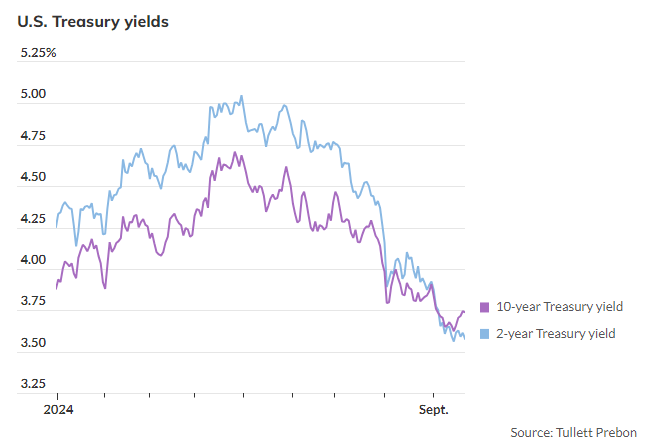
The U.S. stock market continued its strong upward momentum on Monday, with the S&P 500 and Dow Jones Industrial Average reaching new all-time highs. According to DataTrek Research, the S&P 500 could hit 6,000 by 2024, a target that now seems realistic after the Federal Reserve began cutting interest rates. The S&P 500 closed at 5,718.57, setting a fresh record, while the Dow also reached a new peak. Nicholas Colas, co-founder of DataTrek, noted that growth in the S&P 500 isn’t just being driven by technology and artificial intelligence. “Multiple sectors are contributing to earnings growth,” he said. Wall Street analysts forecast S&P 500 earnings per share to grow by 15.2% next year, up from 10% this year, with the biggest growth expected in cyclical sectors like energy, materials, and industrials. DataTrek projects earnings will rise to $258 per share over the next four quarters, a 12% increase from the previous year. With the Federal Reserve now easing interest rates, and the economy still growing, Colas sees the path of least resistance for stocks as higher. The S&P 500 is trading at 22.1 times forward earnings, higher than its five-year average of 19.5 but still below the 2020 peak of 23.2. Colas believes 6,000 is an “optimistic but achievable” target based on current earnings expectations. Stocks Rise After Fed’s Rate Cut The S&P 500’s new high comes after the Federal Reserve initiated a rate cut of half a percentage point last week, marking the start of its easing cycle. John Madziyire, head of U.S. Treasuries at Vanguard, said the probability of a “soft landing” for the U.S. economy has increased, as inflation cools under tighter monetary policy. He expects the Fed to lower its benchmark rate toward a neutral level of around 3%, down from the current target range of 4.75% to 5%. On Monday, the 10-year Treasury yield finished at 3.74%, while the two-year Treasury closed at 3.576%. Colas emphasized that reaching 6,000 for the S&P 500 is “hardly a stretch” given rising earnings and lower interest rates, representing just a 5.2% increase from last Friday’s close. The broader market also gained Monday, with the S&P 500 rising 0.3%, and both the Nasdaq Composite and Dow Jones Industrial Average up 0.1%. John PaulJohn Paul is the founder of DayTradeToWin, a trading education and software company established in 2008, supporting traders worldwide. His expertise focuses on price action-based futures trading strategies and structured market analysis. DayTradeToWin delivers trading education, indicators, and software tools designed to help traders apply disciplined, rule-based decision-making across global futures markets. He is the creator of multiple trading methodologies, including the Sonic System, Atlas Line, and Trade Scalper, which help traders identify structured opportunities in markets such as the E-mini S&P 500 (ES), Nasdaq (NQ), crude oil (CL), and gold (GC). Official website: https://daytradetowin.com daytradetowin.com

Market News

Why Stocks Are Poised for Gains This September

September is typically the worst month for U.S. stocks, but 2024 is breaking that pattern. Historically, September has earned a bad reputation on Wall Street, with the S&P 500 averaging a 1.2% loss, making it the weakest month of the year, according to Dow Jones Market Data. However, this year’s market performance tells a different story. For the first time in five years, U.S. stocks are set to end September with gains. In recent years, September has been particularly brutal. The S&P 500 fell nearly 5% in 2023 and over 9% in 2022, continuing a trend of steep losses. But 2024 is seeing a reversal. As of now, the S&P 500 has gained 1%, the Dow Jones is up 1.6%, and the Nasdaq Composite has risen 1.5%, positioning these indexes for their best September in years. Much of this optimism can be attributed to the Federal Reserve’s recent 50-basis-point interest-rate cut, which has boosted investor confidence. According to Thomas Martin of GLOBALT Investments, the Fed’s easing cycle is a key factor in the market’s recovery. Although stocks have generally performed well in 2024, they experienced volatility in August and early September, as investors feared a faster-than-expected economic slowdown. Despite these concerns, the Fed’s intervention helped stabilize the market. Looking forward, the market could still face some short-term swings, especially with the upcoming U.S. presidential election, which may cause temporary uncertainty. Investors are also closely monitoring upcoming economic data, such as GDP growth and inflation figures, to assess whether the Fed’s actions will continue to support the market. The so-called “September Effect” has puzzled analysts for years. Some attribute the month’s usual losses to increased trading activity after the summer or portfolio rebalancing by funds. However, this year is defying expectations, giving investors hope as they approach the end of 2024. John PaulJohn Paul is the founder of DayTradeToWin, a trading education and software company established in 2008, supporting traders worldwide. His expertise focuses on price action-based futures trading strategies and structured market analysis. DayTradeToWin delivers trading education, indicators, and software tools designed to help traders apply disciplined, rule-based decision-making across global futures markets. He is the creator of multiple trading methodologies, including the Sonic System, Atlas Line, and Trade Scalper, which help traders identify structured opportunities in markets such as the E-mini S&P 500 (ES), Nasdaq (NQ), crude oil (CL), and gold (GC). Official website: https://daytradetowin.com daytradetowin.com

market
Market News

Stock Market Veteran: Rate Cuts May Not Prevent Recession

On Wednesday, the U.S. Federal Reserve made waves by cutting interest rates by half a percentage point. While market responded positively, whether this marks a successful move remains uncertain. David Rosenberg’s Top Picks: Long-Term Treasury Bonds, Gold, Utilities, Real Estate, Financials, and Dividend Growth Stocks “The Fed’s 50-basis-point rate cut is merely an admission that it had kept policy too tight for too long.” David Rosenberg, former chief North American economist at Merrill Lynch and now president of Rosenberg Research, remains cautious. A vocal critic of Fed Chair Jerome Powell, Rosenberg believes that while the rate cut was the right move, it was long overdue. “The Fed’s decision acknowledges that they stayed too tight for too long,” said Rosenberg. In an interview with MarketWatch, Rosenberg explained that while the move addresses some economic pressures, it’s unlikely to prevent a recession. He argues that the Fed, having been slow to combat inflation, will also struggle to avert an economic slowdown. As a result, Rosenberg advises investors to focus on rate-sensitive assets that can benefit from a prolonged easing cycle, predicting that the federal funds rate will fall to its pre-pandemic level of 1.75%. “The recession has been delayed, but it’s not off the table,” Rosenberg said. Investment StrategyRosenberg recommends investors shift toward sectors that traditionally perform well in times of slower growth, lower inflation, and declining interest rates. His top choices include long-term Treasury bonds, gold, utilities, real estate, financials, and dividend-paying growth stocks. Rosenberg is skeptical that the Fed’s easing measures will create a “soft landing” for the economy, warning that past missteps make a recession likely. For investors, he suggests focusing on assets that can weather the storm. John PaulJohn Paul is the founder of DayTradeToWin, a trading education and software company established in 2008, supporting traders worldwide. His expertise focuses on price action-based futures trading strategies and structured market analysis. DayTradeToWin delivers trading education, indicators, and software tools designed to help traders apply disciplined, rule-based decision-making across global futures markets. He is the creator of multiple trading methodologies, including the Sonic System, Atlas Line, and Trade Scalper, which help traders identify structured opportunities in markets such as the E-mini S&P 500 (ES), Nasdaq (NQ), crude oil (CL), and gold (GC). Official website: https://daytradetowin.com daytradetowin.com

Bond Market
Market News

Bond Market Reacts: Fed vs. Recession Outlook

Long-term bond yields rose even after the Federal Reserve made a significant move to cut interest rates. Here’s why. On Wednesday, the Fed reduced short-term borrowing costs by half a percentage point, lowering the target range to 4.75%-5%. This was the central bank’s first rate cut in four years, aimed at providing relief to the economy. However, Wall Street’s reaction was mixed. Instead of dropping, longer-term Treasury yields, which influence rates on mortgages, auto loans, and other credit products, climbed from their lows earlier in the week. This rise in yields suggests the market was less than thrilled with the Fed’s overall message about future rate cuts. Cindy Beaulieu, Chief Investment Officer at Conning, explained that rates had likely fallen too quickly in recent weeks. Although the Fed’s 50 basis point cut surprised many, Fed Chair Jerome Powell signaled a cautious approach to future cuts during his press conference, indicating that the Fed isn’t in a rush to lower rates further. Powell referred to the cut as “the beginning of this process,” and stressed that the Fed will take its time in future decisions. While this approach may seem wise, Beaulieu noted that it wasn’t exactly what investors had hoped for. She added that, given the strength of the economy and resilient consumer spending, it makes sense for long-term rates to move higher. The 10-year Treasury yield, for example, rose 4 basis points to 3.704%, coming off its yearly lows. Beaulieu expects the 10-year yield to potentially rise above 4%, possibly reaching 4.25% by the end of the year. She warned that keeping rates too low risks signaling a recession rather than the “soft landing” investors are hoping for. Bond market volatility has been high since the Fed began hiking rates in 2022, leading to sharp losses and disruptions across financial markets. While inflation and rate hikes no longer dominate investors’ concerns, sudden shifts in interest rates can still impact portfolios. Karen Manna, a fixed-income portfolio manager at Federated Hermes, pointed out that both bond and stock markets often try to anticipate economic trends, but they can’t always predict what’s coming. With uncertainty still lingering, especially around a potential recovery in the housing market, Manna advised caution. Beaulieu remains hesitant to add longer-duration bonds to portfolios, doubting the Fed’s ability to bring inflation back to its 2% target. She also expects credit spreads to widen as the November presidential election approaches, adding further volatility to the bond market. Manna echoed these concerns, suggesting that the Fed’s next steps and the outcome of the election will likely fuel continued uncertainty. She also advised monitoring liquidity in portfolios to avoid getting stuck in illiquid assets if markets take an unexpected turn. Stocks closed the day lower, with the Dow Jones down 0.3%, the S&P 500 losing 0.3%, and the Nasdaq Composite also dipping 0.3%. John PaulJohn Paul is the founder of DayTradeToWin, a trading education and software company established in 2008, supporting traders worldwide. His expertise focuses on price action-based futures trading strategies and structured market analysis. DayTradeToWin delivers trading education, indicators, and software tools designed to help traders apply disciplined, rule-based decision-making across global futures markets. He is the creator of multiple trading methodologies, including the Sonic System, Atlas Line, and Trade Scalper, which help traders identify structured opportunities in markets such as the E-mini S&P 500 (ES), Nasdaq (NQ), crude oil (CL), and gold (GC). Official website: https://daytradetowin.com daytradetowin.com

Scroll to Top