
stock market

small-cap
Market News

Small-Cap Stocks: Ready to Soar After Fed Rate Cut?

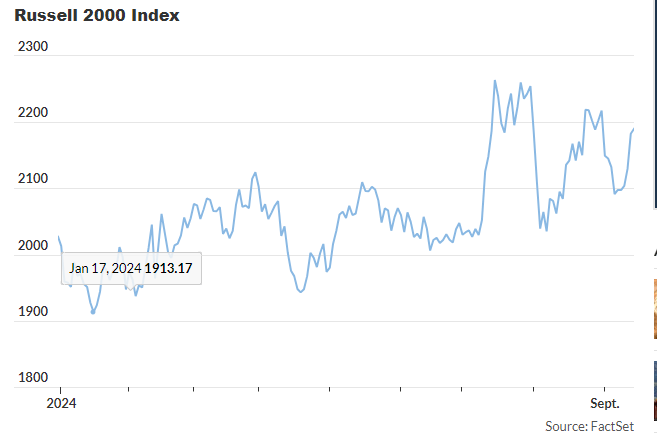
Small-cap stocks are navigating a fog of uncertainty surrounding the U.S. economy and Federal Reserve policy, analysts say. Despite a strong rally over the past month, where the Russell 2000 Index (RUT) climbed 3%, outpacing the S&P 500’s 1.4% gain, questions remain about the sustainability of this momentum. Investors are grappling with concerns over the broader economic outlook and the Fed’s upcoming decisions on interest rates. After an impressive 13% surge in July, the Russell 2000 has been on a volatile path, retreating nearly half of those gains in August. Market experts, however, suggest that the bullish momentum in small-cap stocks could persist, driven by the potential for rate cuts and hopes for a “soft landing” for the U.S. economy—where growth slows but avoids recession. Why Rate Cuts Matter for Small Caps Smaller companies often benefit more from rate cuts than larger ones due to their higher debt levels and reliance on external financing. With the Federal Reserve expected to start reducing rates, many market participants are optimistic about small caps continuing to outperform the broader market. Furthermore, small-cap valuations appear attractive. For example, the S&P SmallCap 600’s forward price-to-earnings ratio is 16.7, compared to 23.4 for the S&P 500. Analysts expect earnings for small caps to grow at a faster pace, with forecasts of a 20% rise by 2025, versus around 15% for large caps, according to FactSet. “The Fed’s rate cuts could be a key catalyst for renewed interest in small-cap stocks,” said Matt Palazzolo, senior investment analyst at Bernstein Private Wealth Management. Impact of the Size of Rate Cuts While the Fed is expected to ease monetary policy, the size of the rate cut remains uncertain. Traders are split between expecting a 25 or 50 basis point reduction. A larger cut could support small-cap stocks further, though some worry it might signal a sharper-than-expected economic slowdown, potentially impacting corporate earnings. Jordan Irving, portfolio manager at Glenmede Investment Management, highlighted that sustained earnings growth for small caps is still needed for the rally to have long-term traction. However, Palazzolo noted that the magnitude of the cut is less important for small-cap performance in the long run, advising investors not to get too caught up in the near-term debate. ‘Value Versus Growth’ in Small-Cap Stocks The recent outperformance of small caps is also seen as part of the “value versus growth” trend. Sectors like financials and real estate, which are heavily represented in small-cap indices, have been key contributors to this rally. In the past three months, the S&P SmallCap 600’s financials sector rose 21.6%, while real estate advanced 18.1%. These sectors also outperformed within the large-cap S&P 500. This trend reflects broader shifts in the market, as large-cap tech stocks have faced headwinds, while value-oriented and income-generating sectors have gained favor. John PaulJohn Paul is the founder of DayTradeToWin, a trading education and software company established in 2008, supporting traders worldwide. His expertise focuses on price action-based futures trading strategies and structured market analysis. DayTradeToWin delivers trading education, indicators, and software tools designed to help traders apply disciplined, rule-based decision-making across global futures markets. He is the creator of multiple trading methodologies, including the Sonic System, Atlas Line, and Trade Scalper, which help traders identify structured opportunities in markets such as the E-mini S&P 500 (ES), Nasdaq (NQ), crude oil (CL), and gold (GC). Official website: https://daytradetowin.com daytradetowin.com
U.S. Dollar
Market News

U.S. Dollar Drops: How a Fed Rate Cut Shapes the Future

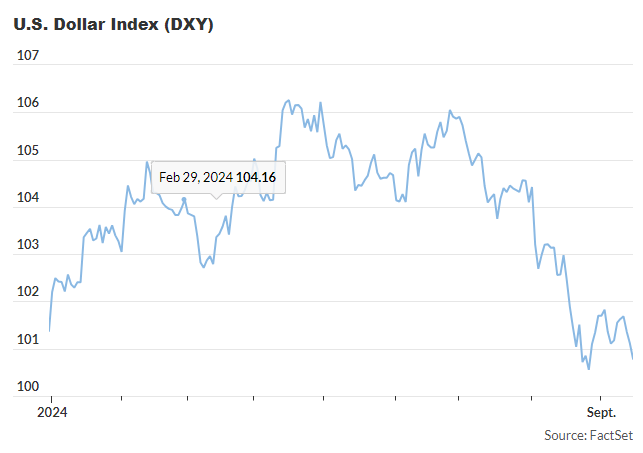
Analyst Joe Tuckey suggests that a larger rate cut from the Federal Reserve may indicate “growth concerns and economic trouble ahead.” The U.S. dollar has been sliding as markets brace for the Fed’s anticipated interest rate cut on Wednesday. The size of the cut could determine whether the dollar weakens further or presents a buying opportunity. On Monday, the ICE U.S. Dollar Index hit 100.77, its lowest level this year, down from a peak of 106.26 in April. The dollar also reached a one-year low against the yen. Market sentiment shifted significantly, with a 63% chance of a 50-basis-point cut — the largest in 16 years — up from 50% last week. This shift followed commentary from Wall Street Journal’s Greg Ip and former New York Fed President Bill Dudley. The odds of a 25-basis-point cut dropped to 37%. Tuckey, head of FX analysis at Argentex, believes a larger cut could drive the dollar to new lows, while a smaller 25-basis-point cut might lead to less volatility. He explained that “a larger cut points to concerns about growth and potential economic trouble.” The U.S. dollar performance hinges on U.S. growth prospects and interest rate trends relative to other global economies. The yen has gained strength against the dollar, with the Bank of Japan expected to raise rates again by year-end, following its exit from negative rates in March. Their next policy announcement comes two days after the Fed’s decision. Uncertainty surrounds whether the Fed will opt for a bigger cut to fend off recession risks or stick with a more measured 25-basis-point reduction. According to TD Securities strategist Mark McCormick, while initial market reaction will hinge on the Fed’s move, data in the coming months will ultimately drive the dollar’s direction. TD also anticipates a potential rebound for the dollar if the Fed takes a gradual approach to rate cuts. John PaulJohn Paul is the founder of DayTradeToWin, a trading education and software company established in 2008, supporting traders worldwide. His expertise focuses on price action-based futures trading strategies and structured market analysis. DayTradeToWin delivers trading education, indicators, and software tools designed to help traders apply disciplined, rule-based decision-making across global futures markets. He is the creator of multiple trading methodologies, including the Sonic System, Atlas Line, and Trade Scalper, which help traders identify structured opportunities in markets such as the E-mini S&P 500 (ES), Nasdaq (NQ), crude oil (CL), and gold (GC). Official website: https://daytradetowin.com daytradetowin.com
stock
Market News

How Fed Rate Cuts Have Moved Stock Before

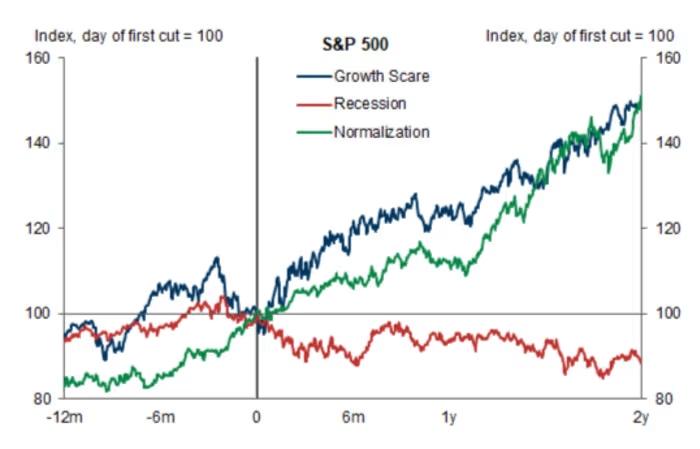
Whether the Federal Reserve can prevent a recession in time could be crucial. A Fed interest-rate cut on Wednesday seems all but certain, but how the stock market reacts to this loosening of monetary policy remains highly uncertain. History offers some insight: why the Fed is cutting rates matters more for markets than the mere fact that borrowing costs are falling. Vickie Chang, a macro strategist at Goldman Sachs, noted that since the mid-1980s, the Fed has cut rates 10 times. Four of those cuts were during recessions, while six were not. When the Fed managed to avoid a recession, stocks typically rallied. When it failed, stocks usually declined. Investors likely won’t get all the answers on Wednesday. How the market responds will depend on economic data in the months ahead. “The key question is whether this rate-cutting cycle is due to a ‘growth scare’ or a more serious ‘recessionary’ phase,” Chang said. In recessionary rate cuts, the S&P 500 typically drops 10% within the first six months. What will Wednesday’s cut reveal about the economy? The size of the cut could heavily influence investor sentiment and potentially shape market behavior for the rest of the year. Investors are particularly eager for clarity, given the mixed signals from recent U.S. economic data. While hiring has slowed, more people have entered the workforce, and layoffs remain low. Inflation has eased, but certain costs, like rent and housing, remain stubbornly high. Optimism earlier in 2024 fueled stock gains, but investor confidence has since been shaken, leading to selloffs in August and September, as concerns about rising unemployment grew. Has the Fed fallen behind? Some experts believe the Fed should have cut rates back in July, and a larger-than-expected 50 basis point cut this Wednesday could spark a negative reaction in the stock market. Wall Street sees such a move as a sign that the Fed may have fallen behind or is reacting to worse-than-expected economic data. Shannon Saccocia, CIO at Neuberger Berman Private Wealth, said, “A 50 basis point cut would suggest the Fed missed the window in July or has more worrying data than we’ve seen.” This uncertainty could trigger a market selloff regardless of the Fed’s decision, according to Deutsche Bank strategists. They noted that the Fed could deliver the biggest market surprise in 15 years, regardless of the cut’s size. Beyond the cut itself, the Fed’s updated economic projections will be carefully scrutinized. John Velis, a macro strategist at BNY Mellon, anticipates that the Fed will revise its unemployment forecast higher while lowering GDP growth projections. While this may not signal a recession, it could influence how aggressively investors expect the Fed to cut rates moving forward. On the edge of a historic achievement Though there are no clear signs of a recession yet, investors remain cautious. If Fed Chair Jerome Powell can guide the economy through inflation without causing a downturn, it would be a monumental achievement. KPMG U.S. chief economist Diane Swonk pointed out that achieving a soft landing would be unprecedented. While inflation complicates the current situation, the Fed has successfully navigated difficult economic conditions before. In 1995, a series of rate cuts helped avoid a recession, according to Jurrien Timmer, global macro director at Fidelity. “It’s rare, but it’s possible,” Timmer told MarketWatch. Last week, the S&P 500 and Nasdaq Composite posted their biggest weekly gains since November 2023, with the Dow Jones Industrial Average also seeing its best week in a month. The Fed’s two-day September policy meeting starts Tuesday, with the interest-rate decision to be announced Wednesday at 2 p.m. Eastern Time. John PaulJohn Paul is the founder of DayTradeToWin, a trading education and software company established in 2008, supporting traders worldwide. His expertise focuses on price action-based futures trading strategies and structured market analysis. DayTradeToWin delivers trading education, indicators, and software tools designed to help traders apply disciplined, rule-based decision-making across global futures markets. He is the creator of multiple trading methodologies, including the Sonic System, Atlas Line, and Trade Scalper, which help traders identify structured opportunities in markets such as the E-mini S&P 500 (ES), Nasdaq (NQ), crude oil (CL), and gold (GC). Official website: https://daytradetowin.com daytradetowin.com
Small-Cap Stocks
Market News

Why Small-Cap Stocks Are Beating the S&P 500 Now

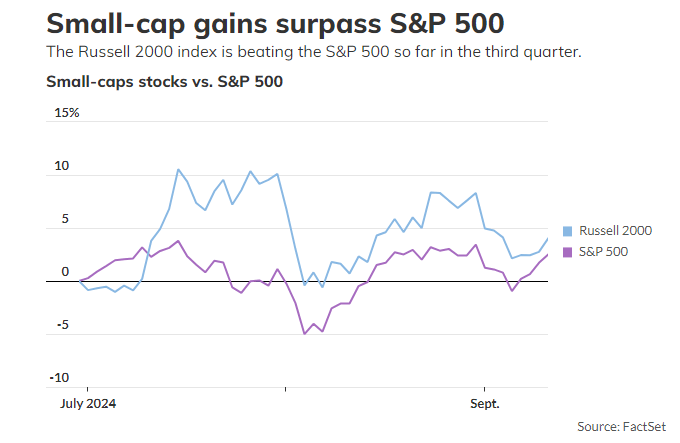
On Thursday, the Russell 2000 index, which focuses on small-cap stocks, saw a strong rise, underscoring the recent outperformance of U.S. small-caps over the S&P 500 in the third quarter. Despite experiencing steeper losses than large-cap stocks in September, small-caps have shown resilience. “Small-cap stocks got a boost when the Federal Reserve signaled a shift toward easier monetary policy,” said Liz Ann Sonders, chief investment strategist at Charles Schwab, in a Thursday phone interview. This shift became evident at the Jackson Hole Economic Symposium in late August. “Small caps tend to benefit during rate-cutting cycles,” she explained, though the effect is usually stronger when cuts are made in response to a recession. “But we’re not in a recession,” Sonders pointed out. Despite some economic slowing, “the economy is still performing relatively well,” she added. The Russell 2000 has risen 4% this quarter, even after a 4% slide in September. By comparison, the S&P 500, which tracks large-cap stocks, has gained 2.5% for the quarter, though it has outpaced small-caps over the course of the year, according to FactSet data. Investors are looking ahead to the Federal Reserve’s policy meeting next Wednesday, anticipating an announcement of rate cuts. The Fed has kept rates at elevated levels since July 2023 after aggressively hiking them to combat inflation, which peaked in 2022 and has since cooled toward the central bank’s 2% target. As of Thursday, traders in the federal funds futures market placed a 69% probability that the Fed would lower rates by a quarter percentage point, bringing them to a target range of 5% to 5.25%, based on data from the CME FedWatch Tool. Sonders cautioned that those hoping for larger cuts should “be careful what you wish for,” as deeper cuts tend to occur during recessions or financial crises. The recent rally in small-caps has lost some momentum after traders adjusted their rate-cut expectations from half a point to a quarter point, triggering profit-taking. Sonders noted that small-cap stocks generally benefit more from lower interest rates than large-cap companies. She also advised focusing on higher-quality stocks within the small-cap space. “Small-cap stocks aren’t a monolithic group,” Sonders emphasized. There is a wide range of performance across the sector, typically driven by differences in quality. “As the economy slows, investors should seek opportunities in higher-quality small-caps,” she suggested. The S&P Small Cap 600 index, which applies a profitability filter, tends to consist of higher-quality stocks than the Russell 2000, Sonders noted. She suggested using the S&P 600 as a base when screening for investment ideas. On Thursday, small-cap stocks outperformed the broader market, with both the Russell 2000 and S&P Small Cap 600 gaining 1.2%, outpacing the S&P 500’s 0.7% increase. U.S. stocks overall rose, with the Dow Jones Industrial Average climbing 0.6% and the Nasdaq Composite advancing 1%. So far in 2024, the S&P 500 has gained 17.3%, significantly outpacing the Russell 2000’s 5% year-to-date rise, even as both stumbled in September. According to FactSet, the S&P 500 is down 0.9% this month, while the Russell 2000 has fallen 4%. John PaulJohn Paul is the founder of DayTradeToWin, a trading education and software company established in 2008, supporting traders worldwide. His expertise focuses on price action-based futures trading strategies and structured market analysis. DayTradeToWin delivers trading education, indicators, and software tools designed to help traders apply disciplined, rule-based decision-making across global futures markets. He is the creator of multiple trading methodologies, including the Sonic System, Atlas Line, and Trade Scalper, which help traders identify structured opportunities in markets such as the E-mini S&P 500 (ES), Nasdaq (NQ), crude oil (CL), and gold (GC). Official website: https://daytradetowin.com daytradetowin.com
nvidia
Market News

Nvidia CEO Addresses Investor Concerns: What’s Next?

Nvidia stock has rebounded, climbing 4%, but investors are still asking a crucial question: Can artificial intelligence drive enough revenue to justify the massive spending on GPUs and other AI hardware? CEO Jensen Huang has faced this question repeatedly. While he addressed it during Nvidia’s August earnings call, the market reaction was lukewarm, with shares dropping after the report. Huang revisited the issue at a Goldman Sachs event, emphasizing the strong returns from AI infrastructure investments. According to Jensen Huang, every dollar spent on Nvidia’s AI hardware yields $5 in rentals worldwide, and demand is outstripping supply. He also highlighted how AI is boosting productivity within Nvidia, with software engineers using AI tools to streamline code development, essentially working alongside “digital companions.” Huang acknowledged that GPU costs can rise for customers, but with a 20x reduction in computing time, users still see a 10x return on investment. Despite Huang’s optimism, the question remains: Can Nvidia maintain its growth trajectory through 2026 and beyond, as tools like ChatGPT and Microsoft’s Copilot continue to transform industries? John PaulJohn Paul is the founder of DayTradeToWin, a trading education and software company established in 2008, supporting traders worldwide. His expertise focuses on price action-based futures trading strategies and structured market analysis. DayTradeToWin delivers trading education, indicators, and software tools designed to help traders apply disciplined, rule-based decision-making across global futures markets. He is the creator of multiple trading methodologies, including the Sonic System, Atlas Line, and Trade Scalper, which help traders identify structured opportunities in markets such as the E-mini S&P 500 (ES), Nasdaq (NQ), crude oil (CL), and gold (GC). Official website: https://daytradetowin.com daytradetowin.com

Financial Stocks
Market News

Can Financial Stocks Maintain Their Bullish Run?

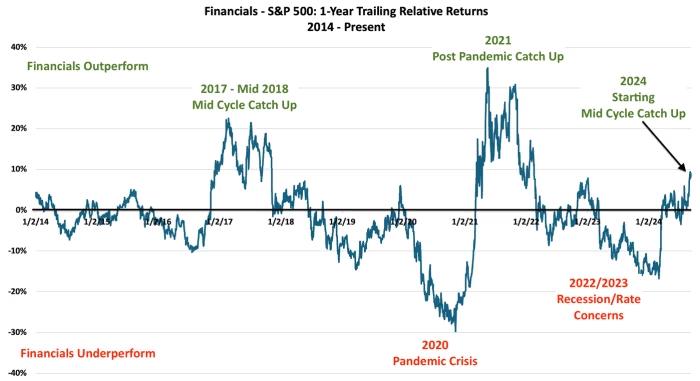
“The financial sector is much more than just banks,” says DataTrek Research. Financial stocks in the S&P 500 have outperformed the broader U.S. stock market over the past year, reflecting optimism about the economy, according to DataTrek. “Even if you’re not overweight on financials, their continued leadership reassures that equity markets are confident in further growth,” said Nicholas Colas, co-founder of DataTrek. The Financial Select Sector SPDR Fund (XLF), which tracks financial stocks in the S&P 500, surged 31.1% over the past 12 months, outpacing the S&P 500’s 22.7% rise, FactSet data shows. While the U.S. stock market has gained in 2024, investors are wary that the Federal Reserve’s tight monetary policy might trigger a recession. Despite this, Colas noted that the Atlanta Fed’s GDPNow model predicts solid economic growth in the third quarter, with a 2.5% estimate. “The financial sector extends beyond just banks, which only account for 25% of the index,” wrote Colas. It also includes growth-oriented companies like Visa, Mastercard, and S&P Global, as well as asset managers such as BlackRock, Blackstone, and KKR. Financials have continued to shine in 2024, with the Financial Select Sector SPDR Fund up 19.6%, outpacing the S&P 500’s 14.7% rise. However, Colas pointed out that while financials have outperformed by 8.4 percentage points, it’s still lower than past midcycle periods, such as 2017-18 when they led by as much as 20 points. On Tuesday, the financial sector in the S&P 500 faced a sharp drop as banks like JPMorgan, Goldman Sachs, and Citigroup saw steep losses. Investors are now looking ahead to new inflation data, set to be released Wednesday by the Bureau of Labor Statistics. John PaulJohn Paul is the founder of DayTradeToWin, a trading education and software company established in 2008, supporting traders worldwide. His expertise focuses on price action-based futures trading strategies and structured market analysis. DayTradeToWin delivers trading education, indicators, and software tools designed to help traders apply disciplined, rule-based decision-making across global futures markets. He is the creator of multiple trading methodologies, including the Sonic System, Atlas Line, and Trade Scalper, which help traders identify structured opportunities in markets such as the E-mini S&P 500 (ES), Nasdaq (NQ), crude oil (CL), and gold (GC). Official website: https://daytradetowin.com daytradetowin.com

Scroll to Top